Ynnari, Exodites, Corsairs, and Other Aeldari Futures
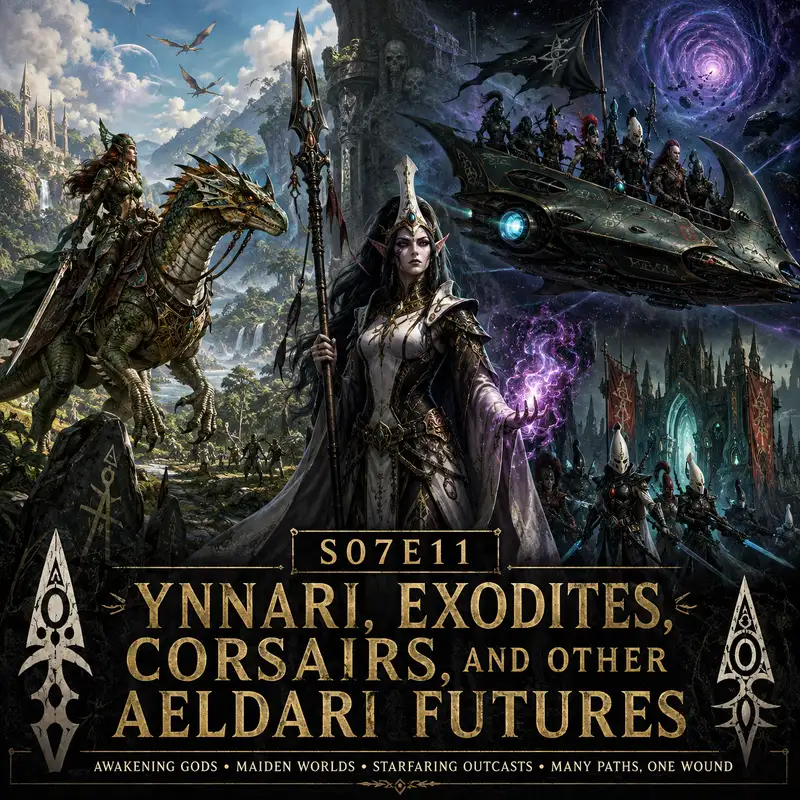
On a maiden world, an Aeldari rider crosses a valley beneath an open sky, mounted on a reptilian beast bred from creatures older than human civilisation. High above, a corsair vessel slips from the Webway, its crew drawn from craftworld exiles, former Drukhari, and wanderers who find rules easier to respect from a considerable distance. Elsewhere, Yvraine walks through the ruins of a broken age with the power of a death god gathering around her. These lives appear to have little in common. One is rooted to the soil, one belongs to the void, and one serves a future tied to death. Yet each is answering the same question. What can the Aeldari become when merely surviving as they are is no longer enough?
The Fall did more than destroy an empire. It shattered the idea that there could be one Aeldari civilisation. The craftworlds answered catastrophe with discipline, enclosing their intense minds within the Paths. The Drukhari answered it with predation, using the suffering of others to replenish souls slowly drained by Slaanesh. The Harlequins placed themselves in the service of Cegorach and preserved memory through ritual, performance, and war. None restored what had been lost. Each created an ingenious and costly refuge. By the closing years of the forty-first millennium, those refuges were under growing pressure. Craftworlds could be destroyed. Commorragh could consume its own children. The Webway was wounded. The Great Rift made every old calculation less reliable. After ten thousand years avoiding a second Fall, they had to ask whether avoidance was a future.
For the Aeldari, any serious future must solve three problems at once. It must protect the soul from Slaanesh. It must give living Aeldari a culture strong enough to restrain the appetites that once destroyed them. It must create unity without rebuilding the arrogant empire that caused the disaster. Solving only one problem is not enough. A hidden settlement may preserve its people for centuries, then vanish when an Imperial colony fleet arrives. A corsair prince may win glory and treasure, then leave nothing that survives the prince. A prophet may unite enemies, yet ask them to place faith in a god whose awakening is tied to their deaths. The smaller Aeldari societies are not colourful footnotes beside the craftworlds and the Dark City. They are experiments conducted by a civilisation with no safe control group.
The most dramatic experiment began with Yvraine. She had lived through several forms of Aeldari existence before she entered the arenas of Commorragh and died. Death should have delivered her soul to the Great Enemy. Instead, the nascent power of Ynnead reached her at the threshold and returned her to life. The event unleashed psychic violence through the Dark City and transformed a gladiator into a divine emissary. Yvraine became the central figure of the Ynnari, the Reborn, a movement that drew followers from the Asuryani, the Drukhari, the Corsairs, and even the Harlequins. Beside her stood the Visarch, an armoured champion bound to her cause, and the Yncarne, the terrible manifestation of Ynnead's growing power. Aeldari from cultures built upon mutual contempt could now look upon the same symbol and call it hope.
Ynnead had existed in Aeldari prophecy long before Yvraine. The god of the dead was believed to be forming within the infinity circuits, spirit stones, and gathered souls of the species. In the bleakest prophecy, Ynnead would awaken only after the last Aeldari died. The god would then rise strong enough to confront Slaanesh. This is victory in the same sense that detonating a fortress after its defenders die prevents enemy occupation. The Ynnari proposed something more daring. Through the Seventh Path, they sought to awaken Ynnead before their species vanished. Death would not merely be escaped or delayed. Its accumulated power would be turned against the being that had claimed Aeldari souls since the Fall.
That promise changed the political meaning of death. Craftworlders carried spirit stones so their souls could join an infinity circuit rather than be devoured. Drukhari clung to life and replenished themselves through torment because death offered no protected refuge. The Ynnari claimed that souls gathered through Ynnead could remain active, could empower the living, and could become part of a weapon aimed at Slaanesh. Their warriors drew strength from nearby death, while their leaders restored life in ways that seemed impossible to their kin. To some, this was liberation from the oldest fear in Aeldari existence. To others, it resembled a death cult asking a dying people to accept more death. Both interpretations have support, which is why the movement remains contested.
The Ynnari proved that their vision could alter history, but proof came with a price. On Biel-Tan, war against daemons and the effort to awaken Ynnead's power tore through the infinity circuit and fractured the world-ship. The Yncarne emerged in terrible splendour, and the Ynnari gained followers, relics, and momentum. Biel-Tan survived, but survival looked uncomfortably like dismemberment. Its people scattered among vessels and damaged regions, while many dead entered wraith constructs because the old refuge was no longer secure. The event exposed the central Ynnari contradiction. Their path may prevent extinction, yet every step toward salvation demands something irreplaceable from those being saved.
The search for the Croneswords sharpened that contradiction. Aeldari legend describes five blades made from the severed hand of Morai-Heg, the crone goddess of fate and souls. Yvraine believed that uniting them could fully awaken Ynnead without waiting for the death of every Aeldari. Four came into the orbit of the Reborn, including the blades carried by Yvraine, the Visarch, the Yncarne, and Prince Yriel. The fifth became the cruel hinge of the plan. Later accounts place it within the Palace of Slaanesh. Reaching it would mean entering the domain of the god it is meant to destroy. The route to salvation ends at a door guarded by damnation. It is an elegant trap, which is the sort of elegance Slaanesh appreciates for all the wrong reasons. The warning became harsher when Shalaxi Helbane confronted the gathered champions of the Reborn. After forcing them to the edge of defeat, the daemon revealed that the enemy they had fought was only a projection of its true power and declared the final blade beyond their reach. The blow was psychological as much as military. Unity had not made the Ynnari immune to humiliation.
This did not make the Ynnari irrelevant. It made them something more difficult to judge. They remain the only major movement uniting scattered Aeldari branches around a new religious answer. They have crossed once-absolute boundaries and fought beside warriors who would otherwise hunt one another. Yvraine's interventions helped place Roboute Guilliman back into the wars of the galaxy, a decision made not from affection for humanity but from calculation about the struggle against Chaos. Yet the movement also depends heavily on a small number of leaders and on faith in prophecies that have not delivered a final victory. Former supporters have questioned what the Ynnari achieved for their homes. Hope can unite a people. Unfulfilled hope can divide them with equal efficiency.
If the Ynnari seek a future by awakening something new, the Exodites seek one by returning to what civilisation forgot. They were among the first Aeldari to recognise the moral collapse of the old empire. Long before the birth of Slaanesh, they abandoned the core worlds and travelled to distant maiden worlds that had been seeded and shaped by ancient Aeldari technology. They were mocked as puritans and alarmists. Then the empire died as they had warned, which made later conversations awkward. Distance spared many Exodite communities, although those too close to the Fall were consumed. Their survival came from leaving early, going far, and accepting that comfort had become dangerous.
The Exodites did not normally choose the gentlest paradise available. Many settled worlds where survival demanded labour, vigilance, and physical courage. The danger was deliberate. Craftworld discipline restrains the Aeldari mind by directing it along formal Paths. Exodite discipline comes from seasons, migration, duty to clan, the hunt, the tending of herds, and the need to avoid being eaten by local wildlife. A mind occupied with survival has less opportunity to drift into the obsession that fed the Fall. This does not make Exodite life simple or innocent. Their societies can be aristocratic, fiercely territorial, and bound by ancient rivalries. Their clans raid, feud, and compete for honour. They arranged their dangers to reinforce survival instead of dissolving it.
To outsiders, Exodites can appear primitive because they live among forests, plains, stone settlements, and great reptilian creatures often called dragons. The appearance misleads. They retain advanced knowledge, wraithbone construction, Webway routes, sophisticated weapons, and war machines. Their dragon knights ride living mounts because those creatures suit their worlds, not because they forgot engines. When required, they can fight beside towering Aeldari knight constructs or call upon allies from the craftworlds. Their chosen austerity is cultural policy, not technological incapacity. Humanity often mistakes restraint for weakness, dispatches a colony mission, discovers prior owners, and begins a very educational final chapter.
The spiritual centre of an Exodite world is its world spirit. Like a craftworld's infinity circuit, it receives and shelters the souls of the dead, binding generations to the land itself. The living inherit not just territory, but a landscape permeated by their ancestors. World singers commune with that presence, while the dead remain part of clan identity and guidance. This gives the Exodites something rare in the forty-first millennium. Their future is physically rooted. A craftworld carries its past through space. A corsair fleet outruns danger. An Exodite community turns a world into memory. The arrangement protects souls and builds continuity, but creates a terrible vulnerability. If the world spirit is destroyed, an entire lineage can be exposed or annihilated at once. On some worlds, the ancestral dead form an undercourt that mirrors the authority of the living nobles and advises them through ritual communion. The arrangement can preserve wisdom for ages, but it can also preserve old disputes with equal determination. Aeldari ancestors do not become less opinionated merely because they are dead.
Exodite worlds are therefore both refuges and front lines. Orks invade them. Tyranids consume them. Chaos seeks the power stored within their world spirits. Human settlers arrive assuming any beautiful planet without an Administratum office is unclaimed. Craftworld Biel-Tan has often defended maiden worlds because it sees them as the seedbeds of a restored Aeldari realm. That vision gives the Exodites strategic importance far beyond their numbers. They prove that Aeldari life can continue beyond sealed world-ships and hidden cities. They cultivate land, raise generations, and maintain societies intended to last. Yet they cannot easily concentrate force across the galaxy, and every rooted community risks being surrounded by younger, more numerous species. A tree may endure a storm better than a ship. It cannot move when the forest burns.
Corsairs choose the opposite answer. Known as the Anhrathe, they turn mobility into identity. Their fleets gather individuals from every Aeldari culture. A craftworlder may abandon the strictures of the Path. An Exodite may hunger for the stars. A Drukhari may tire of Commorragh's endless treachery, which is understandable after the first few centuries. Former Ynnari and even rare Harlequins can find places among them. These crews share no single doctrine. A prince, a vessel, adventure, and a choice of the void over home hold them together. They raid, trade, recover relics, explore forgotten routes, and perform heroism later described as a profitable misunderstanding.
Corsair warfare reflects this freedom. Their warbands strike quickly, seize their objective, and vanish before a larger enemy responds. Their equipment can mix craftworld elegance with Drukhari cruelty and relics collected from a lifetime of raids. Void Dreamers and Way Seekers guide them through unstable passages, reading the near future and the shifting hazards of the Warp and Webway. Such psykers are invaluable far from craftworld protection. They also create risk. Psychic talent without firm discipline can burn brightly and end badly. Corsair life escapes one cage, but the void contains larger cages, many with teeth. Freedom also does not end Slaanesh's claim. Corsairs still require spirit stones, waystones, and skilled soul-weavers to protect the fallen. A raid that loses its dead as well as its living has paid twice, and the second price lasts forever.
Prince Yriel shows both the strength and the instability of the corsair future. Once a commander of Iyanden, he left after conflict with its council and became lord of the Eldritch Raiders. Exile did not sever his identity. When Hive Fleet Kraken brought Iyanden to the edge of destruction, Yriel returned. His fleet broke the Tyranid assault in space, and he fought on the home he had abandoned. The corsair came home not as a humbled prodigal, but as the leader his people desperately needed. Yriel's life refuses the neat distinction between loyal Autarch and pirate prince. He can be both, sometimes within the same campaign. That flexibility is powerful but difficult to turn into government. A civilisation cannot rely on brilliant exiles arriving at the correct moment.
Corsairs matter because they keep the separated Aeldari worlds in contact. They carry news, weapons, people, and ideas between cultures that might otherwise harden into isolation. They can fight for Exodite clans, cooperate with craftworlds, join the Ynnari, or return to more predatory habits. Their mixed crews show that Aeldari identity is not as fixed as the great factions pretend. An individual can cross boundaries and survive the crossing. Corsair fleets are laboratories of cultural adaptation. Their weakness is that adaptation can become appetite. Without the Path, the hard discipline of an Exodite clan, or sincere devotion to Ynnead, freedom can slide toward obsession. Some remain daring privateers. Others become raiders scarcely distinguishable from Drukhari except for better lighting.
Beyond the corsair fleets are the quieter outcasts, especially the Rangers who leave craftworld society to walk the Path of the Outcast. They wander realspace and the Webway, scout worlds, trace lost routes, and observe dangers before craftworld councils do. Many eventually return, bringing experience that no enclosed society could produce. Others never do. Rangers embody a smaller future built on individuals who live between communities without belonging fully to any. They scout both enemy ground and possible ways of life. Every outcast tests how much of Aeldari identity can be carried without a craftworld around it. Some fail. Some are consumed by the freedom they sought. Some return with exactly the warning or alliance their people need.
These societies are called separate factions because maps and military records prefer clean categories. In practice, the boundaries are porous. Rangers visit Exodite worlds. Corsairs recruit from every branch. Harlequins deliver messages and manipulate alliances. Craftworlders join Yvraine, then reconsider. Drukhari fight beside relatives they once regarded as weak. Exodites trade through the Webway and sometimes leave their clans for the stars. The Aeldari future may not be one restored nation. It may be a network of communities connected by travellers, prophets, performers, and pirates. Such a network lacks ancient power, but also lacks one centre whose corruption can doom everyone. Fragmentation is dangerous. It can also be a form of firebreak.
Each possible future answers a different part of the crisis. The Ynnari offer unity and a direct challenge to Slaanesh, but are entangled with death and prophecy. The Exodites offer continuity and rooted communities, but their worlds are exposed. Corsairs offer movement and reinvention, but struggle to build institutions that outlive their leaders. Rangers and other outcasts offer knowledge and connection, but they remain individuals rather than a population-wide answer. Even craftworlds and Commorragh preserve resources the smaller groups cannot replace. No branch possesses the complete solution. That may be less a failure than a warning against seeking one perfect answer from a species whose last perfect civilisation created Slaanesh.
The deeper question is whether the Aeldari should want their empire back. Biel-Tan and other restorationists imagine maiden worlds as foundations for renewed dominion. The Ynnari envision a people freed from the Great Enemy. Corsair princes sometimes recreate the splendour and arrogance of old nobility on the scale of a fleet. Yet the old empire was not merely defeated by an outside invader. It collapsed beneath its own appetites and gave those appetites divine form. Restoring that power without changing its assumptions would repeat the catastrophe. The Exodites understood this before almost anyone. Survival required escape and a refusal of the life that made destruction inevitable.
The Aeldari are therefore not waiting for one future. They are living several, all incomplete. Yvraine carries the possibility that death itself can be turned against Slaanesh. The Exodites cultivate worlds where discipline grows from soil, memory, and obligation. The Corsairs prove that identity can move, mix, and return home changed. The outcasts keep watch along the roads between them. None can promise safety. In the forty-first millennium, safety is generally a rumour spread by people selling fortifications. What these paths offer is something more demanding. They allow the Aeldari to become different from the civilisation that fell. Their species may survive not by rebuilding one shining empire, but by learning to remain many peoples without forgetting that they share one wound. The future of the Aeldari is not a destination waiting beyond the darkness. It is the fragile web they keep weaving across it.