Lorgar and the Word Bearers: The Need to Believe
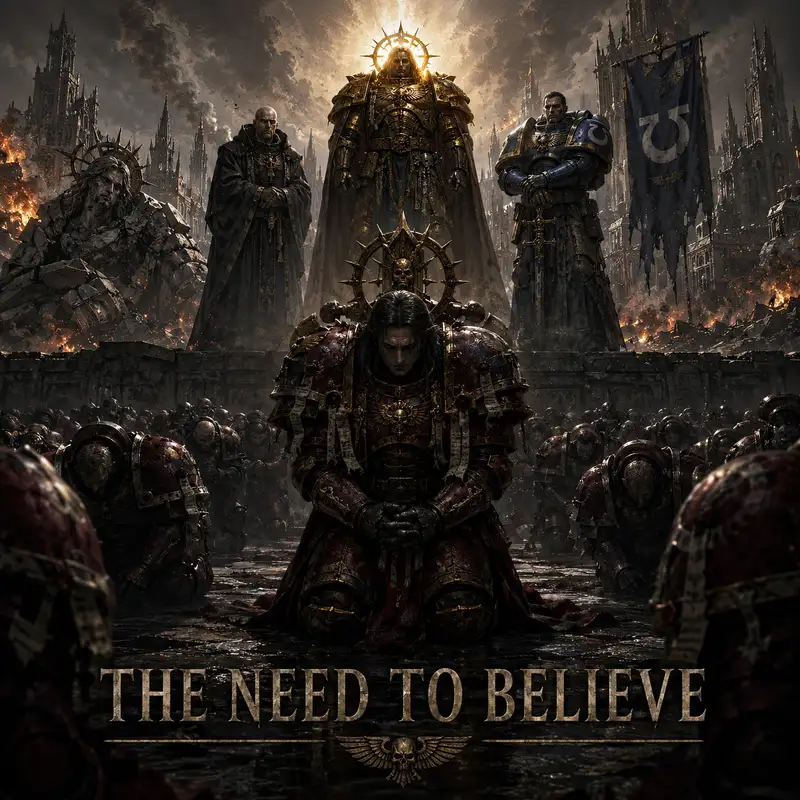
The city of Monarchia had been built as an act of devotion. Its avenues were broad, its towers graceful, and every stone proclaimed the same impossible certainty: the Emperor of Mankind was not merely a ruler. He was a god. Then the Ultramarines came. They emptied the city, shattered its monuments, and reduced its temples to dust. When Lorgar and the Word Bearers arrived, they found the work of generations burning beneath a cold sky. Their father had not sent an argument. He had sent another Legion. The lesson was delivered with artillery, which has always been one of the Imperium’s clearer methods of theological debate.
Lorgar was forced to kneel in the ashes before the Emperor, Malcador, and Roboute Guilliman. His entire Legion was driven to its knees beside him. The Emperor condemned their worship, their slow pace of conquest, and their refusal to accept the secular Imperial Truth. Lorgar had tried to offer his father a faith. He received humiliation in return. From that moment, the question was no longer whether Lorgar would believe. Belief was as necessary to him as breath. The question was what he would choose to believe in once the Emperor rejected the role Lorgar had created for him.
Among the primarchs, Lorgar Aurelian is often dismissed as the weak son, a preacher who sought through religion the greatness he lacked in war. That judgment contains some truth, but not enough to be useful. Lorgar was not helpless. No primarch was. He could command armies, conquer worlds, and kill with the frightening ease common to the Emperor’s sons. His distinction was that he wanted the Great Crusade to mean something beyond victory. Where Horus saw brotherhood and ambition, Guilliman saw order, and Perturabo saw tasks to be endured, Lorgar saw a universe waiting for revelation.
That hunger began on Colchis, a harsh world shaped by deserts, ancient cities, priesthoods, and expectation. Religion governed society, justified authority, and explained the stars. Lorgar was raised under Kor Phaeron, a powerful priest whose guidance was mixed with cruelty and control. The young primarch possessed visions of a golden figure approaching from the heavens. He came to believe that a single divine power was coming to Colchis, and he fought a religious war to prepare the world for that arrival. By the time the Emperor appeared, Lorgar had already built the altar.
The reunion seemed to confirm everything. A radiant being descended from the sky at the head of a vast interstellar empire. He possessed knowledge beyond ordinary humanity, commanded impossible armies, and had created demigod sons from his own genetic design. To Lorgar, the distinction between such power and godhood seemed almost deliberately thin. He knelt before the Emperor not because he misunderstood what he saw, but because he interpreted it through the only framework that had ever made the universe coherent to him.
The Emperor rejected that interpretation. His Imperium was founded publicly upon the Imperial Truth, a doctrine that denied gods, superstition, and the supernatural. Humanity was to be united through reason, material understanding, and obedience to secular authority. The message, however, was carried by gene-forged giants, psychic wonders, cathedral-like warships, and a ruler who inspired involuntary awe. The Imperium insisted that no gods existed, while behaving with all the restraint of a conquering church. Lorgar was expected to notice the contradiction and then politely ignore it.
Before Lorgar’s discovery, the Seventeenth Legion had been known as the Imperial Heralds. They proclaimed the Imperial Truth before compliance actions and destroyed the temples, scriptures, and idols of defeated cultures. They were breakers of sacred images. Under Lorgar, their purpose shifted. They still conquered, but conquest became conversion. Worlds were not merely brought into the Imperium. They were taught to worship the Emperor. Cities were rebuilt as sacred places. Monumental works replaced local faiths with a new one, and the Legion became the Word Bearers, soldiers whose most important weapon was certainty.
This made them effective missionaries and frustrating conquerors. Lorgar wanted transformed societies, not signatures on compliance documents. He lingered after victories, preaching, rebuilding, and ensuring that populations understood the new order as a spiritual truth. The Emperor wanted the Great Crusade to advance. Other primarchs delivered systems. Lorgar delivered congregations. He believed he was creating loyalty that would endure for millennia. From the Emperor’s perspective, one of his generals had mistaken a military timetable for an invitation to write scripture.
Lorgar’s most influential early work was the Lectitio Divinitatus, a declaration of the Emperor’s godhood. Its ideas spread far beyond the Legion, often quietly, because official policy condemned them. Humans who had witnessed the Great Crusade found the argument persuasive. The Emperor commanded angels and performed apparent miracles. To say that he was merely a very capable administrator required a level of disciplined skepticism not commonly encouraged elsewhere in the Imperium. Lorgar’s creed took root precisely because it gave ordinary people language for what Imperial power felt like from below.
Monarchia was the Emperor’s answer. The city was Lorgar’s perfect expression of a world remade through devotion. Its destruction was intended to break the pattern. Guilliman and the Ultramarines carried out the command, though he took no joy in it. The Emperor then confronted Lorgar and made the issue unmistakable. Worship would stop. Conquest would accelerate. The Word Bearers would behave as a Legion rather than a priesthood, or they would face consequences more severe than the loss of a single city.
The rebuke succeeded in the narrowest possible way. The Word Bearers did accelerate. Their campaigns became swift, brutal, and outwardly exemplary. Reports showed a Legion finally embracing the purpose for which it had been created. Compliance followed compliance. The problem appeared corrected. In reality, Monarchia had not removed Lorgar’s need for faith. It had removed the last reason for him to place that faith in the Emperor. The Legion learned to conceal its inner life, and secrecy proved much more dangerous than public disobedience.
Kor Phaeron and Erebus were waiting inside that secrecy. Both had preserved Colchisian beliefs that worship of the Emperor had displaced rather than destroyed. Kor Phaeron was Lorgar’s adoptive father, political mentor, and architect of the Legion’s religious culture. Erebus was a chaplain of immense charisma and almost unmatched talent for turning another person’s weakness into a door. Neither created Lorgar’s hunger, but both understood how to guide it. They offered him an answer to Monarchia. Perhaps the Emperor was not the god Lorgar had sought. Perhaps the old powers had been real all along.
Lorgar began a pilgrimage toward the Eye of Terror, the great wound in reality where the material universe and the Warp bled together. He was not simply seeking military advantage. He wanted proof. He found beings that answered rituals, possessed knowledge, manipulated matter, and claimed authority over souls. They claimed to stand behind ancient faiths, including those of Colchis. They called their revelation the Primordial Truth. Gods existed. The universe had a spiritual order. Humanity’s denial of it was not enlightenment, but blindness.
The witnesses sent deepest into that truth included Argel Tal and warriors of the Serrated Sun. They entered the Eye and returned transformed, sharing their bodies with daemonic entities. These first Gal Vorbak were not merely Space Marines using the Warp as a weapon. They were living evidence that the barrier between flesh and spirit could be crossed. They horrified some brothers and inspired others. To Lorgar, they were confirmation. The universe had answered him, and its answer had teeth.
The Warp entities offered visions, including claims about the scattering of the primarchs and the Emperor’s intentions. Such testimony should not be mistaken for neutral history. Daemons rarely speak without purpose, and a true statement can be arranged into a very effective lie. Lorgar understood that the powers were cruel. He saw what their servants became. He knew that worship would demand blood, corruption, and surrender. He did not confuse Chaos with goodness. He decided reality itself deserved worship, no matter how monstrous its ruling powers proved to be.
That choice reveals the core of Lorgar’s need. He could endure an evil cosmos more easily than a meaningless one. If the gods were cruel, cruelty could be obeyed. If suffering fed them, suffering could become sacrifice. If damnation was the price of truth, then damnation could be renamed enlightenment. What Lorgar could not accept was a silent universe in which humanity made its own meaning and no higher power confirmed it. The Emperor demanded that mankind stand without gods. Lorgar preferred gods who devoured mankind to an existence in which no one was listening.
Once he accepted the Primordial Truth, faith became strategy. The Word Bearers spent decades preparing a rebellion while presenting themselves as reformed servants of the Imperium. Their chaplains became organizers of hidden cults. Their remembrancers, auxiliaries, and human followers carried doctrine between fleets and worlds. Erebus encouraged warrior lodges that offered officers private fellowship across Legion boundaries. These societies appeared harmless, even useful, while creating spaces where loyalty could be redirected and forbidden ideas discussed beyond formal command. The conspiracy spread through conversation before it spread through gunfire.
The Legion also began changing the worlds it conquered. Publicly, compliance was faster. Privately, populations were prepared for another allegiance. Old symbols and hidden rituals returned beneath Imperial administration. Loyal elements within the Word Bearers were isolated, expended, or removed. The Legion punished for preaching too openly learned to conceal belief behind efficiency. The Emperor had demanded soldiers. He received soldiers who could pass inspection while turning entire systems into loaded weapons.
Horus became the most important of those weapons. His fall had many causes: pride, injury, resentment, fear of being discarded, and manipulation. Yet the path to Davin was prepared in large part by Erebus, acting from within the religious project Lorgar had sanctioned. The Warmaster was wounded with a Warp-tainted blade and taken into a ritual where visions were shaped around his doubts. Horus chose rebellion, but the Word Bearers built the chapel in which that choice was made.
This is why calling Horus the sole author of the Heresy misses its deepest origin. Horus gave the rebellion its commander and military center. Lorgar gave it a theology. He explained betrayal as revelation, daemonic alliance as truth, and mass murder as participation in a cosmic order. The traitor primarchs did not all share his faith. Perturabo had little interest in worship. Angron was driven by rage and pain. Mortarion despised sorcery even as he moved toward it. Their motives differed, so the alliance was not built for pleasant staff meetings. Lorgar supplied the language that could bind their separate grievances to Chaos.
At Isstvan Five, that hidden faith became open treachery. The Word Bearers stood among the Legions sent to reinforce the loyalists against Horus. When the exhausted Raven Guard, Salamanders, and Iron Hands fell back, the supposed reinforcements opened fire. The Drop Site Massacre broke three loyal Legions and announced that betrayal had reached deeper than Terra understood. Lorgar’s warriors fought not as reluctant rebels but as converts participating in a sacred unveiling. They had spent years pretending. Now the mask itself became part of the ritual.
Lorgar confronted Corvus Corax amid the slaughter and discovered that spiritual certainty did not make him the finest duelist among his brothers. Corax nearly killed him before Konrad Curze intervened. The moment is revealing because belief did not remove physical consequence. He still had to survive the catastrophe in armor, facing a brother whose sons were being murdered around them. Revelation had become very practical.
The Word Bearers’ war against the Ultramarines carried an older wound. Calth was presented as reconciliation and joint deployment. Instead, the Word Bearers launched a surprise attack intended to cripple one of the largest and best-organized loyal Legions. Ships fired at near point-blank range. Orbital infrastructure became weaponry. The surface and underground networks of Calth turned into killing grounds. The attack carried revenge for Monarchia, but that does not explain its scale. The violence had ritual purpose, helping create the Ruinstorm and sever much of Ultramar from Terra.
Here Lorgar’s theology reached its mature form. A planet was not merely conquered or destroyed. Its suffering could be used. Death became an offering, atrocity a technology, and war a form of prayer. Priest and general became one office. The Word Bearers did not abandon military planning when they embraced Chaos. They added metaphysical objectives to it. A massacre could break an army, weaken reality, and feed the gods at once. It was appalling, but one cannot accuse them of failing to seek efficiency.
The Shadow Crusade through Ultramar deepened that logic. Lorgar fought beside Angron, whose mind and body were being destroyed by the Butcher’s Nails. Lorgar recognized that his brother was dying. He also believed he could save him. On Nuceria, amid slaughter tied to Angron’s past, Lorgar transformed him into a daemon prince of Khorne. Angron’s mortal death was averted. His bondage became eternal. Lorgar regarded this as rescue because his faith had changed the meaning of salvation.
That act may judge him most clearly. Lorgar was capable of compassion. He saw Angron’s agony when many brothers saw only a dangerous brute. He wanted to prevent his death. Yet belief allowed him to convert concern into damnation without feeling that the two were opposed. He saved what could fight and sacrificed what remained free. Chaos did not erase Lorgar’s virtues. It recruited them. His empathy became a means of identifying the wounds through which corruption could enter.
The Word Bearers followed the same path as their father. They were not mindless berserkers, nor were they merely sorcerers wearing scripture as decoration. They remained disciplined, hierarchical, and political. Their hosts were led by warrior-priests. Their Dark Apostles preached, judged, and commanded. Rivalries were expressed through doctrine as readily as ambition. They worshipped Chaos in its broad unity rather than giving themselves wholly to one god, though individual warriors and cults could favor particular powers. For them, the Long War became a missionary campaign conducted with fleets, daemons, and very little tolerance for declining the invitation.
Lorgar’s relationship with Horus eventually exposed another contradiction. The Warmaster had been chosen as the rebellion’s leader and elevated by the gods, but he was not a priest. As the war approached Terra, Horus became increasingly consumed by the powers flowing through him. Lorgar came to doubt him and attempted to replace him. The effort failed, and Horus cast Lorgar from his host. The prophet who created the Warmaster’s sacred role learned that sacred roles are difficult to control once their occupant gains overwhelming force.
Lorgar therefore did not stand at the center of the final assault on the Imperial Palace. Some of his sons continued toward Terra, but their primarch’s path had diverged from the commander he helped corrupt. This was a dispute within damnation over who understood the gods. Lorgar had spent his life seeking unquestionable authority, yet every authority he embraced produced conflict. The Emperor rejected worship. The Chaos Gods offered too many voices. Horus accepted divine power but refused to remain subordinate to its priest.
After the Heresy, the Word Bearers endured with more cohesion than many traitor Legions. Their faith supplied identity, structure, and purpose across ten thousand years of exile and war. They continued to seed cults, corrupt institutions, summon daemons, and preach against the Imperium’s denial. Lorgar himself entered daemonhood and a long seclusion, while his writings and institutions continued to shape his sons. He had wanted a truth that could survive empires. He found one capable of surviving even his absence.
The final irony lies within the Imperium he betrayed. The Emperor became the divine center of human civilization. Across countless worlds, priests proclaimed his godhood, martyrs died in his name, and armies carried sacred icons into battle. The Imperial Truth vanished. The faith Lorgar had once preached became, in altered and often unacknowledged form, the foundation of the Imperium’s spiritual life. Monarchia was destroyed to prove that the Emperor was not a god. Ten thousand years later, the ruins would be the heresy.
This does not vindicate Lorgar. The Imperial Creed may echo his first devotion, but his answer to rejection was alliance with powers he knew were predatory. Erebus and Kor Phaeron manipulated him, the Emperor treated him with catastrophic arrogance, and the Warp showed him visions chosen to wound. None of that removes his agency. Lorgar repeatedly chose certainty over mercy. He chose a universe ruled by monsters because monsters at least confirmed that worship mattered.
The need to believe made Lorgar one of the Emperor’s most consequential sons. It gave the Word Bearers patience when other Legions had anger, doctrine when they had grievance, and a plan when they had only rebellion. It also made Lorgar vulnerable to any power willing to answer him. He spent his life searching for something above humanity, and never accepted that greater power might be less worthy than the people kneeling before it.
In the end, Lorgar found his gods. They were real, they were vast, and they welcomed every prayer with an open mouth. His failure was not believing too deeply. It was mistaking existence for holiness, power for moral authority, and an answer for the truth. The Emperor broke his perfect city to end a religion. From its ashes, Lorgar built a war that taught the galaxy to worship forever.