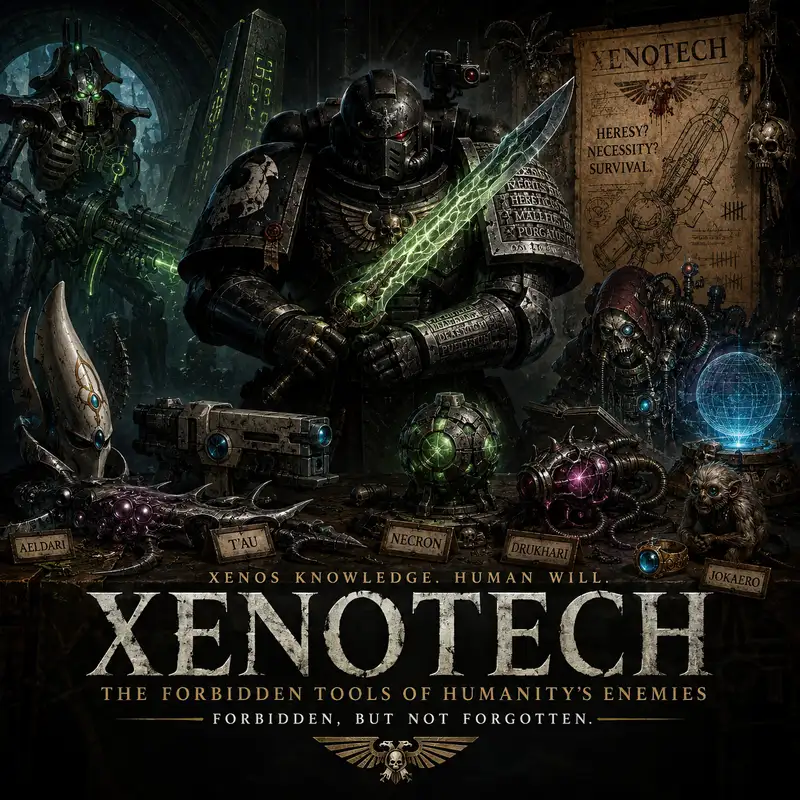
Xenotech: The Forbidden Tools of Humanity’s Enemies
The blade should not have been in human hands. It shimmered at the edge of sight as a Deathwatch veteran raised it inside a Necron tomb, a weapon built by a civilisation older than humanity’s recorded history. Imperial doctrine called such things corrupt, dangerous, and forbidden. The warrior had sworn to exterminate the alien without pity. Then he stepped forward and used the alien’s own weapon to cut through its living metal guardians.
That contradiction sits at the heart of xenotech. The Imperium condemns alien tools as an offence against faith, reason, and survival, yet its secretive servants catalogue them, hoard them, study them, and sometimes carry them into battle. The question is not merely why xenotech is forbidden. The more revealing question is why the prohibition weakens whenever the weapon is useful enough, the enemy is dangerous enough, or the person holding it has a sufficiently impressive seal.
Xenotech is an Imperial term broad enough to hide several fears inside one convenient word. It can mean a T’au pulse weapon, an Aeldari navigation device, a Necron phase blade, a Jokaero digital weapon, a Drukhari pain engine, or a relic whose makers have been extinct for millions of years. Some are weapons. Others are tools, maps, medical instruments, power sources, or objects whose purpose remains unknown. In the Imperium, uncertainty is rarely reassuring.
The official position is simple. Human technology descends, however imperfectly, from the rightful inheritance of humanity. Alien technology does not. To the Cult Mechanicus, machinery is bound to sacred history, ritual practice, and the quest for lost human knowledge. A recovered human pattern may be damaged, misunderstood, or dangerously ancient, but it belongs somewhere inside the story the priesthood tells about the Machine God. Xenotech arrives from outside that story, carrying principles that may not acknowledge humanity at all.
This is why the ban is more than a safety regulation. It protects a structure of authority. The Adeptus Mechanicus does not merely repair engines. It controls technical knowledge across much of the Imperium. Its rites determine what may be built, who may maintain it, and which discoveries are sacred. An alien device that performs wonders without an approved human lineage is not simply foreign equipment. It is evidence that the universe contains answers beyond the priesthood’s monopoly.
The Imperium’s hatred of alien influence gives that technical fear a political and religious edge. Humanity remembers Old Night as an age of isolation, predation, mutation, and collapse. The Great Crusade violently reunited humanity and destroyed or subjugated those judged to stand in its way. Ten thousand years later, the details have hardened into doctrine. The alien is not merely a rival. It is presented as a contaminant whose ideas can be as dangerous as its armies.
There is an inconvenient complication. Many alien devices really are dangerous. Imperial superstition survives partly because the galaxy keeps rewarding it. A relic may be psychically active, biologically keyed to its maker, inhabited by an intelligence, or designed to manipulate dimensions human science barely recognises. Some objects change their users. Others attract their original owners. A few appear harmless until someone turns the wrong surface, speaks the wrong sound, or bleeds on them.
The Halo Devices offer the clearest warning. They promise longevity, restoration, and power, then reshape the human bearer into something predatory and no longer entirely human. They are xenotech in its most seductive form because they do not begin as weapons. They begin by granting a wish. The danger is not hidden behind clumsy construction or a skull-shaped warning label. It arrives through success, and by the time the price becomes visible, the user usually has strong opinions about continuing the arrangement.
Other technologies are dangerous because they belong to alien systems rather than isolated machines. Aeldari devices may depend upon psychic sensitivity, psycho-reactive materials, and cultural practices built across millennia. Wraithbone is not merely an elegant substitute for steel. It is shaped through psychic art and exists within a civilisation where spirit, memory, and engineering overlap. A human who steals an Aeldari artefact may understand its trigger while remaining completely ignorant of what the device is listening to.
Drukhari technology is often more immediately practical and considerably less comforting. Their weapons can involve exotic toxins, darklight energies, living components, and methods developed by a civilisation that treats suffering as both resource and recreation. An Imperial collector may admire the precision of a splinter weapon without appreciating the biological logic of its ammunition. The Drukhari, it should be remembered, have had a very long time to ensure that curiosity becomes an educational experience.
T’au technology creates a different kind of threat because much of it appears understandable. Pulse weapons, drones, battlesuit systems, and compact energy sources do not always look like cursed relics from a dead god’s tomb. They look efficient. They can be demonstrated, repaired, and compared. That makes them dangerous to Imperial authority in a way that a shrieking alien idol is not. A guardsman shown a lighter rifle with greater reach may begin asking why suffering is an essential component of logistics.
The danger extends beyond the object to the society that produced it. T’au equipment arrives with the possibility of T’au influence, trade, negotiation, and the Greater Good. Imperial commanders can burn an alien idol and call the matter closed. A functioning medical device, a reliable generator, or a weapon that outperforms local issue creates a more troublesome question. It suggests that the alien is not only capable of destruction, but capable of offering something a human population might choose.
Tyranid technology makes the distinction between tool and organism nearly meaningless. Their ships, guns, ammunition, armour, and communications are living systems shaped by the Hive Mind. Capturing such material is less like recovering a rifle and more like carrying part of an enemy ecosystem into your laboratory. Even when separated from the greater swarm, Tyranid organisms can remain lethal, adaptive, and difficult to contain. The sensible handling procedure is usually fire, followed by more fire, followed by an investigation into why the fire has started moving.
Necron technology is perhaps the purest expression of xenotech as humiliation. Their weapons manipulate matter, energy, space, and time through principles that can make the finest Imperial machines seem primitive. Living metal repairs itself. Gauss weapons strip targets apart. Dimensional prisons can confine beings that ordinary fortresses could never hold. Much of this technology was created in an age when humanity’s ancestors had not yet developed the ambition to stand upright and argue about ownership.
The Imperium has still found uses for it. The phase swords associated with the Callidus Temple rely upon ancient Necron technology. These blades shift through matter and bypass protections that would stop more conventional weapons. They are carried by assassins who serve one of the most ruthlessly controlled institutions in the Imperium. In public doctrine, alien technology is an abomination. In a sealed armoury beneath sufficient security, it becomes specialised equipment.
That bargain contains its own warning. In one infamous account, a Callidus assassin struck a being who was later revealed as the C’tan called the Deceiver. Her phase blade did not remain a loyal Imperial weapon. It was absorbed back into the star god from whose technology it had ultimately derived, leaving the assassin defenceless before an enemy that understood the weapon more completely than its user ever could. The tool had not truly changed sides. It had merely been away from home.
This is the central operational problem with xenotech. Possession is not mastery. An Inquisitor may know that an artefact opens a doorway, disrupts a field, or kills a particular species, yet remain ignorant of its limits and loyalties. Human engineers can test what a machine does under expected conditions. They may have no way to discover what it does when exposed to a psychic presence, a hidden command signal, a stellar alignment, or the return of its maker.
The Inquisition responds to this uncertainty with the usual Imperial combination of unlimited authority and internal disagreement. The Ordo Xenos investigates alien species, their cultures, their methods, and the humans who deal with them. Some Inquisitors insist that alien tools must be destroyed because study itself creates contamination. Others argue that ignorance is more dangerous. To fight a species effectively, they say, one must understand not only its weapons but the assumptions beneath them.
These disagreements are often described as the divide between puritans and radicals, though the boundary shifts with circumstance. A puritan may permit examination of a captured weapon under strict containment. A radical may carry it personally, employ alien agents, or bargain with one enemy to defeat another. Both can claim they are protecting humanity. Both can accuse the other of preparing the next catastrophe. Inquisitorial debate is unusually vigorous because the participants possess private armies and broad definitions of necessary force.
Lord Inquisitor Kyria Draxus represents the radical argument clearly. She is an Ordo Xenos hunter of Necrons who has worked alongside Aeldari and carries alien weaponry. Her methods do not arise from affection for xenos civilisation. They arise from calculation. If an Aeldari device can help destroy a Necron threat, she sees no virtue in refusing it merely to preserve the appearance of purity. Humanity comes first, but in her reasoning, humanity survives by using every available advantage.
That distinction matters. Radical Inquisitors do not usually regard xenotech as morally equal to human technology. They regard it as captured enemy capability. The object is tolerated because a sanctioned authority controls it, directs it, and accepts responsibility for the risk. This is the theory, at least. In practice, radicalism has a habit of beginning with one necessary exception and ending with a private vault whose inventory would make a puritan reach for orbital fire.
The Deathwatch lives inside the same contradiction. These veteran Space Marines are trained to understand alien weaknesses and use unorthodox methods against them. Their watch fortresses contain archives, specimens, captured devices, and relics taken from campaigns across the galaxy. Among their signature weapons are xenophase blades, alien tools turned against alien enemies. Hatred has not prevented study. It has made study operationally urgent.
A Deathwatch warrior does not approach xenotech like a scholar admiring a foreign culture. He approaches it like a breaching charge. The weapon is isolated, tested, sanctioned, and assigned for a particular purpose. Its use is wrapped in oaths and restrictions because ritual serves a practical role as well as a religious one. It reminds the bearer that the device is never ordinary. The Marine may wield it with complete skill while refusing the idea that ownership has made it human.
This is one reason watch fortresses make such effective settings for Imperial hypocrisy. Behind layers of adamantium, prayer, genetic locks, and armed guards sit the things that humanity publicly claims should not exist. The collection is justified as preparation. Every specimen may reveal a weakness. Every weapon may become a countermeasure. The vault is both arsenal and confession, proof that the Imperium cannot defend itself from the alien without preserving pieces of the alien close to its heart.
Jokaero digital weapons reveal an even quieter accommodation. The Jokaero are an alien species with an extraordinary instinct for technology, and their compact weapons can be disguised as rings or other small objects. Such devices are prized by powerful Imperial figures because they offer lethal force in an elegant form. The same civilisation that condemns alien craftsmanship can therefore place it on a noble’s finger, provided the noble is important and everyone agrees not to discuss the artisan.
These exceptions create markets. The illegal traffic in alien artefacts is known in some regions as the Cold Trade, though other sectors give it other names. Rogue Traders, smugglers, criminal houses, corrupt officials, ambitious nobles, and radical agents all have reasons to participate. A fragment recovered beyond Imperial space may be worthless scrap, a priceless weapon, a navigational key, or a dormant extinction mechanism. The seller rarely knows. The buyer often pretends to.
Rogue Traders occupy the most useful grey area. Their warrants permit them to travel beyond ordinary Imperial boundaries, negotiate where others would shoot, and make decisions that would bring a lesser citizen immediate execution. This does not grant unlimited permission to flood Imperial worlds with alien relics, but it places Rogue Traders near the sources, routes, and customers of xenotech. They are explorers, merchants, private warlords, and occasionally the galaxy’s most heavily armed customs declaration.
The Cold Trade flourishes because prohibition increases both profit and prestige. A hive noble may purchase an alien sculpture not because it is useful, but because no rival can legally possess one. A planetary governor may hide a device that extends life, predicts danger, or promises military advantage. An underhive gang may receive a weapon whose ammunition cannot be replaced and whose safety mechanism was designed for hands with seven fingers. Every transaction transfers mystery along with metal.
When these objects fail, the damage rarely remains private. An artefact can become the centre of a cult, a beacon for raiders, a source of mutation, or the cause of conflict between Imperial agencies. The local authorities may conceal the first deaths to protect their reputations. The Inquisition may arrive after the evidence has been moved, sold, or activated. By then, the person responsible has generally discovered that wealth is less useful when the walls are speaking in an extinct language.
The Adeptus Mechanicus has its own radicals. Xenarites are Tech-Priests devoted to the study and exploitation of alien technology, often operating behind secrecy, coded records, and carefully controlled expeditions. Their strongest association is with Stygies the Eighth, a forge world whose hidden interest in xenotech has repeatedly drawn suspicion. To a Xenarite, alien machinery is not proof that human doctrine has failed. It is raw data that can be seized, classified, and turned toward the Omnissiah’s purposes.
That argument has not protected them from violence. During the Xenarite Schism, the Ordo Xenos sent Deathwatch kill teams against Stygies the Eighth after its forbidden research became impossible to ignore. The defenders survived through measures that did little to improve anyone’s trust. The episode exposed a familiar Imperial pattern. One institution studied xenotech to strengthen humanity. Another attacked it to protect humanity. Both were prepared to kill large numbers of humans to settle the distinction.
The conflict persists because the Mechanicus cannot entirely stop looking. Tech-Priests are driven by reverence for knowledge, hunger for lost capability, institutional rivalry, and the practical demands of endless war. A Necron complex may contain power systems beyond Imperial manufacture. An Aeldari ruin may reveal routes through impossible space. Blackstone can suppress or amplify warp phenomena depending upon how it is used. The order to destroy such things competes with the sacred impulse to understand them.
Yet widespread adoption remains rare for reasons beyond dogma. Alien equipment may require materials the Imperium cannot produce, maintenance rites it does not know, biological interfaces humans cannot survive, or supply chains that end inside hostile territory. A single captured weapon can be issued to an elite operative. Arming a regiment requires ammunition, spare parts, training, transport, repair, and confidence that the device will behave the same way on the thousandth use as it did on the first.
Reverse engineering is also less straightforward than taking a machine apart and copying the pieces. Necron devices may depend upon physical laws understood through sciences the Imperium has lost or never possessed. Aeldari systems can blend psychic function with material design. T’au equipment may be reproducible in principle, yet politically intolerable and difficult to integrate into Mechanicus production. Tyranid weapons grow rather than assemble. Ork devices may be crude, ingenious, and inseparable from the methods of the Mek who built them.
The ban therefore protects the Imperium from real danger, but it also protects the Imperium from comparison. Xenotech proves that humanity’s enemies solve problems differently. Some have retained knowledge the Imperium lost. Some create technologies humans cannot imitate. Some build cleaner, smaller, or more adaptable systems. Admitting this openly would threaten military doctrine, Mechanicus authority, and the comforting claim that human supremacy is a fact rather than an article of faith.
This is why possession depends so heavily upon rank. A labourer found with an alien trinket is contaminated. A noble with the same object is eccentric until political conditions change. A Rogue Trader is investigating commercial opportunity. A Tech-Priest is conducting sanctioned analysis, unless a rival gains access to the records. An Inquisitor is employing necessary means. The artefact remains the same. What changes is the power of the person explaining why it must not be destroyed.
Calling this hypocrisy is accurate, but incomplete. The Imperium survives through contradictions because no single doctrine can meet every threat across a million worlds. Total prohibition would deny it weapons and knowledge that sometimes prevent disaster. Open acceptance would undermine institutions built upon fear of contamination and control of technology. The solution is neither honest nor consistent. It is compartmentalisation, secrecy, selective permission, and the occasional execution of anyone who notices the pattern.
Xenotech is forbidden because it can corrupt, deceive, awaken, infect, outthink, or simply explode in ways its human owner does not understand. It is also forbidden because it carries an idea more dangerous than any weapon. Humanity is not the sole heir to knowledge. Its enemies possess truths that Imperial faith cannot comfortably absorb. The most trusted servants of the Imperium use alien tools because survival sometimes requires touching that truth, then locking it away before anyone else can see.
So the forbidden tools of humanity’s enemies are not kept outside the Imperium. They are buried beneath its fortresses, worn beneath its robes, mounted inside its assassins’ armouries, and carried by warriors sworn to hate the hands that made them. The Imperium does not overcome its fear of xenotech. It gives that fear a security clearance, seals it behind a vault door, and draws the weapon only when the darkness on the other side is worse.