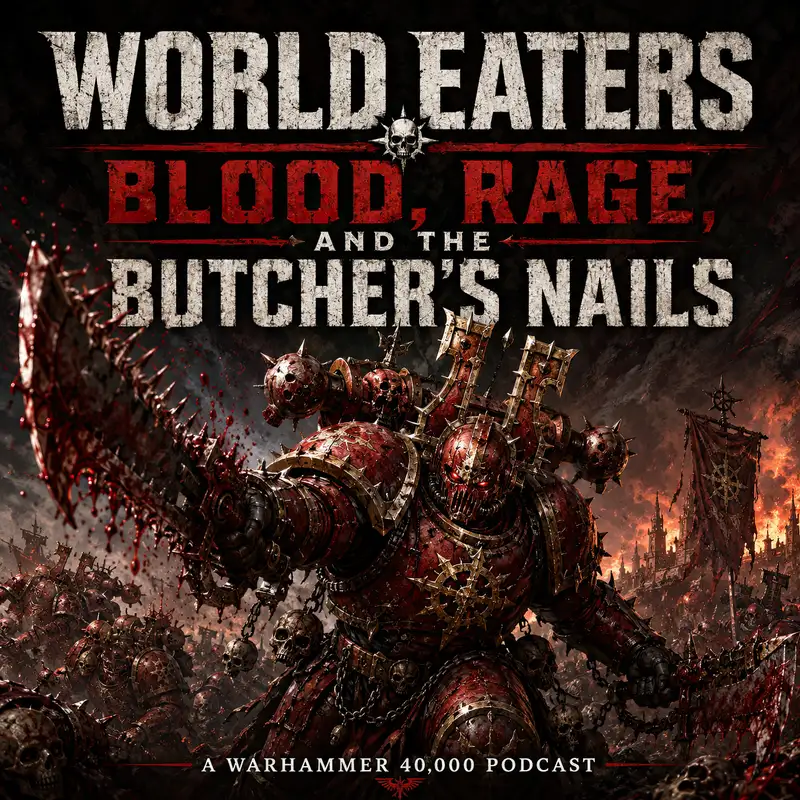
World Eaters: Blood, Rage, and the Butcher’s Nails
The pain begins before the enemy is visible.
Inside the sealed helmet of a World Eater, the Butcher’s Nails are already working. They bite into the brain with a rhythm that is not quite sound and not quite thought. Every delay is torment. Every order that requires patience is an insult written directly into the nerves. Then the assault ramp falls, the chainaxe rises, and the first impact brings a moment of relief. Not joy. Not peace. Only the brief absence of pain.
That moment explains more about the World Eaters than all the skulls piled around them.
They are often described as the simplest of the Traitor Legions. They worship Khorne. They charge. They kill. They continue until there is nothing left to kill, at which point internal disagreement becomes almost inevitable. Yet the apparent simplicity hides one of the bleakest transformations in the history of the Space Marines. The World Eaters were not created as mindless berserkers. They were made into them by a wounded primarch, an obedient Legion, a cruel machine, and a god who recognised a promising arrangement when he saw one.
The central question is not why the World Eaters are angry. The answer to that is physically embedded in their skulls. The more difficult question is how an entire Legion came to accept pain as its inheritance, rage as its identity, and slaughter as the only medicine that still worked.
Before they were the World Eaters, the Twelfth Legion were the War Hounds. Even then, they were no one’s idea of a ceremonial guard. They preferred direct assaults, close combat, and the kind of victory that left little need for negotiations afterward. The Emperor kept them for wars in which an enemy had to be broken quickly and completely. Their methods produced heavy casualties on both sides, which was considered acceptable because the Great Crusade had a remarkably flexible definition of acceptable.
Yet the War Hounds were more than violence. They possessed discipline, unit loyalty, and a powerful culture of brotherhood. Their warriors fought as packs, trusted one another at close range, and treated the bond between Legionaries as something almost sacred. They were brutal, but their brutality served a military purpose. They could plan, coordinate, withdraw, and obey. A War Hound might have enjoyed the charge, but he still understood why the charge had been ordered.
Then the Legion found its primarch.
Angron had landed on Nuceria, a world whose ruling elite entertained themselves with gladiatorial bloodshed. He was captured, enslaved, and forced into the fighting pits. There he formed bonds with the other gladiators, people who became his comrades and, in every way that mattered to him, his family. Angron resisted his masters, and the masters answered with surgery.
The Butcher’s Nails were driven into his brain.
The name makes them sound crude, but Angron’s implants were remnants of sophisticated and vicious technology. They altered the way his mind processed sensation and emotion. Calm became agony. Reflection became difficult. Anger and violence offered relief. The devices did not simply make him irritable. They punished the parts of him capable of restraint and rewarded the impulses his owners wanted to exploit.
One of the first great cruelties of Angron’s life was that the Nails turned him against the very people he loved. In a forced rage, he killed the gladiator who had been mentor, father figure, and friend. The ruling class had found a way to make rebellion consume itself. Angron eventually rebelled anyway. He led an army of escaped slaves called the Eaters of Cities, and they fought a desperate war against Nuceria’s armies.
They could not win. Angron knew it. His comrades knew it. Their final battle was meant to be a death freely chosen, which was one of the few freedoms Nuceria had left them.
The Emperor arrived before that last stand. He offered Angron a place in the Great Crusade and command of the Legion created from his own genetic legacy. Angron refused. He chose to remain with the people who had suffered beside him. The Emperor responded by teleporting Angron away and leaving the rebels to die.
From the Emperor’s perspective, this may have been practical. A primarch was too valuable to lose in a doomed provincial uprising. From Angron’s perspective, it proved that the master of humanity was merely another high rider looking down from above, taking what he wanted and calling it destiny. The Emperor saved Angron’s life while destroying the reason Angron had chosen to live it.
Imperial experts later studied the Nails and concluded that removing them would probably kill him. The devices had replaced and damaged too much of his nervous system. The Emperor therefore faced a grim choice. He could attempt an uncertain rescue, withdraw Angron from command, or use the weapon that remained. He chose use.
The War Hounds received a father who did not want them. Angron did not see sons. He saw soldiers serving the ruler who had abandoned his real brothers and sisters. In his first encounters with the Legion, he killed several of his own warriors. Most commanders attempt to establish authority with speeches, ceremony, or a carefully managed inspection. Angron’s method was more immediate.
Kharn, then a captain of the Legion, became the closest thing Angron had to a bridge. Kharn approached him when others could not, survived when others did not, and tried to translate the primarch’s fury into something the Legion could understand. Through that fragile connection, the War Hounds learned about Nuceria, the gladiator pits, and the Eaters of Cities. They took a new name in honour of Angron’s lost comrades. They became the World Eaters.
The gesture was meant as devotion. It also revealed the Legion’s desperation. These warriors had spent their lives awaiting the father whose nature they carried in their blood. Other Legions had been transformed by reunion with their primarchs. The War Hounds expected the same. When Angron rejected them, they did not question the idea that they needed his approval. They questioned what they had failed to sacrifice.
Angron demanded that his sons accept versions of the Butcher’s Nails.
The Legion’s Apothecaries and technical specialists attempted to reproduce the implants from the machinery inside Angron’s skull. Their copies were not identical to the ancient devices used on Nuceria, but they served the same purpose. They inflicted constant pain, heightened aggression, and made violence the most reliable path to relief. Early procedures maimed or killed some subjects. The project continued.
Not every World Eater welcomed the change, and acceptance was not always free. There was resistance within the Legion, including officers who understood that the Nails would destroy the brotherhood they hoped to preserve. The Librarians were generally left without them because the interaction between psychic power and the implants was dangerously unstable. Yet the institution moved forward. Angron demanded it. Ambitious officers enforced it. Many Legionaries volunteered because they believed shared pain might finally create a bond with their primarch.
This is the defining tragedy of the World Eaters. They accepted the Nails to become closer to Angron, but the Nails damaged the very qualities that had once made closeness possible. Patience, empathy, trust, and restraint became harder. Brotherhood survived, but increasingly as loyalty tested through violence. The Legion tried to understand its father by sharing his wound. Instead, it reproduced the wound until there was little room for anything else.
The change did not happen in a single day. A World Eater remained a Space Marine, with enhanced intelligence, decades of training, and the ability to operate advanced weapons and starships. The Nails did not erase tactical knowledge. They narrowed the conditions under which that knowledge could be used. Plans became increasingly focused on reaching close combat as quickly as possible. Officers learned to direct rage rather than control it. Casualties increased. Discipline became punishment, and punishment often became killing.
Angron imposed impossible standards on his sons. When they failed to conquer worlds within the time he allowed, he ordered decimation. Legionaries were forced to kill members of their own units as punishment. The practice did not make the World Eaters more efficient. It taught them that failure, hesitation, and weakness would be answered by violence from within. The Legion became a machine that consumed its own components and then blamed them for wearing out.
The confrontation remembered as the Night of the Wolf exposed exactly what had been lost. Leman Russ and the Space Wolves challenged Angron over the Nails and the direction of his Legion. Accounts differ over the formal authority behind the intervention, but the argument became a battle. Angron fought Russ and drove him back. Around them, however, the Space Wolves maintained enough discipline to isolate Angron while the World Eaters rushed toward individual combats.
Angron could claim that he had beaten his brother. Russ could claim that his Legion had demonstrated the larger truth. A primarch who wins a duel while allowing himself to be surrounded has not necessarily won the battle. Angron’s sons had abandoned the strategic situation to follow their rage. Russ wanted Angron to understand that they would die for him while he spent them without purpose.
Angron did understand. He simply did not value the lesson.
A lesson is only useful when the recipient considers survival a desirable outcome. Angron had wanted to die with his gladiator family on Nuceria. The Emperor denied him that death and gave him a Legion instead. Every World Eater who died in his service may have looked, to Angron, less like a son lost and more like another piece of the Emperor’s property destroyed.
When Horus rebelled, Angron required little persuasion. The Emperor had taken him from his chosen family, failed to heal him, and used him as a weapon. Horus offered revenge and a war vast enough to satisfy the Nails. The World Eaters followed their primarch into treason, but even then the Legion was not unanimous. Loyalist World Eaters were among those condemned on Isstvan Three. They survived the first attempt to erase them and fought against their own brothers.
Their resistance matters. It proves that neither gene-seed nor the Nails made betrayal inevitable. Some World Eaters still chose loyalty, even when loyalty meant facing Angron himself. The Legion’s fall was shaped by coercion, injury, and corruption, but it also involved decisions. Tragedy does not remove responsibility. It explains how responsibility became harder to exercise.
During the Horus Heresy, the World Eaters were unleashed as a weapon of terror. At Isstvan Five and across later campaigns, they drove into enemy lines with a ferocity that even other Traitor Legions struggled to direct. Their old white and blue armour became increasingly associated with red, whether through deliberate repainting, allegiance, or the practical difficulty of keeping white armour white during a massacre.
Their most important campaign came beside the Word Bearers in the Shadow Crusade against Ultramar. Lorgar, primarch of the Word Bearers, understood that the Nails were killing Angron. He also believed he had found a way to save him. This should immediately make any sensible observer nervous, because Lorgar’s medical solutions had begun to involve daemons, mass sacrifice, and definitions of survival that required careful reading.
The campaign returned Angron to Nuceria. The world had rewritten its own history, presenting the slave uprising in ways that flattered its ruling class. Angron confronted the place where his life had been broken, but there was no healing waiting for him. The battle became part of a ritual built from slaughter, psychic force, and Lorgar’s determination to transform his brother before the Nails finished their work.
World Eaters Librarians, among the few sons who had remained outside the culture of the Nails, tried to resist what was happening. Their effort failed. Angron was elevated into a daemon primarch of Khorne.
Lorgar had saved him from death. He had also made escape impossible.
As a mortal, Angron might eventually have died when the Nails destroyed what remained of his brain. As a daemon, he became an eternal expression of the forces that had ruined him. The implants did not disappear. They remained part of his transformed body, fused into the Red Angel’s daemonic form. The slave masters of Nuceria had wanted a gladiator who could never stop fighting. Khorne inherited their design and removed the final limitation of mortality.
This is why the relationship between the World Eaters and Khorne is more than a convenient match between angry warriors and a god of bloodshed. The Nails created a cycle. Pain encouraged rage. Rage encouraged violence. Violence provided relief. Relief reinforced obedience to the cycle. Khorne then gave that cycle religious meaning. Every spasm became devotion. Every killing became an offering. Every loss of control could be praised as purity.
Khorne did not need to cure the World Eaters. He needed them to believe their disease was a sacrament.
By the Siege of Terra, the Legion could still fight as a mass formation, but its command structure was collapsing under the pressure of the Nails and Chaos corruption. Angron had become so difficult to direct that bringing him to the final war required force and manipulation from his allies. Once unleashed, the World Eaters were devastating assault troops. They were also increasingly unable to distinguish military purpose from the continuation of slaughter.
Kharn remained one of the few figures capable of leading large numbers of them. He was no mindless beast. He could still reason, speak, plan, and understand what his Legion had become. That awareness did not save him. It made his descent more revealing. Kharn had once helped the War Hounds reach Angron. Over time, he became one of the purest expressions of the culture that followed.
After Horus fell and the Traitor Legions retreated, the World Eaters carried their violence into the Eye of Terror. Their remaining unity finally broke at Skalathrax, where they fought the Emperor’s Children in a battle made worse by the planet’s lethal cold. When night fell, warriors on both sides sought shelter. Kharn judged his own comrades’ desire not to freeze to death as cowardice.
He burned the shelters.
Then he attacked allies and enemies alike, driving the battle into complete fratricide. The act earned him the name by which he would be remembered, Kharn the Betrayer. It also shattered what remained of the World Eaters as a unified Legion. The old War Hounds had been bound by brotherhood. The new World Eaters proved their devotion by turning weapons on brothers who failed to display sufficient rage.
The Legion became warbands. Some followed champions. Some gathered around old officers, daemon princes, or masters of execution. Some retained fragments of military hierarchy. Others abandoned nearly everything except the hunt for battle. They could still crew ships, maintain armour, negotiate temporary alliances, and plan invasions. Someone must, after all, decide which planet to charge at. Yet every practical function existed under the growing pressure of the Nails and the demands of Khorne.
In the present age, the World Eaters are most often seen in crimson and brass, surging forward with chainblades while mortal cultists and daemon engines follow in their wake. Khorne Berzerkers form the familiar core of these assaults. More extreme warriors become Eightbound, submitting to possession and fighting for mastery over the daemons forced into them. Angron himself returns again and again, a living catastrophe drawn toward wars large enough to feed his god.
They are not subtle, but subtlety should not be confused with simplicity. A World Eaters assault can involve transports, orbital attack, diversion, and calculated timing. The goal of the calculation is merely predictable. Everything exists to close the distance. Firepower opens the path. Vehicles carry the killers forward. Strategy delivers the Legion to the point where strategy can be abandoned.
The World Eaters are frightening because their madness was industrialised. One broken man’s torment became a surgical programme. The programme became a military culture. The culture became a form of worship. Each stage made the next easier to accept. By the time Khorne claimed them openly, much of the work had already been done by human cruelty, Imperial expedience, and the Legion’s own need for approval.
Angron remains the centre of that story, but he is neither a blameless victim nor a simple monster. He was enslaved, mutilated, robbed of his chosen death, and used by powers greater than himself. He then inflicted his own mutilation upon sons who wanted only to belong to him. He hated the Emperor for treating people as tools, yet he treated his Legion in much the same way. The abused slave became a master who could imagine no inheritance except the chain.
The World Eaters followed because obedience, pride, longing, and fear all pointed in the same direction. Some believed the Nails would make them stronger. Some believed they would finally understand Angron. Some obeyed because refusal meant disgrace or death. Some resisted. Many later embraced Khorne because he offered certainty. There is comfort in a faith that asks only one thing, especially when the machinery in your skull makes every other thought hurt.
Blood, rage, and the Butcher’s Nails are not three separate features of the World Eaters. They are a sequence. The Nails produce the pain. Rage dulls it. Bloodshed rewards the rage. Khorne turns the reward into purpose, and purpose keeps the warrior inside the cycle.
That is why the World Eaters were not always destined to become what they are. They had other virtues once. Their brotherhood was real. Their discipline was real. Even during the Heresy, some chose a different end. Yet at every decisive moment, a person or institution chose to deepen the wound rather than close it. The Emperor chose usefulness. Angron chose replication. The Legion chose resemblance. Lorgar chose transformation. Khorne chose eternity.
For the World Eaters, peace is not the absence of war. It is the fraction of a second when the Nails fall silent, and that silence can only be purchased with someone else’s blood.