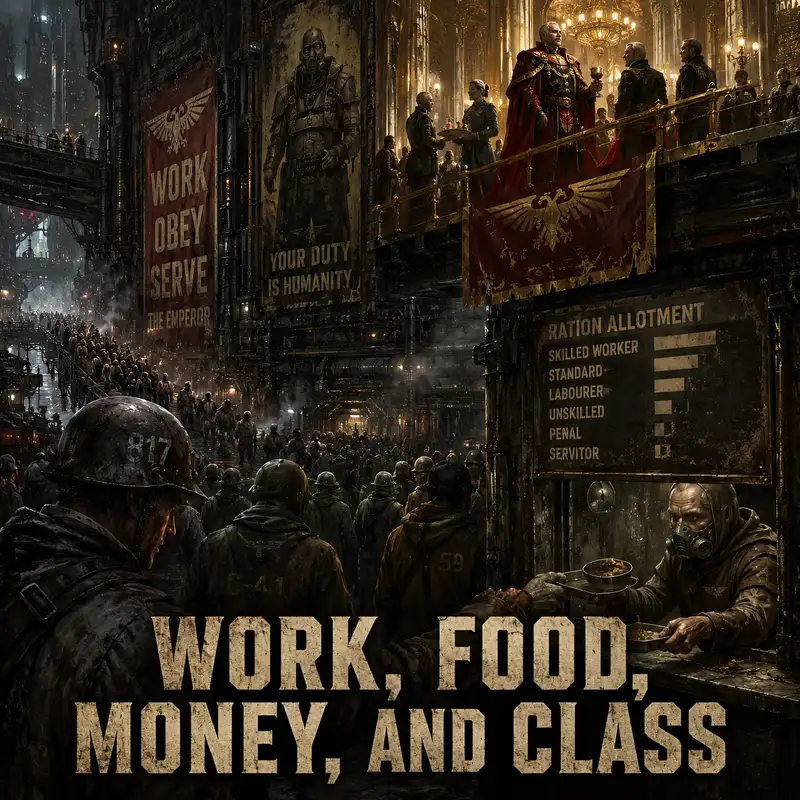
Work, Food, Money, and Class
The shift siren sounds before dawn, though in a hive city dawn may be nothing more than a change in the colour of the lamps. Thousands of workers leave their hab-blocks at once. They descend through iron stairwells, cross bridges suspended above machinery they will never understand, and join queues that have existed longer than some Imperial dynasties. One queue leads to the manufactorum. Another leads to the ration station. A third leads nowhere useful, but the sign has not been corrected, and no one wishes to be the first person to complain.
For most citizens of the Imperium, life is not measured in campaigns, crusades, or the movements of primarchs. It is measured in shifts worked, calories issued, debts inherited, and doors that remain permanently closed. The Imperium may claim every human being as a subject of the Emperor, but it does not make those subjects equal. It does not even make them poor in the same way. A miner on an airless moon, a scribe on Terra, a tenant farmer on a feudal world, and a guild factor in a hive spire all live inside the same empire. Economically, they may as well inhabit different ages of history.
That is the first difficulty in describing work, food, money, and class in the Imperium. There is no single Imperial way of life. The Imperium is too large, too old, and too badly connected for that. Some worlds use coins stamped with the face of a local ruler. Others use paper notes, electronic accounts, ration chits, guild tokens, or company scrip. Some people are paid wages. Some are paid in food and shelter. Some owe labour by ancient custom. Some are legally owned. Some believe they are free because the forms describing their servitude have not yet been processed.
The Imperium governs at a distance. It demands loyalty, worship, military manpower, raw materials, manufactured goods, and taxes collectively described through the system of the Imperial tithe. A planetary governor is expected to deliver what the wider Imperium requires. How that governor obtains it is usually a local matter, provided the quotas are met and open rebellion does not become inconveniently visible. One world may tax merchants. Another may conscript entire generations. A third may hand control of its mines to hereditary houses and let those houses squeeze the population until the required shipments leave on time.
This arrangement gives the Imperium enormous flexibility. It also allows almost any form of exploitation to survive under Imperial authority. A democratic council, a hereditary monarch, a corporate cartel, a priesthood, or a military dictatorship can all rule in the Emperor’s name. The Imperium is less interested in how a world arranges its labour than in whether the labour produces useful results. Local customs may therefore be ancient, contradictory, and vicious, yet still be perfectly legal. There are worlds where a worker signs a contract. There are worlds where a worker’s great-grandparent signed it on behalf of every descendant.
Work is not merely an economic activity in the Imperium. It is a moral duty, a social identity, and often a religious obligation. The citizen does not simply operate a machine. The citizen serves the Emperor by operating the machine. A clerk does not merely copy numbers from one ledger into another. The clerk sustains the sacred order of mankind. A maintenance crew does not merely replace a corroded valve. It performs a rite that keeps an ancient system alive. The language of duty transforms labour into worship, which is useful when the work is dangerous, monotonous, and difficult to escape.
In a manufactorum, labour may be divided into tasks so narrow that a worker spends a lifetime performing one motion. One person fits a component. Another checks a seal. Another recites the prescribed words while the machine is started. The process may contain genuine technical knowledge, inherited ritual, needless repetition, and essential safety procedure, all mixed together so thoroughly that separating them would be risky. The worker may not know what the finished object does. A factory producing ammunition does not need every hand to understand the war. It needs every hand to meet the quota.
Quotas define much of Imperial working life. They may be measured in tonnes of ore, crates of lasgun power packs, fields harvested, forms processed, bodies recruited, or hours spent at a station. Missing a quota can mean reduced rations, fines, punishment, loss of status, or intervention by authorities whose interest in labour relations usually begins with the word discipline. Meeting the quota offers no guarantee of comfort. It may simply establish the next quota. The Imperium has survived for ten thousand years partly because it can turn emergency production into a permanent condition.
Conditions vary wildly. On an agri world, labour may follow the seasons, although the seasons themselves may be engineered, chemically accelerated, or ignored by machinery that never stops. On a mining world, work follows the seam, the drill, and the oxygen supply. In a hive, it follows the shift bell. On a forge world, labour may be organised through the cult structures of the Adeptus Mechanicus, where flesh, machinery, and hierarchy are inseparable. A skilled artisan may possess knowledge valuable enough to provide some protection. An unskilled labourer is more easily replaced, and Imperial institutions are rarely sentimental about replaceable parts.
Not all work is industrial. The Administratum employs armies of clerks, copyists, assessors, messengers, archivists, and record keepers. Their labour can appear absurd, especially when a form crosses a star system only to be stamped and sent back. Yet bureaucracy is one of the few forces holding the Imperium together. A tithe must be assessed. A regiment must be recorded. A shipment must be assigned. The tragedy is not that these tasks are unnecessary. It is that they are performed through institutions so vast and fragmented that necessary work can become indistinguishable from ritualised delay.
Food reveals class more clearly than almost anything else. The Imperium can move armies across the stars, but feeding ordinary people remains a local problem until it becomes an Imperial emergency. Most citizens eat what their world can produce, recycle, import, or issue. On fertile worlds, that may include recognizable grains, vegetables, meat, and local dishes shaped by climate and tradition. On ships, hive worlds, industrial planets, and besieged settlements, food becomes processed, preserved, rationed, and increasingly mysterious.
The famous example is corpse-starch. The name has become a convenient symbol for Imperial horror, and with reason. In some places, human remains and other organic waste are processed into food products. The practice reflects both scarcity and the Imperium’s refusal to waste usable material. Yet it would be misleading to imagine that every Imperial citizen eats human remains at every meal. Food varies too much from world to world. Corpse-starch is real, but it is one part of a much broader system of recycled proteins, ration blocks, nutrient pastes, fungal products, algae, preserved meat, and whatever else can keep a population working.
Grox meat is widespread where it can be raised or imported. Grox are tough, useful livestock, valuable because they can survive in harsh conditions and produce a considerable amount of meat. They are also notoriously unpleasant animals, which is perhaps why the Imperium respects them. Recaf, a caffeinated drink with countless local variations, appears across military and civilian life. Better-off citizens may drink amasec, imported wines, or beverages whose names are more expensive than their ingredients. The poor receive what is available. The rich receive what can be transported.
The difference is not only taste. It is reliability. A low-status worker may have enough food this week and too little next week because a shipment was diverted, a machine failed, or a supervisor adjusted the ration scale. A noble may eat delicacies brought from another continent or another world. In the upper levels of a hive, food can be fresh simply because wealth purchases distance from contamination. In the lower levels, even clean water may be a controlled commodity. The most powerful people do not merely eat more. They are protected from uncertainty.
Rations can function as wages, discipline, and social classification at the same time. A worker may receive food according to occupation, productivity, family status, or institutional rank. A soldier receives an issue. A prisoner receives an allotment. A menial receives what the household provides. A guild may distribute tokens redeemable only at approved stores. When food and employment come from the same authority, losing a job means more than losing income. It may mean losing the legal right to stand in the ration line.
Money exists throughout the Imperium, but there is no single reliable coin circulating from one edge of the galaxy to the other. Terms such as thrones, crowns, credits, gelt, chits, and scrip appear in different places, sometimes describing official currency and sometimes local custom. A currency accepted in one hive may be worthless in another. On worlds with sophisticated banking, wealth may be recorded electronically or through guild accounts. On backward worlds, obligation may be measured in grain, livestock, land, or days of labour.
For the wealthy, money may represent land, shipping rights, mineral concessions, hereditary offices, trade charters, and control over labour. A noble house can be rich without carrying a single coin. Its wealth lies in the fact that thousands of people owe it service, factories owe it production, and officials recognize its claims. Guilds and merchant combines may control transport, storage, manufacturing, or access to markets. The ability to move goods can be more valuable than the goods themselves, especially on a world where one district has grain and another has guns.
For the poor, money is immediate. It is the difference between a full ration and a reduced one, between a hab with functioning heat and a room beside a leaking pipe. Debt is especially powerful because it can bind families across generations. A worker borrows against future wages, then discovers that food, tools, clothing, rent, and medical treatment are all charged by the same employer. The account never reaches zero. The debt becomes hereditary, and hereditary debt becomes custom. After enough time, custom becomes tradition, and tradition acquires a priest.
Class in the Imperium is not one ladder. It is a series of ladders built beside one another, with bridges available mainly to those who already own them. A planetary noble may outrank almost everyone locally and still become irrelevant in the presence of an Inquisitor. A senior Administratum adept may command resources beyond the imagination of a merchant prince, yet remain subordinate to a higher office whose occupant has never visited the planet. A tech-priest belongs to a hierarchy that overlaps with Imperial society without fully joining it. A Space Marine stands outside ordinary class altogether, less a noble than a living weapon wrapped in religious authority.
Within a typical hive, class is made visible by geography. The highest levels contain the ruling houses, wealthy guilders, senior officials, and those fortunate enough to purchase cleaner air and stronger walls. The middle levels hold merchants, artisans, clerks, enforcers, technicians, and stable workers whose lives may be difficult but recognisable. Below them are labour districts, slums, industrial zones, and underhive settlements where official authority weakens and local gangs, clans, and strongmen become governments of necessity.
Birth usually determines the starting point. A child born into a noble house inherits education, connections, and claims. A child born into a worker clan may inherit a station at the same production line. A child born to a scribe may learn the same script and occupy the same office. The Imperium values continuity, and hereditary service is continuity made human. It reduces training costs, stabilises institutions, and keeps everyone where the records expect them to be. It also turns society into a machine that reproduces its own inequalities.
Social mobility exists, but it is rarely gentle. The Imperial Guard can carry a recruit away from a dead-end life, assuming the recruit survives the carrying. The Ecclesiarchy offers authority to the devout, the charismatic, and the politically useful. The Adeptus Mechanicus can transform a gifted labourer into something far more influential, though possibly less recognisably human. Criminal organisations offer advancement based on nerve, violence, and loyalty. A person may rise through trade, military service, bureaucracy, or patronage. The door is not sealed. It is simply narrow, guarded, and occasionally on fire.
Servitors reveal the system’s darkest edge. They are human beings converted into biological machines, often as punishment, labour, or institutional necessity. Their existence sends a clear message about the value of the individual. A body can be repurposed. A mind can be reduced. Work can continue after personhood has been removed. The Imperium presents servitors as useful and, in many contexts, ordinary. That normality is more disturbing than any dramatic display of cruelty. The horror is not that someone built them. The horror is that everyone walks past them on the way to work.
Slavery also exists in many forms, from openly owned labourers to serfs bound to land, household, ship, institution, or noble estate. The terminology changes because societies prefer respectable words for arrangements they intend to keep. A menial may be fed, housed, and protected, yet possess no meaningful right to leave. A bonded worker may technically earn wages that can only be spent within the system that employs them. A hereditary retainer may feel genuine pride in service. Exploitation and loyalty are not opposites. In the Imperium, they often reinforce one another.
Religion gives this order a sacred frame. The Emperor stands above every class, at least in doctrine. Rich and poor kneel before the same divine ruler. In practice, they do not kneel on the same floor. The Ecclesiarchy teaches duty, sacrifice, obedience, and the honour of labour. These beliefs can provide real community and meaning. They can also convince suffering people that endurance is virtue and hierarchy is natural. A worker who believes each completed shift serves humanity may withstand conditions that wages alone could never justify.
It would be easy to describe all Imperial citizens as passive victims, but that would be false. People form families, friendships, neighbourhoods, guilds, worker associations, gangs, religious fraternities, veterans’ groups, smuggling networks, and informal systems of mutual aid. They celebrate feast days. They gamble. They drink. They trade favours. They steal time from employers who have already stolen most of their lives. Even under oppressive conditions, ordinary people remain inventive. The Imperium survives not only because it commands them, but because they constantly repair the failures of the institutions above them.
Rebellion begins when the stories supporting the system stop working. Hunger alone does not always produce revolt. Imperial citizens endure extraordinary hardship when they believe the hardship has meaning, when everyone appears to share it, or when authority still provides some protection. Rebellion becomes more likely when sacrifice is visibly unequal, when rations disappear while nobles feast, when quotas rise without explanation, or when officials become incapable of maintaining the order they demand. A starving population may remain obedient. A population convinced that someone else stole its food is far more dangerous.
War distorts every part of this structure. Labour is redirected toward weapons. Food is requisitioned. Currency loses value. Refugees arrive. Skilled workers are conscripted. Noble houses compete for contracts while poor districts receive casualty lists. A world near a major campaign may become rich through production and ruined by the same production. The Imperium’s economy is built for mobilisation, but mobilisation consumes the society that sustains it. Victory can leave a planet exhausted, indebted, polluted, and praised for its sacrifice by officials who have already departed.
Who, then, is rich in the Imperium? The person with money is rich. The person with food during a shortage is richer. The person who controls transport is richer still. The person who can command labour, alter records, or ignore local law may be wealthier than all of them. Imperial class is ultimately about access. Access to clean air, reliable food, education, medical treatment, weapons, information, protection, mobility, and the attention of powerful institutions. Currency is only one method of purchasing that access.
Who is poor? The person whose survival depends on one employer, one ration station, one guild, one noble, one machine, or one line in an Administratum ledger. Poverty is not merely having little. It is having no safe alternative. A worker may possess a wage, a hab, and a legal status, yet remain trapped because every road out leads through the same authority. The chains need not be visible. The most efficient chains are described as procedure.
Work, food, money, and class are therefore not separate parts of Imperial life. They are one system viewed from four directions. Work determines the ration. The ration sustains the worker. Money records the obligation. Class decides who sets the terms. Above it all stands an empire that demands output while leaving most details to local rulers. This produces astonishing variety, from prosperous civilised worlds to industrial hells, but the underlying question remains the same everywhere. Who controls what people need?
When the shift ends, the worker returns through the same iron corridors. Perhaps the ration was sufficient. Perhaps a child has found a better apprenticeship. Perhaps the supervisor overlooked a missed target. Life in the Imperium is not constant misery, because no civilisation could survive on misery alone. There are meals shared, jokes whispered, favours repaid, and small victories no archive will preserve. Those moments are real. So is the structure surrounding them.
Far above, the lights of the spire burn through cleaner air. Far below, machinery continues through the artificial night. Between them, millions of people trade hours of life for food, shelter, and permission to remain where they were born. The Imperium calls this duty. Its rulers call it order. Its accountants call it production. For the ordinary citizen, it is simply the price of waking up tomorrow.