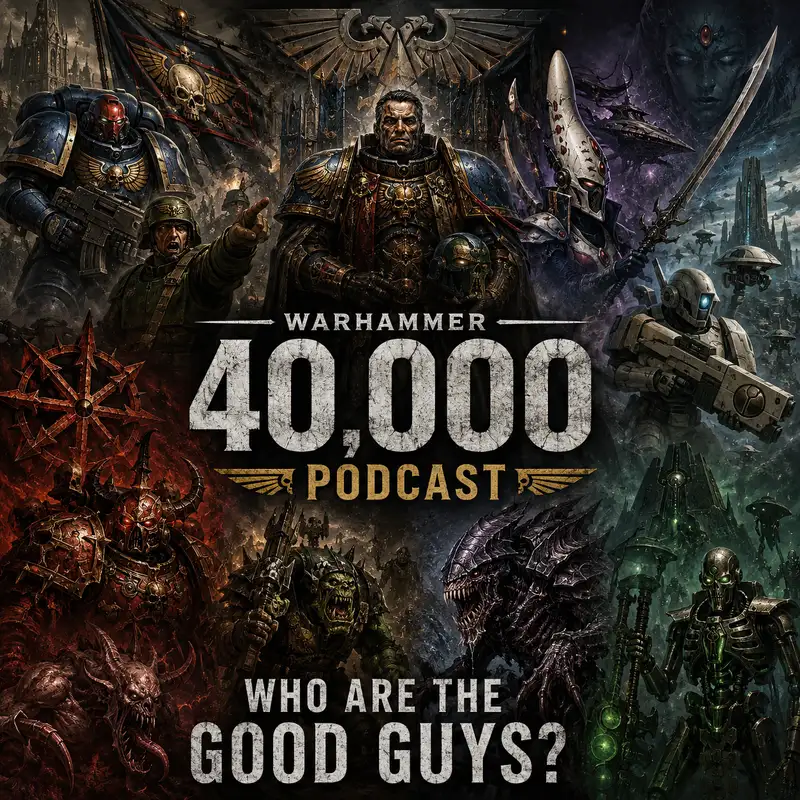
Who Are the Good Guys?
In most stories, the arrival of an army means that someone has come to save you. In Warhammer forty thousand, it usually means that your world has become important enough to fight over.
An Imperial fleet may answer your distress call, crush the invader, and then execute anyone suspected of contamination. The T’au may offer protection, medicine, and a place within the Greater Good, provided that your people accept who will be making the larger decisions. An Aeldari warhost may destroy the enemy before it reaches your city, not because your lives matter to them, but because your survival produces a future they prefer. A Necron dynasty may drive away the creatures consuming your planet, then explain that the planet has belonged to them for sixty million years and that your tenancy has concluded.
The question is not difficult because everyone in this galaxy is equally evil. They are not. It is difficult because courage, mercy, loyalty, and sacrifice exist inside civilizations built on conquest, fear, hunger, and control. Warhammer forty thousand contains heroes. It simply refuses to guarantee that their flags are heroic.
Human beings naturally look first to the Imperium. Most of the stories are told from its side, its soldiers look human, and its enemies often arrive with claws, sorcery, or an alarming interest in what is inside the skull. When an Imperial Guard regiment stands against a Tyranid swarm, there is no serious moral confusion about whether the civilians behind the line should be eaten. When a Space Marine kills a daemon, the daemon does not become a misunderstood public servant merely because the Marine serves a brutal regime.
The Imperium exists in a galaxy filled with genuine existential threats. Chaos can corrupt minds, bodies, institutions, and entire worlds. Tyranid fleets consume every useful fragment of life. Ork empires spread through war because war is the center of Ork existence. Drukhari raiders carry populations away to suffer in places where death may be the least unpleasant outcome. The Imperium’s defenders are not imagining these dangers, and the people who resist them may display extraordinary courage.
A soldier who holds a corridor so that families can escape is doing something good. A pilot who turns a damaged aircraft back toward the enemy to protect a retreating column is doing something good. A Space Marine who places himself between civilians and a monster is doing something good. The fact that all three serve the Imperium does not make their sacrifice false.
It does not make the Imperium good either.
The Imperium is a theocratic, authoritarian empire that preserves humanity by consuming human lives on an industrial scale. It punishes doubt, restricts knowledge, persecutes difference, and often treats entire populations as replaceable parts. Its worlds range from tolerable to nightmarish, but even its more peaceful societies exist beneath institutions that can demand soldiers, labor, food, faith, and obedience without meaningful consent. It creates servitors from human bodies, destroys planets when leaders decide they cannot be recovered, and teaches that hatred of the alien is not merely prudent but sacred.
Some of this brutality grew from real catastrophe. Much of it is defended as necessity. That defense cannot simply be dismissed, because necessity in this setting sometimes arrives with teeth. Yet the Imperium also calls cruelty necessary when cruelty is convenient, traditional, profitable, or easier than admitting a mistake. Its bureaucracy can lose armies, starve worlds, and condemn loyal citizens while every official involved follows procedure with admirable precision. The paperwork survives. The people are less fortunate.
The Emperor’s original project already contained this contradiction. He sought to unite humanity, end destructive superstition, and protect the species from threats it barely understood. He pursued those goals through conquest on a galactic scale. Human cultures were ordered to comply, absorbed by force, or destroyed. Alien civilizations were rarely offered a meaningful place in his future. The Great Crusade promised liberation while advancing behind armies.
Horus rebelled against that order, but rebellion did not make him a liberator. Whatever legitimate grievances existed among the primarchs and their followers were consumed by Chaos, personal ambition, bitterness, and manipulation. The Horus Heresy was not a contest between freedom and tyranny. It was a struggle between a harsh human empire and a rebellion that opened the door to powers far worse. The tragedy is that defeating Horus preserved humanity while helping create the nightmare the Emperor claimed he wanted to prevent.
Chaos often presents itself as the answer to Imperial oppression. That is part of its appeal. The worker ground down by an uncaring governor may pray for change. The scholar forbidden to ask a dangerous question may seek knowledge elsewhere. The soldier treated as expendable may embrace rage. The ambitious may want power, the frightened may want protection, and the grieving may want one impossible moment returned to them.
Chaos does not need every first desire to be wicked. It only needs that desire to become absolute.
The four great Chaos Gods offer strength, knowledge, sensation, endurance, belonging, purpose, and release from restraint. Their gifts always contain a chain. Anger becomes slaughter without end. Hope becomes manipulation. Pleasure becomes appetite without limit. Acceptance becomes decay and surrender. Even those who believe they are using Chaos usually discover that Chaos has a more durable understanding of ownership.
A person may turn to Chaos for an understandable reason. A rebel group may begin by resisting a genuine injustice. Neither fact makes the destination good. Chaos consumes freedom while speaking the language of freedom, and it eventually reduces people to instruments of impulses they can no longer control. It is possible to pity the corrupted. It is usually unwise to let them open the city gates.
The Aeldari offer a different problem. They are survivors of a civilization destroyed by its own excess, and many of them live under disciplines designed to prevent that disaster from happening again. Craftworld Aeldari preserve art, memory, skill, and identity in a galaxy that has little patience for any of those things. They understand Chaos better than most species, and their warriors have repeatedly fought threats that would otherwise consume countless worlds.
They are also capable of treating those worlds as pieces on a board.
An Aeldari seer may redirect a war that would kill thousands of Aeldari and billions of humans. From the seer’s perspective, this can be a rational choice made in defense of a species standing close to extinction. From the human perspective, it remains the deliberate sacrifice of billions. Aeldari foresight does not make them omniscient, and their belief that they see farther than younger species can become wisdom, arrogance, or both in the same decision.
Individual Aeldari can show compassion, honor, restraint, and genuine respect for humans. Others regard humanity as a dangerous infestation. Craftworlds differ, leaders disagree, and circumstance matters. There is no single Aeldari moral character, just as there is no single human one. Their best actions can be genuinely noble. Their larger strategy usually begins with the survival of their own people and asks about everyone else afterward.
The Drukhari remove much of that ambiguity. Their civilization in the dark city of Commorragh depends upon inflicted suffering. They raid, enslave, torture, and consume the agony of others to hold back the spiritual hunger of Slaanesh. This explains their behavior. It does not excuse it. A culture can be shaped by terrifying circumstances and still choose to make terror its economy.
There may be individuals among the Drukhari who display loyalty, affection, courage, or even rare mercy. Those qualities do not transform a society whose survival system requires victims. A pirate who loves his crew may still be a pirate. A torturer who keeps a promise has not thereby entered a competitive field for sainthood.
Orks are sometimes offered as the honest answer. They do not pretend to be building a better galaxy. They want to fight, grow stronger, gather into larger wars, and enjoy the process. They possess loyalty, courage, ingenuity, and a rough form of community. They are also violent conquerors who enslave weaker beings and reduce inhabited worlds to battlefields because battle is what makes existence meaningful to them.
The Orks may be the happiest major species in the setting. Happiness is not the same as goodness, especially when everyone nearby is contributing involuntarily.
Tyranids sit almost outside the question. A hive fleet does not hate the people it consumes. It does not punish, convert, or conquer in the political sense. It feeds. Calling Tyranids evil is like calling a wildfire evil, except that the wildfire can adapt its weapons, coordinate across continents, and arrive from orbit.
This makes the Tyranids morally simple but not morally good. There is no lasting peace to negotiate, no shared society to build, and no appeal to conscience that the Hive Mind appears willing to consider. The Genestealer Cults that prepare worlds for invasion are more tragic. Their members may believe they are fighting oppression, building family, and awaiting liberation. Their faith ends when the liberators descend and the faithful become biomass with everyone else.
The Necrons were once presented by many Imperial observers as little more than silent machines. That picture is incomplete. Necron nobles can possess memory, pride, humor, grief, honor, obsession, and political ambition. Their dynasties differ. Some may negotiate, respect agreements, preserve curiosities, or oppose Chaos for reasons that also benefit living species.
They are still the remnants of an ancient empire awakening to reclaim a galaxy they consider theirs.
A Necron ruler may honor a truce more faithfully than an Imperial commander. Another may erase a civilization because its settlements spoil the symmetry of a tomb complex. Codes of honor matter, but they do not automatically include anyone the code defines as vermin. A courteous demand for planetary evacuation is better than immediate extermination. It remains awkward when the deadline is measured in minutes.
The T’au come closest to what many newcomers expect from conventional good guys. They build coalitions rather than insisting that every other intelligent species must be destroyed. Their empire can offer education, public order, advanced technology, and material conditions that are better than life on many Imperial worlds. They prefer diplomacy when it works, and the Greater Good asks individuals to think beyond personal interest toward a shared future.
Those are meaningful differences. It would be lazy to claim that the T’au Empire is simply the Imperium with cleaner streets.
It would be equally lazy to call it a free and equal utopia. T’au society is organized through castes, guided by Ethereals whose authority is rarely open to challenge, and committed to expansion. The Greater Good can welcome cooperation, but it also defines the boundaries of acceptable thought. Worlds may join through persuasion, economic dependence, political pressure, covert influence, or military force. Species within the empire can gain security and opportunity while remaining subordinate to a system whose final decisions are not theirs.
The T’au are often less cruel than the powers around them. Less cruel is not a meaningless achievement in this galaxy. It is also not the same as good without qualification. Their story asks whether a benevolent empire remains benevolent when the people being helped are not permitted to refuse the help.
The Farsight Enclaves appear to offer an alternative. They reject Ethereal rule and preserve a more independent T’au society beyond the main empire. Yet they are frontier states shaped by war, commanded by a revered military leader, and surrounded by enemies. They may represent greater freedom from one form of control without providing a final answer to the problem of power.
The Leagues of Votann are easier to like at close range than many galactic powers. The Kin value family, continuity, skilled work, trade, and mutual obligation. They can be dependable allies and practical partners. They are not driven by a universal desire to purge every other species, which places them ahead of several competitors before breakfast.
Their moral concern, however, centers on the Kin. They assess planets, systems, and civilizations through the logic of survival and resource value. If a world contains material the Leagues require, the presence of another population may be treated as a complication rather than a moral boundary. Their loyalty is real, but it is strongest inward. A society can care deeply for its own people while remaining dangerous to everyone outside the family.
So where does that leave the question?
It leaves us with an important distinction between a good faction, a good cause, and a good person.
Scale changes the verdict as well. A government can be monstrous while the defense of one village is just. A military unit can perform an act of mercy while serving a campaign of conquest. A species can face extinction without gaining the right to treat every other species as expendable. Judging one level does not settle the others. This is why calling the Imperium heroic is too simple, but calling every Imperial defender a villain is also too simple. The same distinction applies elsewhere. A T’au colony can provide a safer life while the empire limits political choice. An Aeldari intervention can save a world while serving a colder calculation. Moral clarity in this setting is usually local. It belongs to a decision, a relationship, or a refusal, not to the enormous machine that later claims credit.
There may be no major faction that deserves unconditional moral loyalty. That does not mean every conflict is morally equal. Defending civilians from a daemonic incursion is a good cause even when the defenders serve the Imperium. Preventing a Tyranid fleet from reaching an inhabited system is better than allowing it to feed. Stopping Drukhari raiders is not morally compromised merely because the rescuers have sins of their own. A T’au commander who avoids unnecessary slaughter has made a better choice than one who does not. An Aeldari who warns a human world instead of sacrificing it has crossed a meaningful moral distance.
Warhammer forty thousand becomes less interesting when there are no good guys is treated as meaning that nothing matters. If every act is equally corrupt, courage becomes foolish, mercy becomes cosmetic, and sacrifice becomes another special effect. The setting works because moral choices still matter even when they cannot repair the galaxy.
A guardsman may serve an empire that would spend her life without hesitation, yet still choose to save a stranger. A Space Marine may be built as a weapon of conquest, yet refuse to abandon civilians. A Sister of Battle may possess terrifying certainty and still stand between the helpless and something worse. An Aeldari warrior may risk a precious life for people his own leaders consider expendable. A T’au citizen may believe in the Greater Good while questioning what is done in its name. Even a Necron noble may discover that an ancient promise matters more than an immediate advantage.
None of these choices cleanses the institutions around them. That is precisely why the choices matter.
The Salamanders are often regarded as among the most humane of the Space Marine Chapters because they retain close ties to ordinary people and place unusual value on protecting civilians. That does not turn them into modern humanitarian peacekeepers. They are still Space Marines, servants of the Imperium, and participants in wars of annihilation. Their compassion is significant because it exists within that role, not because it erases the role.
The same is true of reformers such as Roboute Guilliman. He can recognize the Imperium’s decay, oppose pointless cruelty, improve governance, and still rule through institutions that deny freedom to uncounted billions. A better ruler may reduce suffering. He does not become morally perfect because the alternatives include daemons.
This is the pattern repeated across the setting. Institutions claim necessity. Leaders claim destiny. Gods claim truth. Empires claim that obedience is the price of survival. Sometimes they are partly correct, which makes them more dangerous than simple liars. The moral question is not whether danger exists. It is what people permit themselves to become while resisting it.
The good guys, when they appear, are rarely identified by species, uniform, or heraldry. They are identified by the limits they place on their own power. They protect someone who offers no strategic advantage. They refuse an atrocity that would make victory easier. They keep faith with people their culture taught them to despise. They preserve life when destruction would be simpler. They admit uncertainty in civilizations built upon absolute claims.
Many of them fail. Some are punished by their own side. Others save a city and lose the planet, save a regiment and lose the war, or die without knowing whether their choice mattered. Warhammer forty thousand is not generous with proof that goodness will be rewarded.
It is generous with opportunities to choose it.
There are no permanently good empires in this galaxy, and no faction whose symbol can relieve its followers of moral responsibility. There are better causes, worse enemies, necessary alliances, tragic compromises, and people who remain capable of decency inside systems designed to grind decency away.
The good guys are not the ones guaranteed to win. They are the ones who know what victory could turn them into, and refuse to surrender that final piece of themselves.