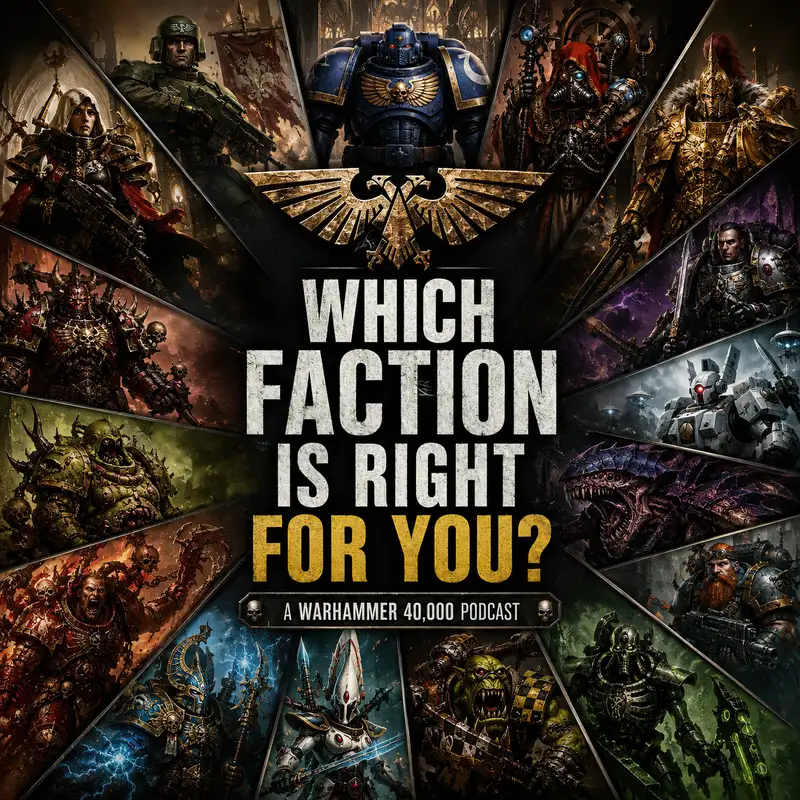
Which Faction Is Right for You?
The most important choice in Warhammer forty thousand is not which faction wins most often. Every faction wins eventually, usually in its own records. The important choice is which kind of failure you are willing to call yours.
That may sound unnecessarily severe for a decision that often begins with plastic soldiers and a pot of paint. It is also useful. Every army has magnificent weapons, memorable heroes, and at least one method of turning a minor dispute into a planetary emergency. What separates them is not power. It is perspective. Each faction asks you to see the galaxy through a different set of fears, loyalties, ambitions, and lies.
Rules change. Reputations depend heavily on who wrote the report. Victories in the forty-first millennium are often defeats that took longer than expected. The right faction is the one whose stories still interest you when it loses, whose appearance you want to spend time with, and whose contradictions make you ask another question.
For many people, the choice begins with the Imperium of Man. The Imperium is familiar because its armies are human, or at least began that way. Yet it is not one faction in any meaningful emotional sense. It is a collapsing civilisation held together by faith, terror, bureaucracy, sacrifice, and the stubborn refusal to admit that the situation may be beyond repair. Choosing an Imperial army means deciding which part of that contradiction speaks to you.
Space Marines are the obvious doorway. They are transhuman warrior-monks, created for wars ordinary soldiers could not survive and shaped by traditions that make one chapter feel very different from another. They suit someone who wants an elite force with a strong identity, deep lineage, and heroes who can stand at the centre of a story.
Their attraction is not merely power. Power becomes dull unless it carries a cost. Space Marines are compelling because they are made into weapons and then expected to remain something like men. Some chapters preserve compassion. Others preserve duty, pride, secrecy, rage, or the memory of an ancient wound. Their armour is heraldry, doctrine, and family history in metal. Choose them if you want to explore what a human must surrender to become the Emperor's angel of death.
If that feels too far removed from ordinary life, the Astra Militarum waits beneath them, usually in the mud.
The Imperial Guard is for people who look at a galaxy full of demigods, monsters, sorcerers, and ancient machines, then ask what happens to the infantry. Its soldiers are weak only by comparison with enemies that should not exist. They fight with discipline, artillery, armour, logistics, and numbers because those are the tools human beings have always used when courage alone is insufficient.
Choose the Guard if military history matters to you. Regiments can be shaped by climate, culture, doctrine, and home world. Guard stories make room for generals, tank crews, medics, deserters, commissars, frightened recruits, and veterans who have seen too much. Their victories feel earned because the people winning them are recognisably fragile. Their campaigns can also turn on railheads, fuel, replacement battalions, and whether the ammunition shipment was sent to the correct continent. The Imperial response is often vast, determined, and administratively adventurous.
The Adepta Sororitas offers another human answer, though one built on faith rather than mass. The Sisters of Battle are human warriors whose strength comes from discipline, conviction, institutional purpose, and a willingness to die for a faith they believe is visibly active in the world. Choose them if you are drawn to cathedral imagery, sacred fire, martyrdom, armoured processions, and the uneasy line between genuine courage and dangerous certainty. Their stories ask whether faith can protect humanity without consuming it. Sometimes it appears to. Sometimes the distinction between miracle and fanaticism becomes difficult to maintain.
The Adeptus Mechanicus is for those who want the future to feel ancient. Its priests replace flesh with machinery, preserve technologies they may only partially understand, and treat knowledge as both sacrament and monopoly. They survived catastrophe by turning procedure into ritual and caution into doctrine. Choose them if you enjoy industrial gothic imagery, cybernetic bodies, forgotten archives, strange weapons, and questions about what knowledge becomes when no one trusts innovation. Their armies resemble religious processions assembled inside weapons factories. Every cable and incense burner suggests that the machine works, though perhaps no one present is entirely certain why.
At the highest and most secretive edges of the Imperium stand forces built for narrower wars. The Adeptus Custodes appeal to those drawn to near-mythic guardianship, individual excellence, and the burden of having failed once in a way that can never be forgotten. Their companions, the Sisters of Silence, embody absence in a civilisation haunted by the Warp.
The Grey Knights suit those who want daemon hunting, psychic warfare, and victories that may require the witnesses to disappear. The Deathwatch offers specialist teams, alien threats, and warriors from different chapters forced to set aside old rivalries long enough to survive. Both are elite answers to specific nightmares. Neither suggests a peaceful professional environment.
Imperial Knights and Titan Legions answer through scale and ancestry. A Knight is a war machine, but also a throne, a bloodline, a feudal obligation, and often a very large family argument. Titans are less like vehicles than moving fortresses wrapped in religious ceremony. Choose them if you want war to feel monumental, if heraldry matters as much as armour, and if a single engine carrying centuries of honour and resentment sounds appealing.
The Imperial Navy belongs to those whose imagination moves upward. Its wars unfold across voids where ships resemble armoured cathedrals and crews may live and die without seeing a planet. Choose it as your guiding fascination if you prefer admirals, convoys, boarding actions, and the terrible patience of ships closing across impossible distances. Armies win planets. Fleets decide whether they reach them.
If the Imperium offers duty inside a decaying order, Chaos offers freedom that gradually reveals its price.
Chaos Space Marines are not simply evil Space Marines with more spikes. They are veterans, rebels, raiders, zealots, empire builders, and survivors of a civil war that never ended for them. Some still fight the Long War against the Imperium. Others pursue personal power, old grudges, forbidden knowledge, or whatever resources can be torn from the next world.
Choose them if you are interested in fallen ideals, fractured loyalties, and people who believe they escaped one form of slavery while entering another. A warband may be disciplined and bitter, theatrical and cruel, religiously devoted, or barely held together by one leader's charisma. Chaos rewards ambition, but rarely allows ambition to remain in control.
The four great cult legions sharpen that bargain. The World Eaters are for those drawn to rage, directness, and tragedy stripped of polite language. Their violence is the consequence of mutilation, conditioning, worship, and a culture that has turned pain into purpose. Choose them if terrifying clarity appeals to you, and if you understand that clarity can be a prison.
The Death Guard offers endurance transformed into corruption. They are patient, difficult to stop, and bound to a god who makes despair feel like acceptance. Their horror lies in the way suffering becomes normal. Choose them if you like decayed grandeur, relentless advance, and the disturbing idea that surrendering hope can feel like relief.
The Thousand Sons are for those who value knowledge, sorcery, tragic pride, and plans so elaborate that reality itself may file a complaint. Many of their warriors are dust sealed inside armour, while their sorcerers seek control through ever greater complexity. Choose them if you prefer psychic power and the tragedy of intelligence that cannot admit its limits.
The Emperor's Children pursue perfection until perfection becomes appetite. Their fall is not a rejection of excellence. It is excellence severed from restraint. Choose them if you want corrupted beauty, sensation, arrogance, and warriors who can still remember what they once believed themselves to be.
Chaos Daemons take the choice further from human motives. They are expressions of the Warp, shaped by emotion, worship, and the great powers behind them. Choose daemons if you want the battlefield to feel like reality has lost the argument. They offer metaphysical horror and a visual language unconstrained by ordinary bodies.
Beyond humanity, the Aeldari offer the perspective of a civilisation living after its own apocalypse.
Craftworld Aeldari are for those drawn to elegance, speed, discipline, and the burden of foresight. Their society survives through Paths designed to keep desire from becoming destruction. Their warriors are specialists because commitment, for them, is both art and danger.
Choose them if you enjoy precision, ancient sorrow, and decisions whose costs may not become clear for generations. Foresight reveals possibilities, not certainty. A choice that saves one world may doom another. An apparently cold act may prevent a catastrophe no one else can see. It may also be arrogance disguised as wisdom. The Aeldari are most interesting when both explanations remain possible.
The Drukhari rejected restraint. They survive in Commorragh through speed, cruelty, intrigue, and the suffering of others. Their society rewards predators because weakness is an invitation, and because the fate waiting for their souls is worse than most deaths. That does not excuse what they do. It explains why their civilisation keeps producing people who do it.
Choose Drukhari if you prefer fast raids, baroque horror, political treachery, gladiatorial spectacle, and villains who are neither mindless nor comfortable. They do not conquer in the Imperial sense. They strike, take what they need, and vanish before the victim understands the purpose of the attack.
Harlequins, Ynnari, and Aeldari outcasts appeal to those who want movement between identities. Harlequins preserve history through performance, serve the Laughing God, and fight as if theatre and war were never properly separated. The Ynnari pursue a dangerous hope tied to death and possible renewal. Corsairs and other outcasts refuse the craftworlds' strict safety without fully embracing Commorragh. Choose these paths if masks, myth, hope, and the edges of civilisation interest you more than its centre.
Orks offer a different answer. They are not merely comic relief, though they are often extremely funny from a safe distance, a location the galaxy rarely provides. Their culture, biology, technology, and social order all push toward conflict. They grow through struggle, build with reckless ingenuity, and follow strength because strength is the clearest political theory they have encountered.
Choose Orks if you want energy, momentum, improvisation, and a faction that sincerely enjoys the setting it inhabits. Other peoples fight because they fear extinction, seek revenge, obey duty, or pursue an impossible future. Orks fight because fighting confirms who they are. That makes them entertaining, but not harmless. An Ork invasion is still a civilisation-ending event for the people beneath it.
They also offer creative freedom. Their machines can be ramshackle without being random, and their clans, warbands, Meks, and Speed Freeks leave room for personality. An Ork army can look as though it was assembled from the wreckage of three other armies and a municipal demolition project. This is not a criticism. It is doctrine.
Necrons are for those who prefer ancient power, dynastic politics, relentless machinery, and the slow horror of memory returning in fragments. They were once a living civilisation. Their transformation into metal bodies granted endurance at a cost so vast that many no longer possess enough of themselves to understand it.
Choose Necrons if you want rulers who awaken expecting obedience and discover that the galaxy has become untidy in their absence. Their leaders may be proud, eccentric, bitter, calculating, or broken by time. The best Necron stories are not simply about machines rising from tombs. They are about identity surviving badly.
Tyranids remove identity almost entirely. The Hive Mind does not hate the galaxy. It consumes it. Tyranid organisms are weapons, workers, scouts, and adaptations within a greater biological system. They do not invade for honour, territory, revenge, or faith. They arrive because living matter is useful.
Choose Tyranids if you want alien horror without the comfort of negotiation. They suit someone drawn to swarms, monstrous forms, adaptation, and the image of an ecosystem turned into an army. Their lack of individual motive changes the story. The drama belongs to those who face them, while the Tyranids remain the approaching fact.
Genestealer Cults bring that horror inside society long before the fleet arrives. They begin in hidden infection, family lines, secret faith, and communities that believe liberation is coming. Their uprisings can resemble revolution because many cultists are oppressed workers resisting brutal regimes. The tragedy is that their promised deliverance is consumption.
Choose the cults if you want secrecy, infiltration, improvised warfare, and the tension between righteous rebellion and catastrophic manipulation. They are one of the setting's cruelest ideas because their hope is real even when its object is false. The star gods do come. They simply do not come to save anyone.
The T'au Empire offers a younger civilisation confident in progress, technology, and collective purpose. Its armies favour coordination, mobility, battlesuits, ranged firepower, and combined arms. Its ideology promises the Greater Good, an order in which different peoples contribute to a shared future.
Choose the T'au if you are drawn to clean military design, strategic cooperation, and the question of whether idealism can survive becoming an empire. They are neither flawless reformers nor uncomplicated villains. Their society contains genuine belief, real achievement, hierarchy, coercion, and uncomfortable gaps between promise and practice. That tension is why they belong in Warhammer forty thousand.
The Leagues of Votann are for those who value kinship, industry, practical technology, stubborn memory, and grudges maintained with the discipline of a well-run archive. The Kin are shaped by cloned lineages, ancestral cores, resource-driven expeditions, and obligations that can outlast generations.
Choose the Votann if you want durable warriors, heavy machinery, frontier pragmatism, and a civilisation that treats memory as inheritance and burden. Their ancestors guide them, but those ancestors are vast, aging intelligences whose responses slow as centuries accumulate. The Kin endure through preparation, mutual obligation, and the firm belief that accounts should eventually be settled.
By now, the choice may seem harder. That is useful. A faction should survive several tests.
Imagine the army losing. Not merely losing a close battle, but being outmanoeuvred, shattered, or reduced to a few survivors. Does the story still feel like your story? A Guard regiment making a doomed stand, a craftworld force withdrawing to preserve lives, a Necron lord raging at an indignity, and an Ork warband declaring the disaster an excellent fight can all lose in ways that remain true to themselves.
Then imagine building the force over time. Which shapes, colours, symbols, and textures will still hold your attention after the first excitement fades? You may love the idea of an army and dislike creating it. That is not a moral failure. It is useful intelligence. An elite force offers fewer figures and more attention per warrior. A horde offers mass, variation, and the satisfaction of seeing a battlefield fill. Large engines create centrepieces. Infantry armies create societies.
Consider the battlefield temperament you enjoy, but do not chain yourself to temporary rules. Do you want to advance relentlessly, strike with speed, hold ground, coordinate specialists, overwhelm with numbers, or make the enemy react to hidden threats? Exact performance changes. The emotional rhythm of a faction changes less.
Most of all, notice which faction makes you curious. Curiosity is a stronger foundation than admiration. Admiration can fade when a hero disappoints you or an army loses. Curiosity survives contradiction. It makes you read one more story, examine one more symbol, and wonder why these people keep choosing the same ruinous path.
There is no requirement to choose only once. Many people begin with one force and discover that its enemies become interesting through contact. Space Marines may lead to Chaos. The Guard may create sympathy for Genestealer Cults. The T'au may make Imperial doctrine look newly strange. Rivals define one another. A second faction often begins as the answer to a question raised by the first.
Which faction is right for you?
Choose Space Marines if you want duty turned into identity. Choose the Guard if courage means more when it is mortal. Choose the Sisters if faith is both weapon and danger. Choose the Mechanicus if lost knowledge is more compelling than new invention. Choose the Imperium's elite if you want a narrow purpose carried to an inhuman scale.
Choose Chaos if you want to explore desire without restraint. Choose the Aeldari if survival requires discipline, foresight, cruelty, or dangerous hope. Choose Orks if war is culture rather than catastrophe. Choose Necrons if memory and empire have outlived the bodies that created them. Choose Tyranids if the enemy should remain truly alien. Choose Genestealer Cults if hope can be weaponised. Choose the T'au if progress is sincere but power is never innocent. Choose the Votann if endurance is built from kinship, industry, and debts that refuse to die.
Those are guides, not verdicts. The right faction is the one whose contradiction you want to carry. It is the army you can recognise in silhouette, defend without pretending it is virtuous, and return to after defeat. It turns painting, reading, collecting, and play into parts of the same larger story.
In a setting where every civilisation is certain of its own necessity, your choice does not need to be rational. It needs to remain interesting. Somewhere beneath the armour, banners, claws, engines, masks, and inherited grudges is the question you want the galaxy to keep asking. Choose the faction that asks it in a voice you will still want to hear when the battlefield falls silent.