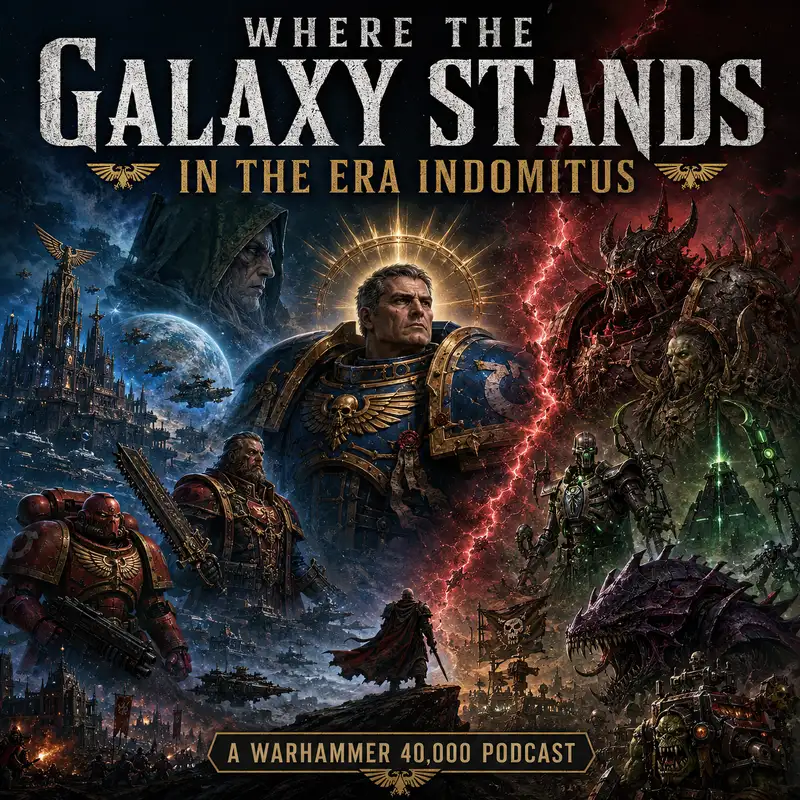
Where the Galaxy Stands in the Era Indomitus
The first difficulty in asking where the galaxy stands is that the galaxy no longer agrees on when it stands. Astropathic messages arrive years late, or appear to have been sent before the events they describe. Fleets emerge from the warp to discover that months have passed for them and generations for the worlds they were sent to save. Imperial chronologers argue over calendars while commanders fight with whatever date is written on the latest order. This is not merely bureaucratic confusion, though the Imperium has always possessed that in heroic quantities. The Great Rift has damaged time, travel, communication, and the very idea that one central authority can understand events across the stars. The Era Indomitus is therefore not a neat chapter beginning on one agreed day. It is the age in which the old map broke, and every power in the galaxy began fighting over the pieces.
The break came with the fall of Cadia. For ten thousand years, the fortress world guarded the principal route out of the Eye of Terror. Its defenders did not fail through lack of courage. Abaddon the Despoiler simply reached the point where destroying the gate mattered more than capturing it. Cadia shattered, its ancient pylon network failed, and warp storms spread across the heavens until they joined in a wound of galactic scale. The Imperium calls it the Cicatrix Maledictum. Most people call it the Great Rift. It runs across the galaxy like a scar of impossible light and darkness, separating worlds that had once been connected by dangerous but usable routes.
For a time, the Astronomican vanished. That psychic beacon, projected from Terra and sustained at terrible human cost, is what allows Imperial Navigators to cross the warp with something approaching intention. Without it, fleets were lost, trade routes collapsed, and isolated planets received no answer to their calls for help. Daemons entered realspace. Cults rose. Old enemies attacked. Some worlds never learned what had happened. They simply watched the sky change and waited for ships that did not return.
When the Astronomican became visible again, it did not restore the old order. On the side of the Rift containing Terra, its light could still guide much of the Imperium. This region became known as Imperium Sanctus. Beyond the Rift lay Imperium Nihilus, the Dark Imperium, where the Emperor’s beacon was obscured or absent and reliable passage became a matter of luck, sacrifice, rare routes, and occasionally all three. Humanity had not lost a distant frontier. It had lost the practical unity of its empire.
Then Roboute Guilliman returned.
A primarch walking into the forty-first millennium sounds like the answer to an Imperial prayer. Guilliman was a son of the Emperor, a conqueror from the Great Crusade, and one of the finest administrators humanity had ever produced. Unfortunately for him, administration requires accurate reports, functioning supply lines, and subordinates who do not regard reform as a form of heresy. He awoke to an Imperium that worshipped the ideals his father had tried to replace, preserved ignorance as doctrine, and had just been torn in half.
Guilliman did not mistake survival for stability. He reached Terra, confronted the political order there, and launched the Indomitus Crusade. Vast fleets departed with armies, warships, priests, machines, and the newly revealed Primaris Space Marines created through the long labours of Belisarius Cawl. The crusade’s purpose was not simply to win battles. It had to reopen routes, relieve besieged systems, reinforce shattered Chapters, restore command, and convince isolated populations that the Imperium still existed.
That distinction matters. The Indomitus Crusade is often imagined as one enormous army sweeping outward in a straight line. In practice, it became many crusade fleets moving across many fronts, dividing again as forces were left behind to defend recovered worlds. Every victory created a new supply requirement. Every rescued system became another place that could be attacked once the fleet moved on. Guilliman had launched the greatest Imperial counteroffensive in millennia, but even a primarch cannot be everywhere. The Crusade’s method was less like rebuilding a wall and more like trying to hold together a collapsing fortress by assigning a soldier to every new crack.
In Imperium Sanctus, that effort has achieved real results. Terra remains the administrative and religious centre of the Imperium. Major forge worlds still produce weapons. Great fleet bases still function. The Astronomican still gives Navigators a reference point. Guilliman has imposed new commands, redistributed forces, and forced parts of the Imperial machine to move at speeds it finds deeply improper. The arrival of Primaris reinforcements saved Chapters that had been reduced to remnants. Worlds thought lost were reclaimed. The Imperium did not die when Cadia fell.
It did not recover either.
Imperium Sanctus is the better supplied half of a broken empire, not a safe one. The Death Guard invaded Ultramar and turned the Plague Wars into both a military campaign and a family dispute conducted with biological weapons. Guilliman survived confrontation with his daemon brother Mortarion, but survival did not restore the realm. He has since ordered the reclamation of the Five Hundred Worlds of Ultramar, a title describing an ambition more than a precise count. Even the most orderly region of the Imperium must be conquered again, sometimes from enemies, sometimes from rebellion, and sometimes from the consequences of being neglected while the galaxy ended elsewhere.
The current Ultramarian Reclamation shows the character of the age. Captain Titus and other Imperial commanders fight to restore worlds that once formed the model of human governance, while Necron forces afflicted by the Destroyer curse push into the same territory. The Imperium is attempting to restore an old political structure while ancient machines arrive with a very different understanding of rightful ownership. Neither side considers the local population’s opinion decisive.
Across the Rift, the situation is worse. Imperium Nihilus is not one territory under one command. It is a darkness containing isolated empires, fortress systems, crusading fleets, shrine worlds, desperate alliances, and planets that may not have heard from Terra since the Rift opened. Some governors remain loyal because they believe relief will come. Others remain loyal because the alternative is execution if relief does come. Many worlds have created their own arrangements simply to survive.
Commander Dante of the Blood Angels was named Lord Regent of Imperium Nihilus, an office whose title is considerably more coherent than the territory it describes. From Baal, the Blood Angels and their successors attempt to defend a region measured in half a galaxy while rebuilding from the devastation inflicted by Hive Fleet Leviathan. Dante is one of the Imperium’s greatest living commanders, but his authority travels aboard ships, through unreliable messages, and in the memories of people who may never see him. In Nihilus, government often means whoever arrives with enough soldiers to make tomorrow possible.
The return of Lion El’Jonson added another primarch to the Imperial side, but not another functioning capital. The Lion awoke in Imperium Nihilus and became a wandering protector in a realm where roads no longer behave like roads. He gathers allies, confronts traitors, and attempts to understand what remains of the empire he once defended. His return is a major source of hope, especially for the Dark Angels and the scattered humans he reaches. It is also a measure of the disaster. Two loyal primarchs now walk the galaxy, and humanity is still losing worlds faster than either can count them.
The brothers also represent different answers to collapse. Guilliman builds systems, issues commands, and tries to make the Imperium function. The Lion appears where the darkness is deepest, fighting like the knight from an older legend. One seeks continuity. The other creates islands of protection. Neither approach is sufficient alone, and the galaxy has not kindly arranged a quiet meeting where they can compare notes.
Chaos, meanwhile, has gained what it sought from the fall of Cadia. Abaddon did not conquer Terra, but he broke the strategic architecture that had contained the Eye of Terror. Traitor fleets can now strike across a vastly expanded front. Daemon worlds and corrupted regions spread along the Rift. In Imperium Nihilus, Chaos warlords can isolate systems, destroy their faith in distant authority, and offer power to populations that believe the Emperor has abandoned them.
Chaos is not a unified empire. Abaddon commands immense loyalty and fear, but the traitor legions, daemon primarchs, cults, warbands, and lesser tyrants pursue competing aims. Their disunity limits them, yet it also makes them difficult to defeat. An Imperial victory over one warlord may strengthen another. A daemon primarch may launch a campaign for reasons that are theological, personal, strategic, or all three in an order no sane staff officer would attempt to brief.
The struggle around the Nachmund Gauntlet shows why narrow routes now matter so much. The Gauntlet is one of the few relatively stable passages through the Great Rift. Vigilus and the surrounding systems therefore carry importance far beyond their local value. Hold the passage, and forces and information can move between the two halves of the Imperium. Lose it, and Imperium Nihilus becomes even more isolated. Entire armies bleed for a corridor through a storm because, in the Era Indomitus, geography has become a weapon.
Abaddon’s campaigns are only part of the threat. Vashtorr the Arkifane has entered the great game with daemon engines, corrupted space hulks known as Arks of Omen, and plans built around ancient technology. Perturabo and the Iron Warriors have begun a grand siege aimed at the remaining Imperial bastions around the old Cadian Gate. Their design is not a single dramatic charge toward Terra. It is an expanding structure of fortified conquest, world after world turned into another wall, another gun position, and another step in a siege measured across star systems. The Imperium’s enemies have learned patience. This is unfortunate, because patience was one of the few strategic resources the Imperium believed it possessed in unlimited supply.
To the galactic east, and increasingly far beyond it, the Necrons are awakening. Their return would be dangerous even if they agreed with one another. They do not. Szarekh, the Silent King, has returned from exile and seeks to restore Necron power, confront the Tyranid threat, and shape the future of his species. Imotekh the Stormlord rejects his authority, and dynasties choose sides according to old loyalties, fresh ambition, and grudges preserved for millions of years. Immortality has not made them less political. It has merely allowed disagreements to mature.
The Pariah Nexus may be the most disturbing expression of Necron strategy. Using blackstone and technologies created before humanity existed, the Necrons have established regions where the influence of the warp is suppressed. Psychic power fades. Warp travel becomes difficult. Living beings lose energy, purpose, and hope beneath a silence that feels deeper than the absence of sound. To an Imperial commander, a device capable of calming the warp might initially resemble a solution to the Great Rift. The difficulty is that the Necrons’ version of peace may leave human souls quiet enough to stop objecting permanently.
Belisarius Cawl has entered the Nexus seeking knowledge and blackstone that might be used against the Rift. Imperial fleets push into the region while Necron dynasties fight both invaders and one another. Guilliman’s crusade is therefore caught between two opposite forms of destruction. Chaos would flood reality with the warp until meaning dissolves into appetite and nightmare. The Necrons can imagine order so complete that the living become an inconvenient chemical process.
Then there are the Tyranids, who remain refreshingly uninterested in anyone’s political theory.
The Fourth Tyrannic War began when new tendrils of Hive Fleet Leviathan appeared on the western fringe, far from the directions from which many Imperial planners expected the next major assault. The swarm advances toward heavily populated regions and the Imperium’s core, adapting as it encounters resistance. Tyranid fleets do not need stable government, ideological unity, or a convincing explanation of history. They need biomass. Every world consumed strengthens the next attack, while every Imperial army diverted to stop them leaves some other front exposed.
The Tyranids change the strategic equation because they threaten all organic life, not merely the Imperium. The Silent King’s concern about them is not generosity. A galaxy stripped of life would leave the Necrons with fewer possibilities for restoring flesh, fewer subjects to rule, and very little to do beyond continuing arguments that began before humanity’s ancestors had developed bones. The Great Rift may divide human power, but it does not divide the Hive Mind’s hunger into manageable administrative zones.
The Orks understand the Era Indomitus in simpler terms. There is more war, therefore the galaxy has improved. Ghazghkull Thraka continues to gather Orks into a vast Waaagh, and Armageddon once again stands at the centre of their ambitions. Wazdakka Gutsmek’s vanguard has reached the war world, Commissar Yarrick has returned to its defence, and Operation Imperator has drawn Space Marines from many Chapters into another desperate coalition. Armageddon has been invaded so often that a lesser planet might consider changing its name. The Orks would probably regard that as poor sportsmanship.
Yet the renewed war for Armageddon is not a side story. Ork invasions grow through momentum. Victories attract more warriors. Great battles attract even more. A fragmented Imperium gives Ork warlords opportunities to raid isolated systems, seize industrial worlds, and build the reputation needed to unite larger hordes. Where Chaos exploits despair and the Tyranids exploit biology, Orks exploit the fact that everyone else is already shooting.
Smaller powers have not become irrelevant. The T’au Empire remains tiny beside the Imperium, but its Fifth Sphere Expansion has pushed into regions where Imperial control is weak or absent. In parts of Imperium Nihilus, a functioning T’au administration can appear to a desperate human population not as an alien conquest but as the first government to answer a distress call. The Greater Good has coercion, hierarchy, and secrets of its own, but it also has food shipments and a timetable. The Imperium often responds to that comparison by declaring the population traitorous, which is doctrinally consistent and strategically less helpful.
The Aeldari continue to pursue survival through divided paths. Craftworld seers manipulate wars to preserve remnants of their people. The Ynnari seek a future connected to the awakening god of the dead. Drukhari raiders use the disorder to harvest captives, while the darkness within Commorragh remains dangerous even to those who have built a civilisation around danger. None of these groups is large enough to dominate the galaxy, but each can change the fate of a campaign through knowledge, mobility, or intervention at precisely the wrong moment for everyone else.
The Leagues of Votann have emerged from the galactic core with ancient technologies, heavily armed kinhosts, and their own claims to territory and resources. They are not a lost branch of humanity waiting to rejoin the Imperium. They are a separate civilisation with long memories, practical priorities, and Ancestor Cores whose wisdom is immense but increasingly burdened. Their appearance reinforces a central truth of the age. The Imperium’s maps did not contain everything that mattered, even before the maps stopped working.
So where does the galaxy stand?
The Imperium remains the largest human power and perhaps the single greatest military structure in the galaxy, but size is no longer the same as control. Imperium Sanctus can still launch crusades, produce armies, and sustain a central government. Imperium Nihilus survives through local strength, heroic intervention, and routes that may close without warning. Guilliman has prevented immediate collapse. Dante holds what he can. The Lion brings protection where central authority cannot reach. None of them has restored the old Imperium, and the old Imperium was already dying.
Chaos has won freedom of movement without winning unity. The Necrons possess technologies capable of changing the relationship between reality and the warp, but their dynasties are divided. The Tyranids may be the greatest external threat to all life, but their advance can still be resisted at terrible cost. Orks grow stronger wherever war becomes common, which currently gives them excellent prospects. The T’au expand where the Imperium leaves a vacuum. The Aeldari struggle to shape futures they may never live to see. The Kin defend interests older human authorities did not know existed.
No faction has achieved decisive supremacy. Several have achieved the ability to cause a catastrophe beyond anyone’s capacity to repair.
That is the defining condition of the Era Indomitus. It is not simply the age after Cadia, or the age of Guilliman, or the age of the Great Rift. It is the moment when the galaxy ceased to operate as one strategic space. Every victory is local. Every route is temporary. Every reinforcement has been taken from another front. Heroes have returned from legend, but so have the enemies those legends failed to destroy.
An Imperial map can still be drawn. Terra can be placed at its centre. Borders can be coloured, crusade routes marked, and lost worlds stamped with the appropriate symbol. The map will look authoritative until the next message arrives. Then another system will have vanished, an ancient king will have awakened, a hive fleet will have changed course, or a forgotten fortress will signal that it has been fighting alone for years.
The galaxy stands because nothing has yet managed to make all of it fall at once. In the Era Indomitus, that is what passes for hope.