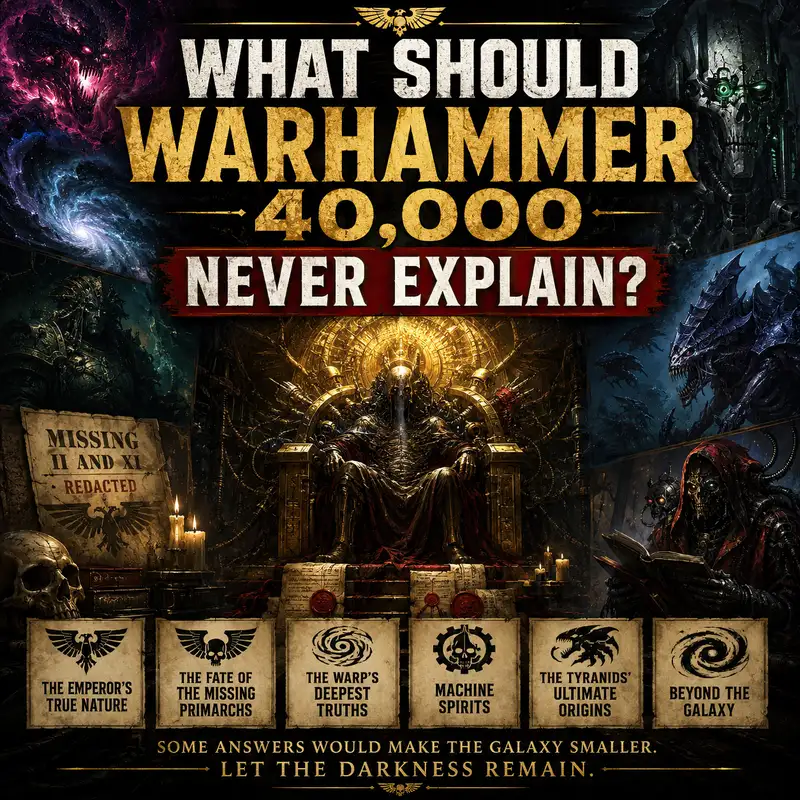
What Should Warhammer 40,000 Never Explain?
The most dangerous vault in the Imperium would not contain a weapon. It would contain an answer. Imagine a chamber beneath the Imperial Palace where every sealed record has survived. The Emperor’s first name. The true fate of the missing primarchs. The final purpose of the Golden Throne. The birthplace of the Tyranids. A complete map of the warp, with every god, current, and hidden depth carefully labelled. The door opens, the lamps come on, and ten thousand years of uncertainty vanish. It sounds like the greatest lore release ever written. It might also be the moment the setting becomes smaller.
Warhammer forty thousand has always lived between revelation and darkness. Its stories need answers. A mystery that never develops eventually stops feeling profound and starts feeling like a filing error. Characters must discover things, campaigns must reach conclusions, and secrets must carry consequences. Yet some questions perform a different job. They are not unfinished plots waiting for a final chapter. They are load-bearing shadows. Remove them, and the architecture remains standing, but the scale, fear, and sacred uncertainty begin to drain away.
The real question is not whether the setting should explain its mysteries. It is what kind of explanation makes the galaxy larger, and what kind closes it down. Good answers create new choices, new conflicts, and new reasons to reinterpret what came before. Bad answers merely replace wonder with a fact. They tell us the monster’s exact height, place of birth, preferred diet, and administrative designation, then seem surprised when it is no longer frightening.
This distinction matters because Warhammer forty thousand is presented through damaged memory. Imperial archives are censored, fragmented, devotional, and frequently written by institutions with a professional interest in being correct after the event. Chaos offers revelation, but rarely without manipulation. Aeldari prophecy can be precise and still misleading. Necron memory has endured across geological ages, which has not necessarily improved its reliability. The setting is not a clean window onto history. It is a pile of cracked lenses, each held by someone insisting that theirs is the only one without a flaw.
That means uncertainty is not merely a lack of information. It is part of the world. The Imperium survives by controlling knowledge, ritualising what it cannot understand, and declaring contradictions heretical rather than resolving them. A complete and neutral account of everything would not just answer questions for the audience. It would quietly remove one of the central pressures shaping every civilisation in the setting. Ignorance in the forty-first millennium is political power, religious protection, military weakness, and sometimes the only barrier between a curious scholar and something that notices curiosity.
The Emperor is the clearest example. His actions can and should be explored. His treatment of the primarchs, his suppression of religion, his plans for humanity, his failures during the Great Crusade, and the price of his survival on the Golden Throne all deserve serious examination. Those are choices with victims and consequences. They reveal character even when his motives remain disputed. The Emperor should not be protected from judgment merely because he is mysterious. A shadow can still cast a very measurable body count.
What should remain unresolved is the final, exhaustive statement of what he is. A definitive origin, complete inner monologue, and perfectly reliable account of his ultimate intention would force every contradiction into one authorised answer. Was he humanity’s necessary guardian, its most successful tyrant, a man becoming a god, a god pretending to be a man, or something for which those categories are inadequate? The power of the Emperor lies partly in the fact that all of these interpretations can illuminate him, and none can safely contain him.
The same restraint should apply to his apparent divinity. The Imperium witnesses miracles. Saints return from death. Prayers are answered often enough to affect battle plans, which is an awkward development for any tidy secular theory. Yet a laboratory result proving that the Emperor is, or is not, a god would weaken the subject. Faith in the Imperium matters because belief produces courage, cruelty, unity, obedience, and occasionally impossible events. The consequences are real even when the metaphysical explanation remains contested.
The fate of the dead should remain uncertain for the same reason. Imperial sermons promise that faithful souls find the Emperor’s light, while the warp offers abundant evidence that death can be far less orderly. The Aeldari build entire systems around protecting souls from Slaanesh. Chaos worshippers bargain for forms of survival that usually prove regrettably literal. These beliefs have practical consequences, but the setting does not need one universal chart of the afterlife. If every soldier knew exactly what waited beyond death, courage, martyrdom, and damnation would become calculations. The unknown gives each promise its power.
The missing primarchs belong in a similar category. The Second and Eleventh were erased so thoroughly that their absence became more important than most preserved biographies. Their empty places tell us that the Great Crusade contained failures even the victors could not absorb into official history. They tell us that the Emperor’s family was never as complete or stable as later legend pretended. They also place a limit on what the surviving primarchs were permitted to remember, discuss, or forgive.
Naming them, describing their home worlds, listing their campaigns, and explaining every step toward their destruction would produce an interesting pair of stories. It would also close a wound that currently runs through the entire mythology of the Legions. The better approach is to reveal the shape of the absence. Show who feared the subject. Show what records were destroyed. Show how the surviving brothers reacted when the old prohibition was disturbed. Give the silence weight, but do not fill every inch of it with furniture.
This does not mean every erased war must remain a blank page. The Rangdan Xenocides, the Pale Wasting, and other half-recorded disasters gain power from fragments because fragments prove that something happened. We need consequences, scars, damaged institutions, and witnesses who cannot agree. Without those, mystery becomes vagueness. The audience should know enough to understand why a subject terrifies the people who inherited it. What should remain hidden is the final inventory of every enemy, battlefield, and secret order. A war can be historically real without becoming administratively complete.
The warp is an even stronger candidate for permanent uncertainty. It needs rules, because stories require cause and effect. Ships enter it under dangerous conditions. Navigators perceive currents. Gellar fields matter. Psykers attract attention. Emotion, belief, and catastrophe shape what dwells there. These patterns make the warp usable in fiction while preserving danger. Without patterns, every crisis could be solved by arbitrary magic, which is not mystery. It is simply the author arriving with a crowbar.
What the warp should never receive is a final physics textbook. Its deepest regions should not be charted with the confidence of a railway map. The Chaos Gods should not be reduced to measurable organisms with fixed boundaries and a neat family tree. Their domains, rivalries, temptations, and methods can be understood because those things drive human decisions. Their total nature should remain beyond any single account. A god of war that can be fully diagrammed has become less a god and more a difficult piece of equipment.
Chaos itself is most effective when explanation reveals seduction rather than eliminating ambiguity. We should understand why a commander accepts forbidden aid, why a population embraces a cult, or why a scholar keeps reading after the sensible page to stop. Corruption needs motive. It should not be random smoke that enters a room and makes everyone evil. Yet the final relationship between mortal emotion, daemonic agency, and the great powers of the warp should retain tension. If every soul can calculate exactly what Chaos is doing, temptation becomes a consumer warning label.
Machine spirits occupy a smaller but equally valuable uncertainty. The simplest answer would declare that every rite of the Adeptus Mechanicus is ignorant superstition wrapped around old technology. The opposite answer would insist that every weapon, engine, and door latch contains a literal conscious soul. Both explanations are too clean. Imperial machines range from simple mechanisms to ancient systems with autonomous functions, layered memories, psychic interfaces, and personalities accumulated across centuries of use. One answer need not fit all of them.
That ambiguity gives the Mechanicus depth. A ritual may be maintenance encoded as liturgy. It may be a security procedure no one remembers how to explain. It may soothe a genuine machine intelligence that cannot legally be acknowledged. It may work because generations of belief have left an imprint in the warp. It may merely give a nervous crew something useful to do while the reactor decides whether to explode. The correct response can vary from machine to machine, which is far more interesting than declaring the entire priesthood either foolish or vindicated.
The Tyranids should also keep their oldest doors closed. Their behaviour can be studied in detail. Imperial defenders can learn how synapse control works, how hive fleets adapt, and how the Hive Mind responds to resistance. That knowledge creates strategy. It allows victories to feel earned and defeats to feel avoidable in retrospect, which is the preferred military condition for maximum bitterness. The Tyranids must be understandable enough to fight.
Their ultimate origin should remain distant. The galaxy does not need a confirmed home world, a creator species, or a final statement of how much of the swarm waits beyond the visible dark. The Hive Mind can possess intelligence, attention, and even something resembling hatred without acquiring a human biography. Giving it a throne room, childhood grievance, and explanatory speech would not make it richer. It would turn an alien ecology of consumption into another empire with unusually poor table manners.
The same principle applies to what lies beyond the galaxy. Expeditions may find signals, dead worlds, isolated species, and evidence that the Milky Way is not the centre of anything. Those discoveries create scale. A complete external atlas would destroy it. The black around the galactic map should remain more than unused paper. It should be the reminder that every empire, god, crusade, and prophecy known to the setting may occupy a very small island in a much older night.
Not every once-mysterious subject needs this protection. The Horus Heresy was once a distant foundation myth, glimpsed through fragments and solemn references. Expanding it into a vast narrative revealed motives, rivalries, friendships, betrayals, and failures that the old legend could only suggest. That explanation did not merely supply dates. It created people. Horus became more than a name attached to treason, and the loyalists became more than statues waiting to be wounded.
The Heresy also demonstrates the limit. Detailed stories strengthened the tragedy because they answered human questions. Why did this brother trust that one? What did a commander know when he gave the order? Which compromise made the next betrayal possible? Yet the deepest nature of the Emperor, the warp, prophecy, and fate remained disputed. The history became clearer while the cosmology stayed dangerous. That is the balance worth preserving.
The Necrons offer another useful example. Revealing dynasties, personalities, rival courts, damaged memories, and the consequences of biotransference transformed them from a single silent threat into a civilisation of competing tragedies. Explanation added scale because it multiplied perspectives. It did not make the ancient past simple. Every ruler remembers loss differently, and some memories have been edited by time, pride, or deliberate interference. The answer opened doors instead of sealing them.
Specific mysteries should therefore be judged by what a resolution would do. The identity games of the Alpha Legion can remain part of its culture, but individual plots eventually need consequences. If every defeat was secretly intended and every corpse might be someone else, strategy loses meaning. Deception is frightening when it changes what people choose. It becomes tedious when it exempts the deceiver from cause and effect. Alpharius may lie. The story still needs to know when the lie costs him something.
Cypher presents the same danger in a different form. His sword, his purpose, and his road toward Terra have carried suspense for a very long time. A revelation could work if it forces the Dark Angels, the Imperium, or the returned Lion into an irreversible decision. It would fail if the answer merely replaces one riddle with a new sealed envelope. Mystery needs motion. Otherwise it becomes a corridor painted onto a wall.
The Legion of the Damned, Imperial apparitions, and other supernatural interventions should remain visible but not fully catalogued. Let witnesses see burning warriors arrive where no rescue was possible. Let records disagree about whether they were ghosts, altered Space Marines, warp manifestations, or the product of desperate belief. The event can be real without the explanation becoming certain. Terror and hope often share that boundary in the Imperium.
That boundary is important because certainty changes moral responsibility. If the Emperor’s will could be measured perfectly, every priest could claim obedience with scientific confidence. If prophecy were fully reliable, every atrocity committed to prevent a future would become a technical calculation. If machine spirits were universally proven, the Mechanicus would lose the tension between preservation and ignorance. Ambiguity forces characters to act without complete assurance. Their beliefs become choices rather than answers copied from the back of the book.
The setting should still be disciplined about uncertainty. Contradiction is not automatically profound. A missing explanation cannot repair a story whose motives make no sense. Unreliable records should create competing interpretations, not excuse every continuity problem. The audience needs solid ground beneath the fog. We should know who made the decision, who suffered, what changed, and why the survivors remember it. Mystery works best when it surrounds a clear event, not when it replaces one.
A useful rule is to explain downward and preserve mystery upward. Explain the soldier’s orders, the governor’s bargain, the inquisitor’s suspicion, and the primarch’s choice. Explain how a weapon functions well enough to understand its cost. Explain why a campaign was lost and who benefited from the official account. As the questions rise toward gods, ultimate origins, the final structure of reality, and the complete design of history, allow certainty to thin.
Another rule is to protect what makes a faction genuinely alien. The Aeldari can be proud, divided, compassionate, ruthless, and wrong without their long view becoming human common sense in elaborate clothing. The Necrons can recover personality without recovering perfect memory. Orks can be funny without becoming a joke, because their joy in violence is also a terrifying civilisational principle. The T’au can reveal more of their empire without settling every question about control, idealism, and coercion. Explanation should deepen a culture, not translate it into familiar modern labels and declare the work finished.
The most valuable mysteries also leave room for ordinary people to misunderstand them. A guardsman does not need the true taxonomy of a daemon to know that it crossed the trench. A tech-priest does not need a final theory of consciousness to hear an engine reject its pilot. A sister of battle does not need a theological ruling to step into fire and find that it does not burn her. The setting becomes intimate when cosmic uncertainty is experienced through practical terror.
Warhammer forty thousand should therefore reveal secrets that create responsibility. Tell us which lord authorised the purge. Tell us why the fleet arrived late. Tell us what a primarch sacrificed to preserve his version of victory. Let hidden crimes emerge, because secrecy should not protect powerful characters from consequence. The mysteries worth preserving are not those that hide accountability. They are those that preserve scale, faith, alienness, and the sense that reality is larger than any empire’s explanation of it.
The Emperor’s complete nature should remain beyond the final page. The missing primarchs should retain more silence than biography. The warp should have patterns without a final map. Machine spirits should resist one universal answer. The Tyranids should remain understandable in battle and unknowable in origin. The darkness outside the galaxy should continue to make the known stars feel exposed. These are not gaps waiting to be repaired. They are the negative space that gives the setting its shape.
A universe with no answers becomes empty noise. A universe with every answer becomes a museum display, labelled, illuminated, and safely behind glass. Warhammer forty thousand needs neither. It needs clear tragedies beneath uncertain heavens. It should tell us exactly what people did when confronted by the unknown, what they believed, whom they betrayed, and what their certainty cost. Then, when they look upward and demand the final truth, the stars should remain silent.
That is what Warhammer forty thousand should never explain: not the events, not the choices, and not the consequences, but the last answer that would make every lesser answer final. The setting should open vaults, expose lies, and name the dead. It should never switch on every light.