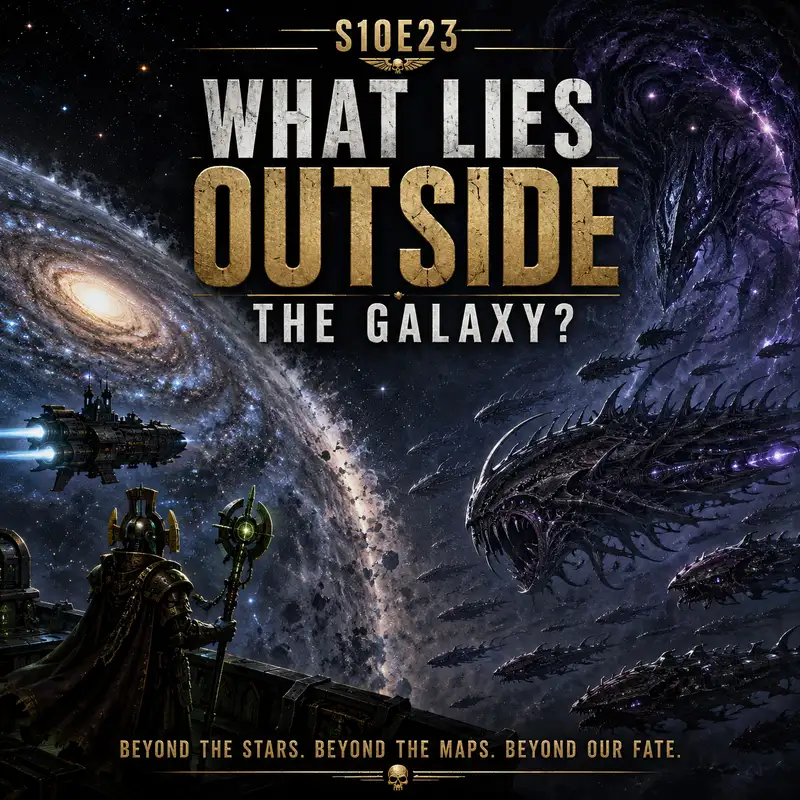
What Lies Outside the Galaxy?
At the edge of the Milky Way, the stars do not end all at once. They thin. The familiar constellations lose their shape, the galactic disk narrows behind the ship, and the darkness ahead becomes wider than any Imperial map was designed to admit. An explorer crossing that boundary would not encounter a wall, a gate, or a warning buoy helpfully marked Here Be Monsters. The crew would face something worse. The Astronomican would fade, astropathic messages would become uncertain, and every practical reason for turning back would arrive long before the first answer.
That is the central difficulty behind the question of what lies outside the galaxy. Warhammer forty thousand fills the Milky Way with empires, ruins, gods, machines, and predators, yet it says remarkably little about the greater universe around it. The silence is not evidence that nothing is there. It is evidence that almost nobody can reach it, survive it, return from it, and leave a record anyone else trusts. The setting gives us a few hard facts, several ancient claims, and an impressive amount of darkness between them.
The first distinction is geographical. The Ghoul Stars, the Eastern Fringe, the Halo Stars, and the outer reaches of the Segmentae are remote, but they are still parts of the Milky Way. They may lie beyond reliable Imperial administration, and some sit where the Astronomican is weak or obscured, yet they remain inside the galaxy's extended disk and halo. To travel outside the galaxy means crossing beyond those last scattered systems into intergalactic space, where the next major island of stars lies millions of light years away. That is not a longer patrol. It is a different category of journey.
The Imperium is poorly suited to such a voyage. Its great advantage in distance is Warp travel, and Warp travel depends on more than a powerful engine and a sufficiently optimistic captain. Navigators orient themselves by the Astronomican, the psychic beacon projected from Terra. Even within the Milky Way, that light can be faint, blocked, distorted, or lost. Beyond the galactic rim, a Navigator would have fewer landmarks, less dependable guidance, and no chain of known ports. The Imperium can cross terrifying distances. It does so by following a lighthouse that was never built to illuminate the universe.
Realspace offers no easy alternative. Imperial ships can travel between systems without entering the Warp, but the distances between galaxies make ordinary interstellar voyages look almost domestic. Fuel, maintenance, food, crew replacement, and simple mechanical wear become strategic enemies. A ship might carry generations of passengers, automated systems, or suspended crews, but none of those methods creates a destination. The Imperium has trouble supplying crusades on the far side of its own territory. An expedition into the intergalactic void would combine that problem with the minor inconvenience of having no known world at the end.
The Warp itself does not appear to stop at the edge of the Milky Way. It is not a second galaxy laid neatly over the first. It is an immaterial realm shaped by psychic life, emotion, thought, and forces that do not respect ordinary geography. Some scholars and fans assume that the Warp beyond the galaxy must be calm because there are fewer minds to disturb it. That may be plausible, but the surviving lore does not provide a reliable weather chart. Calm water is also not useful when there is no shore, no beacon, and no certainty that the thing beneath the surface is asleep.
The same caution applies to Chaos. There is no firm basis for declaring that the Dark Gods simply end at the galactic rim, as though daemons require an Imperial border stamp. The great concentrations of Warp activity described in the setting are tied to the peoples, wars, and psychic catastrophes of the Milky Way. That tells us where the stories occur, not the full limits of the Immaterium. A ship carrying psykers, fear, ambition, and desperation would not become spiritually harmless merely because the stars behind it had grown small.
Other familiar routes are no more reassuring. The Aeldari Webway is a broken network of impossible passages, but the known gates and domains are tied to the history of this galaxy. No dependable road to another galaxy has been established. Necron technologies can evade many of the Imperium's navigational limits, yet even their dynasties remain rooted in the worlds they once ruled. The T'au have experimented with new forms of faster travel and paid for the privilege in the usual manner, which is to say by creating a disaster large enough to receive a proper name. None has opened a routine extragalactic frontier.
There is, however, one traveler whose story reaches beyond the rim. Szarekh, the Silent King of the Necrons, left the galaxy after the ancient war that destroyed his people as a living species. He had led the Necrontyr into biotransference, exchanged flesh for metal, rebelled against the C'tan, and then watched his civilization retreat into the Great Sleep. Before departing, he released his command over the other Necrons. His exile was part penance, part abdication, and perhaps the only journey grand enough for a ruler trying to escape a decision that followed him everywhere.
What Szarekh found in the outer darkness brought him back. Necron accounts say that he encountered the Tyranids during his exile and recognized them as a threat greater than the divided dynasties understood. The precise nature of that encounter is unclear. He may have seen fleets in transit, worlds already stripped, or only enough biological evidence to understand the scale of the danger. The record gives us the conclusion, not a travel diary. Somewhere beyond the galaxy, the Silent King saw a predator moving toward the Milky Way and decided that exile had become a luxury.
His fear was not that the Tyranids would eat the Necrons. Living metal offers poor nutrition, even by military ration standards. The deeper danger was that the Tyranids might consume the galaxy's biological life and leave nothing from which the Necrons could recover flesh. Many Necrons regard reversal of biotransference as impossible, undesirable, or beneath them, but Szarekh's plans have long included the preservation of that possibility. A dead, barren galaxy would be a kingdom of tombs with no future beyond endurance. The Tyranids threatened not only survival, but the last argument that Necron history could still be repaired.
Szarekh's warning must also be read politically. A returning monarch needs more than regret. He needs a danger large enough to make rival dynasties listen. The Tyranids provide exactly that. This does not mean the threat is invented. It means that the Silent King's account serves two purposes at once. It describes what he claims to have found, and it justifies his return to authority. In Warhammer forty thousand, even accurate intelligence is expected to arrive carrying a throne on its back.
The Tyranids are the clearest answer to what lies outside the galaxy because they are unquestionably extragalactic. Their hive fleets entered the Milky Way from the surrounding void, not from a forgotten home world within Imperial borders. They travel as immense biological migrations, with living ships adapted for dormancy, resource conservation, and movement across distances that would destroy conventional fleets. Each visible tendril is only part of a greater organism. The question is not whether something lives beyond the galaxy. The Tyranids have already answered that by arriving hungry.
Their arrival also reveals how little the galaxy understood its own visibility. During the Horus Heresy, the ancient Pharos device on Sotha was overloaded in a desperate act of war. The destruction produced a signal of extraordinary intensity. Far away in the intergalactic darkness, a vast intelligence noticed the flare. It turned its attention toward the source. The event did not create the Tyranids, and it did not summon them from nowhere. It told something already moving through the void that a bright, crowded galaxy was waiting.
That detail changes the emotional scale of the setting. The civil war between Horus and the Emperor was already a catastrophe beyond ordinary measure, yet one of its distant consequences was to advertise the Milky Way to an extragalactic predator. The defenders of Sotha acted to survive an immediate battle. They could not know that their beacon would be seen across the darkness. The irony is severe even by Imperial standards. Humanity helped save a world for the afternoon and may have marked the entire galaxy for consumption.
The Hive Mind's origin remains unknown. It may have arisen in another galaxy. It may have passed through several. It may have consumed civilizations whose names will never be spoken in the Milky Way because no witness survived to carry them. Codices and stories encourage the possibility that whole galaxies have already been stripped, but they do not provide a verified count or a clear map. Claims that the Tyranids have eaten everything behind them are therefore warnings and interpretations, not settled census data.
The shape of the invasions does not solve the mystery. Early Imperial understanding treated the Tyranids as a threat arriving from a particular direction, especially along the eastern reaches. Later hive fleets and renewed assaults demonstrated that tendrils could approach from below the galactic plane, curve around defended regions, or appear where established strategy expected safety. Leviathan turned the edge of the galaxy from a frontier into a surrounding ocean. Different directions do not necessarily mean different origins. They may simply reveal how vast the same organism has become.
This has produced one of the setting's most persistent fears. Perhaps the fleets already encountered are only scouts. Perhaps the main body remains outside, larger than every invasion seen so far. The image is powerful, and Tyranid behavior makes it difficult to dismiss. Yet it remains an inference. The Imperium cannot stand at a safe distance and measure the whole swarm. It sees only what enters sensor range, survives translation through frightened reports, and leaves enough witnesses for the Administratum to misfile it in triplicate.
A related theory claims that the Tyranids are fleeing from something worse. The idea survives because it offers a larger terror beyond a known one. It also fits the human habit of assuming that any creature moving quickly must be running away. The available evidence points more strongly toward attraction and predation. The Pharos drew the Hive Mind's notice, and the fleets behave like organisms seeking biomass, not refugees searching for sanctuary. Something may exist behind them, but nothing established requires it. Sometimes the monster is not being chased. Sometimes it has simply smelled food.
If the Tyranids crossed from another galaxy, then they may not be unique. Other civilizations could have risen beyond the Milky Way, created their own empires, fought their own wars, and vanished without ever touching Imperial history. There could be galaxies dominated by machine intelligences, psychic species, or forms of life that do not fit any familiar category. There could also be dead galaxies, emptied by age, war, or consumption. Warhammer forty thousand does not deny these possibilities. It leaves them beyond the edge of the map, where possibility is abundant and evidence is not.
That absence matters because the setting is often mistaken for a complete cosmology. It is not. The Imperium's maps are political documents built by a civilization that cannot reliably count its own worlds. Necron memories are ancient, damaged, and shaped by dynastic pride. Aeldari knowledge is deep but guarded, fragmented, and focused on survival. Chaos reveals truths in forms designed to corrupt the listener. Even the Tyranids communicate their history mostly by eating the people asking questions. No faction possesses a neutral survey of the universe.
There are older, stranger claims. One often repeated piece of Imperial and Orkish lore suggests that probes sent toward the outer dark detected Ork signals, implying that greenskins may be found far beyond known space. It is memorable, and entirely suited to a species whose strategic plan is often to keep going until something objects. It is not a precise astronomical report. At most, it reminds us that Orks are ancient, widespread, and difficult to exclude from any answer involving the words everywhere or somehow.
The possibility of extragalactic Orks is less absurd than it first sounds. Ork spores travel with fleets, infest worlds, and can survive circumstances that would defeat carefully prepared colonists. A lost space hulk, a wandering Waaagh, or an ancient migration could carry them beyond the rim. Yet crossing the space between major galaxies is not the same as drifting between nearby systems. The old claim works best as a dark joke with a serious edge. Even if humanity escaped its own galaxy, it might arrive somewhere else and discover that the Orks had taken the earlier transport.
Humanity has no confirmed extragalactic refuge. The Dark Age of Technology sent ships across vast regions of the Milky Way, and human worlds were planted farther than later Imperial authorities could easily recover. None of that establishes a surviving human empire in another galaxy. Stories of lost expeditions, forgotten colonies, and vessels thrown far off course should not be converted into proof. The distinction is important. The setting contains many things that might have happened. Canon begins where a surviving account, artifact, or consequence gives the possibility weight.
Nor is leaving the galaxy a practical escape from the age of the Imperium. A refugee fleet would need navigation, supplies, genetic stability, industrial capacity, and a destination worth reaching. It would have to survive the Warp without the Astronomican or cross realspace over an almost incomprehensible span. It would also carry its politics, cults, psykers, rivalries, and damaged machinery with it. Distance can remove a population from the High Lords of Terra. It cannot remove human beings from the habits that made the High Lords necessary.
For the Aeldari, departure would not erase the spiritual crisis created by Slaanesh. Their souls, psychic nature, and dependence on carefully maintained systems of protection would travel with them. For the Necrons, another galaxy might offer untouched resources, but their deepest problems are memory, identity, and the loss of flesh, none of which are solved by a longer horizon. For the Orks, the voyage would merely be a very long approach march. Every major faction carries its defining conflict internally. The galactic edge is a boundary of distance, not absolution.
The Tyranids are different because the void is part of their way of life. Their civilization, if that word can be used, does not depend on permanent cities, trade routes, or cultural memory stored in monuments. The fleet is the organism. Its archives are genetic, its industry is digestion, and its strategy can remain dormant for ages until gravity and prey provide direction. Intergalactic space is lethal to societies built around places. It is less decisive against a predator that brings its entire ecology inside its own body.
Even so, the Tyranids do not make the void familiar. They make it more alien. No Imperial observer knows how long the Hive Mind spent between galaxies, how it selected its route before the Pharos flare, or whether other swarms moved elsewhere. The Shadow in the Warp announces their arrival by overwhelming psychic space, but it does not offer a view backward toward their origin. The galaxy experiences the pressure of something outside without seeing the hand that applies it.
The Silent King may know more than he has revealed. His exile lasted across ages, and Necron technology gives him possibilities unavailable to almost every other traveler. Yet his motives encourage caution. Knowledge is power among the dynasties, and the ruler who returns with a private map of the darkness has little reason to distribute copies. He may be protecting the galaxy, reclaiming an empire, preserving a path back to flesh, or pursuing all three. His silence is not proof of a greater secret, but it is one of the few silences that belongs to an actual witness.
There may also be no single answer. The universe outside the Milky Way is not one kingdom waiting behind a curtain. It contains enormous distances, satellite galaxies, isolated stars, dark matter, and other galactic systems separated by void. Asking what lies outside the galaxy is like asking what lies beyond an ocean while refusing to name the shore. The truthful answer may include predators, empty regions, ancient civilizations, and places where no intelligence has ever formed. The setting narrows that infinity to what can threaten, tempt, or haunt the peoples we already know.
This is why the unknown beyond the rim works so well in Warhammer forty thousand. The Milky Way already feels impossibly crowded, yet the surrounding darkness makes it small. Every crusade, Black Crusade, awakening dynasty, and hive fleet occurs on one luminous island. The Imperium calls itself the master of mankind while failing to master a fraction of that island. The wider universe does not need to invade to diminish such claims. It only needs to remain visible as darkness around them.
The established answer, then, is both narrow and terrible. Outside the galaxy lies intergalactic space, almost entirely unmapped by the factions of the Milky Way. The Silent King crossed it and returned with a warning. The Tyranids crossed it and became the warning. Beyond those facts, the lore offers fragments, old claims, and possibilities that should remain possibilities. There is no confirmed friendly empire waiting to rescue humanity, no proven sanctuary beyond Chaos, and no reliable evidence that the darkness is empty.
What lies outside the galaxy is not a secret list of new factions. It is distance on a scale that defeats empires, silence that defeats historians, and life capable of crossing both. The last stars of the Milky Way do not mark the end of danger. They mark the end of witnesses. Somewhere in that lightless expanse, the Hive Mind once saw a brief flare from Sotha and turned toward it. The galaxy has been living with the consequence ever since.