What Is Warhammer 40,000?
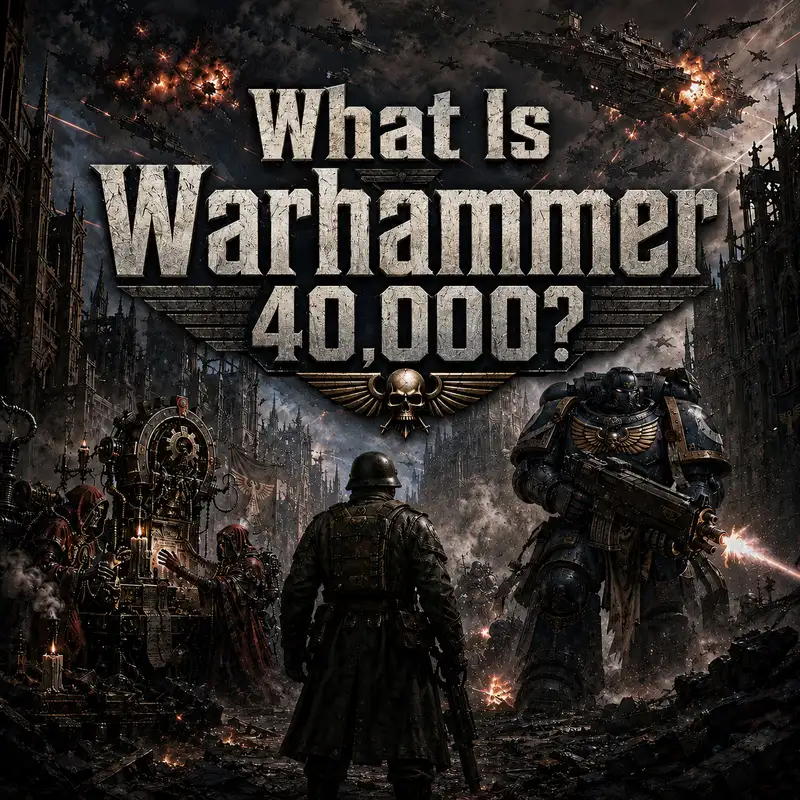
Picture a human soldier standing in the ruins of a city built like a cathedral. The sky above him is crowded with burning warships. Somewhere beyond the clouds, fleets are fighting across distances too large for the eye to understand. In the street, priests chant over a machine they no longer fully comprehend. A giant in powered armour advances through the smoke, carrying a weapon that fires explosive shells. The soldier does not know whether that giant has come to save the city, condemn it, or simply use it as ground worth defending.
That single image contains much of Warhammer forty thousand. It is a universe of impossible scale, ancient institutions, religious machinery, alien empires, and wars so vast that an ordinary life can disappear inside a footnote. It is also a setting where the ordinary life still matters, precisely because the universe does not.
Warhammer forty thousand is not one story. It has no single central hero, no final quest, and no neat point at which the audience is expected to begin. It is a fictional setting designed to hold many stories at once. Some are military campaigns. Some are political tragedies. Some are horror stories. Some follow demigods and monsters. Others follow frightened people trying to survive one more night in a corridor where the lights have gone out.
Outside the fiction, Warhammer forty thousand began as a tabletop miniature wargame created by Games Workshop. Players collect armies, assemble and paint models, and fight battles using rules, dice, and terrain. From that foundation grew novels, role-playing games, video games, animations, and decades of lore. The tabletop game is one doorway, but it is not the whole house.
The name points toward the basic premise. This is humanity in the far future, roughly thirty-eight thousand years beyond our own era. Human beings have spread across a large part of the Milky Way, but they have not created a peaceful or enlightened civilisation. They live within the Imperium of Man, a decaying galactic empire ruled in the name of the Emperor, a being who has sat broken and immobile upon the Golden Throne of Terra for ten thousand years.
The Imperium calls him divine. He did not begin by asking to be worshipped.
Long before the main era of the setting, humanity passed through ages of expansion, technological achievement, isolation, and collapse. Worlds were cut off from one another. Civilisations fell. Knowledge was lost. When the Emperor emerged openly on Terra, he launched the Great Crusade to reunite the scattered human worlds under one authority. His armies included the Space Marine Legions, genetically transformed warriors created for conquest, and the primarchs, extraordinary sons fashioned to lead them.
The project was vast, violent, and confident. It was also built around one man’s belief that he could master forces no civilisation had ever mastered safely.
The Great Crusade ended in the Horus Heresy. Horus, the Emperor’s favoured son and Warmaster, rebelled. Half of the Space Marine Legions followed him. The civil war burned across the Imperium and ended at Terra, where Horus was killed and the Emperor was mortally wounded. The rebels fled toward the Eye of Terror. The surviving loyalists inherited an empire that had won its civil war by destroying the future it had been intended to create.
Ten thousand years later, the Imperium still survives. Survival, however, is not the same thing as health.
The pressure has only increased. The Great Rift now tears across much of the galaxy, making travel and communication even more dangerous and cutting many Imperial worlds off from Terra. The primarch Roboute Guilliman has returned to lead desperate campaigns of recovery, but even this miracle does not restore the lost golden age. It gives a dying empire a capable commander and more emergencies to command.
The Imperium is enormous, fragmented, and difficult to govern. Messages can take months or years to arrive. Entire wars may end before distant authorities learn that they began. Local rulers interpret commands through politics, fear, faith, and whatever records have survived. The state is supported by armies, priesthoods, noble houses, secret police, machine cults, and bureaucracies capable of losing a planet without admitting it existed.
The Imperial response to a crisis may be heroic. It may be monstrous. It may also be filed correctly and sent three centuries late.
At the centre of this civilisation is a contradiction. The Imperium protects humanity from genuine horrors. It also consumes human beings to preserve itself. Its soldiers defend worlds from alien invasion and daemonic corruption. Its officials also crush dissent, suppress knowledge, destroy populations, and treat individual rights as a dangerous eccentricity. It is not a modern nation projected into space. It is a fortress built from the ruins of ten thousand years of emergency rule.
The setting does not ask the listener to believe the Imperium is good. It asks a more uncomfortable question. What happens when a civilisation faces real monsters and gradually becomes monstrous in order to endure them?
The most famous servants of the Imperium are the Space Marines. They are often the first image newcomers encounter. They are towering, genetically altered warrior-monks encased in power armour, organised into Chapters with their own traditions, rivalries, rituals, and histories. They are not the ordinary human army, and they are not common. A Space Marine is a rare strategic weapon, part knight, part commando, part sacred relic.
Their presence can turn a battle. It can also distort our sense of the setting. Most Imperial wars are fought by ordinary people.
The Astra Militarum, commonly called the Imperial Guard, supplies those people in numbers beyond meaningful counting. Its regiments come from thousands of worlds and follow wildly different traditions. Guardsmen face tanks, aliens, traitors, daemons, and commanders whose maps may be older than their nations. They do so with human bodies, massed firepower, armoured vehicles, discipline, and whatever courage remains after the first bombardment.
Their courage is not impressive because they are invincible. It is impressive because they are not.
Around them stand the other great institutions of the Imperium. The Adeptus Mechanicus maintains technology through engineering, ritual, guarded knowledge, and religious devotion. Its priests replace flesh with machinery while searching for ancient devices they may only partly understand. The Adepta Sororitas, the Sisters of Battle, combine disciplined force with absolute faith. The Inquisition hunts threats within and beyond humanity, granted extraordinary authority because the dangers are real and because extraordinary authority has never caused a problem in human history.
Imperial Knights stride across battlefields as walking noble war machines. Titans loom above them like armed cathedrals. Fleets cross the void carrying armies large enough to conquer worlds. Yet all of this power depends on travel through the Warp, and the Warp is where the setting stops being merely futuristic and becomes something darker.
The Warp is a parallel realm shaped by psychic energy and emotion. It allows ships to cross interstellar distances far faster than ordinary travel would permit. Navigators guide vessels through it using the light of the Astronomican, the great psychic beacon associated with the Emperor on Terra. Without the Warp, the Imperium could not function as a galactic power.
The Warp is also inhabited.
Human fear, rage, ambition, despair, desire, and obsession have echoes there. Across vast ages, those echoes have formed terrible intelligences. The great powers of Chaos are not simply horned villains waiting behind a curtain. They are vast concentrations of emotion and idea. Khorne embodies rage, bloodshed, and martial violence. Tzeentch offers change, ambition, knowledge, and manipulation. Nurgle offers endurance, decay, and the comfort of surrender. Slaanesh offers excess, sensation, perfection, and desire without limit.
Chaos is dangerous because it can tempt before it destroys. It offers strength to the humiliated, knowledge to the desperate, relief to the suffering, and purpose to the forgotten. The price is rarely stated clearly. By the time it becomes obvious, the person paying it may no longer see the loss as a loss.
Daemons are manifestations of the Warp, but Chaos also has mortal servants. Traitor Space Marines, corrupted soldiers, cultists, sorcerers, and entire renegade civilisations wage what they see as liberation, revenge, worship, or conquest. Some remember the Horus Heresy as a war that never truly ended. Others have forgotten why they began fighting. Ten thousand years provides ample time for ideology to become habit.
Humanity is not the only civilisation in the galaxy, and it is not automatically the oldest, wisest, or most dangerous.
The Aeldari are survivors of an ancient species whose empire once dominated the stars. Their civilisation collapsed in a catastrophe created by its own excess, giving birth to Slaanesh and tearing open the Eye of Terror. The Craftworld Aeldari escaped aboard enormous world-ships and now follow rigid paths of discipline to avoid repeating that disaster. They can be farsighted and painfully aware of consequences. They can also be arrogant, divided, and willing to sacrifice millions of outsiders to save their own.
Their darker kin, the Drukhari, dwell in the hidden city of Commorragh. They preserved the old empire’s cruelty and sustain themselves through the suffering of others. They are heirs to a civilisation that chose predation as spiritual survival.
The Orks offer a different vision of galactic life. They are a species built around conflict. War is culture, recreation, social order, and, in a grim biological sense, ecology. Their technology appears crude but can be brutally effective. Their leaders rise through strength, and their invasions become migrations of destruction assembled with alarming enthusiasm.
Orks are often funny because they enjoy the universe everyone else finds unbearable. That does not make them harmless. A charging Ork horde is amusing chiefly from a safe distance, and the galaxy has very few of those.
The Necrons are remnants of a civilisation older than humanity’s recorded history. Long ago, their rulers transferred their people into bodies of living metal in pursuit of immortality and power. The bargain cost them more than flesh. Many became mindless warriors, while their nobles retained varying degrees of personality, memory, pride, madness, and regret. Now their dynasties awaken beneath worlds that younger species settled without realising they were building farms over tombs.
Some Necron rulers want to restore ancient domains. Some seek vengeance or pursue impossible scientific projects. Others are trying to recover what they lost when they ceased to be mortal. Their armies can seem mechanical, but their strongest stories are often about identity. A mind may survive for millions of years and still discover that survival is not the same as remaining oneself.
The Tyranids come from beyond the galaxy in hive fleets of living ships and organisms designed for particular functions. They consume a world’s biological material and reshape it for the next assault. Individual creatures may show cunning, but the greater intelligence behind them is profoundly alien. It does not appear to need anything a diplomat can offer.
Against Tyranids, a planet is not merely conquered. It is processed.
The T’au are a younger power with advanced technology, a growing empire, and an ideology called the Greater Good. They present cooperation and shared purpose as alternatives to the hatred around them. Their society has confidence and capability, but also rigid structures, political control, and a tendency to assume that refusal is merely a failure of persuasion.
The Leagues of Votann come from the galactic core, organised into hardy kin groups and guided in part by ancient machine intelligences. They value trade, inheritance, obligation, and accumulated knowledge, along with old claims and long grudges backed by formidable weapons.
These factions do not exist merely to provide differently coloured armies. Each represents a different answer to survival.
The Imperium survives through sacrifice, repression, faith, and scale. Chaos survives by embracing forces that dissolve the self. The Aeldari rely on discipline and manipulation. The Drukhari make others suffer. The Orks are perfectly adapted to war. The Necrons abandoned mortality and discovered the cost. The Tyranids consume everything else. The T’au expand through coordination and belief in a system that expects others eventually to comply.
No answer is clean. Most are armed.
That is why war is permanent in Warhammer forty thousand. Conflict is not a temporary crisis before diplomacy resumes. Resources are scarce. Communication is unreliable. History is weaponised. Religion is political. Technology is sacred, feared, or poorly understood. The Warp turns emotion into a strategic hazard. Civilisations carry grudges older than the human species. Even when two powers share an enemy, cooperation is usually local, temporary, and conducted with one hand near the weapon.
The scale can be overwhelming. Worlds are lost. Sectors burn. Fleets disappear. Billions die in a sentence. Yet the strongest stories often narrow that scale rather than trying to shout over it.
A squad holds a gate for ten more minutes. A commander chooses which city will be abandoned. A tech-priest discovers that the sacred machine is failing. A Space Marine begins to doubt the tradition that shaped him. An Aeldari seer acts on a vision that may save her people and doom someone else’s. A Necron lord notices a memory has vanished. A citizen learns that the monsters described by the state are real, then learns that the state is also one of them.
The galaxy matters because of those choices. Without them, the numbers become decoration.
The tone of Warhammer forty thousand is often described as grimdark. The word means more than violence or skulls on architecture, though the setting has invested generously in both. Grimdark is the idea that power is compromised, institutions are decayed, victories are costly, and the future offers no guaranteed moral progress. The setting magnifies authoritarianism, fanaticism, militarism, bureaucracy, and religious certainty until they become terrifying and absurd.
That absurdity matters. Warhammer forty thousand can place a sincere tragedy beside a war machine shaped like a cathedral and expect both to work. It can admire a soldier’s sacrifice without admiring the government that ordered it. It can make a heroic last stand emotionally real while quietly asking why the defenders were sent there with the wrong ammunition.
This balance is easy to miss. Treated only as spectacle, the setting becomes a catalogue of large weapons and larger shoulder armour. Treated only as satire, it loses the people whose fear and loyalty give the stories weight. Treated only as tragedy, it becomes exhausting. Reduced to a contest over the strongest faction, it becomes a particularly elaborate argument conducted near a ruler.
Warhammer forty thousand works when all of those elements remain in tension.
Its lore is not a perfectly reliable history. Information comes through codices, novels, campaign accounts, legends, propaganda, battlefield reports, and characters who possess only part of the truth. Accounts differ. Dates can be uncertain. Official claims may conceal defeat. Ancient memories may be damaged. An Imperial record will not describe an event the same way as an Aeldari survivor or a Chaos warlord.
That uncertainty can strengthen the setting. The lore feels less like a database and more like a ruined archive recovered after repeated disasters. The reader becomes a historian, comparing records written by people who were frightened, devoted, ambitious, deceived, or trying very hard not to be executed.
For a newcomer, the amount of material can still seem impossible. The useful answer is that no one must learn everything before beginning. Choose one doorway.
Military history might lead toward the Imperial Guard, a campaign, or the Horus Heresy. Tragic knights lead toward the Space Marines. Horror leads toward the Inquisition, Chaos, or Tyranids. Lost civilisations lead toward the Aeldari or Necrons. A painter can begin with models, while a reader or gamer can simply choose a story that sounds interesting.
There is no examination at the gate. The setting has enough examinations after entry, and several are administered by the Inquisition.
The most important thing to understand is that Warhammer forty thousand is a setting, not an instruction to approve of everything shown within it. Its symbols belong to fictional institutions that are often cruel, fanatical, and self-destructive. Its most compelling characters may be brave, loyal, compassionate, or honourable, but they live inside systems that twist those virtues toward terrible ends.
A loyal Imperial officer may save a world and preserve an empire that will oppress it. A Chaos rebel may correctly identify the Imperium’s brutality and then offer souls to something worse. An Aeldari leader may prevent a catastrophe by arranging one somewhere else. A T’au commander may speak sincerely of unity while denying that genuine refusal is possible. Warhammer forty thousand rarely allows moral purity to survive contact with strategic necessity.
That does not mean every choice is equally bad. It means the setting is interested in the cost of choices made under pressure, and in the stories people tell themselves afterward.
So what is Warhammer forty thousand?
It is a tabletop wargame surrounded by a vast shared fictional setting. It is military science fiction dressed in gothic architecture. It is fantasy translated into starships, psychic warfare, and industrialised crusade. It is horror on the scale of a galaxy and drama on the scale of one frightened person. It is satire that sometimes speaks with a straight face, and tragedy that occasionally remembers to laugh.
More than any single faction, battle, or hero, it is a universe built around survival without innocence. Every civilisation is trying to endure. Every one has chosen methods that reveal what it values, what it fears, and what it is willing to become.
The soldier in the ruined city may look up and see the armoured giant disappear into the smoke. He may never learn which war brought the fleets overhead, which ancient betrayal made the enemy possible, or which distant official decided his world could be spent. He knows only that the line must hold until dawn.
In Warhammer forty thousand, dawn is not a promise that darkness will end. It is simply proof that someone survived the night.