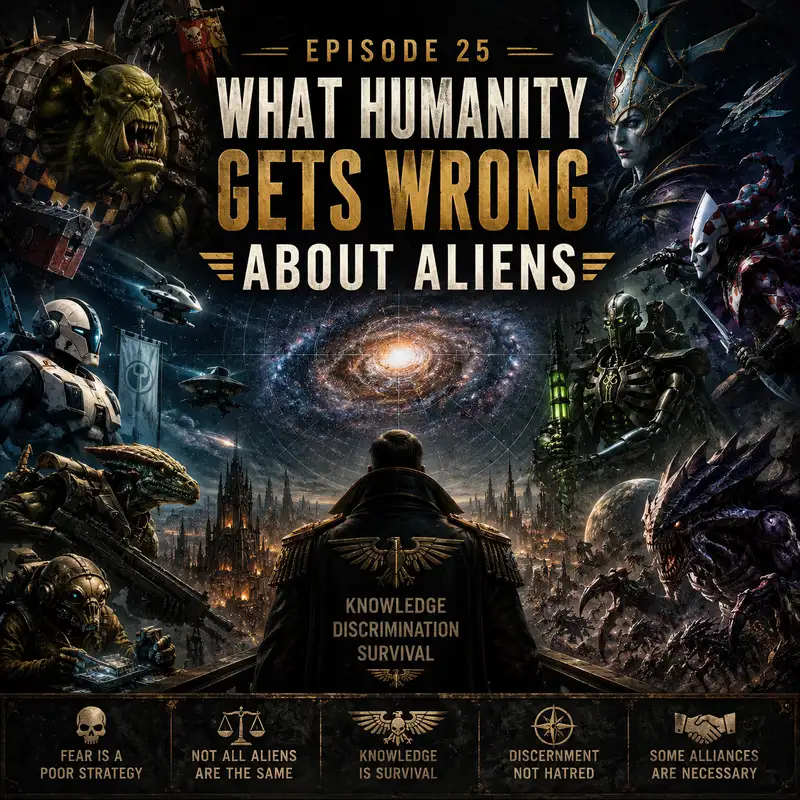
What Humanity Gets Wrong About Aliens
The Diasporex had committed a crime for which the Imperium possessed no language of forgiveness. Humans and aliens crossed the darkness as one wandering civilisation, sharing labour, technology, and danger. When the Great Crusade found them, the issue was not whether they had attacked humanity. The issue was that they had rejected the oldest Imperial assumption: that human survival required separation from every other intelligent species. The Diasporex were destroyed, and the Imperium treated the result as liberation.
That moment reveals something larger than cruelty. It reveals a habit of thought. The Imperium does not merely hate alien empires for what they have done. It treats alienness itself as evidence. A xenos body is a confession. A xenos civilisation is a conspiracy. Peace is camouflage, trade is infiltration, and compromise is simply defeat with better manners. In a galaxy of Orks, Drukhari, Tyranids, and awakening tomb worlds, that suspicion is understandable. It is also one of the most dangerous mistakes humanity makes.
Humanity gets aliens wrong because it imagines them as a single category with a single moral meaning. The word xenos folds the nonhuman galaxy into one administrative box. A Craftworld seer, a Kroot mercenary, a Necron overlord, a Jokaero weaponsmith, and a Tyranid feeder organism become variations of the same problem. The classification is convenient. Administrations enjoy convenience, especially when the alternative requires thought. Strategy does not enjoy it nearly as much.
The roots of this worldview reach back through Old Night, when human worlds were isolated by warp storms and many were conquered, raided, enslaved, or abandoned. Imperial memory insists that aliens turned upon humanity the moment its strength failed. Some undoubtedly did. Orks overran vulnerable systems. Predatory species exploited worlds that could no longer call for aid. Other cultures remembered betrayal, occupation, and extinction. Those memories made the promise of unity, strength, and revenge irresistible.
The problem came when trauma became universal doctrine. The Great Crusade did not simply reunite scattered human societies. It judged them. A stable and prosperous human civilisation could still be condemned for cooperating with aliens or refusing Imperial rule. The Emperor’s project offered protection at the price of obedience to one vision of humanity. In that vision, coexistence was not a political choice. It was contamination.
This is why the destruction of the Diasporex matters. Their existence did not prove that every alien could be trusted. It proved something more modest and therefore more threatening. It proved that cooperation was possible. Humans and aliens had survived together without becoming one species or subjects of an obvious master. The Imperial response removed the example and then treated its absence as confirmation that no such example could exist.
A similar possibility appeared in the Interex. They were human, but their society had incorporated the Kinebrach, an alien people they had once fought. The Interex understood Chaos as a grave danger and built their culture around vigilance against it. When Horus encountered them, he briefly considered diplomacy rather than immediate conquest. The meeting collapsed after Erebus stole a Kinebrach weapon and the Interex blamed the Imperials. War followed. The episode is remembered as a step toward Horus’s fall, but it also shows how little room the Great Crusade allowed for misunderstanding. One disaster was enough to turn contact into extermination.
The Imperium would argue that this caution is necessary because mistakes are fatal. It is correct. A friendly vessel may carry Genestealers. A diplomatic envoy may be an Aeldari manipulation. A beautiful offer may come from something that considers human pain a renewable resource. The galaxy punishes trust enthusiastically. Yet distrust also has costs. When every encounter begins with a death sentence, the Imperium gives other species no reason to distinguish between negotiation and surrender.
Consider the Orks. Imperial propaganda often portrays them as stupid brutes, and on an individual level many Orks are direct in their interests. They like fighting, noise, speed, and the satisfying certainty produced by a large weapon. None of this makes them simple. Ork society is an ecosystem, a culture, and a war machine produced by the same biological design. Spores seed worlds. Different castes emerge to sustain it. Mekboyz possess instinctive technical knowledge. Weirdboyz channel the collective psychic pressure of the mob. Warbosses create political order through violence.
Calling Orks mindless encourages the wrong kind of confidence. An Ork invasion is not merely an army that can be defeated and sent home. It is a spreading environment. A battlefield victory may leave spores beneath the ash, feral communities in the wilderness, and the beginnings of another war decades later. Orks learn through conflict. They loot weapons, copy useful ideas, and gather around success. As the Waaagh grows, so does its ability to organise fleets, supply systems, and vast campaigns.
Humanity’s mistake is not that it hates Orks too much. Orks are an enduring military threat, and negotiation with them usually means arranging the location of the next fight. The mistake is imagining that contempt is analysis. To call an enemy stupid can become a way of refusing to study him. The Imperium has paid for that refusal on countless worlds, often just before discovering that the supposedly primitive greenskins have built a moon-sized attack platform or turned an asteroid into public transport.
The Aeldari produce the opposite error. They are often treated as if they were one ancient, scheming intelligence distributed across many elegant bodies. Imperial accounts collapse Craftworlders, Exodites, Corsairs, Harlequins, Ynnari, and Drukhari into one image of treachery. They share ancestry and certain dangers, but they do not share one government, one purpose, or even one answer to the catastrophe that destroyed their old civilisation.
A Craftworld may divert an Ork Waaagh away from its own people and into an Imperial system. From the human perspective, this is treachery with a poetic accent. The judgment is fair. Another Craftworld may warn humans of a Chaos threat, fight beside Imperial forces against Tyranids, or sacrifice lives to prevent a disaster that would consume both species. The Imperium still expects betrayal, and often creates the conditions for it. A warning delivered by an alien is easier to shoot than to understand.
The Aeldari are not innocent victims of human prejudice. Their seers manipulate events, sometimes sacrificing millions of humans to save far fewer Aeldari. Their sense of time, history, and cultural superiority makes genuine equality difficult. The Drukhari are worse by any ordinary moral measure. Their society survives by feeding suffering into the spiritual wound left by the birth of Slaanesh. Raiding, slavery, and calculated cruelty are not accidents in Commorragh. They are institutions.
Yet even here, precision matters. A Drukhari raider and an Exodite defending a maiden world are not the same strategic problem. A Harlequin serving Cegorach and a Corsair prince seeking plunder may share language and ancestry while pursuing entirely different ends. To treat them as one enemy is to enter every encounter half blind. The Imperium’s hatred tells it that all Aeldari are dangerous. It does not tell it how, why, or when.
The T’au expose another human assumption: that alien power must resemble Imperial power to be serious. The T’au Empire is young by galactic standards. Its territory is small beside the Imperium, its people live brief lives, and its history lacks ten thousand years of accumulated catastrophe. Imperial observers often mistake youth for innocence or weakness. Both judgments are comforting. Neither is reliable.
The T’au expand through diplomacy, economic pressure, military force, and ideological absorption. They offer membership in the Greater Good, but the offer does not place every culture on equal terms. The Ethereals sit at the centre of authority. The caste system defines social function. Worlds that refuse may face patient persuasion, covert influence, or open war. T’au rule can look materially attractive beside famine, arbitrary punishment, and administrators who have never visited the lower levels of their own hive city. That does not make the T’au disinterested humanitarians.
What makes them dangerous is not merely their weapons. It is their ability to learn. T’au commanders study losses, revise doctrine, and integrate the capabilities of other species. Kroot serve as scouts and adaptable fighters. Vespid provide specialised aerial forces. Human auxiliaries fight for the empire and show that Imperial subjects may imagine life outside Imperial rule. The Imperium sees this as corruption. From a military perspective, it is coalition building.
Dismissing the T’au as naïve prevents humanity from understanding the real contest. The empire is offering an alternative political story. It says order need not require the same misery, technology need not be a sacred monopoly, and aliens can share a system without immediate extermination. The story contains control, hierarchy, and propaganda of its own. It remains powerful because the Imperium has made the comparison possible.
The Necrons reveal how badly humans confuse appearance with identity. To most Imperial soldiers, a Necron is a metal skeleton carrying a weapon that strips matter apart. This is enough information for the immediate tactical decision. It is not enough for strategy. Necron dynasties are not one machine intelligence. Their nobles retain varying degrees of memory, personality, obsession, and madness. They possess rival courts, ancient claims, formal codes, territorial ambitions, and grudges older than the human species.
Some Necron rulers treat humans as vermin. Others regard them as trespassers who may be removed, enslaved, studied, or occasionally tolerated. A few can bargain when interests align. Their honour may be sincere, theatrical, or merely aristocratic vanity. Their internal conflicts can matter as much as their hostility toward outsiders. An Imperial commander who assumes every tomb world will behave identically may discover, rather late, that he has insulted the one overlord who would have accepted a boundary line and pleased the one who wanted an excuse for war.
Again, this does not make Necrons safe. Their technology can devastate armies, extinguish stars, and reduce human claims of mastery to a brief administrative error. Some dynasties seek restoration on a scale that leaves no room for younger species. The point is that fear must become knowledge. The Imperium often stops at fear because doctrine has already supplied the conclusion.
Then there are the Tyranids, the species that seems to justify every Imperial nightmare. They do not negotiate. They do not occupy territory in the ordinary sense. They consume worlds, dismantling ecosystems and reducing living planets to exhausted stone. Their fleets are made of organisms. Their weapons are organisms. Their ammunition is alive. Even their invasion behaves less like an army than like a predatory biosphere descending from orbit.
If any alien can be treated as a single existential category, it appears to be the Tyranids. Even so, humanity repeatedly misunderstands them. Imperial forces call smaller creatures beasts and larger ones monsters, encouraging soldiers to think in terms of animal instinct. The Hive Mind coordinates them across scales that resemble strategy, logistics, adaptation, and command. Destroy one bioform and later swarms may arrive altered. Break synaptic control and lesser creatures may become disorganised, but the invasion has not become unintelligent. It has become wounded.
The Tyranids also expose the weakness of imagining alien threats as something that begins outside human society. Genestealer Cults grow within mines, factories, underhives, pilgrim routes, and neglected settlements. Their infection is biological and psychic, but their strength is social too. They offer belonging to the abandoned, purpose to the exploited, and family to people the Imperium treats as replaceable machinery. By the time the uprising begins, the alien invasion has human faces.
The Imperial answer is purgation, and once a cult matures there may be little alternative. Yet mass suspicion cannot cure the conditions that helped the cult spread. A regime that answers every grievance with violence trains its population to hide everything, including extra limbs and prophetic dreams. The Imperium’s hatred of aliens does not protect it from infiltration when its own citizens have no reason to trust the authorities hunting the infiltrators.
This is one of the deepest things humanity gets wrong. It imagines that alienness is located in the body. The threat can therefore be identified, classified, and burned. The galaxy is less cooperative. Chaos corrupts humans without changing species. Genestealers remake family and loyalty from within. Necron technology can influence minds. Aeldari prophecy can steer human decisions without a single alien soldier appearing. T’au ideas can cross a border faster than a Fire Warrior cadre.
The Imperial category of xenos is therefore moral, biological, and political all at once. It tells citizens what to fear, commanders what to destroy, and rulers which failures can be blamed on outsiders. It also conceals useful distinctions. The same Imperium that proclaims purity lets Rogue Traders negotiate, Inquisitors employ alien specialists, frontier worlds trade unofficially, and armies accept temporary alliances against immediate annihilation.
These are not signs of tolerance. They show reality defeating doctrine. An Aeldari force may be an ally until the Chaos host is broken. A Necron dynasty may cooperate against Tyranids and resume hostilities afterward. Kroot mercenaries may serve human employers despite official disgust. Jokaero may be kept as useful curiosities because their ability to improve weapons is apparently more persuasive than several thousand years of sermons.
The Imperium survives through these contradictions while refusing to learn from them. Each bargain becomes an emergency, a secret, or a necessary impurity. It never becomes evidence for a more discriminating policy. The institution preserves its certainty by treating every successful exception as something that must never be repeated, except when required again next week.
There is a reason for this rigidity. The Imperium is too large, too slow, and too frightened to rely on subtle judgment at every frontier. A simple rule travels farther. Do not trust the alien can be taught to a conscript, painted on a chapel wall, and enforced by an officer who knows nothing about the approaching species. Distinguishing among several hundred alien cultures, political factions, and biological threat patterns is not quite as memorable.
Simple rules help in emergencies. They become disastrous substitutes for intelligence. The Imperium’s universal hostility makes its behaviour predictable. Rivals can assume that peaceful contact will probably fail. Neutral powers may arm themselves before humans arrive. Potential allies learn to cooperate only in secret. Even species that despise one another can agree that the Imperium is unlikely to leave either of them alone.
The result is self-fulfilling. Humanity expects betrayal, acts as though betrayal has already occurred, and then cites the inevitable resistance as proof. Worlds are attacked because they may become threats. Survivors become threats because they were attacked. Imperial historians record the final war and omit the earlier choice that made it unavoidable. The archive becomes cleaner. The frontier becomes bloodier.
None of this means the Imperium could replace hatred with optimism. The forty-first millennium is not waiting for a sufficiently persuasive exchange programme. Orks will still invade. Drukhari will still raid. Tyranids will still feed. Many Necron rulers will still consider human civilisation an infestation on stolen ground. T’au diplomacy will still serve T’au expansion. Aeldari cooperation will still bend toward Aeldari survival.
The alternative to xenophobia is not trust. It is discrimination in its older sense: perceiving differences. Which enemy can be deterred? Which can be bribed? Which can be divided? Which warning is credible? Which alliance will last one battle, and which will last one generation? Which species seeks territory, which seeks slaves, which seeks biomass, and which seeks an object buried beneath the capital city? These questions do not make the galaxy kinder. They make survival less blind.
Humanity also gets itself wrong when it looks at aliens. Imperial propaganda calls humans uniquely capable of faith, sacrifice, courage, and rightful dominion. Alien societies become mirrors for qualities humanity refuses to recognise in itself. Orks are violent, as if the Imperium were not built around war. Necrons are trapped by the dead past, as if Terra were not ruled in the name of a dying god. T’au citizens are controlled by ideology, as if Imperial children were raised on open debate. Aeldari are arrogant, which is at least an accusation delivered with impressive confidence.
The similarities do not erase the differences. They help explain why difference feels so threatening. An alien civilisation demonstrates that intelligence, loyalty, art, ambition, cruelty, and courage are not human possessions. Some xenos societies are monstrous. Some are merely rivals. Some contain individuals capable of honour beside institutions capable of atrocity, a combination humanity should find familiar.
The Diasporex were destroyed because they represented more than a fleet outside Imperial control. They represented a rejected future. The Interex were destroyed after misunderstanding, sabotage, and fear overwhelmed the possibility of another relationship. Ten thousand years later, the Imperium still treats these failures as warnings against contact rather than warnings about itself.
What humanity gets wrong about aliens is not that it fears them. Fear is often sensible. It is not even that it fights them. Many must be fought. The mistake is believing that alien is an answer rather than a question. Once the label has been applied, motive no longer matters, history no longer matters, and strategy becomes ritual. The weapon rises before anyone asks what stands before it.
In the end, the Imperium does not survive because every alien is the same. It survives because, in unrecorded moments across a million worlds, someone notices that they are not. A commander accepts a warning. A trader recognises a boundary. An Inquisitor postpones an execution. Two enemies fire in the same direction until the greater horror is dead. None of it becomes doctrine, because doctrine requires certainty. Survival requires something harder: knowing which alien must be destroyed, which can be endured, and which became an enemy only because humanity arrived with the answer already written.