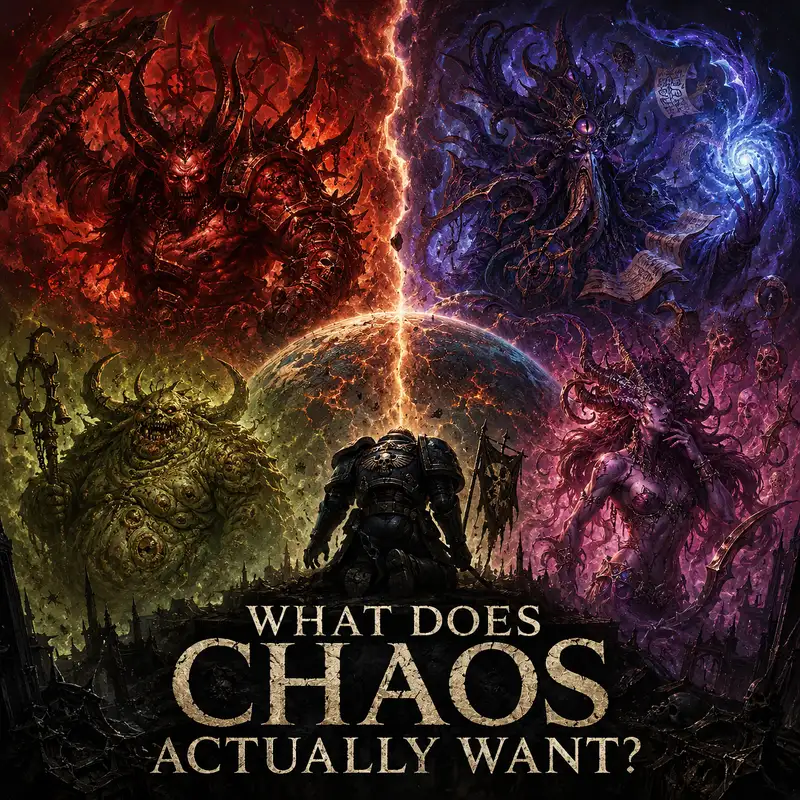
What Does Chaos Actually Want?
A city can surrender to Chaos without a single daemon crossing its walls. It happens when soldiers decide that rage is the only honest response, when a governor begins sacrificing lives for one more month in office, when the sick are told to embrace corruption as a blessing, or when an artist decides that perfection is worth any cost. By the time the banners change, the conquest may already be complete.
That is what makes the simplest question about Chaos so difficult. What does it actually want?
The Imperium has an answer ready. Chaos wants the destruction of humanity, the death of the Emperor, and the ruin of all ordered existence. This is not exactly wrong. It is also not enough. Chaos has no single commander, no common constitution, and no agreed vision for the morning after victory. The forces called Chaos include gods, daemons, traitor primarchs, warlords, cultists, sorcerers, desperate civilians, and entire civilizations that may share little beyond their willingness to open doors best left closed.
Even the four great Chaos Gods do not truly want the same thing. They compete more fiercely with one another than they do with most mortal enemies. Their ancient struggle is called the Great Game, and the material galaxy is only one of its battlefields. Mortal wars matter to them, but so do rivalries within the warp, the rise and fall of champions, and the endless contest to make one form of corruption dominant over the others.
To understand their desires, it helps to stop thinking of the Chaos Gods as ordinary rulers. Khorne is not merely a king who happens to enjoy war. Tzeentch is not simply a politician with an unusually complicated filing system. Nurgle is not a plague lord who could choose cleanliness after a change of heart. Slaanesh is not a decadent aristocrat who might eventually decide that enough is enough.
They are vast intelligences formed within the warp, a dimension shaped by psychic energy and the emotions of sentient life. Across immense spans of time, rage, ambition, despair, desire, fear, hope, obsession, and countless related impulses gathered, echoed, and intensified. In the warp, those patterns became more than reflections. They became powers with personalities, domains, servants, plans, and appetites.
The gods are therefore both beings and processes. They can scheme, bargain, deceive, reward, and punish. They can direct daemons and elevate mortal champions. Yet they cannot separate themselves from what they embody. Khorne does not merely prefer violence. Khorne is violence sharpened into will. Tzeentch does not merely use change. Tzeentch is change made conscious and endlessly suspicious of completion. The same is true of Nurgle and Slaanesh.
Their desires are not political programs. They are hungers.
Khorne wants conflict, bloodshed, fury, and strength proved through domination. He is often described as the most straightforward of the four, which in this company is not the same thing as being reasonable. Khorne has little patience for elaborate sorcery or subtle manipulation. He values the direct contest, the challenge answered with force, and the moment when restraint is discarded.
Yet Khorne is not only concerned with mindless killing. He can corrupt martial pride, courage, wrath, vengeance, and the belief that violence reveals truth. A warrior may begin with a cause that appears defensible. He fights to protect his comrades. He hates an enemy responsible for genuine atrocities. He takes pride in discipline and courage. Chaos rarely needs to replace those motives immediately. It only needs to remove the limits around them.
Protection becomes vengeance. Vengeance becomes identity. The enemy’s death becomes more important than the people who were meant to be protected. Soon the warrior no longer asks whether the battle is necessary. Battle itself has become the proof that he is alive.
What does Khorne want from him? More. Another duel, another campaign, another enemy, another reason to be angry. Victory cannot satisfy Khorne because victory ends a particular conflict. Peace is not the reward for serving the Blood God. Peace is the condition that must be destroyed so the service can continue.
Tzeentch wants change, possibility, ambition, knowledge, manipulation, mutation, and the endless rearrangement of fate. He attracts sorcerers and conspirators, but also reformers, scholars, revolutionaries, and anyone who believes the world can be remade through sufficient intelligence and will.
That makes Tzeentch’s temptation especially dangerous. Hope belongs within his domain. So does the refusal to accept an unjust condition. A prisoner plotting escape, a citizen imagining a better government, and a scholar seeking forbidden truth may all move through emotional territory that Tzeentch can exploit. The corruption does not begin with a love of evil. It begins with the conviction that change is possible and that the person seeking it is clever enough to control the price.
Tzeentch offers secrets, but each answer creates new questions. He offers plans, but every plan contains another plan. His servants may spend centuries pursuing a triumph whose purpose was merely to place them in position for a different scheme. Even success can be a form of failure, because a completed design becomes fixed, and fixed things are the enemy of limitless change.
A final victory would therefore be a problem for Tzeentch. If every mystery were solved, every rival defeated, and every future controlled, then possibility would collapse into certainty. Tzeentch wants the game won and also wants the game never to end. This is not hypocrisy in the ordinary sense. It is the contradiction at the center of his nature.
Nurgle wants decay, disease, endurance, despair, resignation, and the acceptance of suffering as permanent. His followers often describe him in the language of affection. He is Grandfather Nurgle, the generous lord who takes away fear and welcomes the abandoned. That kindness is real from the perspective of those who receive it, but it is the kindness of surrender.
Nurgle’s most powerful promise is not that pain will end. It is that pain will stop mattering. The infected body continues to rot, but the victim no longer recoils. The doomed soldier laughs at wounds that should have broken him. The despairing population is offered belonging, resilience, and relief from the exhausting burden of hope.
This is why Nurgle cannot be reduced to a god who wants everyone dead. Death is part of his cycle, but so are growth, fecundity, and grotesque renewal. His gardens teem with life. His plagues breed, adapt, and spread. He delights in the persistence of living things, provided that persistence takes place within corruption and decay.
What Nurgle wants is acceptance. He wants the victim to stop resisting the conditions that are destroying them. He wants endurance without recovery, community without freedom, and comfort without cure. A plague that simply kills everyone is useful, but a plague that teaches survivors to love the source of their suffering is better.
Slaanesh wants excess, sensation, desire, perfection, obsession, and the destruction of every boundary that says enough. The youngest of the four great gods was born from the catastrophic decline of the ancient Aeldari empire, whose pursuit of experience and indulgence reached such intensity that it tore open reality and consumed vast numbers of Aeldari souls.
Slaanesh is often misunderstood as a god concerned only with sexual excess. That is one expression, but the domain is far wider. A swordsman seeking the perfect technique, an artist pursuing a flawless performance, a commander addicted to praise, a gourmet searching for an impossible flavor, or a devotee who needs pain simply to feel something new can all move toward Slaanesh.
The beginning may look admirable. Excellence requires discipline. Art requires sensitivity. Skill grows through practice. The corruption appears when the pursuit no longer serves any purpose beyond itself. The swordsman stops caring whom he kills. The artist stops caring what the work communicates. The commander stops caring whether the army survives. Each becomes a servant of the next sensation, the next achievement, the next impossible standard.
Slaanesh can never be satisfied because satisfaction creates a stopping point. Every pleasure dulls with repetition. Every triumph becomes ordinary. The servant must go further, and the god must demand more. Perfection remains just beyond reach, not because the follower has failed to work hard enough, but because reaching it would end the pursuit.
Each god therefore wants a galaxy shaped increasingly in its own image. Khorne wants a galaxy where every dispute becomes violence. Tzeentch wants one where every certainty dissolves into change and conspiracy. Nurgle wants one where resistance collapses into diseased acceptance. Slaanesh wants one where desire consumes every limit.
The difficulty is that these visions interfere with one another. Khorne’s direct violence can ruin Tzeentch’s careful plan. Tzeentch’s sorcery offends Khorne. Nurgle’s stagnant endurance resists Tzeentch’s appetite for transformation. Slaanesh’s refinement can appear contemptible to Khorne, while Khorne’s blunt slaughter may end pleasures Slaanesh intended to prolong. Their alliances are temporary because their natures are incompatible.
The Ruinous Powers can cooperate when faced with a common threat. They do so in much the same way rival commanders cooperate when the artillery is landing on all of them. The arrangement can be effective. It is rarely warm.
The Horus Heresy is the greatest example. The four gods supported the rebellion against the Emperor and poured power into Horus and the traitor primarchs. Their reasons are not recorded with the clarity an Imperial historian might prefer, although Imperial historians have often solved that difficulty by executing anyone who asks. The available accounts suggest that the Emperor’s project threatened the influence of Chaos through his immense psychic power, his attempt to guide humanity away from dependence on the warp, and his refusal to accept the gods as rightful masters.
For a time, the gods could place rivalry behind a shared purpose. The Emperor had to be broken. His Imperium had to be turned against itself. The primarchs, designed to unite humanity, became instruments of civil war. Yet the alliance did not create a single stable cause. Each god claimed champions, pursued separate designs, and worked to ensure that no rival gained too much.
That pattern continues in the forces of Chaos Undivided. Some mortals worship the four gods as a pantheon. Some revere Chaos as a single transcendent power beyond the individual gods. Some, like many within the Black Legion, accept gifts from Chaos while attempting to remain masters of their own purpose.
Abaddon the Despoiler is important because his goal is not identical to the goals of the gods. He wages the Long War against the Imperium and seeks to destroy the Emperor’s realm. He has resisted becoming a daemon prince, because such elevation would also make him more completely a creature of the warp and more dependent upon divine patronage. Whether he truly uses Chaos without being used by it is one of the central questions surrounding him. He believes he can. The gods have had a very long time to appreciate ambitious men who believe that.
This difference between mortal goals and divine hunger explains much of Chaos warfare. A traitor Space Marine may want revenge for the defeat at Terra. A planetary rebel may want freedom from an Imperial tithe that is starving his world. A cult leader may want immortality. A sorcerer may want knowledge. A frightened parent may want a child cured. A governor may want one more year of power.
Chaos can work with all of these desires. It does not need every servant to understand the Great Game. It does not even need every servant to worship willingly. The gods are fed by the emotions and acts that reflect them. A loyal Imperial soldier consumed by hatred may strengthen Khorne without ever speaking his name. A bureaucrat who builds an ever more elaborate network of deception may echo Tzeentch while believing herself entirely faithful. A population that abandons hope under endless suffering moves closer to Nurgle. A priest obsessed with achieving perfect purity may discover that obsession has its own master.
This does not mean every strong emotion is automatic damnation. Anger can defend the innocent. Hope can sustain resistance. Acceptance can help people survive grief. The pursuit of excellence can produce beauty and mastery. Chaos corrupts by removing proportion, restraint, context, and choice. It takes a human impulse and makes that impulse the whole person.
The most successful temptations are therefore tailored. Chaos offers the warrior a worthy enemy, the scholar a hidden truth, the sick a release from fear, and the artist an audience capable of appreciating perfection. The gift answers a real need. The chain is hidden inside it.
Once the bargain is accepted, the promised end keeps retreating. The warrior never reaches the final battle. The scholar never possesses the final answer. The sick never become whole. The artist never completes the perfect work. The servant may receive enormous power, but power only increases the scale of the next demand.
Daemons reveal the same pattern. They are not simply foreign creatures living in the warp. They are portions of Chaos given identity and form, often tied to a particular god. A Bloodthirster does not dream of retirement after one last campaign. A Lord of Change does not hope for a quiet future in which all plans have succeeded. Their existence is the continuation of the appetite they embody.
This is why asking whether Chaos wants to destroy the galaxy produces an uncomfortable answer. Many servants of Chaos openly seek apocalypse. They tear wounds in reality, summon daemonic armies, corrupt worlds, and attempt to drown material existence in the warp. The Great Rift has already split the galaxy and made entire regions vulnerable to horrors that once required far rarer conditions.
Yet Chaos also depends upon sentient life as a source of emotion, worship, conflict, and souls. A completely dead and silent galaxy would appear to offer the gods far less than one filled with rage, hope, despair, and desire. The contradiction has never been resolved into a neat doctrine, because Chaos is not a rational state planning for sustainable growth.
A fire does not preserve the forest because it may need timber tomorrow. Hunger does not become wise merely because it has learned to speak.
The gods pursue expansion according to their nature, even when that expansion risks consuming the conditions that feed them. Their servants may build empires, maintain supply lines, negotiate alliances, and plan campaigns across centuries. Chaos itself can display immense patience. But patience is not the same as restraint. Every delay serves a greater indulgence later.
There is another possibility. The gods may not require the material galaxy to survive in any form mortals would recognize. The warp does not obey ordinary time, and the Chaos Gods perceive existence from perspectives no human record can fully describe. Some accounts imply ambitions far beyond a single age or realm. The surviving lore does not settle the question, and claims made by daemons are not famous for their reliability.
What can be observed is simpler. Wherever Chaos gains influence, it seeks to make the boundary between the warp and reality weaker. It seeks more emotion, more extremity, more souls, more champions, and more opportunities to reproduce its own patterns. It does not build toward peace. It builds toward conditions in which its appetites become the laws of existence.
That is why the Imperium’s methods can strengthen the enemy it claims to oppose. Endless war feeds rage. Political repression feeds ambition and conspiracy. Hopeless labor feeds despair. Fanatical demands for purity can become obsession. The Imperium is not secretly identical to Chaos, and the distinction matters. Imperial institutions can protect human life, preserve worlds, and resist literal daemonic annihilation. But the machinery of survival often generates the emotions on which the Ruinous Powers thrive.
Chaos does not need the Imperium to become kind. It needs the Imperium to remain afraid, furious, desperate, and absolute.
Nor does Chaos require universal conversion. A galaxy divided among enemies may serve the gods better than one obedient empire. Every crusade creates Khorne’s harvest. Every secret weapon and concealed conspiracy offers Tzeentch another thread. Every besieged world that loses hope enters Nurgle’s shadow. Every champion convinced that one more victory will finally prove perfection moves toward Slaanesh.
The Great Game continues because none of the gods can accept a final balance, and none can tolerate another god’s complete supremacy. When one grows too powerful, the others have reason to resist. This rivalry sometimes protects reality by accident. Chaos checks Chaos. It is a defense system with the unfortunate feature that all of its components are also trying to eat the patient.
So what does Chaos actually want?
It wants more of whatever makes it itself. Khorne wants rage without reconciliation. Tzeentch wants change without resolution. Nurgle wants endurance without recovery. Slaanesh wants desire without satisfaction. Their mortal servants may seek revenge, freedom, knowledge, immortality, justice, or power, but the gods translate those aims into endless repetition.
Chaos does not promise an ending. It promises that the feeling driving you now can become the only truth you will ever need. Then it strips away every part of you capable of saying no.
Its ideal galaxy is not merely ruined. It is a galaxy in which every soul becomes a door, every passion becomes a chain, and every victory creates the hunger for another. Chaos wants the war to be won, the plan to succeed, the plague to spread, and the perfect sensation to arrive. It also needs each of those moments to remain unfinished forever.
That is the final cruelty. Chaos offers freedom from limits, then makes its servants incapable of becoming anything beyond their deepest compulsion. It does not simply destroy the worlds it conquers. It teaches them to participate in their own destruction, and to call the process destiny.