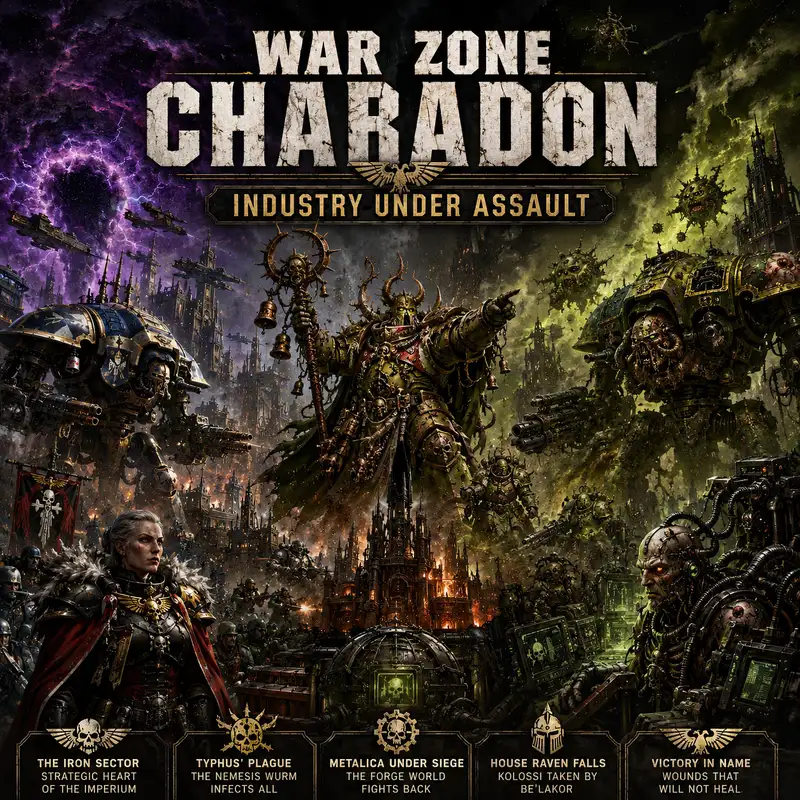
War Zone Charadon: Industry Under Assault
Metalica did not fall silent when the plague reached it. The furnaces still burned. Conveyor lines still carried ammunition through cathedral-sized foundries. Servitors still turned valves, lifted shells, and fed raw metal into machines older than many Imperial dynasties. For a time, every indicator suggested that the forge world was functioning. Then weapons began to emerge from the production lines carrying corruption inside their housings. Data moved through sacred networks and returned altered. Reclamation systems took contaminated material, processed it efficiently, and distributed the infection farther. The world had not been conquered in the ordinary sense. Its factories had simply begun helping to destroy it. That was the achievement of War Zone Charadon, and the reason the campaign matters. It was not merely a battle for territory. It was an assault on the Imperium’s ability to make war.
The Charadon Sector was often called the Iron Sector for good reason. Its mining worlds, agricultural planets, gas giants, and ore-rich asteroid fields supported military campaigns across the eastern Imperium. At the centre of that system stood Metalica, a forge world capable of supplying weapons, aircraft, and ammunition on the scale required by entire crusades. Its surface had been stripped of natural life and remade as one continuous industrial organism. Valleys were clad in metal. Subterranean passages became assembly lines. Mountains housed furnaces, data vaults, and weapons-testing ranges. The priesthood of Metalica regarded this transformation as evidence of mechanical purity. Flesh failed. Nature decayed. Properly ordered machinery endured. Typhus the Traveller looked at that doctrine and saw both a strategic target and a theological insult.
The invasion began after the Great Rift divided the galaxy and the long darkness of the Noctis Aeterna shattered communications, travel, and reliable chronology. Even the servants of the Imperium struggled to agree on what year it was, so Metalica measured the crisis in local labour rotations. It was an appropriately industrial solution to the collapse of time. Abaddon the Despoiler understood the opportunity. He sent the Lord Discordant Akhorath Zeid into the Charadon region and used his authority to draw Typhus into the campaign. Neither commander was a loyal subordinate in the conventional sense. Zeid served Abaddon’s larger strategy. Typhus served Nurgle, his own ambition, and whatever grudges happened to be ripening at the time. Chaos cooperation is often less a chain of command than several predators agreeing that the same door should be broken down.
Typhus did not need to occupy every factory or hold every road. His objective was to place the Nemesis Wurm inside Metalica’s industrial heart. The Wurm was a plague-phage designed for a world whose people had replaced much of their flesh with machinery. It attacked the boundary between biology, technology, and information. Metal could grow diseased. Networks could transmit corruption. Ritual systems intended to preserve purity could become delivery mechanisms. This was Nurgle’s answer to the Adeptus Mechanicus belief that the machine could escape the weakness of the body. Typhus intended to prove that decay did not require permission from anatomy. A forge world might remove every tree, animal, and unmodified human from its surface, but it could not remove dependence, repetition, or the movement of material. Those were the veins through which the Wurm would travel.
The first attacks did not look like an invasion. Prophets announced doom and were arrested. Aquifers produced gore. Strange lights appeared beneath oceans. Plague outbreaks turned the dead into attackers. Cults rose, vanished, or were destroyed by rival cults before Imperial investigators understood whom they had been serving. Fabricator-General Heptus Khleng attempted to contain the panic through secrecy and decisive sterilisation. He dispatched Eradication Arks to scour worlds judged irrecoverable, reducing whole populations to acceptable losses in the name of quarantine. This protected some routes, but it also weakened the sector’s outer defences and poisoned relations with Imperial commanders who had been abandoned. Khleng’s calculations treated worlds as components. Components could be discarded. Unfortunately, soldiers and citizens occasionally notice when a strategic withdrawal includes leaving them to plague zombies.
Chaos then opened a broad offensive across the sector, forcing defenders to react to multiple emergencies at once. Death Guard formations advanced beside Black Legion warbands, Word Bearers, Alpha Legion cells, corrupted Knights, daemon engines, cultists, and Titans of the traitor Legio Morbidus. Ork freebooters and Drukhari raiders attacked wherever the fighting created an opportunity. Genestealer cults pursued their own uprising beneath the confusion. On Okharium, Imperial troops attempted a fighting withdrawal after Drukhari raiders struck the battlefield. The raiders killed the messengers carrying notice of the retreat. Allied gun-servitors therefore identified the withdrawing soldiers as hostile and destroyed them. It was a small incident compared with the wars of Titans and fleets, but it revealed the campaign’s central method. Break communication, overload command, and let the defender’s own machinery finish the work.
In the Alumax System, Colonel Elena Broski organised a disciplined defence around Saint Bartolph’s Throne while plague fleets and space hulks closed in. Mining crews on Heliotyr even used blasting charges to collapse ground beneath traitor Titans. Such resistance delayed the invasion, but Typhus’ lieutenants were willing to turn the sector’s infrastructure into ammunition. The Death Guard captured one of Khleng’s Eradication Arks and sent it crashing into Hive Rastigan. The impact destroyed the city, Broski, and much of her army. Then Ork freebooters attacked the plague fleet and created enough disorder for surviving Imperials to escape. No one controlled the whole battlespace. Every faction was pursuing a different war, and every apparent rescue carried the reasonable possibility of being followed by another invasion.
Khleng eventually concentrated his defence around three systems known as the Metalican Gates. Rhodior, Brezantius, and Feiror guarded the approaches to the forge world. The decision was logical. It also required abandoning large parts of the sector. Imperial Guard regiments, Sisters of Battle, and Space Marines sometimes refused the withdrawal order and continued fighting without Metalican support. Survivors in the Chromyd System remembered the decision as Khleng’s Betrayal. The name mattered because an industrial war depends on trust as much as ore. Fleets must believe that promised supplies will arrive. Garrisons must believe relief forces are actually coming. Once those assumptions fail, commanders hoard resources, ignore central orders, and fight separate campaigns. Khleng saved forces for Metalica, but he weakened the coalition needed to keep the enemy away from it.
For a period, the Imperial position appeared to improve. The Excruciators and other Space Marine forces launched counterattacks. Warriors from the forge moon of Deimos arrived with weapons suited to fighting daemons, accompanied by Grey Knights. House Raven deployed its Imperial Knights in strength, crushing traitor armour and daemon engines beneath machines that walked like armed fortresses. Battlefleet elements drove back plague ships, sometimes with unintended assistance from Orks who had selected the same targets. These victories created a chance to regain the initiative. Yet the Imperial command remained divided. Some forces distrusted Metalica after the abandoned systems. Khleng became trapped in calculations and delayed orders while local commanders pursued their own objectives. The defenders won battles, but they did not recover control of the campaign.
Typhus used that delay to complete a network of Miasmic Malignifiers across the war zone. These corrupted structures spread disease, raised the dead, and anchored a ritual on a sector-wide scale. When the network was activated, Saint Bartolph’s Throne was consumed and replaced by a vast warp rupture. The defenders named it the Sore. It opened a direct route into the Metalica System, bypassing the fortified gates that had consumed so much Imperial effort. This was the decisive operational stroke. Khleng had built a defence around predictable approaches. Typhus changed the geography. A wall can be very impressive while the enemy is opening a door behind it. Through the Sore came plague fleets, daemons, corrupted war engines, and storms that disrupted travel and hid the Astronomican from Imperial navigators.
The outer worlds of the Metalica System were struck first. Plague flares fell upon Munis Ferrum and infected its servitors, turning industrial labourers into killers inside the facilities they had maintained. Death Guard forces attacked the mining world of Plenitas. Legio Morbidus and corrupted Knights descended upon the fortress moon Ferrovigilum, where Skitarii, the Iron Skulls Titan Legion, and Freeblades of the Forgotten Company fought to hold the line. Other battles erupted around battery worlds, quarries, anchorages, and defence platforms. Many of these engagements looked like the main attack. They were not. Typhus was fixing the defenders in place, damaging transport, and forcing Khleng to spend reserves away from the Primary Industrial Cluster. The battlefield was a system of dependencies, and the Death Guard were cutting them one at a time.
The Sore also isolated Metalica from relief. Warp disturbances made navigation unreliable, communications failed, and corruption entered Skitarii control ships through scrapcode. Thousands of plague structures seeded the surrounding war zone with disease and swarms. The contamination was not perfectly obedient. Even allied Iron Warriors saw vehicles disabled by ferric blight. Nurgle’s gifts have never been famous for respecting organisational boundaries. Yet the strategic effect favoured Typhus. Imperial commanders could not tell which routes remained safe, which machines remained loyal, or which distress calls described conditions that still existed. Metalica possessed enormous firepower, but firepower without dependable information becomes expensive noise.
While Typhus closed on Metalica, Be’lakor attacked Kolossi, the home world of House Raven. Most of the household’s Knights were away fighting in Charadon, leaving the Keep Inviolate strongly defended but undermanned. Be’lakor did not begin with bombardment. He lengthened the nights, entered dreams, encouraged resentment, and allowed fear to spread among the population. The Keep alone seemed protected from the unnatural darkness, which made its nobles appear favoured while civilians suffered outside. Refugees were admitted, along with Be’lakor’s agents. Traitorous Tech-Priests corrupted the Throne Mechanicum of loyal Knight suits. When those engines marched out, they turned their weapons on their own kin. The fortress designed to withstand months of siege collapsed in hours because its defenders could no longer distinguish reinforcement from betrayal.
Be’lakor then dragged Kolossi into the warp. The loss was larger than a single world. House Raven was Metalica’s principal Knight ally, and Kolossi contained the social, technical, and ritual foundations that allowed the household to maintain its war engines. A Knight is not merely a large vehicle. It depends upon noble lineages, Sacristans, repair vaults, training traditions, and the accumulated memory of the Throne Mechanicum. By stealing the planet, Be’lakor attacked the institution behind the machines. Kolossi later became associated with the corrupted House Korvax, bound to the Dark Master. The surviving loyalists of House Raven became a household without a home. Typhus was infecting one industrial power while Be’lakor amputated another. Their motives differed, but the effects reinforced each other.
Relief finally arrived under Morvenn Vahl, Abbess Sanctorum and High Lord of Terra, leading Battle Group Tarsus from the Indomitus Crusade. Her fleet brought Sisters of Battle, Space Marines, Imperial Guard, Knights, and even elements of the Talons of the Emperor. Vahl restored direction through ruthless speed. Worlds overrun by plague were cleansed. Fleeing vessels were judged with little patience. On some planets, her determination to eliminate contamination brought her into conflict with Space Marine officers who resisted the slaughter of Imperial survivors. Her authority prevailed. The relief force drove deep into Charadon and began rolling back scattered Chaos armies, but it had arrived after the campaign’s most important doors had already closed. Kolossi was gone. Metalica was isolated. The enemy’s objective was no longer to hold the sector. It was to leave wounds that victory could not repair.
On Metalica, orbital defence platforms succumbed to corruption and turned their guns upon loyal ships. Typhus landed contamination teams at the southern polar reclamation shrines. Those facilities existed to recover material and return it to production. Once tainted, they did precisely that, distributing corruption through the same efficient cycles that had sustained the forge world. Other Death Guard formations seized choke points and prevented distant reserves from reaching the Primary Industrial Cluster. Typhus established a foothold in the Ironclad Expanse, a mechanical wilderness used for weapons testing, then drove north behind packs of daemon engines. Every defensive success cost Metalica time, fuel, ammunition, and irreplaceable machines. Every Death Guard casualty was acceptable if it moved the Nemesis Wurm closer to its destination.
Khleng responded according to the beliefs that had shaped his entire rule. Every span of Metalica was sacred. Every foundry was part of the Omnissiah’s design. He attempted to contest ground rather than surrender functioning systems to preserve the whole. Typhus exploited that rigidity. At the towering stacks of the Datacanyon, Imperial armour halted the first Chaos advance, only to be outflanked by fresh landings. A damaged plague ship fell from orbit and struck the world with catastrophic force. The Sore was beginning to contract, and Typhus understood that his route would not remain open forever. He abandoned caution and ordered the Plaguebringer Offensive, concentrating armour, artillery, infantry, and Titans in one final drive toward the Macrosanctum.
The last advance became a battle between industrial gods. Titans of Legio Morbidus strode through fire while the Iron Skulls and surviving Knights met them at close range. At the centre came the Imperator Titan Despair Incarnate, commanded by the Balequeen Lathfyr the Drowned. Khleng committed more and more forces against it as the machine shattered defensive lines. Vortex missiles finally stopped the corrupted god-engine before the Macrosanctum, but the struggle had opened the route Typhus needed. His armoured spearhead was damaged. His offensive was losing momentum. He left his vehicle and continued on foot with his Terminator elite. The attack had become tactically desperate, which did not make it strategically foolish. Typhus required only one surviving delivery team.
Marshal Decitor Septrax-Tertian and his veteran Skitarii waited at the final entrance. They had fought across the sector, endured the fall of the gates, and returned to defend the centre of Metalica. Their fire damaged Typhus and slowed his Terminators, but the Destroyer Hive poured from the gaps in his armour and overwhelmed the defenders. Typhus killed Tertian, broke into Khleng’s command chamber, and reached the Fabricator-General. Dark Mechanicum priests then drove the cocoon of the Nemesis Wurm into Khleng’s immense augmented body. The ruler who had connected himself to Metalica so he could observe and direct the whole forge world became the point from which its corruption spread. His greatest administrative strength was converted into a delivery system.
Typhus withdrew after completing the implantation. His assault force had suffered ruinous losses, but casualty ratios were irrelevant to the mission he had chosen. Metalica remained in Imperial hands, and repair teams began purging the infection. Khleng’s mutated form was destroyed. For a brief period, the Mechanicus believed the Nemesis Wurm contained. Seven labour cycles later, it appeared again. Purges removed it, and it returned. Corrupted growth spread through the Prime Industrial Cluster and the ancient data network. Rogue servitors, mutants, and malefic entities continued to haunt the world after the main Chaos forces departed. Metalica had survived, but much of its surviving capacity became devoted to detecting, isolating, and burning out a disease that used the forge world’s own systems to preserve itself.
Elsewhere, Morvenn Vahl continued the counteroffensive and drove Chaos forces from several worlds. She pursued Akhorath Zeid through the fighting on Fathom, where the final battles killed hundreds of thousands. Zeid escaped aboard a great orbital lander, only for Vahl and the surviving Knights of House Raven to strike it from the sky. The vessel crashed into the immense habitation sprawl below, and the Lord Discordant was not seen again. Imperial authorities later declared the sector pacified. The declaration was not entirely false. The Imperium retained Charadon. Warp storms diminished after Typhus left. Many invading armies were destroyed or driven away. It was simply the kind of truth that requires a very careful choice of nouns.
Charadon was a strategic Chaos victory because the attackers did not need to govern what they had broken. Metalica was crippled and trapped in recurring purgation. House Raven lost Kolossi and the infrastructure that had anchored its identity. Entire worlds remained quarantined. Refugees moved into neighbouring regions, carrying fear, scarcity, and the possibility of contamination. The Imperium still possessed territory, but its armoury had been damaged, its alliances embittered, and its resources diverted into recovery. Abaddon’s wider purpose had been served without his armies planting a permanent flag over the forge world. Typhus had demonstrated that an industrial system could be defeated by corrupting its processes rather than demolishing every machine.
That is what made industry the true battlefield of Charadon. The furnaces, data-tethers, reclamation shrines, transport routes, Knight traditions, and chains of command were not scenery behind the war. They were the war. Metalica’s defenders could destroy Titans, retake cities, and count the enemy dead, yet none of those achievements removed the Wurm from the systems that made the planet valuable. Somewhere beneath the renewed chants and hammering production lines, a sensor would eventually record an impossible growth. A maintenance servitor would repeat a corrupted instruction. A purification rite would begin again. Metalica survived the assault, but survival meant feeding more of itself into the fire, cycle after cycle, while the machines continued to work.