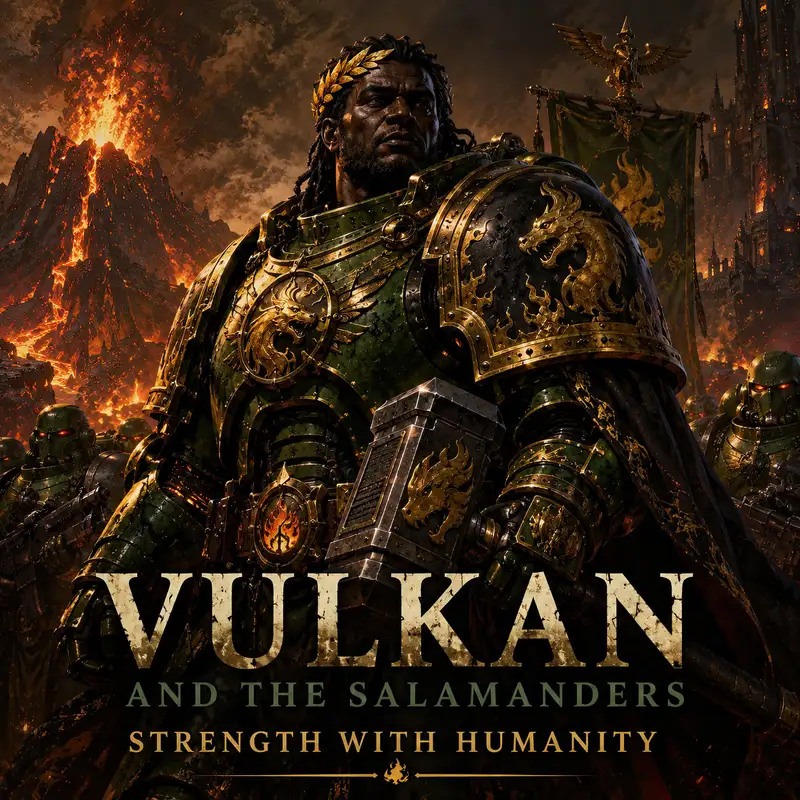
Vulkan and the Salamanders: Strength With Humanity
Vulkan won the contest at the moment he admitted that victory no longer mattered. On the volcanic world of Nocturne, he had hunted a fire drake and brought the beast down, only to find himself stranded above a river of molten rock. Across the burning divide stood the mysterious outlander who had challenged him. The stranger carried the larger prize. He could have returned to the settlement alone and claimed triumph. Instead, he cast that prize away, crossed the lava, and pulled Vulkan to safety. The people declared Vulkan the winner. Vulkan knelt to the stranger. A man who valued another life above his own glory, he decided, possessed the greater strength. The stranger then revealed himself as the Emperor of Mankind.
That story contains the ideal at the heart of Vulkan and the Salamanders. Strength was never merely the ability to kill, endure, or dominate. Every primarch could do those things with alarming efficiency. Vulkan’s distinction was his belief that power gained meaning from what it protected. He was the largest and physically strongest of the Emperor’s sons, a warrior who could break monsters with a hammer and survive wounds that should have ended any living creature. Yet the quality that defined him was not force. It was restraint, responsibility, and a stubborn refusal to forget the ordinary people standing behind the battle line.
Nocturne taught that lesson before the Emperor ever arrived. It was a death world of unstable ground, volcanic fire, poisonous air, and recurring seasons of catastrophe known as the Time of Trial. Mountains split. Settlements burned. Communities that had taken years to build could vanish beneath ash and lava. Survival depended less upon heroic individuals than upon people who prepared together, worked together, and rebuilt together. Nocturne produced fierce warriors, but it also produced smiths, builders, hunters, and families accustomed to measuring courage by whether the community survived another night.
Vulkan was found and raised by N’bel, a blacksmith rather than a king. That mattered. Several primarchs grew up in palaces, war camps, or prisons. Vulkan grew up beside a forge. He learned that creation demanded patience. Metal could not simply be beaten until it obeyed. It had to be heated, understood, shaped, cooled, and tested. A flawed blade endangered the person who carried it. A careless craftsman could kill someone long after leaving the workshop. Responsibility therefore continued beyond the act of making. The maker was answerable for what his work became.
He also learned that the weak were not abstractions. They had names, homes, and places at the same communal fires. When Drukhari raiders descended upon Nocturne to seize captives, Vulkan did not encounter xenos cruelty as a distant military report. He saw neighbours taken from their families. He led the resistance, destroyed the raiders’ portals, and became the protector of his people. This gave his compassion a hard edge. Vulkan cared deeply for human life, but his experience also planted a lasting hatred of those he associated with humanity’s suffering. His mercy was real. It was never universal.
The Emperor asked Vulkan to leave Nocturne and join the Great Crusade. Vulkan hesitated because departure meant abandoning the people he had sworn to defend. The Emperor persuaded him that Nocturne was only one settlement beside a much larger fire. Human worlds across the galaxy were isolated, enslaved, or threatened with destruction. Vulkan accepted the argument. He would protect humanity on a greater scale. Like many promises made during the Great Crusade, it sounded nobler before the fleets arrived in orbit.
The warriors waiting for Vulkan were the eighteenth Legion, sometimes remembered in their early history as the Dragon Warriors. They already possessed courage in excess. They had been committed to desperate campaigns against enemies that other formations could not stop, often holding impossible positions while civilians or Imperial forces escaped. Their endurance and willingness to sacrifice themselves earned admiration, but admiration did not replace the dead. The Legion repeatedly suffered ruinous losses because it treated self-destruction as proof of loyalty. The plan was usually successful in the limited sense that someone survived. It was simply not always the Legion.
Vulkan did not remove that instinct. He reforged it. Under his leadership, sacrifice had to serve a purpose rather than satisfy pride. Endurance was not the art of dying slowly. It was the discipline required to remain effective when easier forces had broken. The renamed Salamanders learned to hold ground, absorb punishment, and fight at close range, but they also learned patience, self-knowledge, and control. Vulkan gave them the Promethean Cult, a body of beliefs drawn from Nocturne’s traditions. Its language was fire and the forge, yet its deeper subject was character.
The forge taught the Salamanders that strength must be made and remade. A warrior examined his weaknesses as a smith examined cracks in metal. He maintained his own wargear, crafted weapons, and learned the value of work performed carefully rather than merely quickly. This made the Legion unusually self-reliant. It also kept its warriors connected to physical creation. A bolter was not just a sacred object issued by a distant armoury. It was a machine whose balance, failures, and purpose could be understood. In an empire already developing a complicated relationship with technical knowledge, this was almost suspiciously practical.
The Promethean Cult was not a gentle philosophy disguised beneath intimidating decoration. Its rites involved heat, pain, endurance, and the deliberate testing of body and will. Salamanders marked themselves through fire and scarification, treating suffering as something to be faced consciously rather than worshipped for its own sake. The objective was mastery. A warrior who could govern fear and anger was less likely to waste his life, abandon a comrade, or unleash power without judgment. The same culture that produced their empathy also produced their frightening calm when the range closed and the air began to burn.
Vulkan also arranged his Legion around the people of Nocturne. Salamanders were drawn from the world’s great cities and remained connected to its clans. Even after transformation into Space Marines, many continued to live among the population rather than withdrawing completely into an isolated fortress. They served as elders, guardians, and examples within the communities that had raised them. This did not make them ordinary. A towering, red-eyed warrior in green power armour is difficult to mistake for the neighbour who borrows a tool and forgets to return it. It did mean that civilians remained visible to them.
That visibility shaped how the Salamanders fought. Other Legions could regard mortal troops as resources, populations as strategic weight, and cities as acceptable entries in a casualty calculation. The Salamanders were more likely to see the people inside those numbers. They became known for defending civilians, covering withdrawals, and refusing to abandon those who could not protect themselves. This was not softness. Protecting an evacuation corridor against an advancing army required disciplined violence, stable command, and the willingness to stand where the enemy was strongest.
This preference could make their campaigns slower and more costly. A commander who diverts warriors to rescue trapped civilians may surrender an advantage elsewhere. A force that refuses to treat inhabited districts as empty terrain gives the enemy choices. The Salamanders accepted that burden because victory was not merely possession of the battlefield. If the people they had come to defend were all dead, the surviving map could be coloured Imperial at very little moral profit. The Administratum might still record a successful compliance. The bereaved tended to use less optimistic terminology.
Their preferred weapons made the contradiction impossible to miss. The Salamanders became masters of flame and melta weapons, fighting at ranges where war ceased to be remote. Fire could shelter a family on Nocturne, heat a forge, purify poisoned ground, or consume a living body. The Legion embraced all of those meanings. A flamer is not a compassionate weapon. Neither is a thunder hammer, however admirable its craftsmanship. The Salamanders did not make war gentle. They tried to make its violence answerable to a human purpose.
That distinction is why calling them the good Space Marines is both understandable and misleading. Compared with many of their cousins, the Salamanders display extraordinary empathy. Compared with any reasonable civilian standard, they remain genetically engineered soldiers of a conquering Imperium. Vulkan fought to unite humanity under the Emperor, and compliance was not always voluntary. Worlds that refused could be crushed. Alien civilizations were not protected by his humanism. His belief in the value of human life existed inside an imperial project that routinely decided which lives counted.
The campaign on Kharaatan exposed that boundary. Vulkan fought beside Konrad Curze and the Night Lords, whose method was terror made systematic. Curze believed that exemplary cruelty could force rapid obedience and prevent longer wars. When the Night Lords slaughtered a city to frighten the rest of the world into submission, Vulkan was horrified. He confronted Curze and condemned the massacre. The disagreement was not about whether the Imperium had the right to conquer the planet. It was about what methods a conqueror could use without becoming monstrous.
Then Vulkan failed his own standard. During later violence on the world, an Aeldari child surrendered before him. Vulkan, enraged by death around him and burdened by memories of the raiders who had preyed upon Nocturne, killed the child with fire. The act haunted him. It should. Remorse did not restore the life he took, and the fact that he regretted the killing does not turn it into a noble mistake. It reveals something more important about his humanity. Vulkan was capable of recognising that he had become what he condemned, even when the ideology surrounding him offered every excuse not to look.
Curze understood the wound and pressed upon it. To the Night Haunter, Vulkan’s compassion was hypocrisy. Both primarchs conquered worlds. Both killed. Both served an empire built by force. Curze simply claimed to be honest about the horror, while Vulkan tried to preserve moral limits inside it. Their conflict became one of the clearest arguments in the Heresy. Curze believed cruelty was the truth beneath all law. Vulkan believed that the existence of failure did not make restraint meaningless. A code could be broken and still be worth rebuilding.
At Isstvan Five, Horus arranged to break that code along with the Legion that carried it. The Salamanders joined the loyalist assault beside the Iron Hands and Raven Guard, striking at the forces already revealed as traitors. Four additional Legions arrived as supposed reinforcements. Then they opened fire on the loyalists. The battlefield became a trap of converging armies, artillery, betrayal, and atomic destruction. The Salamanders fought within the first wave and were shattered. Vulkan disappeared beneath the bombardment, while most of his sons died around him.
The massacre was particularly cruel because the Salamanders’ virtues offered no escape. They were built to hold. They did not readily abandon allies or leave the wounded behind. On Isstvan, loyalty fixed them in place while betrayal closed from every direction. Their resilience prolonged resistance, but it also gave the enemy more time to destroy them. There are battles in which courage finds a path to victory. Isstvan was a battle in which courage mainly determined how expensive the murder would become.
Vulkan survived because he was a Perpetual, one of the rare beings able to return from death. His sons did not share that gift. He awoke amid their destruction and was eventually captured by Curze. The Night Haunter now possessed an immortal brother whose beliefs he wanted to disprove. He killed Vulkan repeatedly, using torture not merely to inflict pain but to force a conclusion. If Vulkan could be driven into hatred, madness, or surrender, Curze could claim that compassion had always been a pose maintained only while circumstances were comfortable.
Immortality offered Vulkan no protection from suffering. It guaranteed that the suffering could continue. Each death ended a single torment and began the wait for another. His body returned, but his mind accumulated every wound. Curze built traps, staged cruelties, and used Vulkan’s concern for others against him. He wanted the strongest primarch to admit that strength meant domination and nothing more. Vulkan sometimes raged. He sometimes broke. He did not become Curze.
His escape carried the same dry lesson as his life at the forge. Curze placed Vulkan inside a labyrinth and left him the hammer Dawnbringer, confident that the weapon was useless within the trap. Curze had mistaken craftsmanship for decoration. The hammer contained a teleportation device because Vulkan had built more into it than its outward purpose suggested. It was, admittedly, still very effective as a hammer. Vulkan escaped, though freedom did not immediately restore him. Trauma followed him to Macragge, and his returns from death left him fractured and unstable.
The Salamanders who remained refused to reduce their primarch to a lost strategic asset. Artellus Numeon and his brothers carried Vulkan’s body back toward Nocturne, convinced that the fires of Mount Deathfire could restore him. Their journey cost lives they could scarcely spare. Numeon ultimately gave his own life in the act of returning Vulkan to the flame. Vulkan rose again, not because immortality made sacrifice unnecessary, but through a chain of loyalty in which others paid what he could not.
Reborn, Vulkan faced a choice between vengeance and duty. His Legion had been murdered. Curze had tormented him. Horus had betrayed everything the Great Crusade claimed to represent. Vulkan nevertheless went to Terra, where the Emperor required him for a final task. Beneath the Imperial Palace, Vulkan became guardian of a terrible contingency. The device he had forged, the Talisman of Seven Hammers, could destroy Terra if the Golden Throne failed, denying the world and the power beneath it to Chaos. The primarch most associated with protecting human life was entrusted with the power to burn humanity’s cradle rather than let it become the enemy’s gateway.
During the Siege of Terra, that endurance was tested again when Vulkan confronted Magnus beneath the Palace. Magnus possessed psychic power on a scale few beings could challenge. He killed Vulkan repeatedly, but the son of Nocturne continued to rise and press the attack. The contest was not won by greater elegance or superior understanding. Vulkan endured long enough to deny Magnus his objective. Once again, his gift mattered because it was attached to duty. Immortality without purpose would have been only an endless sequence of deaths. Vulkan turned it into time purchased for everyone above him.
That was not a betrayal of his character. It was its darkest expression. Vulkan’s compassion never meant refusing every terrible act. It meant accepting responsibility for the act, understanding what it would cost, and refusing to disguise necessity as pleasure. Curze harmed others to prove a philosophy. Vulkan was prepared to destroy Terra only to prevent something worse, and there was no triumph in the prospect. Strength with humanity did not promise clean hands. In the age of the Heresy, clean hands usually belonged to those standing far from the work.
The later Salamanders Chapter preserved the pattern Vulkan had forged. Its warriors remained closely tied to Nocturne, practiced the Promethean Cult, mastered the crafts of war, and earned a reputation for defending ordinary people even when doing so complicated the campaign. They also carried the scars of Isstvan. The Legion that had once numbered in the tens of thousands became a Chapter living beneath the shadow of near extinction, its identity hardened by the memory of those who held the line and did not return.
Vulkan himself vanished from the Imperium’s continuing story, though later ages preserved accounts of his return and disappearance. The Salamanders came to believe that gathering his scattered artefacts would prepare the way for his final return. Their Forgefather, Vulkan He’stan, took up the long search. The relics mattered because they were works of the primarch’s hand, but the quest also reflected his teaching. A worthy inheritance could not simply be claimed. It had to be sought through patience, endurance, and service.
The Salamanders remain unusual, not because they escaped the darkness of the Imperium, but because they preserved a small fire within it. They can still be ruthless, intolerant, and terrifying. Their compassion is centered upon humanity and bounded by Imperial belief. They are not a correction to the setting’s cruelty. They are evidence that even its most brutal institutions contain people struggling to decide what their power is for.
Vulkan’s greatest strength was therefore not that he could not remain dead. Curze proved that immortality could become another form of helplessness. Nor was it his skill at the forge, though few could match it, or the force of his hammer, though many enemies had very little time to reflect upon the distinction. His strength was the decision to keep rebuilding a moral purpose after war, rage, grief, and his own failures cracked it.
On Nocturne, the Emperor threw away a victory to save a life, and Vulkan recognised the act as greater than conquest. Across the centuries that followed, he did not always live up to that lesson. Neither did his sons. Yet they remembered it when others forgot. For the Salamanders, strength is not simply the power to survive the fire. It is the choice to carry someone else through it.