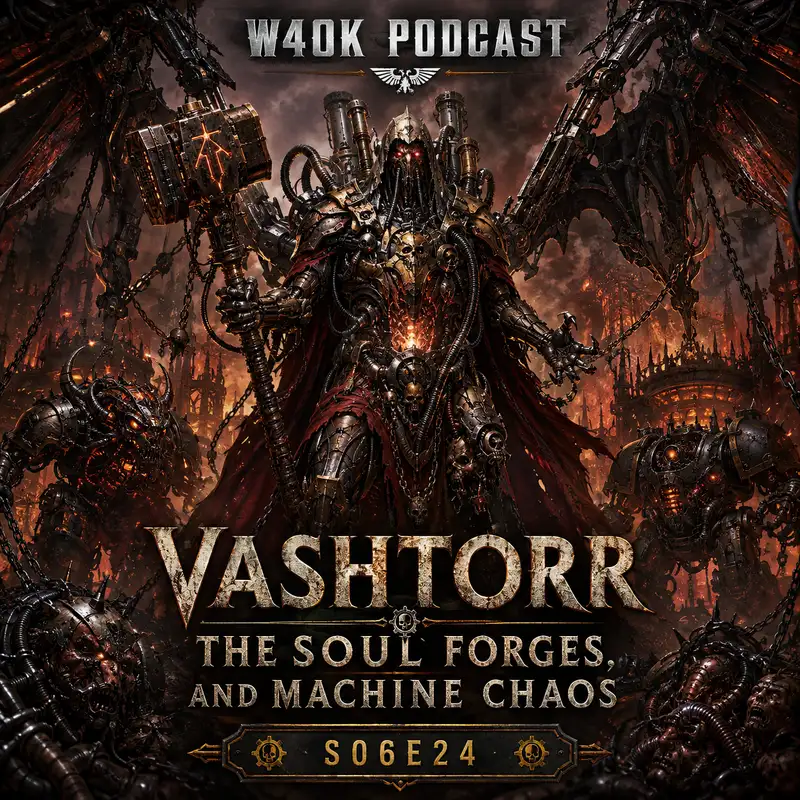
Vashtorr, the Soul Forges, and Machine Chaos
There is a place in the warp where daemons do not gather around a throne, a garden, a battlefield, or a banquet hall. They gather around furnaces. Black smoke coils through an artificial sky. Chains drag screaming shapes toward anvils large enough to break warships. Every hammer blow reshapes something that was never meant to possess a skeleton, much less an engine. This is the domain of Vashtorr the Arkifane, master of the Soul Forges, and perhaps the closest thing Chaos has to an arms manufacturer with a legal department. That description sounds almost reassuring. It should not. Vashtorr represents a form of corruption that does not begin with rage, despair, ambition, or desire. It begins with a practical question. Can this be made stronger? The horror follows when every other question, including what it costs and who must suffer, is dismissed as inefficient.
Vashtorr is not a mortal champion who pleased the Dark Gods and was rewarded with daemonhood. He is a being of the warp, a daemonic demigod whose existence is bound to invention, artifice, and technological creation stripped of moral restraint. He is neither a man covered in machinery nor a machine wrapped in corrupted flesh. In his manifested form, flesh and metal are the same substance. Pistons resemble tendons. Cables emerge like nerves. His wings are sharpened mechanisms, more symbolic than aerodynamic, and his hammer is both tool and weapon. Vashtorr looks engineered because engineering is not merely something he does. It is part of what he is. Where Khorne embodies murderous wrath and Nurgle draws power from despair and endurance, Vashtorr feeds upon the impulse to create without conscience, to solve the problem while refusing to ask whether the solution should exist.
That makes him an awkward fit within the familiar map of Chaos. Innovation can resemble Tzeentchian change. Obsessive craftsmanship can drift toward Slaanesh. Industrial slaughter can serve Khorne, while machines of contamination seem entirely at home in Nurgle’s armies. Vashtorr does not deny those connections. He profits from them. Yet he is not presented as a servant of any one of the four great powers. His authority rests upon a narrower and increasingly important domain: the union of the warp and the machine. He is the patron of the inventor who has forgotten the purpose of invention, the weaponsmith who regards suffering as a useful test condition, and the engineer who sees a soul as just another source of energy. The four gods turn emotion into appetite. Vashtorr turns appetite into production capacity.
No reliable account explains when Vashtorr first came into being. Some in-universe speculation connects him to a catastrophic arms race in an ancient, galaxy-spanning war. Other theories point toward the Dark Age of Technology, when humanity built wonders it could no longer control and created intelligences it later came to fear. Such claims are possibilities, not settled history. The warp does not provide birth certificates, and its inhabitants are rarely helpful when questioned. What can be said is that Vashtorr has been strengthened by technological ambition across many ages and civilisations. Every experiment performed without restraint does not automatically serve him, but the pattern matters. Curiosity opens the door. Pride removes the locks. Necessity provides the justification. By the time anyone notices the smell of hot metal and burnt incense, the project budget has usually become the least troubling part of the situation.
At the centre of Vashtorr’s power stand the Soul Forges, an infernal industrial realm within the wider immaterium. Here, warp entities are hammered, cut, chained, and fused into mechanical forms. The forges are fed by souls, wreckage, and the endless demands of the Great Game, the struggle among the Chaos Gods for supremacy. Daemon craftsmen labour beneath black fumes. Engines howl with voices that were once independent beings. Nothing is manufactured in the clean sense of the word. It is broken, bargained, bound, and remade. A mortal forge transforms ore into a weapon. The Soul Forges transform identity into function. A creature enters with pride, hatred, fear, and memory. It leaves with armour plates, weapon mounts, and a contract it will regret for longer than most civilisations survive.
The Soul Grinder is the clearest example of that bargain. A daemon that has been defeated or diminished may seek renewed strength from the forges. Vashtorr’s servants provide a towering mechanical body, but the gift is not free. The daemon becomes indebted, and the terms traditionally bind it to gather souls, deliver the wreckage of destroyed war machines, and defend the forges if the great powers ever attempt to seize them. The result is not a loyal employee in the ordinary sense. It is a furious warp predator trapped inside an arrangement that turns every victory into another payment. Vashtorr’s reputation for honesty grows from this practice. His agreements are said to provide exactly what they promise. The important detail is that they do not promise mercy, freedom, or a fair exchange. A trap written clearly is still a trap.
This is why calling Vashtorr the most honest daemon is accurate only in the way a warning label can be accurate. He does not need the theatrical deception favoured by other warp powers. His victims usually deceive themselves. They believe they can manage the debt, exploit a loophole, or use his gift long enough to escape the consequences. Daemons are creatures of obsession, and obsession is very good at refinancing disaster. Each defeat creates another need for repair. Each repair deepens the obligation. Vashtorr does not have to chase them. He merely keeps the furnaces lit and the paperwork available. The arrangement gives him something more valuable than temporary worship. It gives him leverage, and leverage is one of the few forces in the warp that can be almost as durable as hatred.
The four great Chaos Gods tolerate this independence because the Soul Forges are useful. Their legions need weapons. Their daemons seek stronger bodies. Their mortal followers want engines capable of carrying the warp into realspace behind armour thick enough to survive the journey. If one god moved openly against Vashtorr, he could favour that god’s rivals. The Great Game therefore protects him through mutual suspicion. He is an arms dealer whose clients hate one another more than they hate him. Even Be’lakor, the ancient Daemon Prince who despises rivals and upstarts, must account for the power Vashtorr has accumulated. This does not make the Arkifane neutral. Neutrality suggests detachment. Vashtorr is deeply invested in the conflict. He simply prefers to sell the blade, improve the blade, and collect payment from whichever hand is currently holding it.
Mortals also come to him. Warpsmiths of the Traitor Legions, magi of the Dark Mechanicum, renegade artificers, and cults devoted to forbidden technology all find something attractive in Vashtorr’s promises. He offers knowledge that the Imperium suppresses, methods the orthodox Mechanicus would condemn, and power unconstrained by safety, doctrine, or the continued survival of test subjects. To an Iron Warrior, he may appear as a patron of siege engines and ruthless efficiency. To a renegade tech-priest, he can seem like proof that the machine contains divinity after all. To a desperate cultist, he may simply be the voice inside a failing generator that suddenly begins working again. Vashtorr does not require every servant to understand him. A factory can operate perfectly well when most of its workers never see the owner.
Machine Chaos is broader than Vashtorr, and not every corrupted engine should be attributed to him. The Dark Mechanicum existed long before he stepped openly into the galaxy’s present wars. Warpsmiths bind daemons through their own rites. Chaos Knights are shaped by cursed thrones, corrupted lineages, and the influence of the warp upon both pilot and war engine. Helbrutes imprison damaged Space Marines within armoured sarcophagi that turn survival into torment. Daemon engines may be built, possessed, grown, or fused through different methods. Vashtorr is not the inventor of every abomination with claws and an exhaust stack. He is the ruler of the greatest infernal foundries and a patron whose influence connects these practices. He gives machine corruption a centre of gravity, a calculating intelligence that sees each separate horror as part of an industrial ecosystem.
That distinction matters because a daemon engine is not simply a tank with an angry ghost inside it. The union changes both halves. Metal becomes hungry. Flesh acquires tolerances, load limits, and replaceable components. A Forgefiend does not merely carry weapons. Its body has been organised around the act of firing them. A Maulerfiend is violence translated into pistons, talons, and forward motion. A Venomcrawler hunts for the energies needed to sustain its own unnatural mechanisms. These creatures retain daemonic appetite, but their mechanical forms channel that appetite into specialised purpose. The result is more disciplined than a wild daemon and less predictable than a conventional vehicle. It can be repaired, enraged, summoned, and aimed, though rarely all four in the order its operator intended.
The Imperium is unusually vulnerable to this form of horror because its own relationship with technology is already religious, fearful, and fragmented. The Adeptus Mechanicus preserves ancient systems through ritual because much of the underlying knowledge has been lost, restricted, or monopolised. Machine spirits are appeased. Sacred procedures are repeated. Innovation is watched carefully, sometimes for good reason. In such an environment, the difference between maintenance rite, superstition, malicious scrap-code, and actual daemonic intrusion may be difficult to recognise until the reactor begins chanting. Vashtorr exploits more than ignorance. He exploits dependence. Imperial civilisation cannot survive without machines it does not fully understand, maintained by institutions that cannot easily admit uncertainty. A corrupted system can therefore hide behind the same mystery that once protected it.
Vashtorr himself reflects this colder style of threat. He is not usually depicted as a roaring beast or ecstatic prophet. He bargains. He measures. He studies. On the battlefield, his violence is deliberate, expressed through the Hammer of the Soul Forges and claws capable of shaping metal or tearing apart those who object to being shaped. His presence can invigorate daemon engines and turn hostile technology against its owners. Yet his most dangerous weapon is credibility. Abaddon the Despoiler has spent millennia refusing to become a puppet of the gods. He bargains with Chaos while insisting that his war remains his own. Vashtorr understood that a grand promise of devotion would fail. He approached Abaddon with a transaction.
The proposal served both ambitions. Vashtorr wanted fragments of an ancient device known as the Key, an artefact or system whose full nature remained hidden. Abaddon wanted new weapons for the Long War. Together they created the Arks of Omen, colossal assault vessels formed from space hulks and remade through the Arkifane’s artifice. Space hulks are already nightmares of accumulated history, masses of wrecked ships fused by collisions, warp travel, and time. Vashtorr turned them into directed instruments of conquest. Abaddon offered these mobile fortresses to warlords across the galaxy. In return, each recipient hunted designated targets and recovered objects whose significance was often known only to Vashtorr. It was a campaign designed like a distributed machine. Ambition supplied the manpower. Greed supplied the initiative. The operators did not need to understand the final product.
This was machine Chaos expressed as strategy. The Arks were not merely large warships. They were incentives. Each warlord received a fortress powerful enough to launch a private crusade, while Abaddon and Vashtorr gained thousands of violent specialists searching for pieces of a puzzle. Failures could be discarded. Successes fed the larger design. The plan did not require unity among the servants of Chaos, which was fortunate because unity has never been their most reliable export. It converted rivalry into useful motion. A champion who believed he was conquering a world for personal glory might actually be retrieving one component in Vashtorr’s unseen mechanism. The campaign spread fear across the Imperium, but its deeper achievement was logistical. Chaos had found a way to make selfishness operate like coordination.
One crucial fragment brought Vashtorr into direct conflict with the Dark Angels. Their mobile fortress-monastery, the Rock, contained the Tuchulcha Engine, an ancient device with its own intelligence and a long, dangerous history. Vashtorr attacked the Rock and fought Supreme Grand Master Azrael, but the assault did not proceed as planned. Be’lakor intervened, not from loyalty to the Imperium, but from hostility toward a rival whose rise threatened the existing order of the warp. The attack failed to deliver an immediate victory. For a more conventional conqueror, that might have ended the project. Vashtorr treated it as a delayed acquisition. He had revealed the target, tested the defences, and confirmed that other powers were sufficiently alarmed to interfere. In infernal engineering, even a catastrophe can become useful data.
The next stage of the trap was Wyrmwood, a daemon world assembled from the shattered remains of Caliban, the lost home world of the Dark Angels. Vashtorr reconstructed those fragments into a grotesque industrial parody, complete with iron forests, chimneys, and mechanisms buried through the planetary crust. Captured servants conveniently revealed its location, drawing the Dark Angels and their successor Chapters into an assault. They knew it was a trap. They went anyway, because some insults are designed to bypass strategy and strike directly at identity. Abaddon arrived with the Vengeful Spirit. Angron was unleashed upon the surface. The returning Lion fought his fallen brother while fleets burned above them. It was an event of immense symbolic weight, which made it an excellent distraction.
While heroes and monsters decided which of them could hit the other hardest, Vashtorr pursued the component he required. He infiltrated the systems of the Rock, reached the Tuchulcha Engine, and carried it away to Wyrmwood. The Key was completed. His Dissonance Engine awakened, and the false Caliban began to convulse as reality twisted around it. Imperial forces withdrew while the daemon world vanished into a wound of silver light, taking Vashtorr and the surviving traitor fleet with it. The Arks campaign had produced massacres, betrayals, and the return of a primarch, but the Arkifane measured success by a quieter standard. The mechanism worked. He had forged the Key. He could now hunt for the Lock.
The exact nature of that Lock and the full consequence of opening it remain unresolved in the surviving account. Vashtorr’s stated ambition, however, is clear enough. He does not intend to remain a useful demigod operating a profitable forge. He seeks apotheosis as a Chaos God in his own right. That desire separates him from a mere supplier. Every contract, daemon engine, cult, and recovered fragment becomes part of an ascension project. He is building not only machines but a divine position, attempting to turn technological dependence and amoral invention into a throne within the warp. Whether the four great powers could prevent such a rise is uncertain. Whether they would cooperate long enough to try is even less certain. Chaos has never been troubled by a shortage of enemies. It has occasionally been troubled by scheduling.
Vashtorr also exposes a weakness shared by both the Imperium and its enemies. They often treat technology as morally neutral until someone uses it badly. Machine Chaos suggests something more disturbing. Design choices can embody values. A weapon built only for suffering does not become innocent because its trigger has not yet been pulled. A system that consumes souls is already an act of violence before it produces anything useful. Vashtorr’s genius is to erase the distinction between means and ends. The forge is not a regrettable step toward victory. The forge is the victory. Every being reduced to fuel, debt, or component proves his principle that creation without conscience eventually becomes another form of predation.
This is why he should not be reduced to the simple idea of an evil machine god. Vashtorr is not dangerous because metal is corrupt, nor because invention is forbidden. The setting contains compassionate artificers, necessary innovation, and machines that preserve life against impossible odds. His domain begins when the maker refuses responsibility for what is made. He thrives when curiosity becomes entitlement, when efficiency becomes the only measure of success, and when people are treated as material. The Dark Mechanicum may worship knowledge, power, or the machine itself. Warpsmiths may seek victory for their Legions. Vashtorr stands behind them as the final logic of their worst decisions, calmly asking how the process might be scaled.
Khorne promises release through violence. Nurgle offers belonging within decay. Tzeentch turns hope and ambition into chains. Slaanesh makes desire consume everything around it. Vashtorr offers a contract, a workshop, and the means to complete the project. His temptation is quieter because it resembles competence. There is always another improvement, another limitation to remove, another ethical safeguard that appears inconvenient under pressure. The first compromise may save a city. The next may win a war. Eventually the machine requires souls, and everyone involved has become too invested in the result to question the fuel. That is machine Chaos: not technology rebelling against its creators, but creators teaching technology to share their worst appetites.
Vashtorr is therefore more than the keeper of a strange corner of the warp. He is Chaos learning logistics, contract law, and industrial scale. The Soul Forges turn daemonic obsession into hardware. The Arks of Omen turned warlord ambition into a search network. Wyrmwood turned vengeance and heroism into cover for a theft. He may fail in battle, lose servants, and draw the hatred of older powers, yet still advance because his true weapon is the system surrounding the fight. Somewhere beyond reality, the furnaces continue to burn, and every measured hammer blow carries the same promise. Anything can be improved, provided no one asks what improvement means. In Vashtorr’s hands, that omission is large enough to forge a god.