Unsolved Mysteries of the 41st Millennium
There are absences in Imperial history that have weight. A plinth stands empty among statues of heroes. A campaign record begins with a victory and omits the war that made victory necessary. A list of the Emperor’s sons passes from the First Legion to the Third, as though arithmetic itself has been declared heretical. In the forty-first millennium, a missing page is rarely just a missing page. It may be a warning, a weapon, or the grave marker of everyone who once knew what the page contained.
That is the central problem with the unsolved mysteries of this age. Some are questions no one has answered. Others were answered long ago, then buried so thoroughly that ignorance became official policy. Some survive only because the witnesses are dead. Others survive because the witnesses are still alive and have every reason to lie. The Imperium does not merely fail to preserve truth. It classifies truth, edits it, sanctifies it, and occasionally shoots it before it can reach the archives.
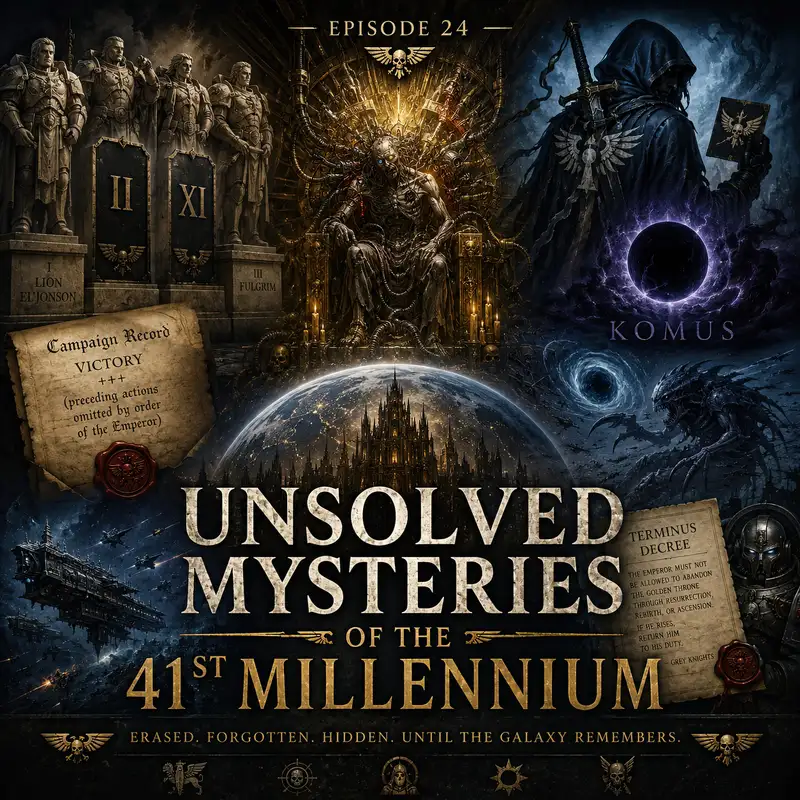
The most famous example begins with two numbers. The Emperor created twenty primarchs, and from their genetic legacy came twenty Space Marine Legions. Yet the Second and Eleventh Primarchs were erased before the Horus Heresy. Their names were removed. Their monuments were destroyed. Their Legions vanished from the active order of battle. Even their brothers were restrained from speaking of them. The traitor primarchs remained infamous. These two were denied even infamy.
That difference matters. Horus became the arch-traitor, but his name endured because the Imperium needed a devil. The missing primarchs received something colder than condemnation. They were made unusable. Whatever happened could not be turned into a sermon, a warning, or a triumph. The available accounts suggest that their fates were not identical, and that at least some of their surviving warriors may have been spared. Beyond that, certainty collapses quickly.
Rogal Dorn once confronted the sealed memory of what had happened. Malcador had suppressed knowledge of the lost brothers, not only from archives but from minds. When Dorn was briefly allowed to understand, he did not emerge demanding that the truth be restored. He accepted that the erasure had protected the Imperium. That scene offers no neat answer. It gives us something more unsettling. The secret was not hidden merely because it embarrassed the Emperor. It was hidden because men as formidable as Dorn believed remembering it could be dangerous.
This leaves the obvious theories, and nearly all of them outrun the evidence. Perhaps one primarch fell to mutation. Perhaps another refused the Emperor. Perhaps they were destroyed during the Rangdan wars. Perhaps their Legions were absorbed into others. Each possibility fits a fragment, but none closes the case. The silence has become so complete that it can support almost any accusation. That is useful for speculation and less useful for military history, where evidence is traditionally considered a pleasant addition.
The lost primarchs reveal the first kind of mystery in the Imperium. It is the mystery produced by authority. The truth once existed. Orders were issued, forces moved, and people died. Then institutions decided that the consequences of knowledge were worse than the consequences of ignorance. The result is not a blank space. It is a carefully engineered wound in the historical record.
Other mysteries are made by destruction rather than censorship. The Pale Wasting struck the Imperium in an age already fractured by civil war and instability. Surviving accounts describe a threat so severe that entire Space Marine Chapters were consumed resisting it. Yet the nature of the enemy remains indistinct. Names, battles, and losses flicker at the edge of the record, while the thing that caused them refuses to come into focus.
The same pattern surrounds the darkest reports from the Ghoul Stars and other regions beyond firm Imperial control. There are expeditions that do not return, worlds found empty, and enemies described only through the damage left behind. The Imperium is accustomed to identifying a threat, assigning it a classification, and then applying an amount of firepower that makes further discussion unnecessary. When no classification survives, the bureaucracy becomes almost philosophical.
The Rangdan wars offer another scar without a complete anatomy. They were among the most severe conflicts of the Great Crusade, involving vast Imperial forces and enemies whose true nature remains only partly described. The First Legion suffered terribly. The Emperor himself became involved. Later references suggest measures of extraordinary severity, including forces and weapons rarely acknowledged elsewhere. Yet the complete history remains sealed, fragmented, or lost.
It is tempting to connect every erased war to every erased primarch. The temptation should be resisted. The chronology allows questions, not certainty. The Rangdan may have been connected to one or both missing Legions, but the surviving record does not settle the matter. The more responsible conclusion is also the more disturbing one. Several catastrophes may have occurred in the same broad era, and the Imperium may have buried each for different reasons.
Then there are mysteries that walk, speak, and shoot people. Cypher has crossed the galaxy for millennia wearing the colours and relics of the Dark Angels’ oldest shame. He is associated with the Fallen, the warriors scattered through time and space when Caliban was destroyed. He carries a great sword that he does not draw. Many believe it to be the Lion Sword. Some believe he means to present it to the Emperor. Others believe he intends to kill Him with it. Cypher has found both interpretations useful enough not to correct.
His actions resist simple allegiance. He has fought beside Imperial forces and beside enemies of the Imperium. He has killed servants of Chaos and servants of the Throne. He aided Roboute Guilliman during the journey to Terra, then allowed himself to be taken into custody when the primarch no longer trusted his purpose. He escaped from one of the most secure places in human space, because apparently the defences of Terra needed another concern.
The easy explanation is that Cypher serves himself. The harder possibility is that his course is consistent, but the observers lack the information required to see it. His office on ancient Caliban was tied to secrets, tradition, and continuity. The title may matter more than the identity of the man carrying it. Cypher may be preserving a duty older than the Dark Angels’ current understanding of their own history.
The return of Lion El’Jonson has sharpened rather than solved the mystery. The Lion now carries a different blade, and he has begun judging some of the Fallen as individuals rather than treating them all as identical traitors. That creates the possibility of reconciliation, but it does not explain Cypher’s destination, the sword on his back, or the command that seems to govern him. A mystery can survive the return of its central character. It simply becomes harder to blame on his absence.
Cypher represents a second kind of mystery. He is not hidden. He is over-observed. Every faction sees part of him and interprets that part through its own fear. The Dark Angels see disgrace. The Inquisition sees conspiracy. Chaos sees opportunity. The Imperium sees a fugitive. None of these perspectives is necessarily false, but none is complete. When every witness arrives with a loaded weapon and a private doctrine, evidence tends to have a difficult evening.
Far from Terra, the Tyrant Star known as Komus creates a different problem. It appears in the Calixis Sector as an impossible black stellar body, associated with madness, mutation, upheaval, and disaster. It does not behave like an ordinary star. Its manifestations are unpredictable. Prophecy, Inquisitorial investigation, and local terror have accumulated around it, but no accepted explanation has contained it.
Komus may be a warp phenomenon, a weapon, a living entity, a sign, or something for which Imperial categories are simply inadequate. Each theory explains some reported effects and leaves others untouched. The most important fact is not that the Imperium lacks a name. It has several. The problem is that naming the phenomenon has not produced control.
This is where the setting becomes stranger than a simple tale of lost records. The warp does not merely conceal information. It damages the assumptions by which information is judged. Time can pass unevenly. Visions can be warnings, temptations, echoes, or all three. A witness may report events that have not happened yet, or remember a journey that took place in a different order for someone else. The archive is trying to preserve reality while reality is under no obligation to remain consistent.
Even the date is uncertain. Imperial chronology was unreliable before the Great Rift, and the opening of that wound made the problem worse. Roboute Guilliman ordered historians to reconstruct a usable calendar, only to find systems built on contradictory records, local traditions, transcription errors, and political convenience. Scholars have fought over the correct reckoning with a seriousness normally reserved for artillery.
Across the divided Imperium, time does not pass evenly. A campaign may endure for years to the soldiers fighting it while distant authorities record a different span. Messages arrive from places whose clocks no longer agree. The phrase the forty-first millennium remains useful, but at the broken edge of Imperial history it can be less a precise date than a declaration that matters have become extremely late.
That uncertainty extends to the edges of the galaxy. The Tyranids came from the intergalactic dark, but their beginning remains unknown. During the Horus Heresy, the destruction and overload of the Pharos produced a signal that reached far beyond the galaxy. Something in the void noticed. The approaching Hive Fleets were not created by that signal, and the signal does not tell us where they originated. It tells us only that they were already out there.
The difference is considerable. Humanity did not summon the Tyranids from nothing. It rang a bell in a dark forest. The creatures moving between the trees had a history before they heard it, perhaps a history spanning other galaxies. Whether the Hive Mind has consumed civilizations elsewhere, whether it is fleeing something, or whether the fleets seen so far are only the leading edge remains unresolved. The evidence supports danger. It does not support comfort.
The silence beyond the galactic rim also limits every grand claim about the known universe. The Imperium calls itself the realm of mankind while failing to govern much of its own map. The Aeldari remember ages humans barely understand, but their knowledge is fragmented and guarded. The Necrons possess memories from before humanity existed, yet those memories have been damaged by time, madness, and deliberate alteration. Ancient does not mean reliable. It sometimes means the witness has had sixty million years to revise the story.
This brings the trail back to Terra, because the greatest mystery in the Imperium is seated at its centre. The Emperor’s body remains bound to the Golden Throne. His power sustains the Imperium’s survival in ways both practical and spiritual. The Astronomican guides navigation through the warp. His presence holds disaster at bay beneath the Imperial Palace. Across the galaxy, miracles, visions, and acts of faith are attributed to Him.
What the Emperor has become is far less clear. He was once a living ruler who denied his own divinity. Ten thousand years of worship have poured belief toward a being of unmatched psychic power. Roboute Guilliman’s audience with his father did not provide a simple reunion. The presence he encountered seemed immense, fractured, and painfully unlike the man he remembered. Guilliman left with instructions, but not with the comfort of believing the past had returned intact.
Several interpretations remain possible. The Emperor may still be fundamentally the same consciousness, broken by pain and divided by the burden of the Throne. He may be changing into a warp power shaped by human worship. Fragments of his humanity may exist apart from the presence on Terra. Visions of a child of light and a figure rising from a throne have renewed ancient ideas about the Star Child, but visions in the Imperium are not notarised documents. Chaos can imitate revelation, and sincere faith can misunderstand what it touches.
Even one old mystery has recently become more precise without becoming less frightening. The Terminus Decree, held by the Grey Knights for the darkest possible hour, commands that the Emperor must not be allowed to abandon the Golden Throne through resurrection, rebirth, or ascension. If He rises, they are to return Him to His duty. The instruction answers what the decree is for. It does not explain how the Grey Knights could carry it out, what the Emperor might have become, or whether obedience would save humanity or merely preserve its present agony.
The decree exposes the contradiction at the heart of the Imperium. Billions pray for the Emperor to rise. One of the most secret orders ever created has instructions to make sure He sits back down. Both positions can claim loyalty. Both may be necessary. The Imperial talent for turning theology into a potential civil war remains undiminished.
Beneath that contradiction lies the failing machinery of the Golden Throne itself. The device was never merely a life-support system, and much of its construction exceeds the understanding of those tasked with maintaining it. Its systems have deteriorated. Desperate efforts to find solutions have reached even toward the Drukhari, whose technical expertise is considerable and whose customer service terms are generally unfavourable to the continued possession of one’s skin.
If the Throne fails, several disasters may arrive together. The Emperor’s physical state could change. The barrier beneath the Palace could collapse. The Astronomican could be lost or transformed. Terra could become the centre of a new warp catastrophe. Yet the exact sequence is unknown because there is no useful precedent. The Imperium has built its survival around a machine it cannot replace, sustaining a ruler it cannot fully understand, against a deadline it cannot measure.
This is why the Emperor’s fate cannot be reduced to the question of whether he is alive or dead. Those words are too small for the situation. His body endures. His mind acts. His power reaches across the galaxy. His identity may be divided, changing, or interpreted differently by every soul that encounters it. He is a person, a symbol, a psychic force, a state institution, and possibly the early shape of a god. The mystery is not which one is true. Several may be true at once.
The same principle applies to many lesser mysteries. The Legion of the Damned may be spectral Space Marines, warp manifestations, survivors of a cursed Chapter, or something shaped by Imperial need. Living Saints may be chosen servants of the Emperor, expressions of collective faith, or human vessels for a power no one can safely define. The Black Library exists, but its location, custodians, and full purpose remain inaccessible to almost everyone who seeks it. Knowledge is present. Access is the problem.
Some questions may eventually receive answers. A sealed vault may open. A primarch may return. A surviving witness may speak. An ancient decree may finally be read after millennia of guarded silence. Yet an answer in this universe rarely closes the door. It reveals another corridor, usually darker, often occupied.
The unresolved nature of these mysteries is not a weakness in the history of the forty-first millennium. It is one of the setting’s central truths. Civilizations this old should possess immense knowledge, but age has not produced clarity. It has produced ruins, rival archives, religious claims, corrupted machines, damaged memories, and institutions that survive by controlling what may be known.
The Imperium therefore fights two wars at once. One is the visible war of fleets, armies, crusades, and sieges. The other is a war over meaning. Who is permitted to remember? Which version becomes doctrine? What truth is too dangerous to preserve? Which lie is necessary for another generation to survive? These questions do not sit behind the battlefield. They help decide where the battlefield will be.
The missing primarchs, Cypher, Komus, the darkness beyond the rim, and the Emperor on the Throne appear to be separate mysteries. They are connected by a single fact. No observer stands outside the conflict. Every archive belongs to someone. Every prophecy serves an interest. Every witness carries fear, faith, damage, or ambition. Even the oldest beings in the galaxy remember from inside their own catastrophe.
That is why the deepest unsolved mystery is not the name of a forgotten primarch or the destination of a wandering knight. It is whether truth can survive long enough to matter. In the forty-first millennium, knowledge is hunted, worshipped, traded, weaponised, and buried. The galaxy is full of answers. The tragedy is that almost no one can be trusted to recognise them.