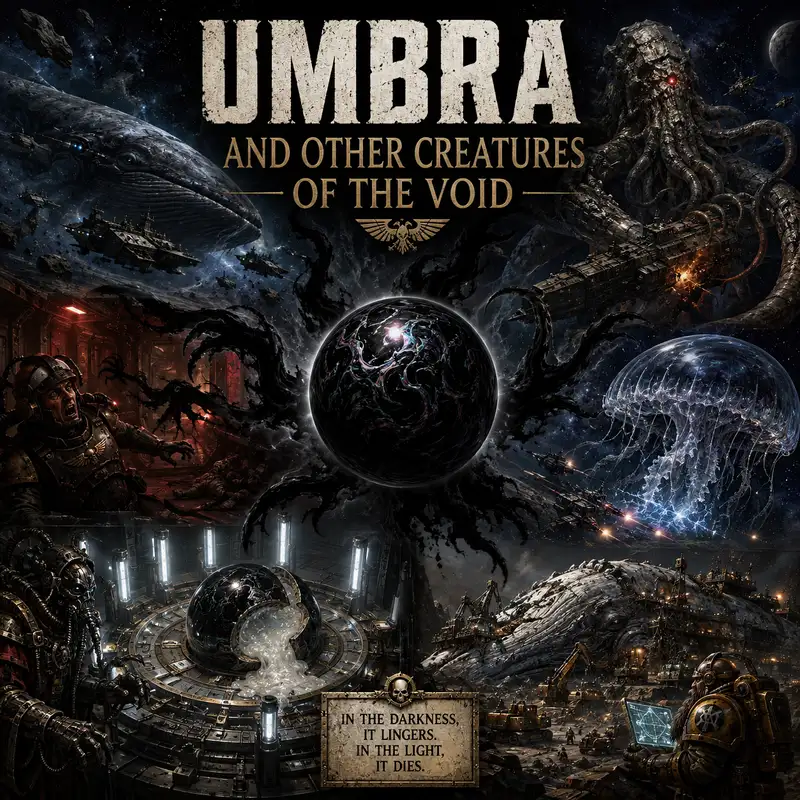
Umbra and Other Creatures of the Void
The first sign is not a distress call or a flicker on the auspex. It is a shadow where no shadow should exist. A smooth black sphere hangs against the outer hull, close to the warp engine, no larger than a human skull and darker than the space around it. It has no claws to grip the metal, no thrusters to hold position, and no visible interest in the crew. Then the emergency lights fail. The darkness begins to move, and the ship discovers that the thing outside was never truly outside at all.
Imperial star charts present the void as distance. Worlds are islands, warp routes are roads, and everything between them is treated as empty space to be crossed as quickly as possible. Void crews know better. They tell stories of shapes moving between asteroids, of living things mistaken for moons, and of shadows that follow a vessel after translation from the warp. Most officers dismiss such accounts as fatigue, superstition, or the predictable effects of recycled air and bad amasec. This is sensible right up to the moment when the legend bites through the hull.
The creatures called Umbra are among the strangest examples because almost every ordinary word used to describe them becomes misleading. They are called animals, yet they show no familiar signs of biology. They are called aliens, yet their true bodies may not exist entirely in realspace. They are called predators, although no one can say with confidence what they eat, whether they eat at all, or whether an attack is feeding, defence, instinct, or simple irritation. The Imperium has classified many impossible things. The Umbra seem almost designed to make the filing system feel optimistic.
An Umbra appears as a glossy black sphere marked by faint, pearlescent patterns that swirl across its surface while it is alive. It can move through open space and hover without any visible means of propulsion. Sightings often place the spheres near warp-active regions, starship engines, or locations believed to connect with the Aeldari Webway. They do not announce themselves with weapons fire or psychic screams. They simply arrive where the boundary between places has already become uncertain, which is not a comforting habit in a galaxy held together by unreliable boundaries.
The sphere itself is dangerous, but the surrounding darkness is the real weapon. An Umbra can seize areas of shadow and make them behave like thick liquid. From those dark patches it forms limbs, hooks, blades, jaws, and serrated shapes that reach far beyond the small body at their centre. A corridor lit by one failing lumen becomes an armoury. The shadow beneath a boot can rise like a trap. Cover offers no safety because every protected corner provides more material for the creature to use. Against an Umbra, tactical concealment becomes an act of generosity.
This ability changes the logic of an encounter. Soldiers are trained to identify the enemy, establish fields of fire, and concentrate force on a target. The Umbra makes the target the least important part of the room. Firing at the sphere may leave the attacking shadows untouched, while moving into a better position creates new pools of darkness behind machinery and bulkheads. A frightened crew will naturally retreat from the thing they can see, only to step deeper into the thing it controls. The correct response is brutally simple. Remove the shadows, and the Umbra loses its reach.
One captured specimen was reportedly contained by exploiting its aversion to intense light. The creature had been driven into a prepared chamber and held there while investigators attempted to understand it. Poison was useless because there was no evident system to poison. Conventional assumptions about suffocation, blood loss, or organ failure were equally unhelpful. The final method was total illumination. Light sources were arranged around the sphere so that no darkness remained for it to grasp. For a being that weaponised shadow, the experiment was less an execution than the removal of its environment.
The resulting dissection did not clarify matters. Beneath the black shell lay a cavity and a core of strange white liquid whose behaviour resisted ordinary analysis. The fluid appeared capable of changing density and solidifying unpredictably, yet it also seemed almost without friction. The shell was brittle, glossy, and threaded with structures that suggested engineering as much as anatomy. No lungs, stomach, nerves, muscles, or waste systems were found. The investigators had killed something, opened it, and discovered that the interior was no more willing to explain itself than the exterior.
One Imperial theorist offered a useful comparison. Imagine a two-dimensional creature seeing a human finger pass through its flat world. It would observe a small shape appearing, changing size, and disappearing, never perceiving the hand, the arm, or the person beyond. The Umbra sphere may be something similar, a tiny cross-section of a much larger being extending through dimensions that human senses cannot follow. Its impossible motion and inconsistent substance might not be violations of nature. They may be ordinary movements viewed from the wrong side of reality.
That interpretation would also explain the creature's attraction to warp engines and other places where dimensions are already under strain. A warp drive does not merely propel a ship. It tears open a passage from realspace into the Immaterium and then trusts ancient machinery, a Navigator, and a great deal of prayer to make the process survivable. An Umbra near such a system may be feeding on the disturbance, using it as a doorway, or simply gathering where the shape of reality resembles its natural habitat. None of those possibilities improves the maintenance officer's evening.
The most disturbing evidence came at the creature's death. As the sphere brightened and its surface patterns stopped moving, nearby observers suffered intense pain and a burst of psychic images. They perceived a humanoid form breaking apart, a violent warp storm, the cold of deep space, and one final word: linger. It was not a scientific explanation. It was closer to a memory fragment released under pressure, the last spark of something too large to fit inside language. The body then fell inert, leaving a small black object and a very large question.
A heretical account offers an answer, though not one that should be mistaken for settled fact. It speaks of an ancient god that survived a war between powers remembered only through distorted names. The being hid in the warp, continued its mysterious works, and was later destroyed when Slaanesh was born from the catastrophe of the Aeldari Fall. Its shattered pieces were cast into realspace, condemned to drift in the cold. Some interpretations connect this figure with Qah, the lost deity remembered by the Hrud as one who lingers.
The story fits the Umbra almost too neatly. A million fragments of a slain god would explain their identical shapes, their psychic presence, their attraction to dimensional wounds, and the image of a body splintering at death. It would also transform their attacks from animal behaviour into the spasms of a broken consciousness. Yet the source is deliberately unreliable, wrapped in heresy, metaphor, and second-hand testimony. Warhammer's oldest histories rarely arrive with clean labels. The account may preserve truth, propaganda, madness, or several of those at once.
What can be said with confidence is narrower and, in some ways, more frightening. Umbra exist. They travel through the void. They can turn shadow into physical violence. Bright, complete illumination appears to weaken or kill them. Their bodies do not resemble known organisms, and their deaths can produce psychic impressions connected with fracture and endurance. Whether each sphere is an individual, a shard, an organ, or the visible tip of something elsewhere remains unresolved. The name describes what humanity has seen, not necessarily what the Umbra are.
That uncertainty separates the Umbra from the great beasts that also inhabit interplanetary space. A void whale may be incomprehensibly large, but it can still be understood as a living creature. It has a body, internal regions, parasites, and behaviour that resembles migration or feeding. Some are capable of passing through the warp, which is an alarming talent for anything with a mouth large enough to alter local maps. Still, a void whale belongs to the category of life, even when the category must be stretched until it creaks.
Accounts vary wildly regarding their size, perhaps because the term covers more than one species or stage of development. Some void whales are described on the scale of warships. Others are thousands of miles long, with eyes compared to cities and mouths capable of swallowing objects that lesser species would call moons. This is not merely decorative exaggeration. In the far reaches of the galaxy, the corpse of such a beast can become geography, a source of minerals, a habitat, and even the foundation for settlements built by those willing to mine something that once swam between stars.
The best-known Imperial encounter involved a void whale warped into something far more hostile. In the late forty-first millennium, an enormous specimen emerged from the Warp Gate of Sloth and threatened the astral stronghold of Perillia. The Space Wolves of Engir Krakendoom's Great Company boarded the creature rather than attempting to destroy it from outside. They fought through gill chasms and internal forests, battling vampiric Remora that had made the whale their home, then planted charges on vital organs before escaping. It was boarding warfare conducted against a living continent.
The operation sounds absurd until the alternatives are considered. A beast of that scale cannot be treated like an ordinary ship because armour penetration means little when the target has miles of tissue behind the wound. Naval guns may injure it without reaching anything essential. Boarding parties, by contrast, can move through natural passages and attack organs that keep the creature alive. The Space Wolves turned anatomy into terrain and surgery into demolition. The method was direct, violent, and remarkably well suited to a Chapter whose preferred answer to a sea monster is usually to board it.
The whale's destruction did not end the danger cleanly. Its remains spread into a vast gas belt that brought further catastrophe to nearby worlds, forcing the Imperium to deal with the consequences of victory. This is a recurring feature of void ecology. Killing the creature may create debris fields, toxins, parasites, or warp contamination on a scale comparable to a planetary disaster. A dead void beast is not simply a carcass. It can become a navigational hazard, a resource rush, a shrine, a battlefield, or all four before the Administratum assigns the correct form.
Other cultures are less inclined to waste so much useful mass. The Leagues of Votann have established mining and trading operations within the remains of immense void whales, treating the body as both claim and landscape. Such sites can contain industrial superstructures, dig works, markets, and persistent infestations of native parasites. The Kin's response is practical. If an ancient creature contains valuable material, then it is a deposit. If something living inside objects, the objection can be removed. Awe is permitted, but it does not take precedence over extraction schedules.
Void kraken occupy the border between confirmed predator and voidsman's tale. They are described as colossal, stone-skinned creatures with tentacles stretching for kilometres, capable of coiling around major vessels and tearing into their hulls. Many officers dismiss them as stories assembled from damaged ships and frightened survivors. Experienced voidfarers point to wrecks carrying enormous embedded teeth and ask what, precisely, the officers believe put them there. In the Imperium, scepticism is often strongest among people who will not be assigned to the boarding party.
The surviving accounts suggest that a kraken's stony exterior may be formed from minerals consumed over its long life. That would make voidships attractive not because of hatred, strategy, or daemonic malice, but because a vessel is a dense concentration of refined metals moving through otherwise sparse space. The kraken may lurk among asteroids or near planetary bodies, strike from concealment, and drag damaged prey away for later consumption. A crew can die in terror while the creature responsible experiences nothing more dramatic than hunger.
That distinction matters. The galaxy contains enemies who plan, corrupt, conquer, and hate. It also contains animals whose natural behaviour happens to destroy cities and fleets. A void kraken does not need a political objective to become a strategic problem. Shipping lanes may be abandoned, patrol groups diverted, and colonies starved because one migrating beast has discovered that merchant hulls are easier to crack than asteroids. The resulting campaign might involve admirals, Rogue Traders, priests, and xenologists, while the kraken remains entirely unaware that a campaign exists.
Plasmic medusae present the opposite danger. These enormous, jellyfish-like organisms drift through space in groups and are not generally described as aggressive. Their bodies, however, contain immense plasmic energy. When destroyed or struck with sufficient force, they explode violently enough to damage nearby ships. A nervous captain who opens fire may turn a harmless obstacle into a chain of detonations across the formation. The threat comes not from pursuit but from proximity, poor judgement, and the enduring military belief that an unknown object becomes safer after being shot.
Then there are creatures whose existence remains uncertain even within the setting. The Auct are said to be colossal, leech-like beings able to wrap around ships, crush them, and consume the crews. On at least one world they are worshipped as star gods, with local rituals preserving the legend in a form that sounds ridiculous to outsiders. A noted xenologist dismissed the entire species as fiction. He may be correct. He may also have made the common scholarly error of assuming that a drunken hymn cannot contain accurate navigational advice.
Voidfarer folklore deserves cautious respect because it develops among people who spend generations inside fragile metal hulls. Sailors misinterpret sensor ghosts, repeat old lies, and improve stories with every telling. They also notice patterns that central authorities never see. A route where ships disappear at similar intervals, a moon that changes orbit without thrust, or a dark shape repeatedly found near warp translation points may first survive as superstition because no institution has bothered to investigate. In an empire of a million worlds, myth is often what evidence becomes while waiting for paperwork.
The Umbra sit at the far end of that spectrum. A kraken can be imagined as an animal adapted to vacuum. A whale can be treated as a migrating ecosystem. A plasmic medusa may be understood as dangerous biology carrying stored energy. The Umbra resist every comfortable category. They behave like creatures, weapons, dimensional projections, and religious relics at the same time. Their weakness to light is practical, but it does not explain them. Their shell can be cut open, but the opened body only exposes another layer of impossibility.
For Imperial commanders, the lesson is not that every sailor's tale is true. That would be expensive, and the Imperium already has enough expensive beliefs. The lesson is that the void must be treated as habitat rather than emptiness. Auspex returns can indicate mass without intent. A vessel's shadow can become a vulnerability. Warp emergence may attract life that does not appear on any threat register. Standard weapons may create worse hazards than the original contact. Survival depends on recognising what kind of danger is present before doctrine supplies the wrong answer with great confidence.
Different factions respond according to their own values. The Mechanicus seeks specimens, measurements, and mechanisms, even when the specimen turns the laboratory shadows into knives. Rogue Traders see risk balanced against rarity and profit. Orks see a hunt large enough to justify more guns. The Kin see recoverable resources and begin calculating yield. The Imperium's priests may declare a monster a sign, a punishment, or an opportunity for martyrdom, sometimes before the Navy has completed identification. None of these interpretations is wholly useless, which is part of the problem.
The deeper truth is that interstellar civilisation has not conquered space. It has learned to cross selected portions of it inside armoured cathedrals while pretending the darkness between ports is inert. The void has currents created by gravity and the warp, reefs of wreckage, migratory giants, ambush predators, drifting colonies, and things that may only intersect realspace briefly. Human maps reduce all of this to routes and coordinates because maps are tools for travellers. They do not show the world as it is. They show the parts a traveller hopes will remain predictable.
Umbra and the other creatures of the void answer the episode's central question in different ways. What lives between the stars is not one hidden ecosystem waiting to be catalogued. It is a collection of overlapping realities. Some beings are animals adapted to conditions humanity barely understands. Some are ecosystems large enough to be mistaken for terrain. Some may be myths built around genuine wreckage. And some, like the Umbra, may be fragments of an ancient event rather than a species in any ordinary sense.
That is why the small black sphere is more unsettling than the monster large enough to swallow a ship. Size can be measured. Hunger can be anticipated. Even a void whale can be boarded, mapped, and killed by warriors carrying explosives. The Umbra offers no such reassurance. It turns absence into a weapon, leaves memory instead of anatomy, and suggests that the darkness around a vessel may contain the broken edge of something that died before humanity existed. The sphere does not roar. It does not pursue. It simply waits near the places where reality opens, and it lingers.