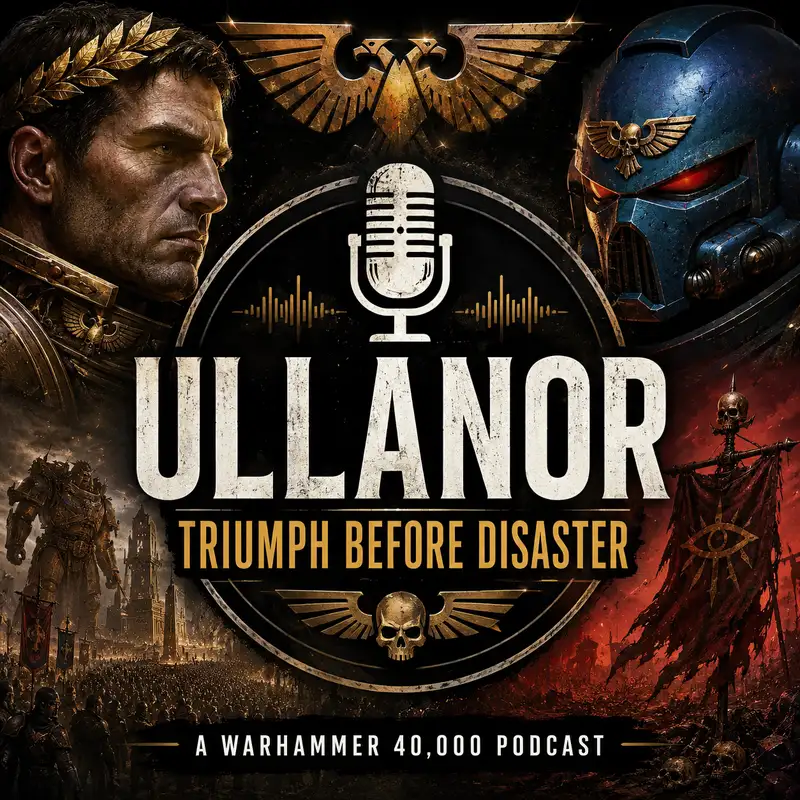
Ullanor: Triumph Before Disaster
Across Ullanor, the ground had been forced flat for thousands of square kilometres. The Mechanicum had carved a parade field from a conquered world, and the skulls of dead Orks had been arranged as decoration. Titans advanced in measured ranks. Millions of soldiers stood beneath banners from across the Imperium. Space Marines from fourteen Legions marched before the Emperor and nine of his primarch sons. It was the largest victory celebration the Great Crusade had ever seen. It was also the moment when the Emperor stepped away from his armies and placed them in the hands of Horus.
That is the contradiction at the heart of Ullanor. The Imperium had defeated one of the greatest military threats in the galaxy. Its armies were united. Its commanders were triumphant. Its future appeared almost embarrassingly secure. Then, in the middle of that victory, the structure holding the Great Crusade together was changed. The Emperor named Horus Warmaster, gave him authority over the crusade, and returned to Terra. Ullanor did not cause the Horus Heresy. The disaster had deeper roots, some of them already growing in secret. Yet Ullanor created the conditions in which those roots could spread.
By the closing years of the Great Crusade, the Imperium had expanded across an astonishing portion of the galaxy. Lost human worlds had been persuaded, pressured, or crushed into compliance. Alien empires had been broken. The Emperor’s primarchs commanded their own Legions and vast military domains. For two centuries, the crusade had survived because its purpose was simple enough to state. Humanity would be reunited. The galaxy would be made safe. The Emperor would lead from the front until the work was done.
The Ork empire centred on Ullanor challenged that confidence. Orks are often remembered through noise, crude humour, and a cheerful disregard for safety regulations. None of that makes them harmless. A large Ork empire is a military ecosystem built around momentum. Victory attracts more warriors. More warriors produce larger fleets, stronger war machines, and more powerful leaders. If such an empire is allowed to grow, it does not remain a regional inconvenience. It becomes a migrating catastrophe with its own supply chain.
The empire of Urlakk Urg had reached that dangerous scale. Its forces numbered in the billions, spread through worlds and fleets under a dominant warlord. Ullanor could do more than resist Imperial expansion. It could gather strength, launch its own conquests, and tear apart regions the Imperium had only recently claimed. A massive Ork power across the crusade’s advance was both a strategic obstacle and a direct challenge to the claim that human victory was inevitable.
The campaign assembled forces worthy of that threat. The Luna Wolves, Ultramarines, and White Scars formed the principal Space Marine strength, supported by millions of Imperial Army troops, hundreds of warships, and Titan Legions. The Emperor was present, but Horus stood at the centre of the design. The outlying worlds were isolated while the Luna Wolves drove toward Ullanor Prime, the heart of the Ork empire. The scale was enormous, but the decisive idea was simple. Cut off the limbs, then strike the head.
That approach suited Horus. He was not merely a powerful warrior, though being a primarch made that description rather inadequate. His greatest gift was the ability to see where force would have the greatest effect. He preferred speed, concentration, and attacks against command. He could coordinate armies larger than many interstellar states, then reduce the decisive moment to a single breach, a single tower, or a single enemy leader who had to die. It was strategy with a talent for becoming personal.
It also reflected how the Luna Wolves understood war. They were the spear point. Other forces could widen the breach and occupy territory. Horus wanted the enemy’s centre of gravity. Against Urlakk Urg’s empire, it was the warlord himself. Ork authority is brutally direct. The strongest leader holds the horde together. Remove that leader at the correct moment, and unity can collapse into panic, rivalry, and enthusiastic violence in several unhelpful directions.
The assault on Ullanor Prime drove straight into the warlord’s fortress. Drop pods and landing craft struck around its defences. Armoured columns pushed toward the walls while the Luna Wolves fixed the Ork masses in place. Then Horus and a force of Justaerin Terminators teleported into the heart of the stronghold. This was not a cautious command decision. It was a decapitation strike carried out by a commander who intended to provide the blade himself.
Horus advanced through the fortress with a small body of his elite. At the summit, he confronted Urlakk Urg and the largest warriors of the warlord’s court. The surviving accounts place the decisive fight in Horus’s hands. He cut through the bodyguard, crippled Urg, and cast the broken warlord from the battlements. The image was almost too perfect for Imperial memory. The greatest son of the Emperor stood above the greatest Ork empire, and its ruler fell from the heights before his own armies.
Below, the effect was immediate. The Ork assault lost coherence as news of Urg’s death spread. Mobs turned back, broke apart, or ran into the advancing Luna Wolves. The victory was not bloodless. Horus found his First Captain, Ezekyle Abaddon, standing among dead Orks and fallen Justaerin. Even the most successful decapitation strike still requires someone to fight through the neck. Yet the strategic result was decisive. Without Urg, the empire fractured, and Imperial forces spent the following months crushing or pursuing its remnants.
The triumph rested on a genuine victory, not propaganda laid over an indecisive campaign. Ullanor had been dangerous, and the Imperial war effort had broken it. The Emperor declared the conquest the greatest success of the Great Crusade. Horus had planned the decisive thrust, led it in person, killed the enemy commander, and turned a vast war into rapid collapse. If the Imperium required one general to direct the next phase, Ullanor made the choice seem obvious.
The celebration was built to make that conclusion visible. The Mechanicum transformed a vast region of Ullanor into a ceremonial field. The scale was less parade ground than modified geography. Columns of Imperial Army soldiers marched beneath standards from conquered worlds. Hundreds of Titans moved like walking fortresses through the formation. Fourteen Space Marine Legions were represented. The spectacle gathered the weapons of human conquest into one place and arranged them as evidence that the Emperor’s project had succeeded.
The presence of the primarchs made the display even more significant. Horus stood with brothers who embodied very different forms of war. Sanguinius inspired devotion. Rogal Dorn represented duty. Jaghatai Khan carried the speed of the frontier. Magnus possessed forbidden depths of knowledge. Fulgrim sought perfection. Angron embodied violence without restraint. Lorgar spoke in the language of faith despite an Imperium that denied religion. They were not a tidy council of officers. They were a family of engineered conquerors, each followed by an army that reflected his nature.
Not all of the primarchs were present, and absence mattered. Some were fighting distant campaigns. Some had rivalries or duties that kept them away. Later accounts suggest that political judgement shaped who stood close to the centre and who did not. Ullanor was a military celebration, but it was also court politics conducted with Titans in the background. The Imperium had no neutral way to rank the Emperor’s sons. Any appointment above them would be understood as praise for one and a judgement upon all the others.
Horus was presented at the climax of the Triumph. Before the assembled armies, the Emperor declared that his own work as a soldier was complete. He named Horus Warmaster and ordered the Imperium’s generals and armies to obey him with the Emperor’s authority. The title placed Horus above his brothers in the chain of command. It did not make him their father, their creator, or their unquestioned master. That distinction would become expensive.
The choice made sense. In the accepted Imperial account, Horus was the first primarch rediscovered and had spent longer at the Emperor’s side than any of his brothers. He understood the Great Crusade not only as a sequence of battles but as a network of personalities, obligations, and rival commands. He could speak to mortal officers without making them feel like insects being granted an interview. He could praise one brother, challenge another, and persuade a third that an order had been his own idea. In a family containing Angron and the Lion, that was not a decorative skill.
Horus also possessed the broadest kind of military reputation. Other primarchs may have surpassed him in particular forms of war. Guilliman built durable governments. Dorn could hold what others would lose. The Lion was a terrifyingly complete commander. Sanguinius was loved in a way Horus could not order into existence. Yet Warmaster required more than excellence in one field. The role demanded someone who could coordinate the others without immediately provoking half of them into proving why the appointment was incorrect.
Still, there was no appointment the Emperor could have made without consequences. Some brothers accepted Horus’s elevation with genuine affection. Some respected the decision while disliking the new hierarchy. Some believed another primarch had a stronger claim. A few saw the title as confirmation that the Emperor had favourites, which was hardly a new discovery but now came with an official seal. Primarchs had been created to command. They were less naturally suited to being commanded by a brother.
The Emperor’s next decision gave the title its dangerous weight. He announced that he would return to Terra and leave the continuation of the Great Crusade to Horus. The reason, hidden from nearly everyone, was the Imperial Webway Project. The Emperor intended to gain access to the ancient network of passages beyond ordinary space, allowing humanity to travel without depending on the Warp. If successful, it could reduce one of the greatest dangers facing the species. It was a project of extraordinary importance.
Almost no one at Ullanor was told that. The Emperor believed secrecy was necessary. The Warp was dangerous, hostile intelligences watched for weakness, and knowledge itself could become a weapon. From his perspective, withdrawing to Terra was not abandonment. It was a change of front. He had spent centuries conquering the material galaxy. Now he was attempting to secure humanity’s future at a deeper level.
His sons could only judge what they saw. The Emperor had led them through war and built their identities around the Great Crusade. At the moment of greatest victory, he promoted Horus and departed without explaining why. The silence left room for every insecurity to provide its own answer. Perhaps the Emperor no longer trusted them. Perhaps the crusade had been only a tool, and the warriors who carried it would be set aside once they were no longer required.
Horus received honour, but he also inherited the space the Emperor left behind. He became responsible for the crusade’s victories, failures, disputes, and delays. He had to order brothers who remembered fighting beside him as equals. He had to represent policies made on Terra while serving as the public face of a military culture suspicious of civilian control. He had been elevated above every commander, then denied the one thing that might have made that position secure: a clear understanding of the Emperor’s larger plan.
The timing made the burden worse. The Great Crusade was entering a transition from conquest to rule. Reclaimed worlds had to be taxed, organised, supplied, and judged. The Council of Terra and the growing civilian administration expected compliance to produce revenue and stable government. Expeditionary fleets often saw those demands as interference by officials who had not crossed the battlefield. Warriors who had spent decades conquering worlds were now informed that clerks would decide what those worlds owed. The clerks, to be fair, had discovered that ammunition and starships do not emerge from patriotic speeches.
Horus stood between those groups. He understood why soldiers resented distant administrators, but he also understood that an empire could not live forever as a moving war camp. Every compromise disappointed someone. Every delay looked like weakness. Every order from Terra could be interpreted as an insult to the Legions. The position of Warmaster gave Horus immense authority, but it also made him the place where every unresolved tension in the Imperium arrived for an appointment.
The Triumph added symbols to that new role. Horus received Worldbreaker, a weapon suited to the scale of his office and, in retrospect, named with a lack of caution that borders on administrative negligence. The Luna Wolves would take the name Sons of Horus, binding the Legion’s identity more closely to its primarch. At Ullanor, these honours proclaimed loyalty and achievement. Later, the same symbols would be read as warnings. That is the cruelty of hindsight. It turns every banner into evidence and every celebration into an omen.
The danger is to imagine that Horus stood at Ullanor already destined to betray the Emperor. He did not. He had ambition, pride, and a deep need for recognition, but those qualities had also helped make him an extraordinary commander. He loved many of his brothers, inspired fierce loyalty, and believed in the Great Crusade. The catastrophe required more than a promotion. It required manipulation, corruption, old grievances, concealed treachery, and a series of choices that had not yet been made.
Some of the treachery was already present, however. Lorgar’s humiliation and secret turn toward the powers of the Warp had begun well before the Triumph. His agents were spreading warrior lodges and building relationships beneath the notice of commanders who regarded private fraternities as harmless tools of morale. Erebus and others understood that Horus’s new position made him more valuable than ever. Corrupt a general, and an army may be lost. Corrupt the Warmaster, and the chain of command itself becomes a weapon.
Ullanor also removed a unifying enemy. While Urlakk Urg’s empire remained intact, the Imperium’s strongest armies had a shared threat and an obvious task. Once that threat collapsed, old questions returned. What was the Great Crusade becoming? Who would govern the worlds it conquered? What place would the primarchs and their Legions have in a peaceful Imperium? Could beings created for war accept a future in which war was no longer the centre of political life? The Imperium celebrated as though victory had answered those questions. It had merely made them harder to postpone.
The appointment of a Warmaster was both practical and unstable. The Great Crusade had grown too large for the Emperor to direct while pursuing his work on Terra. Delegation was necessary. Horus was a rational choice. Yet the office depended on personal loyalty, which is vulnerable to pride, secrecy, rivalry, and betrayal. The Imperium had built forces capable of conquering star systems, but no stable method for one primarch to command the others without reopening every competition among them.
The Emperor seems to have believed that his authority could be transferred through Horus because the crusade’s purpose was understood. Horus seems to have believed that being chosen proved both his worth and his closeness to the Emperor. His brothers interpreted the appointment through their own relationships with father and brother. None of them possessed the full picture. The largest military organisation in human history changed commanders while nearly everyone involved misunderstood at least one essential part of the decision. It was an impressive ceremony. The briefing was less successful.
The disaster after Ullanor did not erase the victory. The Ork empire was broken. Horus had demonstrated real strategic brilliance. The Emperor’s Webway ambition was neither trivial nor unnecessary. Even the office of Warmaster answered a genuine command problem. The tragedy is that reasonable decisions were placed inside a system built on secrecy, personal authority, and engineered pride. No single choice guaranteed ruin, but several made ruin easier to arrange.
That is why Ullanor deserves to be remembered as more than the pageant before the Horus Heresy. It was the high point of the Great Crusade and the moment when its hidden weakness became structural. Until then, the Emperor’s presence had held together conquest, ideology, family, and command. At Ullanor, those functions were separated. Horus received the armies. Terra received the government. The Emperor kept the secret purpose. The primarchs were left to decide what the separation meant.
Across the parade field, Titans passed beneath the gaze of men who would soon order Titans against one another. Legions marched in unity beneath commanders who would divide the galaxy. Horus stood honoured before the father he would later try to kill, carrying the trust that would make his betrayal catastrophic. No one needed to pretend the triumph was false. Its sincerity was part of what made the future so terrible.
Ullanor was triumph before disaster because the Imperium mistook military victory for political completion. It had destroyed the enemy before it, but it had not resolved the rivalries within it. It had found a Warmaster, but it had not created a stable way for him to rule. It had given Horus almost unlimited responsibility while hiding the purpose that might have helped him understand it. The parade marked the end of the Emperor’s direct leadership in the Great Crusade, and the beginning of an age in which his sons would act upon incomplete truths.
The tracks of the Titans eventually faded. The banners were taken down. The armies returned to their fleets, carrying pride, resentment, loyalty, and ambition into the dark between stars. Behind them lay a world covered in Ork bones and the memory of a victory so complete that the Imperium believed its greatest dangers were behind it. Ullanor was not the first battle of the Horus Heresy. It was the last day the Imperium could still believe it had already won.