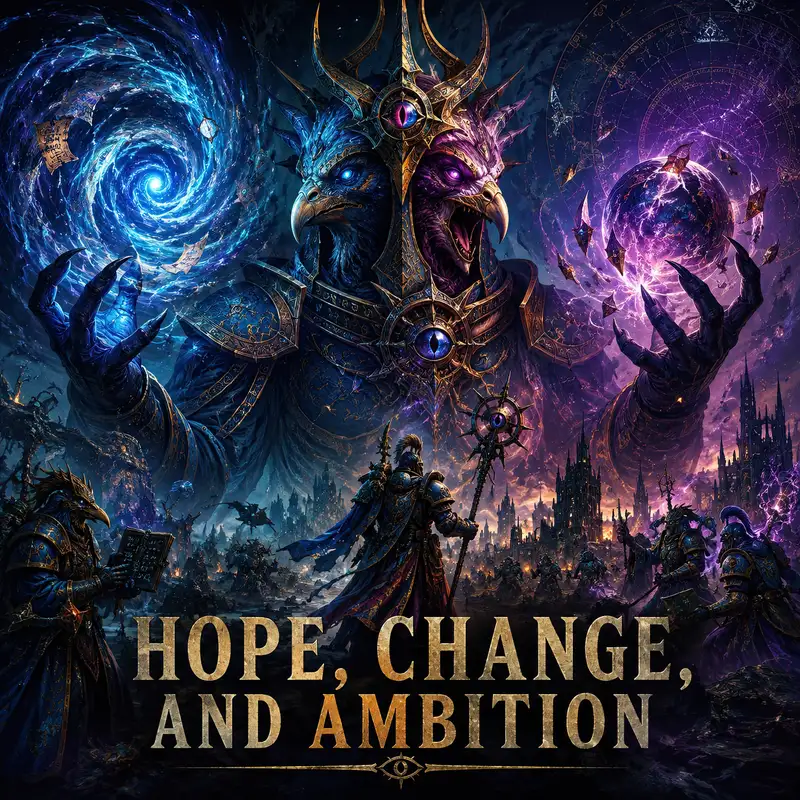
Tzeentch Beyond Schemes: Hope, Change, and Ambition
The most dangerous prayer to Tzeentch does not begin with his name. It begins with four quiet words: things could be better. A prisoner imagines the door unlocked. A scholar believes one forbidden page could cure a plague. A junior officer knows the war would be won if only wiser hands held command. None of them needs to crave mutation, daemons, or sorcery. They need only look at the world as it is and refuse to accept it. In the forty-first millennium, that refusal can be noble. It can also begin a chain ending with a city burning in colours no human eye was built to see. Tzeentch is commonly described as the god of schemes, as though the Warp had produced an especially patient spymaster. The schemes are only the visible machinery. Beneath them are hope, change, and ambition: the conviction that tomorrow can be different, and that someone clever enough has the right to make it so.
The Chaos Gods are not tidy deities with fenced responsibilities. They are vast powers of the Warp, shaped and sustained by the emotions, impulses, and repeated actions of living minds. Khorne is more than anger. Nurgle is more than disease. Slaanesh is more than pleasure. In the same way, Tzeentch is more than deception. Called the Changer of Ways, the Architect of Fate, and the Lord of Sorcery, his domain includes transformation, possibility, knowledge, magic, ambition, and the effort to bend events toward a desired future. His daemons are psychic energy given form, and their shifting bodies reflect a power that cannot remain settled. Even Horrors of Tzeentch divide, change colour, alter temperament, and continue the argument after being cut apart. With Tzeentch, destruction is rarely permitted the dignity of being final.
Hope belongs within that domain because hope is an act of imagination. It compares the present with a future that does not yet exist. It says that the prison can be opened, the disease can be cured, the war can be won, the dead can be restored, or the self can become greater than it is. Hope is not automatically good. A rebel hopes to overthrow a tyrant. A tyrant hopes to crush the rebellion. A physician hopes to save a patient. An ambitious courtier hopes to inherit the physician’s hospital after arranging an unfortunate inspection. The moral difference matters greatly to the people involved. The Warp is less discriminating. It feels the longing and pressure for change. Tzeentch is not the patron of better futures. He is the power that grows wherever minds strain to replace the present with something else.
That distinction explains why Tzeentch is so dangerous in the Imperium of Man. The Imperium is built upon stagnation amid permanent crisis. Its institutions insist that the old ways are sacred, even when no one remembers why those ways began. Knowledge is restricted. Innovation is suspect. Social position is inherited, assigned, or enforced at gunpoint. A gifted worker may spend an entire life maintaining a machine whose purpose has been forgotten. A competent officer may serve beneath a noble who regards maps as suspiciously intellectual. The Imperium has many procedures for obedience and comparatively few for constructive criticism. This leaves endless people who see what is wrong but have no lawful means to change it. Hope becomes private. Ambition becomes secret. Reform becomes conspiracy. Tzeentch need not invent the first grievance. The Imperium manufactures those on an industrial scale.
Corruption often begins without robes or whispered invocations. It begins with an exception. A savant opens a sealed archive because the official records are inadequate. A psyker reaches slightly farther into the Warp because conventional methods will not save the ship. A commander falsifies one report to move troops where they are actually needed. The choice may work. That matters. Chaos is more seductive when the first step produces a result. The archive contains the missing answer. The ship survives. The troops arrive in time. Success becomes evidence that caution was cowardice and rules were obstacles designed by lesser minds. The next exception is easier. Soon the reformer is not asking whether a boundary should be crossed, but which boundary remains. When the voices begin offering advice, the victim may regard them as recognition long overdue.
Ambition supplies the forward motion. Tzeentch appeals to those who believe they could do more, know more, rule better, or become something greater. Ambition can be petty, like a clerk plotting for promotion, imperial, like a governor seeking a throne, or sincere. A researcher may want the authority to distribute a cure. A military officer may seek command because the current commander is genuinely incompetent. A psyker may desire mastery because untrained power kills innocent people. These motives differ, but each can create the same dangerous conclusion: I alone understand what must be done. Once that thought hardens, other people become obstacles, assets, or acceptable losses. The future is elevated above those who must survive the journey toward it. Tzeentch does not merely promise success. He encourages the believer to see resistance as proof that success requires still greater power.
Knowledge is central to this temptation because knowledge changes the person who possesses it. In the Imperium, information is not neutral. A forgotten name can open a warded vault. A scrap of xenos mathematics can redirect a fleet. A prohibited text can reveal that an accepted religious truth was edited three thousand years ago for administrative convenience. The Adeptus Mechanicus guards technical understanding through monopoly and ritual, while the Inquisition suppresses truths judged too dangerous for ordinary minds. Sometimes that caution is tyranny. Sometimes the forbidden book contains a sentence capable of eating the reader’s soul. The difficulty lies in knowing which is which before opening it. Tzeentch thrives in that uncertainty. Every sealed door becomes a challenge, and every warning sounds like an attempt by the ignorant to preserve their authority.
Sorcery is the purest expression of the same principle. A psyker does not merely understand reality. A psyker can impose thought upon it. Distance folds. Fire appears without fuel. Minds open. Futures flicker at the edge of perception. The normal order of cause and effect becomes negotiable, which is precisely the sort of administrative flexibility the universe was not designed to survive. Tzeentch is therefore associated with magic not simply because magic is mysterious, but because it is change enacted by will. The sorcerer says that natural law is not a boundary, only a problem awaiting sufficient insight. Success strengthens that confidence. Every failure invites another theory, another sacrifice, and another attempt. The search becomes endless because the Warp does not reward perfect understanding. It is an ocean made partly from the mind of the person trying to chart it.
Mutation reveals the price hidden inside the promise. Tzeentch offers transformation, but transformation does not stop when the recipient is satisfied. A servant may receive sharper senses, strength, prophetic sight, or a mind perceiving patterns invisible to ordinary humans. The same gift may continue until eyes open across the skin, limbs become symbols of an argument no one remembers, or the mind fragments beneath too many possible futures. Chaos boons and punishments often use the same method. The difference is largely a matter of timing and perspective. A champion may celebrate the first alteration as proof of favour and conceal the fifth beneath armour. By the tenth, concealment may require a building. Tzeentch’s change is not personal growth guided by a compassionate teacher. It is change as a cosmic appetite, indifferent to whether the subject remains capable of recognising the person who first asked for help.
This explains the endless schemes. A plot is a machine for producing change. It moves people from loyalty to betrayal, ignorance to knowledge, weakness to power, and certainty to doubt. One scheme creates rivals. Rivals create counter-schemes. Every secret produces suspicion, every victory alters the board, and every alteration demands a new plan. The apparent objective may matter, but the process matters more. Accounts of Tzeentch often present designs nested within designs, some contradicting others and some damaging his own servants. Mortal observers assume there must be one final arrangement with every piece where Tzeentch intended. The truth may be messier. A final, permanent victory would end possibility. For a god of change, perfect control risks becoming another form of stagnation. One interpretation is that Tzeentch does not seek to finish the game. He seeks to ensure that no one else can stop playing it.
His natural rival is Nurgle. Nurgle offers endurance, acceptance, and release from the pain of resistance. Tzeentch offers escape, improvement, and the possibility of becoming something else. Nurgle whispers that suffering is inevitable, so one should cease struggling against it. Tzeentch whispers that suffering proves the present order must be overturned. Both speak to the same desperate person. One says, accept what you are. The other says, reject every limit placed upon you. Neither promise is as generous as it first appears. Nurgle’s comfort leads toward decay and dependency. Tzeentch’s hope leads toward restless dissatisfaction, where every achievement becomes merely the platform for another transformation. Their conflict is more than plague against sorcery. It is a war between resignation and aspiration, fought inside every mind that asks whether survival means enduring the world or remaking it.
Kairos Fateweaver embodies the problem of Tzeentchian knowledge. He is a two-headed Lord of Change whose sight reaches into past and future. One head perceives what has been, the other what may come, yet the present remains his weakness. The image is almost too precise. Perfect memory and immense foresight do not guarantee understanding of the moment in which a decision must actually be made. Warp futures are possibilities, branching and colliding under choice. To see more of them can grant power, but it can also make action harder. Which future is real? Which warning prevents the disaster, and which warning causes it? Kairos represents the arrogance of believing that enough information can eliminate uncertainty. Tzeentch’s servants pursue prophecy because they want control, only to discover that foreknowledge creates new variables the instant anyone acts upon it.
Magnus the Red demonstrates the seduction tragically. Magnus was not born longing to become the servant of a Chaos God. He valued knowledge, reason, and the psychic potential of humanity. He believed ignorance was a prison and that disciplined understanding could open it. His Legion, the Thousand Sons, shared that confidence while suffering from the flesh-change, a curse of mutation that destroyed their bodies and threatened their existence. Magnus sought a solution and accepted aid from a power he did not fully understand. The result appeared miraculous. The Legion was preserved. The deeper cost remained hidden. This is Tzeentch’s preferred bargain, not a crude contract, but a successful answer that convinces the recipient he was right to ask.
Magnus’s virtues and flaws were tightly bound together. Compassion drove him to save his sons. His faith in knowledge made him believe every force could be understood. His immense power encouraged the conviction that warnings applied chiefly to lesser minds. When the Emperor forbade the use of psychic sorcery after the Council of Nikaea, Magnus did not become less certain. He believed the ruling mistaken and had reason to resent it. Yet when he later tried to warn the Emperor of Horus’s betrayal, he used overwhelming psychic force to break through barriers he did not comprehend. The warning was true. The method was catastrophic. Here lies the cruelty of Tzeentchian corruption. A person can be correct about the danger, sincere in the attempt to prevent it, and still become the instrument through which a greater disaster enters.
Prospero completed the trap. Misunderstanding, manipulation, pride, and violence brought the Space Wolves against the Thousand Sons. Their home burned, their learning was shattered, and the survivors were driven into the Warp. Magnus eventually became a Daemon Primarch of Tzeentch, but describing this as a simple conversion misses the tragedy. Tzeentch did not need to replace everything Magnus valued. He needed to bend those values until they served another purpose. Protecting knowledge became contempt for those deemed ignorant. The wish to guide humanity became the assumption that humanity must be guided by superior minds. Hope for psychic evolution became a gamble with powers treating souls as material. Magnus did not fall because hope was false. He fell because he believed his hope, intelligence, and intention made him master of every consequence.
Ahriman repeated the pattern in a different form. After the Heresy, mutation again ravaged the Thousand Sons. Ahriman, their former Chief Librarian, refused to watch his brothers dissolve into monsters. He gathered fellow sorcerers and cast the Rubric, a working intended to halt the flesh-change. It succeeded. It also transformed most of the Legion into dust sealed within their armour, their remaining spirits bound to hollow shells. Powerful psykers survived with magnified abilities, while the brothers they meant to save became silent automata. Ahriman was exiled, yet he did not surrender his purpose. He continues to seek forbidden knowledge and a way to reverse the Rubric. His perseverance looks almost heroic from a distance. Up close, it leaves worlds ruined and lives spent as components in an experiment that has lasted millennia.
Ahriman is one of Tzeentch’s sharpest ironies because he frequently acts as though he can oppose the design that ensnares him. He seeks freedom from error through greater knowledge, and every failure convinces him that the missing answer lies in an even more dangerous archive. He wants to restore his brothers, but his quest continually deepens his identity as the Arch-Sorcerer of Tzeentch. Whether the god arranged every step matters less than the pattern. Ahriman supplies his own chains. Hope drives him forward. Ambition assures him he can succeed where all others failed. Change remains the method, the objective, and the consequence. The Rubric Marines beside him provide the final contradiction: a servant of the god of change commanding warriors trapped in the same unchanging condition, while pursuing one more transformation that will supposedly make everything right.
The Thousand Sons show why Tzeentch cannot be reduced to clever plans. Their entire history is built from admirable desires carried beyond safe limits. They wanted to preserve knowledge amid destruction. They wanted humanity to understand its psychic nature rather than fear it. Magnus wanted to save his sons. Ahriman wanted to save them again. None required theatrical villainy, fortunate because most of the Legion could not manage a moustache after becoming dust. The horror lies between noble intention and monstrous result. Tzeentch does not always tempt people to abandon what they love. He offers them the power to protect it, improve it, or perfect it, then makes that mission so absolute that everything else can be sacrificed.
The process works far below primarchs and legendary sorcerers. A Tzeentchian cult may begin among workers who want relief from impossible quotas, scholars trying to preserve banned history, or officials who believe their superiors are leading a world toward collapse. The cult may share information, expose corruption, or solve problems the authorities ignored. Its members learn secrecy protects them and manipulation produces results. Then the circle narrows. Outsiders become unreliable. Doubters become threats. Every setback proves that hidden enemies are more powerful than expected. Every success proves that the leadership was chosen by destiny. Ritual enters as another tool, then becomes the tool upon which all others depend. When open worship appears, the cult may no longer see itself as corrupted. It sees itself as the only group brave enough to do what history requires.
This does not mean every hope feeds directly into damnation, or that every ambition is secretly worship. Warhammer’s moral universe is brutal, but not quite so mechanically bleak. People can hope without calling to Tzeentch. They can seek knowledge while respecting limits, pursue reform without reducing others to pieces, and use power without believing themselves exempt from consequence. The danger appears when hope becomes entitlement, change is valued merely as change, and ambition makes an imagined future more important than people in the present. Tzeentchian corruption turns possibility into obsession. It cannot accept that some doors should remain closed, some victories are too costly, and some failures must be mourned rather than reversed at any price.
That is why Tzeentch’s gifts never settle the recipient. Power reveals greater power beyond reach. Knowledge uncovers a deeper mystery. Promotion exposes a higher throne. Prophecy reveals another future that must be prevented. Even triumph creates uncertainty, because completed ambition leaves the champion asking what comes next. Tzeentch offers motion without arrival. His servants climb staircases that rearrange themselves beneath their feet, convinced the next landing will finally provide a clear view. There is always another landing, another secret, and one more necessary betrayal, justified as the final compromise before the better world begins.
Tzeentch beyond schemes is the god of the sentence, I refuse to remain what I am. That refusal may begin in courage. It can inspire resistance to tyranny, the pursuit of understanding, or the determination to save those who would otherwise be lost. Tzeentch’s corruption does not make those desires worthless. It reveals how easily they can be severed from humility, restraint, and responsibility. Hope becomes dangerous when it promises that no cost is final because the future will justify it. Change becomes monstrous when people are treated as raw material. Ambition becomes slavery when the climber can no longer choose to stop. The Changer of Ways does not merely hide behind conspiracies. He waits inside the better tomorrow that must be achieved at any price. In the darkness of the Imperium, a whispered promise that things will be different can be more dangerous than a shouted oath to Chaos.