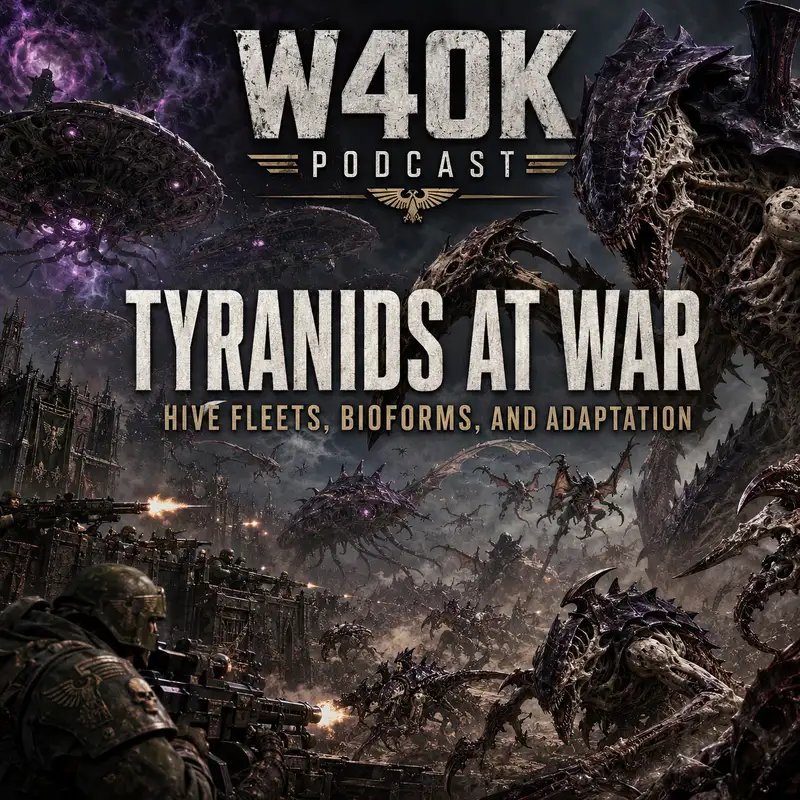
Tyranids at War: Hive Fleets, Bioforms, and Adaptation
The defenders knew the swarm was learning when the bodies stopped piling up in the same places.
During the first assault, the smaller creatures had rushed the walls and died beneath overlapping fields of fire. During the second, they had come through drainage channels and maintenance trenches. By the third, the largest organisms advanced behind walls of hardened chitin while winged beasts attacked the gun crews from above. The fortress had not changed. The enemy had.
That is the central fact of Tyranid warfare. A Tyranid army is not simply a mass of alien creatures directed by some distant intelligence. It is a temporary biological answer to a military problem. If that answer fails, the Hive Mind does not mourn its losses, defend its reputation, or insist that the original plan was fundamentally sound. It grows a better answer.
Most armies in the galaxy divide themselves into recognisable parts. They have soldiers, officers, vehicles, supply formations, communications networks, hospitals, factories, and fleets. The Tyranids blur every one of those distinctions. Their ships are organisms. Their weapons are organisms. Much of their ammunition is alive. Their commanders are bred for command, their artillery is grown for artillery, and their assault troops may exist only long enough to cross a single battlefield.
Even the word army is slightly misleading. A hive fleet is closer to a migrating ecosystem that has discovered military strategy.
At the centre of that ecosystem is the Hive Mind, a vast gestalt consciousness linking the Tyranid swarms across enormous distances. It should not be imagined as a single creature sitting upon a throne and issuing spoken orders. No known Tyranid sovereign studies maps in a chamber while subordinates wait for instructions. The Hive Mind is expressed through the combined psychic presence of countless organisms, especially the synapse creatures that carry its will into battle.
Within that network, individual beasts can act with terrifying coordination. Gaunts that would otherwise behave like predatory animals advance in disciplined waves. Artillery organisms fire in support of creatures they cannot see. Winged swarms alter direction together. Larger beasts exploit openings almost as soon as those openings appear. What looks like a stampede from a distance may be a carefully layered attack conducted by a mind too large for the defenders to perceive.
This does not make every Tyranid creature equally intelligent. A Termagant is not secretly a philosopher with poor social skills. Lesser organisms possess instincts suited to their functions. Synapse brings those instincts under a greater purpose. Tyranid Warriors, Hive Tyrants, Neurotyrants, Zoanthropes, and other command organisms act as nodes in the living network. Destroy those nodes, and nearby creatures may lose coordination, falling back upon hunger, aggression, or self-preservation.
Imperial commanders learned to target synapse beasts for exactly that reason. Unfortunately, the Hive Mind learned that they had learned.
Redundant synapse creatures appeared. Command organisms were protected more carefully. Some broods were bred with stronger instincts or greater independence. The network became harder to sever with a single well-placed strike. The lesson was unpleasant but clear. A weakness in a Tyranid invasion may remain a weakness only until it is exploited often enough to become useful information.
The first stages of an invasion may begin long before the main hive fleet arrives. Genestealers can infiltrate ships, stations, and worlds, spreading hidden bloodlines that grow into cults. Lictors and related vanguard organisms stalk the wilderness and the ruins, gathering information through senses far beyond those of ordinary troops. They locate command posts, power systems, airfields, defence lasers, and isolated leaders. They do not need to send a conventional reconnaissance report. What they learn becomes part of the swarm’s understanding.
By the time the defenders see the first great shapes moving in the void, their world may already be compromised.
Then comes the Shadow in the Warp. Astropathic communication becomes uncertain or impossible. Psykers feel a pressure that is often described as a crushing psychic presence, though descriptions vary because those experiencing it are rarely in a condition to provide tidy testimony afterward. Navigators struggle. Dreams turn violent. Panic spreads among people who do not yet know what is approaching.
The Shadow is not merely terror used as a weapon, though it certainly accomplishes that. It is the psychic weight of the Hive Mind drawing near. A world under its influence becomes isolated at the precise moment it most needs help. Requests for reinforcement vanish into silence. Reports arrive late, corrupted, or not at all. Imperial bureaucracy is fully capable of losing a planet without alien assistance. The Tyranids simply make the process more efficient.
In space, the hive fleet is composed of living vessels ranging from smaller escorts to immense bio-ships. They carry broods, spores, and the biological infrastructure of invasion. Their weapons may spit corrosive fluids, launch living projectiles, or extend great tendrils toward enemy ships. Damage that would cripple a conventional vessel may be endured, sealed, or regrown if the organism survives. Yet Tyranid fleets are not invulnerable. They can be destroyed, diverted, starved, and outmanoeuvred. In fact, stopping an invasion in space is often the best chance anyone has.
Once the swarm reaches the ground in strength, the problem becomes considerably less polite.
The first waves establish contact, test resistance, and overwhelm exposed positions. Spore mines drift or crawl into likely avenues of approach. Gargoyles and other winged organisms crowd the skies. Termagants bring living firearms, while Hormagaunts close with speed that can turn a defensive line into close combat before many soldiers have understood what they are seeing.
Those creatures are expendable, but not pointless. Every attack reveals something. Where are the mines? Which weapons penetrate the carapace? How quickly can the defenders shift reserves? What happens when the power grid fails? Which species protects its wounded, and which abandons them? The Hive Mind learns the habits of its prey along with the strength of its armour.
Behind the smaller creatures come the organisms designed to break what remains.
Carnifexes are living battering rams, bred to smash fortifications, vehicles, and dense infantry positions. Tyrannofexes and Exocrines provide immense biological firepower. Biovores seed the battlefield with living mines. Zoanthropes weaponise psychic force. Raveners tunnel beneath defensive positions. Lictors isolate officers and specialists. Harpies and other aerial beasts strike from above. The names assigned by Imperial savants make these creatures sound like separate species gathered into an army. In practice, they are specialised organs grown by the same larger system.
Their weapons follow the same principle. A fleshborer does not fire a metal bullet. It launches a ravenous organism. Other weapons spit acids, hurl parasitic creatures, drive hardened spines through armour, or project organisms that feed upon heat and flesh. The Tyranids have no industrial base in the conventional sense because they do not need one. Their industry moves with them, gestating inside ships and breeding chambers.
This is one reason the distinction between creature and equipment becomes unreliable. A gun may be bonded to the creature carrying it. Smaller organisms may live within larger ones. Ammunition may possess its own appetite. The result is not technology as the Imperium understands it, but biology forced into the role of technology with very little concern for the comfort of anyone involved.
Above the battlefield stand the command and apex organisms. Hive Tyrants combine physical power with the ability to direct the swarm. The Swarmlord is a rarer and more formidable expression of that pattern, remembered across multiple wars and recreated when the Hive Mind requires its strategic ability. Newer horrors such as the Norn Emissary and Norn Assimilator show the same principle pushed toward a specific purpose. One is shaped to hunt vital leaders and dominate through psychic force. The other is built to destroy the hardest targets in its path.
These are not heroes in the human sense. They do not seek honour, legacy, or recognition. They are missions given flesh.
The hive fleets themselves display distinct patterns of warfare. These differences are not uniforms, traditions, or cultural preferences. They are adaptations developed through long campaigns of consumption.
Hive Fleet Behemoth struck the Imperium with direct and overwhelming force. Its assault on Ultramar culminated at Macragge, where the Ultramarines committed their veteran First Company to the defence of the polar fortresses. Those warriors died to the last, surrounded by the bodies of the creatures they had killed. In orbit, the struggle against the hive fleet cost ships and lives on a scale that transformed victory into survival by the narrowest margin.
Behemoth taught the Imperium that the Tyranids could be stopped. It also taught the Tyranids what the Imperium would do to stop them.
When Hive Fleet Kraken arrived centuries later, it did not simply repeat Behemoth’s advance. Its tendrils spread across a wider front, striking many targets and dragging multiple powers into the war. The Aeldari craftworld Iyanden was nearly destroyed. Imperial worlds fell. The swarm’s dispersed approach made it harder to identify a single decisive point where one grand victory might end the invasion.
Kraken behaved less like a spear and more like a net.
Hive Fleet Leviathan then approached on an even more alarming scale, with tendrils entering the galaxy from directions that undermined earlier assumptions about where the main Tyranid threat lay. Its wars reached the Octarius Sector and the realm of the Blood Angels. At Baal, the Blood Angels and their successor Chapters faced near destruction while the greater galaxy was already breaking apart under the opening of the Great Rift.
Even apparent victories against Leviathan proved temporary. Tendrils were severed. Swarms were burned. Worlds were denied to the fleet. Yet the greater organism remained. Later assaults emerged on the western fringes of the Imperium, revealing that what had been fought before was not necessarily the whole threat. Humanity had celebrated the destruction of jaws while the rest of the beast was still approaching.
Other hive fleets demonstrate more specialised forms of adaptation. Gorgon became infamous for toxins that changed rapidly against resistant enemies. Jormungandr favoured burrowing assaults and subterranean approach. Some fleets developed stronger ranged capabilities or methods suited to enemies that offered little useful biomass. The exact boundaries between stable hive fleet traits and temporary responses are not always clear, but the pattern is unmistakable. The Hive Mind does not require one universal method of war.
It requires a method that works here.
Adaptation, however, should not be mistaken for magic. A Tyranid creature does not watch a lascannon strike its neighbour and instantly grow the perfect armour before the next shot arrives. The process operates at several levels. Individual organisms may alter behaviour. Synapse creatures may redirect broods and change tactics. New waves may be spawned with different weapons, senses, armour, or metabolism. Over longer campaigns, the hive fleet can rework entire strains and emphasise the traits that best answer local resistance.
The raw material comes from consumption. Tyranids absorb biomass and genetic information from the worlds they devour. Useful traits can be broken down, recombined, and expressed in later organisms. The Hive Mind’s genius lies not only in inventing new forms, but in treating life itself as a library of possible weapons.
That library is vast, but it is not free. Every organism costs biomass. Every failed assault spends resources. Every specialised creature represents an investment that may become less useful when the enemy changes tactics. Tyranid adaptation is powerful because the swarm can accept losses that would destroy the morale and political will of other armies. It is not powerful because losses have no material cost.
This creates the basic strategy for those trying to survive. Deny the fleet biomass. Destroy its ships before they can feed. Separate broods from synapse. Force it to spend more than it gains. Change tactics before the Hive Mind can settle upon an efficient answer. Strike command organisms, then exploit the confusion. Evacuate what can be saved and burn what cannot.
None of these measures is pleasant. Several are almost as destructive as the invasion itself.
Inquisitor Kryptman’s response to Hive Fleet Leviathan remains the most infamous example. Worlds in the fleet’s path were subjected to extermination so their populations and ecosystems could not become Tyranid fuel. Another part of the strategy drew Leviathan into the Ork empire of Octarius, where two enemies of the Imperium could be encouraged to destroy one another.
The logic was cold, ruthless, and strategically understandable. It was also catastrophic. Denying biomass could slow the Tyranids, but the war in Octarius created a prolonged contest between organisms and Orks that both thrived on conflict. Kryptman was condemned for the scale of the destruction he ordered. His methods may have purchased time. They did not produce safety.
That distinction follows every Tyrannic War. Time is what most victories buy.
A world can defeat the first landing waves and still fall when the next wave changes. A fleet can destroy one tendril while others pass beyond sensor range. A famous commander can kill a Hive Tyrant and later face a creature carrying the same strategic pattern in a new body. The Tyranids do not preserve individuals because the information that made an individual useful can be preserved elsewhere.
This is especially disturbing in the case of the Swarmlord. Imperial accounts present it as a recurring leader-beast, encountered in different wars and recreated by the Hive Mind. Whether every detail attributed to it belongs to one continuous consciousness is uncertain, and perhaps the distinction matters more to humans than to Tyranids. The strategic memory survives. The body is replaceable.
The defenders, by contrast, cannot reproduce a veteran officer from stored experience. They cannot regrow a destroyed fortress during the battle. They cannot turn their dead into both food and reinforcements. Every Imperial lesson is purchased with lives that remain lost. Every Tyranid lesson is purchased with creatures designed to be spent.
When resistance finally collapses, the nature of the invasion becomes fully clear. Tyranids do not conquer in order to rule. They do not raise flags, impose taxes, recruit collaborators, or argue over the succession. Feeder organisms swarm across the surface. Biomass is broken down and gathered. Seas, forests, animals, defenders, and the Tyranids’ own dead become material for the fleet. The atmosphere is stripped. The living abundance of a world is drawn upward into the waiting ships.
The planet left behind is not occupied territory. It is an empty shell.
This final stage explains the military logic of everything that came before. Gaunts are not citizens of a Tyranid empire. Carnifexes are not veterans expecting retirement. Even the greatest battlefield organisms are temporary concentrations of useful matter. When their work is finished, they too may be consumed and remade.
The Hive Mind wages war without the political burdens that shape every other power in the galaxy. It has no public to reassure, no noble houses to appease, no industrial guilds to protect, and no sacred pattern of warfare that pride forbids it to abandon. It can spend a million organisms to discover one weakness, provided the weakness leads to more biomass than the attack cost.
That freedom is the source of Tyranid strength. It is also the nearest thing they possess to a belief.
The Imperium fights to preserve worlds, institutions, bloodlines, relics, and memories, even when those things hinder the defence. The Aeldari fight knowing every lost life brings their people closer to extinction. The T’au must hold together an empire of many species. The Orks seek the joy and status of battle. Chaos pursues desire, worship, vengeance, or transformation.
The Tyranids seek no future beyond the next act of consumption. Their unity is complete because nothing within the swarm is permitted a separate purpose.
That does not make them unbeatable. Behemoth was broken. Kraken was checked. Leviathan has lost tendrils, battles, and worlds it intended to consume. Individual broods can be deceived. Synapse can be disrupted. Hive ships can be killed. Adaptation can be outrun, misdirected, or made too expensive.
Yet every victory demands that the defenders solve the same problem again under different conditions. The fortress commander who defeats a swarm has not disproved the Hive Mind’s strategy. He has submitted a battlefield report to it.
That is why Tyranids at war are more dangerous than their numbers, their monsters, or their hunger. A hive fleet does not arrive with one army. It arrives with the capacity to grow many armies, each shaped by the failures of the last. Its dead are raw material. Its defeats are research. Its commanders are replaceable expressions of a mind that remains beyond reach.
On the final day, the guns may still be firing when the first digestion pools spread across the ruins. The defenders may believe they are holding a line, buying time for relief, or protecting the memory of everyone who died there. Above them, the hive ships wait while the world is reduced to nutrients and information.
The Tyranids do not need to remember the planet’s name. They will remember how it fought.