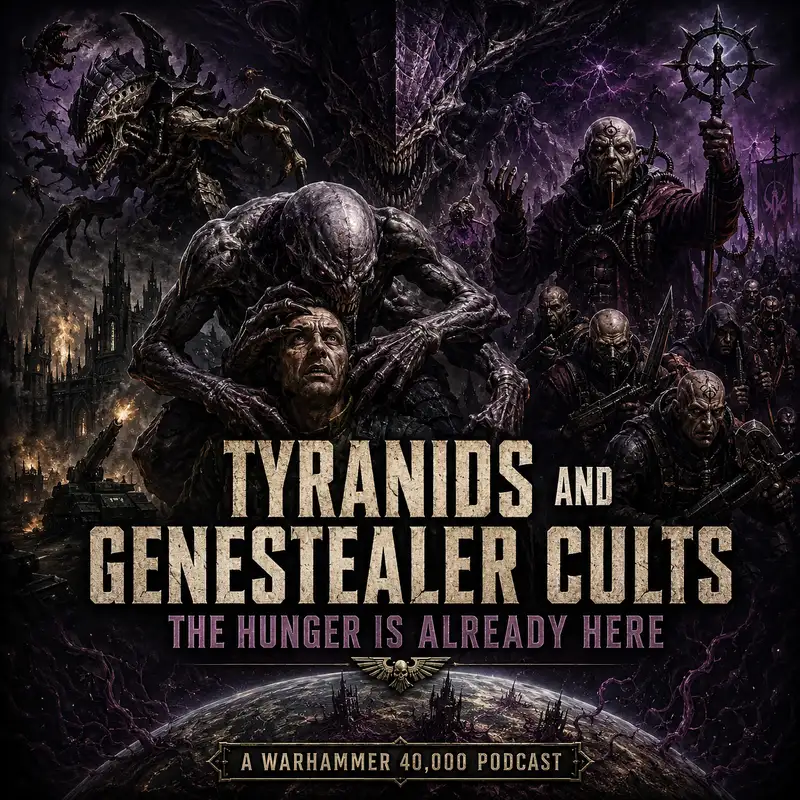
Tyranids and Genestealer Cults: The Hunger Is Already Here
The first sign of a Tyranid invasion may not be a living ship crossing the edge of a star system. It may be a missing dockworker, a sealed maintenance tunnel, or a family in the lower hive that suddenly becomes very protective of its new religion. By the time the guns look upward, the enemy may already control the power stations, the freight elevators, the planetary defence batteries, and several people responsible for reporting that everything is perfectly normal.
That is what makes the Tyranids different from almost every other great enemy in Warhammer forty thousand. Orks arrive loudly. Chaos announces itself through corruption, mutation, rebellion, and the occasional tear in reality. Necron tomb worlds wake beneath your feet, which is unpleasant but at least reasonably direct. Tyranids can approach as a fleet, a swarm, a plague, and a family secret. Their hunger does not merely cross the void. It infiltrates the society it intends to consume.
The Tyranids come from beyond the galaxy. No reliable account explains where they began, how much they have already devoured, or whether the hive fleets seen so far represent the main body of the species. Imperial scholars have attempted estimates. Those estimates tend to become less comforting with every new invasion. What is known is simple enough. The Tyranids travel in immense living armadas called hive fleets, and every vessel, weapon, soldier, and support organism is biological. Their ships are creatures. Their ammunition is alive. Their artillery may give birth to the thing it fires. Tyranid logistics are what happens when an ecosystem develops a military doctrine.
Behind these countless organisms is the Hive Mind, an intelligence so vast and alien that calling it a commander is probably inadequate. A human general issues orders to separate soldiers. The Hive Mind appears to think through the swarm itself. Synapse creatures carry and focus that controlling presence, linking lesser organisms into a coordinated whole. Near those nodes, a Tyranid force can manoeuvre with terrifying purpose. When the link is broken, many creatures fall back on powerful instincts. They do not necessarily become harmless or stupid. A knife does not need strategic awareness to remain a knife.
The psychic pressure created by an approaching hive fleet is known as the Shadow in the Warp. Astropathic communication becomes difficult or impossible. Psykers suffer terror, confusion, or worse. Entire worlds can find themselves isolated just as they most need help. The darkness is not merely an electronic blackout. It is the mental presence of something too large to perceive clearly, pressing against every sensitive mind in the system. An Imperial governor may still possess armies, fortresses, and a very impressive collection of ceremonial uniforms. What the governor may no longer possess is a way to tell anyone that the planet is dying.
The Hive Mind does not conquer for territory in the ordinary sense. Tyranids do not plant flags, demand tribute, or replace one bureaucracy with another. They consume. Plants, animals, people, oceans, and useful organic material are broken down and absorbed. The genetic qualities of prey species can be studied and incorporated into future bioforms. Even the Tyranids killed during the invasion may be reclaimed. Victory turns the battlefield, the defenders, and much of the attacking army into raw material for the fleet.
This is why the image of Tyranids as very large insects is useful only until it becomes misleading. Some have chitin, claws, multiple limbs, and the general appearance of something discovered beneath a cupboard at the worst possible moment. Yet the swarm is not a collection of natural animals. It is a designed arsenal. A Termagant is a living infantry weapon. A Carnifex is a biological engine of demolition. A Hive Tyrant is a command organism built to direct war. Lictors stalk command posts and isolated prey. Genestealers infiltrate, ambush, and begin a far more patient form of invasion.
The Imperium first learned the scale of the threat through the destruction of the world called Tyran. The alien species took its Imperial name from that dead planet. Hive Fleet Behemoth then drove into Ultramar and nearly destroyed the Ultramarines on Macragge. Behemoth was stopped, but only after losses severe enough to demonstrate that this was not a single wandering species or a conventional raiding force. Later came Hive Fleet Kraken, spreading its tendrils across a much wider region, and Hive Fleet Leviathan, whose attacks made earlier victories look increasingly temporary.
Each hive fleet is named by the Imperium, usually after a monster from ancient human myth. The Tyranids do not appear concerned with the names. Behemoth, Kraken, and Leviathan are human attempts to divide an immense biological threat into categories that can fit inside reports. Those categories are useful, but they can create the impression that each fleet is a separate nation or personality. The truth is less comfortable. They may be distinct expressions of one intelligence, testing different strategies against a galaxy that keeps finding new ways to resist being eaten.
The great fleets are the visible part of the threat. Long before the main swarm arrives, vanguard organisms can move ahead of it. Some travel aboard Tyranid vessels. Others infest drifting space hulks, merchant ships, mining craft, or any transport unfortunate enough to carry them onward. Among the most dangerous are Genestealers, creatures fast enough to cross a chamber before trained soldiers have properly regretted opening the door.
A Purestrain Genestealer is a close-combat predator with four arms, powerful claws, and the speed to tear through heavily armoured prey. Its greater strategic importance lies in what it can do without killing. A victim may be seized and implanted with alien genetic material through a process the Imperium calls the Genestealer’s Kiss. The name sounds almost delicate. The procedure is not.
The infected victim returns to society changed. A psychic and biological compulsion binds that person to the Genestealer and influences future reproduction. The victim may conceal the creature, protect it, and begin a family shaped by the infection. Children born into this line are hybrids, carrying visible or hidden signs of Tyranid inheritance. The earliest generations are often markedly alien. Across successive generations, descendants can appear increasingly human, allowing them to move through Imperial society with far less suspicion. Later in the cycle, new Purestrain Genestealers may be born, ready to spread the infestation again.
The original Genestealer grows in physical and psychic power as the brood expands. It becomes the Patriarch, the centre of a shared psychic network called the Broodmind. To its followers, the Patriarch is not a monster lurking beneath the city. It is a sacred father, a prophet, and often the living representative of a coming divinity. The cult’s Magus gives spiritual and psychic direction. Its Primus prepares war. Other specialists emerge according to the needs and mutations of the brood. What began with one hidden creature becomes a community, then an organisation, and finally a parallel civilisation living inside the host world.
A Genestealer Cult is therefore not simply a group of people who have made an unusually poor religious choice. Many members are born into it. Their family bonds, psychic loyalties, faith, and sense of identity all point toward the same hidden centre. They may love one another sincerely. They may work, marry, raise children, endure hardship, and believe that they belong to something kinder than the society above them. The horror works because the affection is real, even when the purpose behind it is not.
Imperial worlds provide excellent soil for such a cult. Hive cities contain billions of people packed into industrial layers where entire populations may live and die without appearing in any meaningful record. Mining worlds send labourers into isolated tunnels. Forge worlds treat human bodies as replaceable components. Pilgrim routes and cargo lines move people across enormous distances. Local authorities are often corrupt, brutal, or simply too overwhelmed to investigate every disappearance. The Imperium has many methods for detecting heresy. It also has forms that must be submitted in triplicate, and the cult is breeding while the forms are in transit.
Genestealers often prey first upon people who will not be missed. The cult then offers what the Imperium withholds. Food may be shared. Children are protected. Work crews look after their own. The faithful are told that their suffering has meaning and that deliverance is coming from the stars. In a hive where the official religion teaches sacrifice to a distant Emperor and the local overseer demands another sixteen-hour shift, the promise of a loving divine family can be powerful.
This does not make the cult benevolent. Its compassion serves an alien reproductive strategy, and dissent is unlikely to receive a patient theological hearing. Yet dismissing every cultist as a fool misses the sharper point. Genestealer Cults recruit within genuine misery. Their propaganda succeeds because much of what they say about Imperial oppression is true. The chains are real. The deception concerns what waits after those chains are broken.
Over generations, the cult spreads into the systems that keep a planet alive. Miners gain access to explosives and deep tunnels. Dockworkers control cargo movement. Factory crews handle machinery and weapons. Administrators alter records. Members of local defence forces become Brood Brothers, outwardly loyal soldiers whose true allegiance lies beneath the skin. A mature cult does not need to defeat every Imperial institution from outside. It has relatives inside them.
Its religion adapts to local culture. On Imperial worlds, the coming power may be worshipped as the Four-Armed Emperor. The Tyranids become Star Children, divine liberators travelling across the heavens to reward their faithful. Familiar Imperial symbols are altered rather than discarded. This is practical camouflage, but it is also how belief works within the cult. Its members interpret their biological compulsion through the language they already know. The result is not a random collection of alien slogans. It is a theology built to survive inspection.
The cult waits for the Day of Ascension. That day may come when the brood is strong enough to seize the planet, when discovery forces an early uprising, or when the approaching hive fleet stirs the Broodmind into open action. Sabotage begins. Communication nodes fail. Munitions stores explode. Officers are murdered. Defence lasers turn upon loyal ships or fall silent at the critical moment. Crowds pour from hab blocks and mine shafts carrying industrial tools, stolen rifles, sacred icons, and generations of accumulated rage.
To an Imperial commander, the uprising can appear impossibly well coordinated. Rebellions are expected to suffer from divided leadership, uncertain goals, and poor timing. A Genestealer Cult has spent decades or centuries building bloodlines, cells, caches, and loyalties around a psychic centre. Its fighters may lack formal training, but they know the tunnels. They know the shift schedules. They know which officer drinks, which gate has not been repaired, and which armoury clerk is a cousin.
The uprising is not merely a distraction for the Tyranids. It can dismantle the world’s ability to resist before the first major spore clouds descend. Planetary aircraft may be destroyed on their fields. Void shields may be disabled. Reinforcements may be directed into ambushes. Food and fuel may disappear. Loyal citizens, already terrified by the Shadow in the Warp, discover that their neighbours have been preparing for this night all their lives.
Then the sky answers the cult’s prayers.
Living ships darken the system. The Shadow deepens. Spores fall through the atmosphere, carrying organisms bred for invasion. Fast creatures probe weak points. Swarms overwhelm defensive lines. Larger bioforms attack fortifications and armour. Synapse organisms impose coordination upon the assault, while the Hive Mind adapts its methods to the resistance it encounters. There is no clean separation between navy, army, air force, artillery, and supply service. The invasion is one predatory ecology arriving in layers.
A successful defence must therefore fight two wars at once. One is against the visible swarm. The other is against the collapse of trust. Every labour gang might conceal hybrids. Every refugee column might carry cult agents. Every unit that fails to answer could be dead, isolated, or waiting to fire upon its own side. Imperial suspicion, rarely in short supply, expands into panic. Authorities may purge innocent districts, creating fresh anger and wasting forces the planet cannot spare.
The cultists believe this is the hour of liberation. Their Patriarch leads them toward the newcomers. Their prophets proclaim that the Star Children have arrived. For generations, they have been taught that ascension means union, reward, and freedom from suffering. In a terrible sense, union is exactly what awaits them.
As the hive fleet closes in, the greater Hive Mind can absorb or overwhelm the cult’s Broodmind. Some cultists continue fighting in ecstatic devotion. Some accounts describe moments in which the psychic veil falls away and the faithful finally perceive the creatures before them as predators. Whether every cult experiences that revelation in the same way is unclear. Tyranid behaviour varies, and surviving testimony from consumed worlds is understandably limited. The broad outcome is not.
The cult is biomass.
Its Patriarch, hybrids, loyal workers, prophets, children, and soldiers are not partners in a new order. They are part of the harvest. Once resistance collapses, Tyranid organisms transform the planet itself. Native life and the dead of both armies are gathered into digestion pools. Great capillary structures rise to transfer liquefied organic matter toward waiting bioships. Tyranid creatures may hurl themselves into the same reclamation process. The fleet wastes little sentiment on veterans.
The final stage of a Tyranid victory is quieter than the invasion. Forests vanish. Seas are drained of useful life and material. The atmosphere can be stripped. The swarms that filled the horizon disappear into the feeding system. The fleet departs carrying the substance of the world, leaving behind a dead sphere and very little evidence that billions once believed, worked, feared, and prayed there.
That is the complete Tyranid method at its most efficient. First, locate the prey. Then isolate it. Weaken its defences. Attack with organisms suited to the resistance. Consume the defenders and reclaim the attackers. Learn. Move on. The process is horrifying not because it is driven by hatred, but because hatred may be unnecessary. A person can plead with an enemy. It is more difficult to negotiate with appetite operating on a planetary scale.
Yet the Tyranids are not invincible. Hive Fleet Behemoth was broken at Macragge. Kraken’s tendrils were defeated in major battles, though not erased. Leviathan has been diverted, wounded, and resisted across multiple war zones. Armies can kill synapse creatures. Fleets can destroy bioships. Worlds can uncover cults before ascension. The Imperium, Aeldari, T’au, Orks, Necrons, and forces of Chaos have all opposed Tyranid advances for their own reasons. The galaxy is exceptionally good at violence, and for once that is a useful quality.
The difficulty is that victory over one tendril does not answer the larger question. No one knows the full scale of the Tyranid presence outside the galaxy. No one knows whether the hive fleets already encountered are the bulk of the species, scattered hunting formations, or the leading edge of something far greater. Imperial maps show invasions approaching from different directions. That could mean the Tyranids have surrounded the galaxy. It could mean the fleets have taken complex routes. The available evidence does not provide a comforting interpretation.
Genestealer Cults make that uncertainty immediate. The Great Devourer is not only a distant mass somewhere beyond the stars. Its advance scouts can be hidden on a transport arriving tonight. A cult can survive after the fleet that spawned it is destroyed or diverted. It can spread through trade and migration, seeding new broods on new worlds. By the time investigators recognise the pattern, several generations may already regard the infection as ancestry, faith, and home.
This is why the phrase enemy within is almost too simple. The cult is within the city, the regiment, the workforce, and the family, but it is not experienced by its members as an invading force. To them, the Imperium may be the alien power. The governor’s soldiers are the oppressors. The Patriarch is kin. The coming fleet is salvation. The cult does not hide merely by wearing human faces. It hides inside real loyalties and justified grievances.
That is also why exterminating a cult is morally and militarily ugly. Some members are obvious hybrids and committed insurgents. Others may appear fully human and occupy every level of society. Entire communities can be bound to the Broodmind. Imperial authorities seldom approach such ambiguity with restraint. Purges may destroy the cult, or they may slaughter thousands of innocents while the true Patriarch escapes through a tunnel marked as inspected three years earlier.
The Tyranids represent hunger stripped of individuality, politics, and mercy. Genestealer Cults give that hunger a human voice. They let it speak of family, justice, faith, and liberation. The fleet attacks the body of a world. The cult enters its memory and teaches generations to welcome the teeth.
So the danger is not simply that the Tyranids are coming. They are always coming somewhere, crossing distances measured in years and ruined systems. The more disturbing possibility is that arrival is only the final stage. The first victory may have occurred long before anyone saw a spore, when one forgotten citizen disappeared beneath a hive and returned home convinced that everything was going to be all right.
By the time the stars go dark, the hunger has already learned the names of your children.