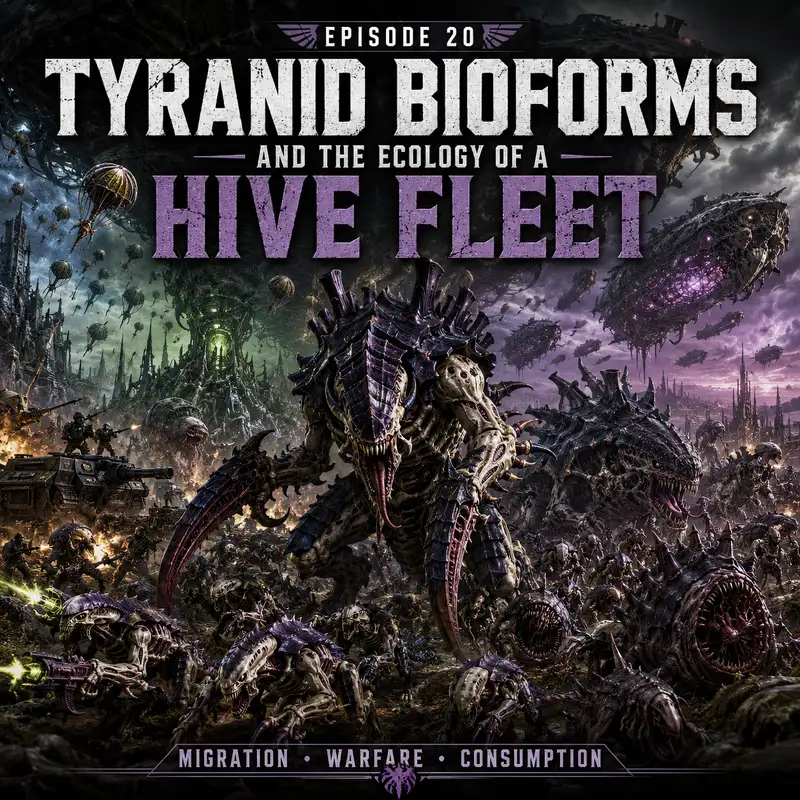
Tyranid Bioforms and the Ecology of a Hive Fleet
By the time the defenders understand that the forest is moving, the invasion has already passed beyond the language of war. The trees sweat unfamiliar spores. Rivers carry oily films of microorganisms that were not present yesterday. Creatures the size of dogs pour through shell holes, while things large enough to crush tanks move behind them with the patience of siege engines. Above the clouds, living ships eclipse the stars. The soldiers on the ground may believe they are facing an army. They are not entirely wrong. They are simply using a word far too small for what has arrived.
A Tyranid hive fleet is an invasion force, a migration, a factory, a nervous system, and a feeding organism at the same time. Its bioforms are not merely different species travelling together. They are temporary solutions grown for particular tasks, linked by the will of the Hive Mind and supported by an ecology designed to dismantle another ecology. A Termagant, a Hive Tyrant, a spore mine, and a vast bio-ship may look like separate creatures. Functionally, they are closer to cells, organs, and weapons belonging to a single distributed predator.
That distinction explains why Tyranid warfare feels so alien. Most armies must recruit soldiers, manufacture equipment, transport ammunition, and keep all of it supplied. A hive fleet grows what it needs. Its soldiers are bred aboard living vessels. Their armour is part of their bodies. Their weapons are symbiotic organisms grafted into claws or limbs. Their ammunition may be alive. Their transports are alive. Their fortifications take root, and their artillery digests food. Even the distinction between an infantryman and his rifle is, from the Tyranid point of view, an unnecessary administrative complication.
The Hive Mind provides the unity that makes this possible, but it should not be imagined as a commander speaking orders into millions of obedient heads. It is a vast psychic intelligence expressed through the entire swarm. Synapse creatures such as Tyranid Warriors, Zoanthropes, Neurotyrants, and Hive Tyrants act as powerful nodes within that network. Near them, lesser organisms move with coordinated purpose. Cut off from synapse, many revert toward instinctive behaviour. They may still hunt, hide, feed, or attack, but the wider battle plan begins to fray. This is not freedom. It is more like a severed hand continuing to twitch.
Within the largest hive ships, Norn Queens direct the gene-weaving that produces new bioforms. They are not queens in the familiar sense, and the term itself is an Imperial attempt to name something barely understood. They do not sit upon thrones receiving ambassadors. They manage heredity, mutation, and production on a scale that turns evolution into logistics. Genetic material gathered from consumed worlds can be examined, recombined, and expressed through later organisms. The spawning chambers around them are therefore armouries and wombs at once. A fleet does not open crates to replace losses. It converts stored matter into eggs, larvae, symbiotic weapons, and fully developed creatures appropriate to the campaign ahead.
Long before the main swarm descends, vanguard organisms begin preparing the world. Genestealers can infiltrate isolated communities and, through the slow spread of a cult, weaken a society from within. Lictors and related hunter forms stalk command posts, capture memories through their feeder tendrils, and identify weaknesses. Von Ryan’s Leapers wait in terrain where speed and camouflage matter more than raw mass. These organisms do not conquer a planet by themselves. They map its reflexes. They learn where authority lives, how reinforcements move, what the defenders fear, and which throat must be cut first.
Genestealer Cults complicate this vanguard role because their members can possess beliefs, families, hierarchies, and a genuine sense of liberation. They may worship the approaching hive fleet as celestial deliverance. When the Tyranids arrive, that faith does not guarantee survival. The cult has helped paralyse defences, sabotage institutions, and guide the invaders toward concentrations of life. Once its usefulness ends, its members are still biomass. Some accounts suggest the psychic revelation of what is coming can break the cult’s ecstatic certainty at the final moment. The promised angels descend, and the faithful discover that heaven has a digestive tract.
As the hive fleet draws nearer, the Shadow in the Warp settles over the target. Astropathic messages fail or arrive distorted. Psykers feel an immense alien pressure. Coordination beyond the system becomes difficult precisely when outside help is most needed. Then the atmosphere begins to change. Spore clouds thicken. Mycetic organisms fall from orbit carrying fresh broods. Winged creatures fill the sky. The invasion does not merely land on the world. It begins rewriting the world’s air, soil, and food chain so that the planet itself becomes increasingly hostile to its original inhabitants.
The smallest participants may be impossible to count. Spores seed toxic growths, alter local chemistry, and support larger organisms. Microbial life introduced by the fleet begins breaking down native matter before the great feeder beasts arrive. Alien vegetation can spread through ruins and battlefields, creating cover, releasing further spores, and making every breath more dangerous. A defender may burn a brood nest and still lose the district because the invasion is already active in drainage systems, reservoirs, and lungs. The Tyranids do not need to hold terrain in the conventional sense when they can make the terrain participate.
The first great waves are often made from gaunts. Hormagaunts are swift assault organisms built to close distance and tear through exposed prey. Termagants advance with living ranged weapons, flooding streets, trenches, and defensive lines. Gargoyles bring the same principle into the air. These creatures are frequently described as cannon fodder, which is accurate only if one remembers that the cannon also grew them, directs them, and intends to recycle whatever remains. Their deaths are not heroic sacrifices or tragic waste. They are expenditures of biomass made by an intelligence calculating whether the return will be greater than the cost.
Gaunts also reveal how narrow human military categories can be. A Hormagaunt is a soldier when it attacks a trench, a hunting animal when it chases survivors, and part of a digestive process when it drives prey toward larger organisms. Ripper swarms make the point even more clearly. They are small, voracious feeder creatures released in vast numbers once resistance is breaking. They strip organic material, swarm over corpses and vegetation, and help reduce the planet into matter that can be collected. The same invasion therefore produces its own scouts, infantry, vermin, slaughterhouse workers, and mobile mouths.
Lesser organisms can overwhelm by mass, but the swarm requires stronger conduits for deliberate control. Tyranid Warriors fill that middle ground. They are larger, more adaptable, and more capable than gaunts, while also extending the synaptic web across a battlefield. A brood of Warriors can anchor an assault, direct nearby creatures, and fight with an array of biological weapons. They are not junior officers in the human sense. They do not hold meetings, compose reports, or worry about promotion. Their authority is anatomical. They have been grown with a greater capacity to carry the Hive Mind’s will.
Above them stand the leader-beasts. Hive Tyrants combine physical power, psychic presence, and strategic coordination. Some are winged. Some are shaped for close combat or ranged destruction. The Swarmlord is the most famous expression of this idea, a recurring apex organism spawned when the Hive Mind requires exceptional military cunning. Its body can be destroyed, but the pattern and accumulated experience associated with it can be expressed again. This is not immortality in a human sense. There is no comfortable continuity of self to celebrate. It is the preservation of a successful weapon design, including the lessons written into it.
Where a defensive line must be broken, the hive fleet grows mass. Carnifexes are living battering rams, bred in multiple forms to smash fortifications, shred armour, or carry heavy bio-weapons. The Screamer-Killer is a particularly infamous strain, combining brutal close assault with blasts of bio-plasma. Larger organisms such as the Haruspex are built to consume as they advance, while Trygons, Mawlocs, and Raveners exploit the ground beneath a battlefield. A wall is useful against an enemy approaching from the front. It is less reassuring when the enemy treats geology as an optional route of march.
Tyranid artillery makes the same biological logic unpleasantly clear. Biovores launch spore mines, which are themselves living organisms able to drift, crawl, and detonate near prey. Exocrines serve as heavy gun-beasts, directing powerful bio-plasmic fire. Tyrannofexes carry enormous symbiotic weapons capable of destroying armoured targets. Pyrovores process matter and project burning chemicals. None of these creatures has been issued a weapon. The weapon is part of the creature, and often a separate organism bound to it. A Tyranid firing line is less like a battery of guns than a row of organs vomiting specialised violence.
Even the smallest weapons display this layered ecology. A fleshborer launches beetle-like organisms that tear into a victim. Devourers unleash living projectiles in swarms. Venom cannons propel corrosive crystals and toxins. Barbed stranglers fire seed-like organisms that grow violently within their target. Descriptions vary among strains and sources, because the Hive Mind continually alters what it breeds, but the principle remains consistent. Tyranid weaponry does not imitate industry with flesh pasted over metal. It replaces industry with controlled life, and then asks life to perform tasks that sane biology would consider grounds for resignation.
Other bioforms shape the battlefield rather than simply killing what stands before them. Venomthropes spread toxic cover around advancing swarms. Toxicrenes turn the air nearby into a weapon. Zoanthropes focus devastating psychic power, while Neurogaunts protect synaptic organisms and help extend their influence. Neurotyrants concentrate the psychic horror associated with the Shadow in the Warp. Psychophages consume victims touched by psychic energy and metabolise that strange feast into further violence. Each form occupies a niche. Together they function like an immune system, a communications network, and a chemical weapons corps grown from the same reservoir of flesh.
The sky and the void have their own niches. Gargoyles harry ground targets and seize the spaces above ruins. Winged Primes and Hive Tyrants move synaptic control rapidly across broken terrain. Harpies and Hive Crones operate as living attack craft. Above them, the bio-ships of the hive fleet travel between stars, breed armies, digest resources, and fight naval battles with weapons that are also organisms. Imperial observers call them ships because they move through space and attack other ships. That is useful language, but it can hide the reality. A hive fleet does not carry its ecosystem inside vessels. The vessels are part of the ecosystem.
Some threats are grown for a single, unusually important purpose. The Norn Emissary is created when the Hive Mind identifies a target that must be slain or an objective that must be seized. The Norn Assimilator is shaped for similarly focused destruction through overwhelming physical force. These towering organisms are not promoted from lesser ranks. They are distilled answers to a problem. Once the Hive Mind decides that a particular commander, relic, gate, or fortress matters enough, it can invest a great quantity of biomass into a creature whose entire existence is the completion of that one task.
This specialization can make Tyranid evolution appear magical, as though the swarm invents a perfect countermeasure the instant it encounters resistance. The reality is more disturbing and less convenient. The Hive Mind tests variations, observes results, preserves useful traits, and breeds new combinations. Some adaptations are rapid. Others emerge across repeated battles or entire campaigns. Different hive fleets display characteristic methods, yet none is frozen into a permanent order of battle. A failed organism is not an embarrassment to be hidden in an archive. Nothing is retained merely because it is ancient, prestigious, or familiar. It is data, meat, and perhaps the beginning of a more successful design.
That process also means the individual bioform has little significance outside its function. A Space Marine carries a Chapter’s traditions. A Guardsman may remember a home world, a family, or the name of the person beside them. Even an Ork has appetites, rivalries, and a rough sense of personal glory. Most Tyranid organisms possess nothing comparable that humans can recognise. Their instincts can be sophisticated, and certain creatures show cunning or recurring patterns of behaviour, but the swarm does not build a society for them. It grows a role, uses it, and reclaims the material.
As resistance collapses, the invasion changes character. Capillary towers rise across the landscape. Reclamation pools receive a flood of liquefied organic matter. Rippers and feeder organisms strip forests, oceans, crops, animals, and the dead from both sides. The atmosphere is harvested. Water is drawn away. Mineral content may also be taken where the hive fleet can use it. The final stage is not occupation. There are no Tyranid governors, settlements, or victory parades. The planet is processed until the world that existed before has been reduced to fuel for the next attack.
The swarm’s own armies are part of that harvest. Surviving organisms are not necessarily rewarded with a place aboard the fleet. Many descend into digestion pools with everything they helped kill. Their bodies are broken down and drawn upward through the capillary network. This is one of the clearest reasons to call a hive fleet an ecology rather than a conventional military. Its predators, workers, weapons, and battlefield infrastructure are temporary growths. Once the feeding cycle is complete, the distinctions between victor and victim become chemically unimportant.
The process is efficient, but not limitless. Biomass spent on an invasion must be recovered, and a costly campaign can weaken a splinter fleet. Synapse creatures can be targeted. Vanguard organisms can be discovered before the main assault. Fire, radiation, poisoned resources, and exterminatus can deny the fleet what it came to consume, though such remedies often resemble saving a house by removing the continent beneath it. Tyranid organisms can also be lured, divided, or forced into battles where the energy spent exceeds the material gained. The great predator can starve. The difficulty lies in surviving long enough to make it do so.
The great named hive fleets demonstrate how broad that adaptation can become. Behemoth struck with concentrated violence, driving immense force toward Ultramar until the Battle for Macragge broke its advance at terrible cost. Kraken spread through multiple tendrils, forcing defenders to confront attacks that were dispersed yet connected. Leviathan approached across the galactic plane in ways that overturned assumptions about where the next threat would appear, and its later resurgence opened another vast front. These names are Imperial labels, not Tyranid nations. They describe immense expressions of the same hunger, each carrying patterns of behaviour and biology suited to the path it has taken.
Defenders who think only in terms of enemy units often miss the larger threat. Killing gaunts matters, but so does burning spore growth. Destroying a Hive Tyrant matters, but so does severing the synaptic web it supports. Holding a fortress matters until the air outside becomes poisonous, the water table is draining, and burrowing organisms are beneath the foundations. Every phase of a Tyranid invasion supports the next. Scouts make the landing easier. The landing creates the conditions for predation. Predation supplies the machinery of consumption. Consumption becomes the next fleet.
This is why the endless variety of Tyranid bioforms is more than a collection of monsters. Each creature represents a military need translated into anatomy. Need more bodies, and the fleet grows gaunts. Need control, and it grows synapse organisms. Need a breach, and it grows Carnifexes. Need terror and information, and it sends Lictors. Need a commander removed, and it invests in a purpose-built hunter. Need a planet dismantled, and it grows towers, pools, spores, and uncountable feeder organisms until an entire biosphere has been turned against itself.
The Hive Mind’s greatest advantage is therefore not any single claw, cannon, or towering beast. It is the absence of boundaries that other civilizations depend upon. The Tyranids do not separate army from supply chain, technology from organism, weapon from wielder, or battlefield from feeding ground. Their logistics bite. Their ammunition breeds. Their factories dream in the dark between stars. Their casualties become raw material. The whole system is directed toward one objective, and no part of it needs to imagine a life after the objective is complete.
A hive fleet is best understood as a moving act of consumption given strategic intelligence. Its bioforms are the temporary anatomy of that act, shaped for the resistance they must overcome and discarded when their purpose ends. The last image of a successful invasion is not a Tyranid banner raised over a conquered capital. It is a silent world with its seas lowered, its atmosphere thinned, and its surface scraped pale beneath departing shadows. Somewhere within those living ships, the stolen planet is already becoming claws, wings, spores, and teeth.