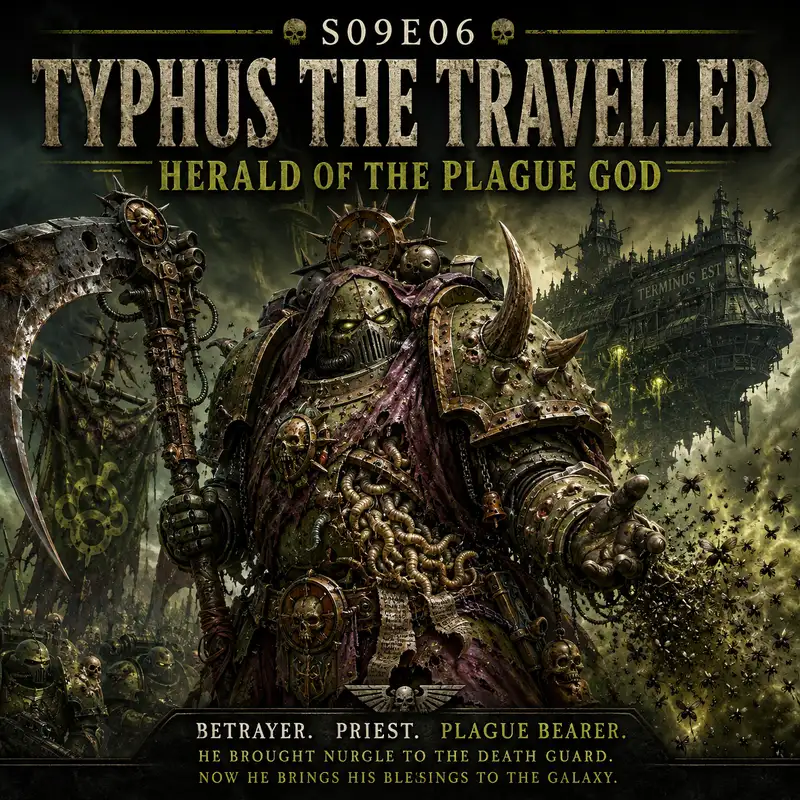
Typhus the Traveller: Herald of the Plague God
The Death Guard did not die when the plague reached them. That was the cruelty of it. Their lungs filled, their flesh split, and their armour became sealed coffins, yet the Legion endured every moment. Somewhere within that trapped fleet, while warriors begged for an ending their gene-forged bodies could not provide, First Captain Calas Typhon waited. He had not been caught by the disaster. He had arranged it. The man who had once helped Mortarion overthrow the poison lords of Barbarus was about to deliver his own brothers to a greater master.
Typhus the Traveller is often introduced as a champion of Nurgle, commander of the Terminus Est, and living host of the Destroyer Hive. All of that is true, but it misses the wound at the centre of his story. Typhus was not an outsider who corrupted the Death Guard from a safe distance. He was one of their founders, one of Mortarion’s oldest comrades, and perhaps the person who understood the primarch’s weaknesses best. His greatest victory was not the ruin of a world. It was convincing an entire Legion that surrender could be mistaken for salvation.
Before he was Typhus, he was Calas Typhon, born on Barbarus beneath a sky that could kill. The planet was divided between human settlements in the lowlands and the strongholds of the Overlords above them. Those rulers were steeped in occult knowledge and protected by poisonous vapours that ordinary humans could not survive. Their armies came down from the heights to raid, enslave, and experiment upon the population. Life on Barbarus therefore taught a simple lesson. Power belonged to those who could breathe where everyone else choked.
The surviving accounts describe Typhon as the child of a human woman and one of Barbarus’s inhuman rulers. Whatever the precise nature of that lineage, he possessed psychic abilities that would have made him dangerous in the eyes of both the Overlords and the humans who feared them. He learned concealment early. When Mortarion began gathering the scattered people of Barbarus into an army, Typhon found in him a leader strong enough to challenge the high places. Mortarion found in Typhon a warrior who knew the enemy’s methods from the inside.
Their alliance was forged before either man knew the scale of the Imperium waiting beyond the clouds. Mortarion supplied the will, the endurance, and the image of liberation. Typhon supplied cunning, occult instinct, and a willingness to cross lines that Mortarion preferred not to see. Together they helped turn frightened villages into a resistance capable of hunting the Overlords through poisoned valleys. It was a partnership built on hatred of tyrants, but not on agreement about power. Mortarion wanted humanity freed from monsters. Typhon had already learned that becoming monstrous could be useful.
When the Emperor reached Barbarus and claimed Mortarion as his lost son, the old rebellion was absorbed into the Great Crusade. Mortarion took command of the Fourteenth Legion, renamed it the Death Guard, and shaped it in the image of the army that had fought beside him in the toxic mists. Typhon rose with him. He became First Captain, one of the highest officers in the Legion, and master of the immense warship Terminus Est. To his brothers, he was not a courtier. He was a veteran of the first war, carrying the authority of shared hardship.
That history made Typhon difficult to question. It also hid the deepest contradiction in the Death Guard. Mortarion despised witchcraft because he associated it with the Overlords who had ruled Barbarus. He distrusted the warp, resented psykers, and later supported the condemnation of the Legiones Astartes Librarius at Nikaea. Typhon was himself a powerful psyker. The friend closest to Mortarion’s throne embodied the thing Mortarion most feared, and he survived by ensuring that the primarch looked everywhere except beside him.
Typhon did more than conceal his gifts. He cultivated them. During the Great Crusade, he moved among warrior lodges and came into contact with the agents who were preparing Horus’s rebellion. The surviving versions of the story differ in detail, but they agree on the essential point. Typhon’s fall was not a sudden loss of control. He listened, considered, and chose. Where many traitors were pushed by resentment or trapped by circumstance, Typhon recognised in Nurgle a power that matched lessons he had carried since Barbarus.
Nurgle promised endurance without victory, belonging without innocence, and relief purchased through surrender. To someone raised beneath poison clouds, that promise had a terrible logic. The Plague God did not say that suffering could be defeated. He offered freedom from the need to resist it. Typhon appears to have accepted this long before Mortarion understood where the path was leading. His faith was not elegant. It did not need to be. It was the conviction that decay was inevitable, and that the clever man joined the process before it reached him.
When the Horus Heresy began, Typhon supported the rebellion, but he was never merely following Horus. He commanded his own forces, pursued his own contacts, and repeatedly behaved like a man serving a patron higher than his primarch. Mortarion believed he had chosen treason in order to escape the Emperor’s rule and preserve his Legion’s identity. Typhon knew that the Death Guard’s identity could be used as a weapon against them. Their pride rested on one claim above all others. They could endure anything.
That claim was tested during the traitor advance toward Terra. Typhon arranged for the Death Guard fleet to lose the Navigators who could guide it safely through the warp. He then offered an alternative, presenting his own chosen path as necessity rather than betrayal. The fleet translated, and the warp closed around it. Engines laboured without progress. Routes folded back upon themselves. Time ceased to behave as time should. The Death Guard, masters of attritional warfare, discovered an enemy they could neither reach nor outlast.
Then came the Destroyer Plague. It moved through ships, armour, blood, and gene-forged organs with impossible speed. The Legionaries bloated and ruptured. Fevers burned through bodies designed to survive battlefields that would kill ordinary soldiers in minutes. Insects gathered where no insects should have existed. The afflicted could not heal, but neither could they die. Their celebrated resilience became the instrument of their torture. A weaker army might have perished quickly. The Death Guard remained alive long enough to understand every stage of what was happening.
Mortarion tried command, medicine, discipline, and rage. None of them mattered. He had built his identity around resistance to poison, tyranny, and witchcraft, yet the fleet was imprisoned by all three. His sons called to him, and he could offer no escape. The primarch who had sworn that no master would ever break him was forced to watch his Legion collapse one warrior at a time. Typhon, meanwhile, stood at the centre of the disaster with the patience of a priest waiting for a reluctant congregation to kneel.
When Mortarion finally confronted him, the old friendship ended without ceremony. Typhon revealed enough of his purpose to make the betrayal unmistakable. Mortarion struck him down, but death no longer worked in the ordinary way. Typhon rose again as the Destroyer Hive erupted from his body, a storm of plague-bearing creatures nesting within the ruined shell of the First Captain. The message was brutally clear. Mortarion could kill the man he had trusted, but he could not kill what that man had invited aboard.
Nurgle’s offer followed. Mortarion could continue to resist while his sons suffered without end, or he could submit and receive the power to preserve them in another form. It was not a fair bargain, and fairness had never been part of the design. Mortarion yielded. The Death Guard were remade as Plague Marines, their pain dulled beneath corruption, their endurance transformed into supernatural decay. Mortarion became a daemon primarch. Typhon became Typhus, host of the Destroyer Hive and herald of the god who had won them both.
This was Typhus’s decisive act. He did not defeat Mortarion in a duel, seize the Legion through formal command, or persuade its warriors through open argument. He constructed a situation in which Mortarion’s virtues became traps. Loyalty forced the primarch to share his sons’ fate. Endurance prolonged their agony. Hatred of sorcery left him unprepared for sorcery used by the man he trusted. Typhus understood that the strongest chains are often made from the captive’s own principles. He had learned that lesson under the Overlords, and he applied it perfectly.
After the Heresy, the difference between Mortarion and Typhus became more visible. Mortarion withdrew into the Plague Planet and the immense bitterness of his own transformation. He remained a conqueror, a warlord, and a favoured son of Nurgle, but he was also bound to old grievances. Typhus travelled. The Terminus Est carried him from war zone to war zone, and his fleets spread disease ahead of their guns. He did not need a stable empire. Every infected ship, besieged hive, and frightened refugee column could become part of his domain.
The title Traveller therefore describes more than movement. Typhus is Nurgle’s contagion made strategic. A plague that remains in one place may destroy a city. A plague carried through trade routes, evacuation corridors, pilgrimage fleets, and military supply chains can alter a sector. Typhus understands that wars are connected systems. Ammunition comes from foundries, food from agri-worlds, reinforcements from mustering grounds, and hope from the belief that somewhere remains untouched. He attacks the connections. The galaxy assists him because the galaxy cannot afford to stop moving.
The Terminus Est is the ideal flagship for such a commander. Ancient, vast, and corrupted beyond any sensible repair schedule, it is less a vessel than a travelling ecosystem of war and disease. Its holds carry Plague Marines, cultists, machines, and things that Imperial classification would prefer not to discuss before breakfast. Its arrival means more than an orbital threat. It announces that the boundary between battlefield and outbreak has disappeared. By the time defenders identify the fleet, the first symptoms may already be spreading below.
Typhus himself has become a weaponised contradiction. He is a Space Marine whose armour no longer protects a stable body. He carries Manreaper, a great power scythe suited to the imagery of harvest and death, yet the more disturbing weapon is what lives inside him. The Destroyer Hive pours from rents in his armour and returns to nest within his flesh. He is not merely infected. He is habitat, reliquary, and delivery system. Killing the host has failed before, which does complicate the usual medical advice.
On the battlefield, Typhus combines the patience of the Death Guard with the aggression of a raider. His forces can absorb punishment, contaminate defensive positions, and turn every delay into an advantage. Plague warfare attacks more than bodies. It attacks trust. Soldiers begin to fear their comrades, commanders distrust casualty reports, and civilians flee along routes that spread the infection farther. Hospitals become concentration points. Supply depots become vectors. Even a successful defence may preserve the walls while destroying the society inside them.
This is why Typhus is best understood as a herald rather than simply a butcher. A herald arrives before a ruler and announces what is coming. Typhus announces Nurgle through sensation. The air thickens. Machines foul. The dead fail to remain still. Despair becomes physically contagious. His wars carry a theological claim that resistance is exhausting, hope is naïve, and surrender is a kind of peace. The claim is false, but it is designed for people who have been denied every easier answer.
Nurgle’s corruption is often misunderstood as simple enthusiasm for disease. Its deeper temptation is emotional. It offers acceptance when cure seems impossible, community when isolation becomes unbearable, and numbness when pain has exceeded the victim’s capacity to imagine relief. Typhus embodies that temptation more completely than many of Nurgle’s louder monsters. He does not need to prove that decay is good. He only needs to make every alternative feel futile. Once the victim stops believing change is possible, the Plague God has already entered the room.
Mortarion has never been comfortable with this truth, because Typhus is living evidence that the primarch did not choose his destiny freely. Mortarion can blame the Emperor, Horus, the warp, or the necessities of war, and each accusation contains some truth. Typhus remains the person who arranged the final choice. Their relationship is therefore more poisonous than ordinary rivalry. Mortarion is Typhus’s commander, father figure, victim, and proof of concept. Typhus is Mortarion’s subordinate, betrayer, and permanent reminder that someone else understood him better than he understood himself.
The two also differ in their relationship with Nurgle. Mortarion serves while retaining pride, resentment, and a desire to command his own fate. Typhus serves with fewer reservations. He may argue, scheme, and pursue personal glory, but he does not pretend that his power comes from somewhere cleaner. This gives him a freedom that Mortarion lacks. The primarch is greater in raw might and status. Typhus can still wound him by acting as though devotion matters more than rank, especially when the god they serve appears to agree.
Their disputes have surfaced repeatedly across the Long War. Mortarion issues commands, Typhus interprets them, delays them, or follows a different sign from the Garden of Nurgle. At times he fights within Mortarion’s wider campaigns. At others he ranges with his own plague fleets or cooperates with Chaos warlords whose goals happen to create useful outbreaks. This independence is not rebellion in the ordinary military sense. Chaos does not offer a tidy chain of command. It offers overlapping loyalties, divine whims, and officers who may receive guidance from the same god and still reach opposite conclusions.
Across the wars surrounding Cadia, Ultramar, and the Charadon sector, Typhus has shown the same operational instinct. He appears where corruption can spread beyond the immediate battlefield. Industrial worlds offer machinery and labour to infect. Fortress systems offer frightened populations and congested supply routes. Crusade fleets offer movement. The details change, but the pattern remains. Typhus does not merely seek victory over defenders. He seeks conditions in which the defenders carry part of his victory onward, usually while believing they are escaping it.
The assault on the Charadon sector displayed this method on an enormous scale. Typhus brought plague fleets against a region whose foundries and shipping lanes supported Imperial war across a much wider area. Metalica, a forge world built on order, production, and mechanical purity, was an ideal target. Disease there was not only biological. It was industrial, spiritual, and informational. Corrupted code, tainted machinery, failing flesh, and panic all served the same purpose. The campaign became a demonstration that even a machine civilisation can be made to rot.
Yet Typhus is not invincible, and Nurgle’s gifts do not remove friction from war. His forces can be delayed, contained, and driven back. Plagues can fail to spread as intended. Rivals can exploit his arrogance. Imperial institutions, for all their cruelty and confusion, sometimes survive because they are capable of sealing whole populations behind bulkheads and calling the loss acceptable. The response is rarely humane, but it can be effective. Typhus wins not because every plan succeeds, but because failure itself often leaves contamination, fear, and weakened systems behind.
His greatest advantage is that he measures success differently from most commanders. Territory can be retaken. Fleets can be rebuilt. A champion can even be banished or forced to withdraw. Typhus looks for the residue. Did the plague enter the refugee ships? Did suspicion fracture the alliance? Did the defenders destroy their own food stores to contain infection? Did a frightened governor accept help from a cult promising relief? A conventional general sees a campaign ending. Typhus sees an incubation period.
That perspective also explains why he remains dangerous after ten thousand years of war. Many servants of Chaos are prisoners of the moment that broke them. They repeat an old grievance across new battlefields, trying to win a verdict history will never deliver. Typhus carries the past, but he is not stationary within it. He adapts the old betrayal to new systems. A void station, a hive city, a forge world, and a crusade fleet require different vectors. The faith remains constant. The delivery mechanism changes.
There is a final irony in the name Traveller. On Barbarus, Typhon fought beside people who wanted to climb out of poisoned lowlands and destroy the masters above them. As Typhus, he carries the poisoned high places wherever he goes. He has become the descending threat, the figure from the toxic clouds, the ruler whose presence makes ordinary life impossible. The rebel did not merely become what he hated. He learned from it, improved the method, and freed it from the limits of a single world.
Typhus is therefore the Herald of the Plague God because he did more than accept Nurgle’s corruption. He translated it into a campaign plan, a fleet doctrine, and a form of faith that could travel. He turned the Death Guard’s endurance into captivity, Mortarion’s loyalty into surrender, and the movement of civilisation into a road for contagion. Mortarion may be Nurgle’s daemon son, but Typhus is the one who keeps opening the door. Wherever the Terminus Est appears, the old betrayal begins again, and somewhere below, someone coughs.