Trazyn the Infinite: Collector of the Galaxy
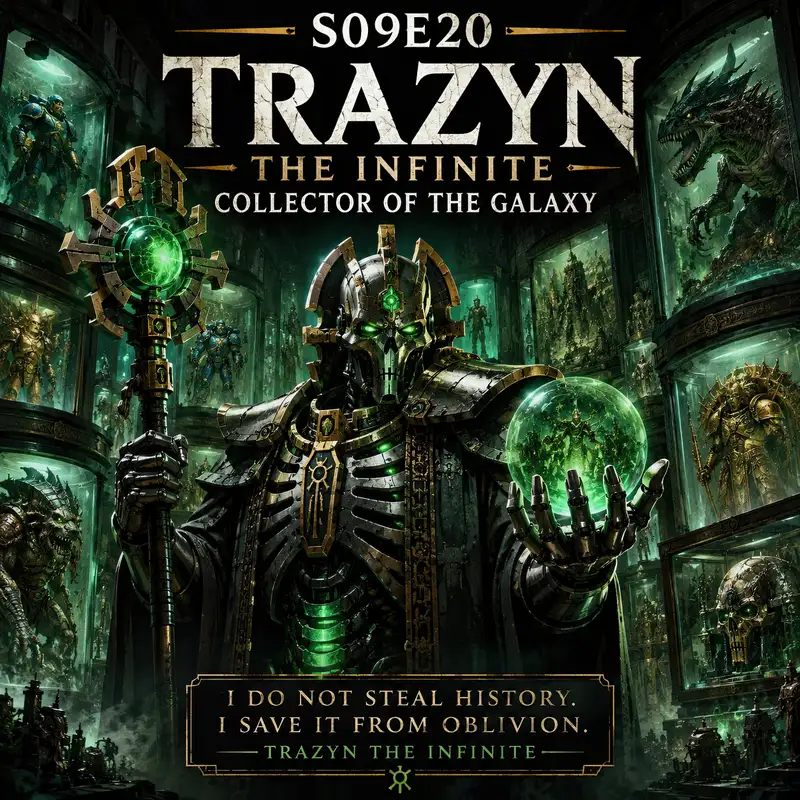
Somewhere beneath the dead surface of Solemnace, wars that ended thousands of years ago are still waiting for the doors to open. Soldiers stand in perfect stasis, weapons raised and faces fixed at the instant before death. Alien beasts crouch inside frozen jungles. Relics taken from vanished civilisations rest beneath cold emerald light. To their owner, these are not prisoners or stolen goods. They are exhibits, preserved against a galaxy that destroys almost everything it touches.
That owner is Trazyn the Infinite, a Necron overlord whose name appears whenever history goes missing. He has stolen sacred objects, abducted heroes, looted tombs, bargained with monsters, and interrupted wars because something interesting was about to be destroyed. At times he has behaved like a villain. At other times he has saved lives on a scale the Imperium could scarcely admit. The central question is not whether Trazyn is a collector. It is what collection means to a being who survived the death of his own civilisation.
Long before humanity reached the stars, the Necrontyr were a brilliant but short-lived species. Their bodies were weak, their lives were bitter, and their civilisation was shaped by resentment toward the long-lived Old Ones. That resentment helped drive the War in Heaven, a conflict so ancient that later empires remember it through fragments, myths, and scars in reality itself. Desperate for victory and freedom from mortality, the Necrontyr accepted the promises of the star gods known as the C'tan.
The bargain gave them bodies of living metal. It also consumed what made them alive. Through biotransference, minds were copied into mechanical forms while the C'tan devoured the souls released by the process. The result was the Necrons, durable beyond ordinary death but severed from flesh, sensation, and much of their former identity. Some emerged as nearly mindless warriors. Nobles and specialists retained more of themselves, though even their memories could be damaged, edited, or rewritten.
Trazyn claims a connection to the preservation of knowledge before biotransference, and he often behaves like an archivist who outlived the archive. Yet the surviving accounts do not settle exactly who he was. His memories conflict with those of Orikan the Diviner, his oldest rival, and both may be remembering versions shaped by trauma or manipulation. That uncertainty matters. Trazyn has built a museum larger than many cities, but he cannot be entirely certain of the history he tells about himself.
His title, the Infinite, is not only a boast about age. When Trazyn's body is destroyed, his consciousness can transfer into a surrogate Necron form. The process may seize a nearby body and overwrite its former occupant, which is an efficient solution to mortality provided one is not the former occupant. Combined with Necron repair systems and prepared replacements, this makes killing Trazyn less like ending a life and more like inconveniencing an institution.
Other Necron nobles do not generally regard this talent as charming. Trazyn has taken relics from tomb worlds, interfered with dynastic claims, and treated ancient property law as an obstacle best examined from a safe distance. His disputes with fellow Necrons can reach formal courts, where beings older than human civilisation argue over provenance, jurisdiction, and attempted murder. The proceedings are dignified. The grudges are not. Even among immortal aristocrats, Trazyn has achieved the rare distinction of being considered exhausting.
Immortality gives him the one resource almost everyone else lacks. Time. Human rulers plan for years. Aeldari seers consider generations. Trazyn can pursue a single object across centuries, wait for a civilisation to expose its treasures, or return after everyone who remembers his theft has become dust. He does not need to rush. He can allow history to ripen, which is a reassuring phrase until one remembers that he is usually waiting to harvest it.
At the centre of his obsession are the galleries of Solemnace. They are not a conventional museum with labels, visitors, and a gift shop of questionable taste. They are vast displays built from stasis fields, dimensional technology, and Necron machinery. Trazyn arranges individuals, armies, creatures, environments, and artefacts into scenes that preserve a particular moment. The effect is part archive, part theatre, and part prison.
The displays are also acts of interpretation. Trazyn chooses the instant to preserve, the figures placed at the centre, and the environment reconstructed around them. He decides whether an object is a weapon, a religious relic, or evidence of a civilisation's decline. The galleries may contain authentic people and artefacts, but their arrangement tells Trazyn's version of events. Like every archive, Solemnace remembers through selection. Unlike most archives, it can shoot anyone who disputes the catalogue.
He does not collect only the powerful. A weapon may matter because of the hand that carried it. An ordinary soldier may complete the composition of a battle. A cultural performance may be as valuable as a military victory because it records how a people understood themselves. Trazyn's taste ranges across species and eras. What unites the collection is not moral worth. It is significance, rarity, and the possibility that the original will soon cease to exist.
This makes him something more complicated than a trophy hunter. A trophy celebrates the hunter. Trazyn often seems interested in the thing itself, in its place within a larger account of the galaxy. He researches, classifies, restores, and stages his acquisitions with genuine care. He can discuss the history of species he considers primitive with more patience than many Imperial scholars devote to their own. His curiosity is real. So is the theft.
His care becomes most visible when an exhibit is damaged. Trazyn can lose bodies and continue through a replacement, but the destruction of an irreplaceable specimen wounds him in a different way. He may respond with anger that resembles grief. This suggests that the collection is not merely an extension of ego. It carries emotional weight he can no longer attach easily to ordinary life. The tragedy is that his empathy often settles on the preserved image rather than the living person from whom that image was taken.
Trazyn rarely accepts the idea that ownership should obstruct preservation. If a relic is being neglected, endangered, worshipped incorrectly, or merely possessed by someone less qualified than Trazyn, he may regard removal as an act of responsible stewardship. The fact that the original owner screams, shoots at him, or begins a crusade is treated as evidence of emotional attachment rather than a serious legal argument. Solemnace has excellent security and a remarkably permissive acquisitions policy.
His methods reveal the limits of his self-image. Trazyn uses deception, mindshackle technology, armies, body transfer, tesseract devices, and carefully prepared contingencies. He can bargain when bargaining is useful. He can cooperate when cooperation places a rarer prize within reach. When those methods fail, he is fully capable of solving curatorial disputes with overwhelming force. The museum is not separate from his power. It is the shape his power has taken.
The clearest portrait of Trazyn comes from his long rivalry with Orikan the Diviner. Orikan is a Necron chronomancer who reads possible futures and manipulates time. Trazyn preserves the past. Orikan attempts to master what comes next. Their conflict is therefore personal, political, and almost philosophical, though it frequently descends into theft, sabotage, litigation, and violence conducted over spans of time that would encompass the rise and fall of human nations.
Their struggle over a mysterious relic on the world of Serenade lasted for millennia. Each believed the prize concealed knowledge or power of exceptional value. Each cheated. Each accused the other of cheating with the wounded dignity of an ancient aristocrat who had just been caught doing exactly the same thing. Beneath the comedy was a serious danger. Two nearly immortal beings were using a living world as the board for a private contest.
As Serenade's human civilisation changed, Trazyn watched it with increasing fascination. He observed its architecture, rituals, performances, and historical memory. Human lives were brief, but human culture transformed rapidly. To Trazyn, that speed made humanity frustrating and compelling. A Necron might carry one grievance unchanged for ten thousand years. Humans could rebuild a city, rewrite a faith, and forget the reason for a war in a fraction of that time.
Trazyn's interest did not make him harmless. During the struggle with Orikan, a genestealer specimen escaped containment and helped seed a cult on Serenade. The infestation grew across generations, hidden inside families and institutions until the planet's fate was consumed by a conflict neither ordinary citizens nor their ancestors had chosen. What began as a weapon or diversion in an immortal rivalry became a catastrophe for people whose entire lives passed between Trazyn's moves.
That disaster exposes the cruel distance created by immortality. Trazyn can care about a civilisation and still treat its inhabitants as material. He may admire an opera while accepting the disappearance of the audience. He may regret the loss of a city while placing a surviving street scene in stasis. His appreciation is not false. It is incomplete, because the lives he studies do not carry the same weight as the history they allow him to preserve.
The relic beneath Serenade eventually proved connected to a shard of the Deceiver, one of the C'tan whose kind had helped enslave the Necrontyr. The resulting confrontation forced Trazyn and Orikan into cooperation against a threat far greater than their feud. Orikan reached a terrifying state of power. Trazyn unleashed assets from his collection. Their victory did not resolve their differences, but it showed what Trazyn's galleries truly are.
Solemnace is a museum, but it is also an arsenal. Trazyn can release stored warriors and creatures from stasis, directing pieces of the past into the battles of the present. An exhibit may be arranged for contemplation one century and deployed as a tactical reserve the next. He does not merely possess history. He weaponises it. Few commanders can call reinforcements from armies that vanished before their enemy's species learned to write.
Some acquisitions carry consequences far beyond scholarship. Trazyn has obtained beings whose existence could alter the balance of power if they were released, including a seemingly perfect clone of the fallen primarch Fulgrim. Fabius Bile surrendered the clone in a bargain, and Trazyn placed him within the galleries. The act may have prevented a dangerous new chapter in the wars of the Emperor's Children. It also allowed one Necron collector to decide, alone, that a being with the mind and presence of a primarch would spend eternity as an exhibit.
This ability reached its most famous expression during the fall of Cadia. The fortress world stood at the mouth of the Eye of Terror and had resisted Chaos for thousands of years. When Abaddon launched the thirteenth Black Crusade, Cadia became the hinge upon which the defence of the Imperium turned. Its soldiers expected aid from Imperial fleets, Space Marines, saints, and perhaps the Emperor. They were less prepared for a Necron collector arriving with professional interest.
Trazyn understood something many Imperial commanders did not. Cadia's ancient blackstone pylons were not merely ruins. They were part of a Necron system capable of suppressing the Warp. Working alongside Belisarius Cawl and others, he helped bring the pylons into operation. For a brief moment, the power of the Eye of Terror receded. Daemonic forces weakened. The impossible pressure of the Warp loosened its grip.
His motive was not simple loyalty to humanity. Trazyn opposed the uncontrolled destruction represented by Chaos, and Cadia itself was historically unique. The battle was also an opportunity to observe, intervene, and perhaps acquire. These motives can coexist. Trazyn is at his most dangerous when others assume that one intention must cancel the rest. He can save a world because it matters, help its defenders because they are useful, and still wonder which of them would improve an exhibit.
When the defence began to fail, Trazyn opened portions of his collection. Warriors taken from distant ages and forgotten campaigns returned to battle with little understanding of where, or when, they had awakened. Among the released captives was Inquisitor Katarinya Greyfax, a formidable Imperial servant who had spent a long and uncertain span outside the flow of time. To the defenders, these arrivals were miraculous reinforcements. To Trazyn, they were carefully selected pieces removed from display.
The intervention helped, but it could not prevent Cadia's destruction. Abaddon sent the remains of a Blackstone Fortress crashing into the planet, breaking the world even as its armies continued to resist. The pylons failed, and the catastrophe helped tear open the Great Rift across the galaxy. Cadia's defenders became symbols of defiance. Trazyn left with another chapter for his collection.
Lord Castellan Ursarkar Creed, commander of Cadia's defence, disappeared during the final collapse. Later evidence points toward Trazyn taking him into stasis. From one perspective, the collector stole a hero at the moment his people needed a martyr. From another, he preserved Creed from certain death. Both descriptions are accurate, and neither captures the full violation. Creed survived, but survival inside a display case is not freedom.
Cadia also reveals why Trazyn cannot be dismissed as a scavenger who arrives only after the shooting stops. He recognised the strategic meaning of the pylons, committed resources during the crisis, and risked valuable parts of his collection. He was willing to alter history, not merely record it. Yet he never ceased being a curator. Even while helping to defend the planet, he was judging which fragments of the disaster deserved to outlive the world.
This is the pattern that follows Trazyn across the galaxy. He rescues what he abducts. He protects what he imprisons. He preserves cultures by removing pieces from the culture that gave them meaning. In a universe where archives burn, species vanish, and governments deliberately erase inconvenient truths, his collection may be one of the most complete historical records in existence. It is also built from countless acts of coercion.
The contradiction is sharper because Trazyn often understands the value of memory better than the living. The Imperium destroys records through censorship, war, and administrative decay. Chaos twists memory into obsession. The Aeldari struggle beneath the weight of a past they cannot restore. Necron dynasties awaken with broken minds and contradictory histories. Trazyn sees the galaxy's amnesia and responds with the most Necron solution imaginable. Freeze everything before it can change.
That response reflects the wound of biotransference. The Necrons escaped bodily death but lost the sensations, relationships, and natural limits that gave life its shape. Their memories became one of the few remaining proofs that they had once been people. Yet memory itself was damaged. Trazyn's museum can therefore be read as an external memory palace, a structure vast enough to hold what his own mind cannot fully trust.
There is also a darker parallel. Biotransference preserved the form of the Necrontyr while stripping away their souls. Trazyn's stasis displays preserve the form of history while stripping away movement, choice, and context. The people inside remain physically intact, but they no longer participate in the story that made them significant. His great answer to loss repeats, on a smaller scale, the original tragedy of his species.
That does not make his work meaningless. Without Trazyn, many objects, creatures, and witnesses would simply be gone. Some may one day emerge when their knowledge is desperately needed. His intervention at Cadia proves that the collection can serve more than vanity. The difficulty is that usefulness does not erase captivity, and preservation does not confer moral ownership. A prison may protect its inmates from the weather. It remains a prison.
Trazyn is therefore neither a harmless eccentric nor a conventional conqueror. He does not seek to rule every world, convert every soul, or reduce the galaxy to ash. He wants to possess its significant moments before time, war, and foolishness destroy them. That ambition sounds almost noble until one asks who decides what is significant, who must be sacrificed to complete the display, and whether history can survive once it belongs to only one curator.
The answer to why Trazyn collects the galaxy lies in what the Necrons lost. He cannot restore the Necrontyr, recover every stolen memory, or reverse the bargain that made him immortal. He can only gather evidence that life existed, that civilisations created meaning, and that events occurred before oblivion swallowed the witnesses. Each exhibit is a defence against erasure. Each locked stasis field is also an admission that he no longer knows how to preserve life without stopping it.
Beneath Solemnace, the galaxy endures in perfect silence. Heroes wait beside monsters. Armies hold their final formation. Civilisations survive as rooms no citizen may enter. Trazyn walks among them as historian, thief, jailer, and perhaps the last sincere mourner of worlds he helped endanger. He is the collector of the galaxy because he fears oblivion more than he respects freedom, and because, like all true Necrons, he survived death only to discover that survival was not the same as living.