Travel and Life in the Void: Pilgrims, Merchants, and Refugees
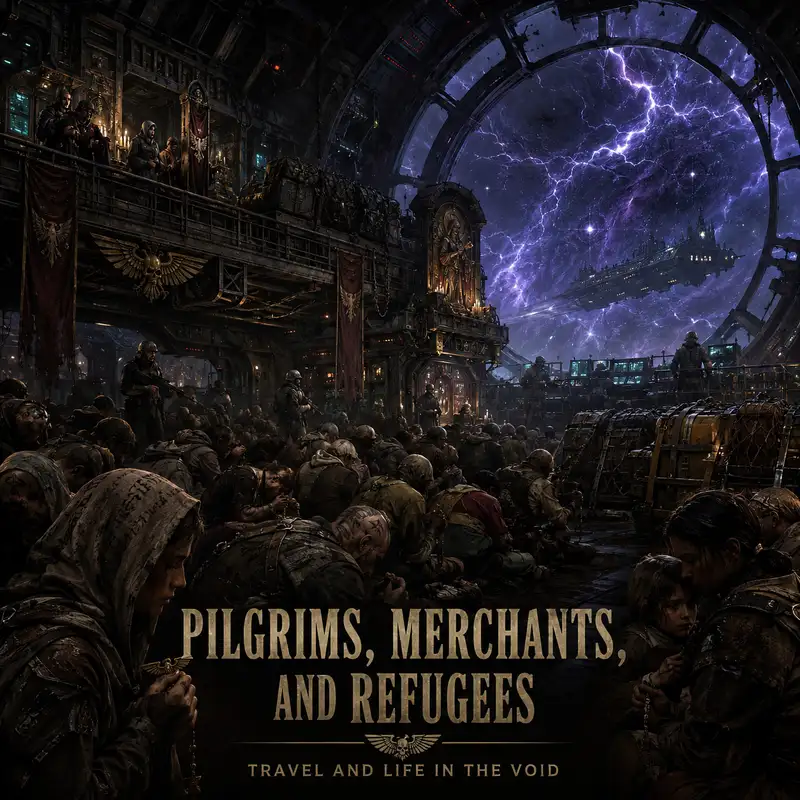
The first warning is not the alarm. It is the sudden closing of doors. Across a pilgrim vessel, bulkheads grind into place, cargo chains are checked, and thousands of passengers kneel wherever they can find room. Some press their foreheads against cold deck plating. Others clutch saintly tokens polished smooth by years of handling. Far above them, behind guarded doors, a Navigator prepares to guide the ship away from the ordinary universe. The engines build toward translation. Priests begin the litany of protection. Merchants seal their strongrooms. Refugees hold their children close. Then the stars disappear, and every soul aboard becomes dependent on a machine older than the family lines of most planetary governors.
Travel in the Imperium of Man is often described through maps, crusades, and fleets. That view is useful, but it hides the people inside the arrows. For most human beings, a journey between worlds is not a clean movement from one point to another. It is an uncertain period of confinement aboard a moving city, surrounded by strangers, machinery, ritual, and danger. A pilgrim may see the voyage as sacred endurance. A merchant sees contracts, losses, and opportunity. A refugee sees the last door closing on a life that no longer exists. All three may travel in the same hull, breathe the same recycled air, and be kept apart by decks, guards, money, and the Imperial talent for turning social rank into architecture.
The problem begins with distance. The Imperium spans much of a galaxy in which ordinary faster-than-light travel is not available to humanity. Imperial ships cross the great reaches by entering the Warp, a parallel realm where distance and time do not behave as they do in realspace. A Navigator uses a rare inherited ability to perceive a path through that realm, often taking guidance from the light of the Astronomican. Around the ship, the Gellar field maintains a fragile envelope of reality against a dimension shaped by emotion, psychic force, and predatory intelligences. This is not merely difficult navigation through bad weather. It is more like sailing through a nightmare that notices the ship.
Even before translation, travel can involve days or weeks of waiting and slow movement. A vessel normally must reach a safe region beyond the strongest gravitational influence of planets and stars before entering the Warp. Passengers may board at an orbital station, spend long periods under inspection, then remain confined while tugs, shuttles, and system engines move the ship outward. Departure dates shift. Cargo arrives late. An astropathic warning changes the route. A port official discovers that a seal is valid in the neighboring subsector but not at this desk. The Imperium possesses a remarkable variety of travel documents, none of which is guaranteed to satisfy the next person demanding to see them.
Once underway, the voyage belongs to the ship. Imperial voidships are not simply vehicles with crews. Many are ancient communities built around engines, weapons, holds, chapels, workshops, and life-support systems whose full workings may be understood by no living person aboard. Generations of voidborn families can serve in the same compartments. Children inherit duties, allegiances, superstitions, and enemies. A deck gang may know every vibration in its section of hull but never see the command spire. A passenger traveling for several months occupies only a brief moment in the ship’s history. The ship was carrying pilgrims before that passenger was born, and may carry their descendants long after their name has vanished from the manifest.
Class determines the shape of that brief moment. Wealthy travelers may receive private cabins, guarded corridors, better food, and access to officers or shipboard factors. Lesser passengers purchase a berth, which can mean a bunk, a marked square of deck, or permission to sleep in a hold not currently needed for machinery. The poorest are packed into converted cargo spaces with communal water points and sanitation that was already inadequate before the last thousand people came aboard. Between these extremes lie guild representatives, clerks, discharged soldiers, missionaries, labor crews, minor nobles, technical specialists, and people whose legal status changes according to which official is reading the papers. A voidship does not erase the hierarchy of the Imperium. It compresses it.
For pilgrims, that compression becomes part of the religious experience. The Imperium is filled with shrine worlds, martyr sites, saintly tombs, battlefields, relic chapels, and places where the faithful believe the Emperor’s purpose has been revealed. Some pilgrims travel to a destination within their own system. Others attempt journeys across sectors. The most ambitious dream of Holy Terra, though approaching the heart of the Imperium requires wealth, permission, endurance, or a willingness to die before seeing anything more sacred than another customs hall. Families may save for decades to send one person. Entire communities may sell property, tools, or hereditary rights to finance a passage. In some cases, the journey lasts so long that the person who arrives is the child or grandchild of the person who departed.
A pilgrim ship can resemble a monastery, a marketplace, a refugee camp, and a prison without needing to change decks. Priests organize prayers around engine cycles and translation rites. Confessors preach in overcrowded holds. Vendors sell devotional tokens, preserved food, counterfeit relics, and entirely genuine water at devotional prices. Pilgrim fraternities form for protection, companionship, and access to scarce supplies. Some passengers are sincere penitents. Some seek healing. Some are fulfilling an oath made by an ancestor. Others are fleeing debts or punishment under the respectable cover of faith. The Ecclesiarchy understands that pilgrimage can strengthen belief, but every port authority also understands that large numbers of frightened, exhausted people create opportunities for disorder, disease, and profit.
The journey itself tests the meaning of devotion. Warp travel may bring nightmares, nausea, strange sounds, lost time, or the conviction that something is moving just beyond a sealed wall. Most travelers never see the Warp directly, and that is a considerable mercy. They experience it through alarms, prayers, changes in gravity, shifts in the engine note, and the behavior of the crew. If the Gellar field flickers, even briefly, passengers may never learn what occurred. A compartment is sealed. A priest declares a cleansing. Names disappear from a ration roll. The official explanation may be accurate. It may also be the explanation most likely to prevent a riot.
Pilgrimage gives people a framework for surviving that uncertainty. Hunger becomes sacrifice. Delay becomes a test. Fear becomes evidence that the destination matters. A death aboard ship can be interpreted as martyrdom on the road to holiness rather than an anonymous failure of ventilation. This does not make the suffering unreal. It makes it bearable, and it binds strangers together through shared ritual. The Imperium often survives because it can convert hardship into meaning faster than it can remove the hardship. A pilgrim vessel is one of the clearest examples of that power.
Merchants inhabit the same routes but speak a different language. The famous Rogue Traders receive attention because they cross uncertain frontiers, command private empires, and possess warrants granting freedoms that would place an ordinary captain before a firing squad. Most Imperial commerce is less romantic. Chartist captains, merchant houses, guild fleets, and licensed carriers move along recognized routes between known worlds. They transport grain, ore, machine parts, ammunition, textiles, chemicals, workers, livestock, devotional goods, and whatever else one planet lacks and another can be compelled or persuaded to provide. Their voyages keep hive populations fed, manufactoria supplied, armies armed, and planetary elites accustomed to luxuries they will describe as administrative necessities.
A chartist captain may operate under a charter that defines where the vessel can trade and what obligations it carries. Merchant families build relationships with ports, governors, guilds, and shipping agents over generations. They learn which routes are stable, which stations are corrupt in a useful way, which customs officials require gifts, and which worlds have recently stopped answering astropathic messages. Their calculations include fuel, stores, wages, tariffs, spoilage, piracy, war, quarantine, and the simple possibility that the Warp will return the ship later than expected. An Imperial timetable can be precise to the hour. The Warp is under no obligation to read it.
That uncertainty makes information almost as valuable as cargo. A merchant arriving from another system brings rumors, price changes, military news, religious proclamations, and reports of danger. Much of it is old before arrival. Some of it was false before departure. Yet a scrap of reliable information can save a fortune or a world. A grain shortage on a hive planet may turn an ordinary shipment into a treasure. A newly declared quarantine can transform the same cargo into rotting evidence of poor judgment. Merchants therefore employ factors, agents, interpreters, scribes, guards, and informants. Their business is not simply moving objects. It is managing uncertainty inside an empire whose communications are psychic, fragmented, and frequently delayed.
Passengers are part of that business. Empty hold space can be sold. Pilgrims bring money and accept conditions that cargo would find objectionable, if cargo had legal standing. Skilled travelers may barter labor for passage. Missionaries can receive reduced rates because their presence reassures the faithful, or because a merchant house wants favor from the Ecclesiarchy. Refugees may be carried under an Imperial order, a charitable arrangement, or a contract so predatory that the distinction between rescue and indenture becomes difficult to locate. A captain must balance profit against water, air, food, security, and the risk that overcrowding will produce disease or revolt. Compassion may influence the decision. So may a naval escort pointing its guns in the captain’s direction.
Merchants reveal a contradiction at the heart of the Imperium. Its worlds are often culturally isolated, politically suspicious, and technologically uneven, yet many cannot survive without interstellar trade. An agri world may feed populations it will never see. A mining world may depend on imported machinery that nobody local can manufacture. A forge world may consume resources from dozens of systems. A shrine world may exist because pilgrims arrive with offerings and because merchant ships arrive with everything the pilgrims intend to eat. The Imperium praises selfless duty, but its arteries are filled with invoices. Without the merchant fleets, entire sectors would not collapse heroically. They would simply run out of essential parts.
Refugees enter this system without the advantage of choice. They flee invasion, rebellion, famine, plague, planetary bombardment, industrial disaster, or the opening of the Great Rift. Some are evacuated before catastrophe reaches them. Many leave after it has already destroyed their homes. They crowd orbital docks carrying bundles, identity seals, family icons, work tools, military discharge papers, and keys to doors that no longer exist. Behind them may stand a burning city or a world under quarantine. Ahead of them is a ship whose crew has been ordered to take a number of passengers, not necessarily these passengers.
Imperial evacuation is rarely equal. Priority often goes to military personnel, officials, technical experts, sanctioned psykers, noble households, sacred relics, strategic archives, industrial equipment, and workers whose skills are considered useful elsewhere. The order may be rational. A reactor specialist can keep another city alive. A regiment can fight again. A data core may preserve the records needed to rebuild. Yet the result is still a line in which one life is weighed against another by rank, utility, influence, and proximity to the loading ramp. A planetary governor can describe this as preservation of essential assets. The people left outside the gates may use shorter words.
Those who reach the ship are not safe. Refugee holds are overcrowded because every empty space appears to an administrator as unused capacity. Rations are calculated against an uncertain travel time. Medical screening may be brutal, especially when authorities fear contagion, mutation, psychic instability, Chaos corruption, or Genestealer infiltration. Families can be separated by quarantine doors and never reunited. Armed guards watch distribution points. Rumors spread through ventilation shafts faster than official announcements. A delayed meal becomes proof that the officers are hoarding food. A course change becomes evidence that the ship has been abandoned. Sometimes the rumors are wrong. Sometimes the official announcement is merely a rumor wearing a uniform.
The destination may offer little relief. Refugees can be resettled as industrial labor, agricultural workers, colonists, soldiers, or inhabitants of camps that acquire permanent walls over time. Local authorities may fear disease, heresy, criminality, or competition for food and housing. A population that saw itself as loyal citizens of one Imperial world may arrive on another and discover that it is classified as displaced manpower. Their dialect, customs, patron saints, and even familiar ways of worship can make them suspect. The Imperium claims universal unity under the Emperor, but ordinary humans often experience that unity as a border checkpoint operated by someone who dislikes their accent.
Still, refugees carry more than need. They carry memory. Survivors preserve the names of lost streets, regiments, shrines, families, and worlds. They bring songs, recipes, curses, techniques, and stories of how the disaster began. Some accounts are confused. Others are politically dangerous. A refugee who says a governor fled early, an officer ignored warnings, or a priest concealed corruption may be giving vital testimony. They may also be accused of spreading sedition. Across generations, refugee communities can reshape the worlds that receive them. The lost home becomes sacred in memory, even if it was considered miserable while it still existed. Absence is a gifted architect.
Pilgrims, merchants, and refugees are not sealed into separate stories. They meet in the same docks and often aboard the same ships. A merchant carrier takes pilgrims because their fares make an otherwise marginal route profitable. The same vessel is then requisitioned to evacuate a threatened world, forcing cargo into the corridors and passengers into compartments never meant to hold them. Pilgrim fraternities distribute food to refugees. Merchants hire displaced clerks and engineers. Refugees adopt the rituals of pilgrims because prayer is one of the few resources not yet rationed. Black markets appear. So do acts of genuine generosity. A voidship reveals human nature under pressure, which is rarely tidy enough for an Imperial form.
The voidborn crew stand between these moving populations and the ship itself. To planetary passengers, the vessel is temporary. To the crew, it is ancestry, employment, homeland, and perhaps the only world they have ever known. They know which passageways flood with fumes, which lifts fail under load, which deck gangs must be approached through an elder, and which shrine receives offerings before a difficult translation. They may regard passengers as ignorant, noisy, and dangerously careless around machinery. The passengers may regard the crew as unsettling people who speak in clipped dialects and treat a failing oxygen valve with more reverence than a visiting noble. On practical grounds, the crew is usually correct.
Authority aboard ship is layered and severe. The captain rules the vessel, but that rule depends on officers, armsmen, Navigators, astropaths, engineers, priests, and the Adeptus Mechanicus personnel responsible for sacred systems. Each group possesses knowledge or power the others cannot easily replace. A captain can command an engine room, but cannot personally persuade a reactor to function. A merchant can purchase a berth, but cannot purchase exemption from a sealed bulkhead during emergency discipline. Passengers live within this structure without understanding most of it. They hear bells, follow painted lines, present documents, attend inspections, and learn very quickly that a closed hatch is not an invitation to debate constitutional theory.
Then there are the dangers that no manifest can organize. Pirates prey on lightly defended routes. Raiders may seek slaves, cargo, or simple destruction. Warp storms close passages and isolate systems. Mechanical failures can strand a ship between ports. Disease can spread through a crowded hold before the medicae identifies it. Mutiny can begin with hunger or fear and end with whole decks without air. A failed Gellar field can turn survival into something far worse than death. Even a successful voyage may end with the ship emerging in the wrong place or at the wrong time. The vessel expected at a peaceful port may find a war zone. The relief ship may arrive after the famine. The refugees may reach safety to discover that safety was conquered months before.
Yet the routes continue. They continue because the Imperium cannot exist without them. Pilgrims carry faith across distances that would otherwise produce isolated religions. Merchants carry the material life of the empire, from grain and ammunition to spare components and printed proclamations. Refugees carry labor, trauma, memory, and the surviving fragments of destroyed communities. Voidborn crews carry all of them, maintaining ships whose age and complexity reflect the civilization they serve. Travel does not make the Imperium modern, connected, or humane. It makes the Imperium possible.
For the pilgrim, the void is a road made sacred by danger. For the merchant, it is a market whose prices include time, chance, and lives. For the refugee, it is the terrible space between belonging somewhere and being assigned somewhere else. Their experiences differ because the Imperium values them differently, but the physical truth is shared. Every passenger is enclosed within metal, protected from the Warp by ancient systems, and carried forward by people whose names will never appear in the grand histories. The greatest empires are often described through rulers and armies. They endure through crews, clerks, loaders, cooks, maintenance gangs, and frightened travelers who keep moving because remaining behind is worse.
When the translation bells sound again, merchants secure their ledgers, pilgrims raise their voices, and refugees count the people who are still beside them. The crew closes the doors. The Navigator turns toward a light no ordinary human can see. For a moment, rank, wealth, faith, and legal status all depend on the same trembling field of reality around the hull. That is life in the void. The Imperium crosses the galaxy not as a united people striding confidently among the stars, but as countless sealed communities carrying hope, profit, duty, and loss through a darkness that is never truly empty.