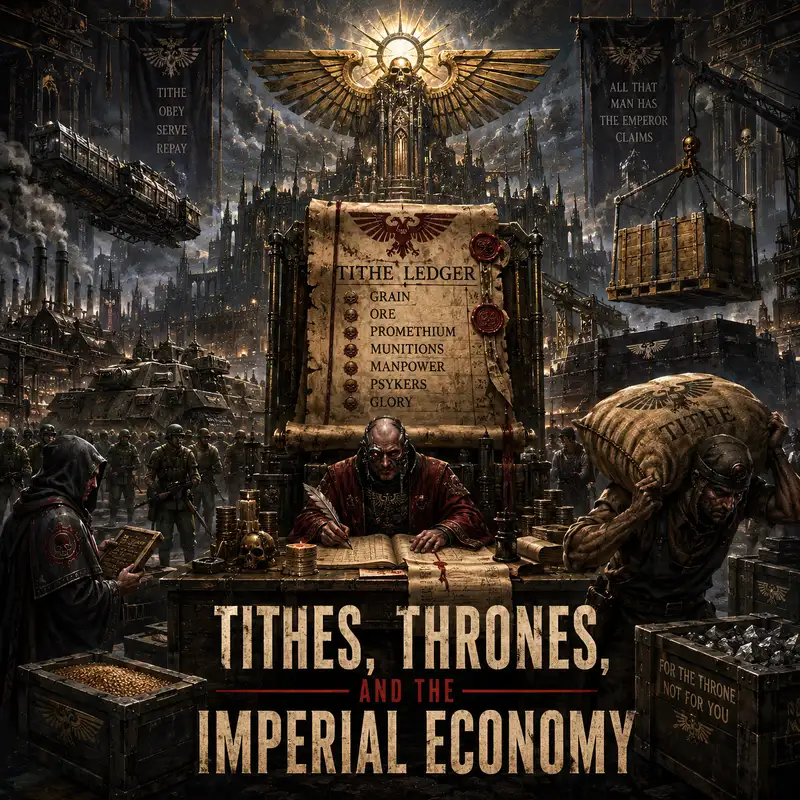
Tithes, Thrones, and the Imperial Economy
An Imperial world can be rich, starving, victorious, or half in ruins. The tithe is still due. Somewhere in the Administratum, behind a wall of wax seals and fading ink, that world has been assigned a value. It is expected to provide grain, ore, weapons, promethium, soldiers, or some other useful portion of itself. The demand may have been calculated generations ago. The official who approved it may be dead. The route by which it travels may cross storms that have swallowed fleets. None of this cancels the obligation. In the Imperium, wealth is not first measured by what a society can buy. It is measured by what the Throne can take.
That is the central fact behind the Imperial economy. The Imperium does contain merchants, wages, banks, markets, fortunes, debts, and currencies. It also contains feudal estates, hereditary monopolies, guild law, ration books, sacred machine contracts, military requisitions, slave labor, servitors, barter, piracy, and theft performed with sufficiently impressive paperwork. These systems do not form one clean galactic market. They overlap, contradict one another, and survive because the Imperium is less an integrated economy than a network of obligations. Local people use money. Planetary rulers manage production. Sector authorities direct trade and war. Terra demands the tithe.
The scale makes anything more orderly nearly impossible. The Imperium claims roughly a million worlds, though no surviving census can be trusted to settle the number. Those worlds are divided by distances that cannot be crossed through ordinary space in any useful time. Ships enter the Warp, follow routes shaped by tides no economist can control, and emerge days, years, or occasionally generations later than expected. Messages travel through astropaths, and even then they may arrive distorted, delayed, or not at all. A modern economy depends upon reliable information. The Imperium often considers information reliable if it arrives before the person who requested it has been executed for failing to provide it.
This means there is no single price for grain, no universal interest rate, and no currency accepted without question from Holy Terra to the edge of the Halo Stars. A coin stamped with an Aquila may be revered on one world, weighed as scrap on another, and forbidden on a third because the local governor’s face is supposed to be on everything. People speak of Thrones, credits, gelt, crowns, scrip, guild tokens, ration chits, and a hundred thousand local forms of payment. In some sectors, Throne Gelt serves as a familiar unit of account. Across the Imperium as a whole, however, the Throne is more symbol than standardized coin. A dock worker on a hive world and a grain factor on an agri-world may both be Imperial subjects while living inside financial systems that have almost nothing in common.
What binds them together is not currency. It is extraction. Every compliant world owes something to the Imperium according to its classification, productive capacity, population, location, and strategic importance. The Administratum assigns a tithe grade, then records what the planet is expected to furnish. The categories and precise burdens differ from world to world. An agri-world may surrender food. A mining world may send refined ore. An industrial world may provide vehicles, ammunition, or machine components. A hive world may contribute manufactured goods and enormous numbers of recruits. Some worlds are exempt or governed through special arrangements, but exemption rarely means freedom. It usually means that the world is already serving the Imperium in a way too valuable to interrupt.
The tithe does not mean that every crate of grain or shell casing is physically shipped to Terra. Much of it is directed to sector depots, nearby hive worlds, forge worlds, naval bases, crusade mustering grounds, and whatever war has become most urgent. The Administratum’s task is not simply to collect. It must classify, redirect, store, and assign the output of entire planets across time and distance. In theory, this turns local surplus into Imperial strength. In practice, it can leave a warehouse overflowing with boots while the regiment that needs them freezes three systems away.
The tithe is not merely a tax paid in things. It is a claim upon productive life. A planetary governor must know how much land can be planted, how much ore can be extracted, how many workers can be conscripted, how many regiments can be raised, and how far the population can be pressed without open revolt. The last calculation tends to receive less attention than it deserves. To meet the tithe, rulers impose their own systems of taxation beneath it. Nobles demand rents. Guilds collect fees. Administrators issue quotas. Manufactoria extend shifts. Local authorities seize transport, labor, and stockpiles. By the time Terra’s demand reaches the ordinary citizen, it may have passed through so many hands that the original figure is almost irrelevant. What remains is the pressure.
That pressure explains why Imperial governors possess such broad local authority. Terra does not care whether a planet is organized as a hereditary monarchy, a commercial oligarchy, a military dictatorship, a council of clans, or a bureaucracy run by people who have forgotten what the bureaucracy was created to do. The governor is expected to maintain order, defend the world, uphold acceptable Imperial worship, and pay what is owed. The Imperium tolerates extraordinary cultural variety because detailed administration across interstellar distances would be impossible. Its apparent flexibility has a hard boundary. A ruler may choose how to collect the tithe. Refusing to collect it is interpreted as rebellion.
The military tithe makes the relationship especially clear. Imperial worlds maintain their own Planetary Defence Forces, but they may also be ordered to raise regiments for the Astra Militarum. These soldiers leave local service and enter a war machine whose demands may carry them far beyond any sky they recognize. The Departmento Munitorum equips, assigns, transports, and sustains them through a logistical system of frightening size. Some regiments receive excellent weapons and adequate supplies. Others arrive with ammunition that does not fit their guns, winter uniforms for a desert campaign, or rations delivered after the unit has moved on. The system is not uniformly incompetent. It moves armies across the galaxy. It is simply large enough that even a small percentage of error produces disasters by the million.
There is also a tithe paid in people whose danger is not military but psychic. The Black Ships of the Adeptus Astra Telepathica travel from world to world collecting psykers whom local authorities are required to surrender. Some will be trained and sanctioned for Imperial service. Some will become astropaths after ordeals that destroy many of those who undergo them. Others will be consumed by the institutions that sustain the Emperor and the psychic beacon by which Imperial navigation remains possible. For ordinary families, this can be the most intimate face of Imperial extraction. A child manifests an impossible gift, authorities arrive, and the household learns that the Imperium recognizes no private claim upon a resource it considers essential to survival.
From the viewpoint of Terra, soldiers are an economic output. So are tanks, shells, starships, uniforms, medical supplies, replacement parts, and the food required to keep them moving. War is the largest market in the Imperium, but it is not a market in the ordinary sense. The Imperium does not wait for a profitable signal before defending a shrine world or feeding a crusade. It requisitions. It redirects. It assigns priorities. A campaign’s true cost is not merely measured in coin. It is measured in transport capacity, industrial time, Navigators, astropaths, fuel, trained personnel, and worlds stripped of the surplus they needed for next year.
This is where the specialized worlds of the Imperium become both powerful and dangerously fragile. Agri-worlds can feed populations far larger than their own. Hive worlds can turn human density into labor, soldiers, and manufactured goods. Mining worlds tear open continents for raw material. Forge worlds produce weapons and machines under the authority of the Adeptus Mechanicus. Shrine worlds draw pilgrims, offerings, and political influence. Fortress worlds consume resources on a scale that would bankrupt a peaceful state, which is convenient because the Imperium is not a peaceful state. Each world can become extraordinarily productive in its assigned role. Each also becomes dependent upon distant systems it cannot control.
A hive city may contain billions of people and almost no ability to feed them from local soil. Its survival rests upon grain fleets arriving through the Warp. An agri-world may produce mountains of food while lacking the industrial base to replace its own harvesting machines. A forge world may build engines of war while importing workers, rare minerals, biological supplies, or fuel. This specialization allows the Imperium to sustain immense populations and campaigns. It also means that a single lost convoy, blockaded route, warp storm, clerical error, or pirate attack can create famine. The Imperial economy is vast enough to absorb catastrophe and brittle enough to create one by misplacing a shipping manifest.
The ships that connect these worlds are therefore as important as the worlds themselves. Merchant vessels, chartered captains, hereditary trade houses, guild fleets, and licensed commercial combines carry the ordinary mass of Imperial commerce. Chartist Captains operate under charters that define where and how they may trade. Some routes are ancient enough to be treated like family property. Navigator Houses make long-range Warp travel possible for vessels wealthy or important enough to secure their service. Astropaths carry the messages that warn a port of shortage, invasion, or opportunity. The entire structure is held together by contracts, custom, privilege, and the fact that voidships are too valuable to be left to anyone with enthusiasm and a map.
Rogue Traders stand apart from this ordinary machinery. Their Warrants of Trade may grant powers that would be unthinkable for a common merchant, including the authority to travel beyond Imperial borders, negotiate with outsiders, claim worlds, and act in the name of distant masters. They can become fabulously wealthy, but they are not the standard model of Imperial commerce. They are instruments of expansion and controlled exception. The grain ship making its thousandth journey between two known systems is less glamorous, but it matters more to the survival of the Imperium. Civilizations usually depend upon the vessel no poet bothers to name.
The Adeptus Mechanicus adds another layer of complication. Mars and its forge worlds are bound to the Imperium through ancient compact, shared necessity, and mutual suspicion. The Mechanicus controls technical knowledge, maintains critical machines, and produces much of the equipment upon which Imperial power depends. Its priests do not treat technology as a neutral commodity. Designs may be sacred. Procedures may be ritualized. Knowledge may belong to a forge, a cult, or a rank rather than to the public. This restricts innovation and spreads production unevenly, but it also preserves fragments of capability through an age when careless experimentation can awaken something that should have remained a cautionary footnote.
The Ecclesiarchy also possesses enormous economic influence. Faith is not separate from material life in the Imperium. Cathedrals own land. Shrines draw pilgrims. Orders receive donations. Religious festivals redirect labor and trade. Ecclesiastical authorities can legitimize rulers, mobilize populations, and declare sacrifice a sacred duty. A poor laborer may give coin to a saint’s shrine while a noble house funds an entire chapel to display loyalty, purchase influence, or ease a conscience that has shown remarkable resilience. The distinction between devotion and transaction is often clear to everyone involved and politely left unexamined.
Beneath these great institutions lie the local economies where most Imperial subjects actually live. A manufactorum worker may be paid in company scrip redeemable only in district stores. A hive ganger may trade ammunition, favors, or water. A noble may hold wealth in land, offices, shipping rights, and debts owed by families over generations. A frontier settlement may barter because its last shipment of coin arrived with the wrong governor’s portrait. On some worlds, hereditary status matters more than money. On others, commercial guilds can ruin a person without firing a shot. The Imperium does not abolish these systems. It uses them, provided they produce obedience and surplus.
This creates fortunes of almost incomprehensible size. Merchant dynasties, Navigator Houses, planetary nobles, forge lords, and senior officials can control assets spread across systems. Yet even their wealth is inseparable from privilege. A charter, patent, hereditary office, or sanctioned monopoly may be worth more than any vault of currency. Imperial elites are rich because they possess legal access to routes, labor, technology, information, and violence. Their position can survive changes in coinage and the collapse of markets. It can also vanish when an inquisitor, rival house, or newly discovered archive decides that the privilege was issued incorrectly three thousand years ago.
Corruption is not an occasional defect in this system. It is one of the ways the system functions. Bribes accelerate paperwork. Favors secure cargo space. Officials adjust quotas to protect allies or punish enemies. Governors underreport harvests. Guilds hide inventory. Munitorum clerks redirect shipments. Priests certify convenient interpretations of duty. Smugglers move goods where official trade has failed. Black markets supply medicine, weapons, food, forbidden technology, and sometimes the simple luxury of receiving the item that was ordered. The Imperium condemns this behavior while depending upon it. An empire built upon perfect compliance would stop before the first form was countersigned.
Yet the tithe remains more than bureaucratic theft. It is also the mechanism by which isolated worlds contribute to a common defense. A peaceful agri-world may never see a Tyranid swarm, but its grain feeds soldiers fighting one. A mining colony may never hear the guns of a crusade, but its ore becomes armor. A hive world may resent the regiments taken from its population, while those regiments hold a fortress whose fall would open entire sectors to invasion. The Imperium’s enemies are real. The need to concentrate resources is real. The tragedy lies in a system that can recognize necessity only through coercion and can rarely distinguish sacrifice from waste.
Because communication is slow, tithe assessments often become detached from reality. A world classified during an age of abundance may still be expected to meet the same burden after plague, war, or ecological collapse. Appeals can take decades. Inspectors may arrive with outdated orders. A governor who reduces shipments to prevent famine risks being accused of withholding Imperial property. A governor who meets the quota may preserve personal loyalty while destroying the population that made the quota possible. The Administratum can revise a tithe, grant relief, or recognize exceptional conditions. It can also continue demanding grain from fields that are now radioactive glass. Both outcomes are perfectly compatible with its procedures.
Failure carries escalating consequences. Auditors, the Adeptus Arbites, Administratum agents, military commanders, or inquisitorial authorities may investigate. A shortfall caused by honest disaster may be treated differently from deliberate refusal, at least when the evidence survives and someone important reads it. Persistent noncompliance can bring punitive levies, replacement of the ruling class, occupation, or war. The Badab conflict demonstrated how disputes over authority, resources, and withheld obligations could grow into something far larger than an accounting disagreement. In the Imperium, a ledger can become a battlefield because the ledger represents loyalty.
The system endures because it is adapted to a civilization that cannot be governed in real time. Terra does not need to understand every local transaction. It needs worlds to remain identifiable, rulers to remain responsible, routes to remain open, and obligations to remain enforceable. The tithe converts wildly different societies into forms the central state can use. Grain becomes survival. Ore becomes armor. Labor becomes production. Population becomes regiments. Money is useful, but only where people agree upon its meaning. The tithe works even when they do not.
It also endures because the Imperium can waste on a scale few civilizations could survive. A single world may be ruined by overcollection, yet a thousand others remain. A fleet may be lost with decades of cargo, yet another convoy is already moving. Whole populations can disappear into war, industry, pilgrimage, penal service, or administrative error, and the larger machine continues. This is not efficiency. It is mass. The Imperium survives by possessing so much territory, labor, and accumulated infrastructure that losses which would destroy a smaller state become entries in a report.
That mass has a human cost hidden inside every abstract term. Productive capacity means workers. Manpower means sons and daughters taken from their homes. Agricultural surplus means food that someone will not eat. Strategic requisition means a hospital without replacement parts because a crusade received priority. Acceptable loss means a district, regiment, city, or world judged cheaper to spend than to save. The language of the Imperial economy is deliberately impersonal. It must be. No clerk could process the true meaning of every number and remain useful to the institution.
So what is the Imperial economy? It is not one economy at all. It is millions of local systems bound together by shipping, privilege, faith, military demand, and fear. Thrones and credits circulate where they can. Merchants pursue profit. Guilds defend monopolies. Nobles accumulate estates. Workers bargain, steal, endure, and occasionally revolt. Above them all stands the tithe, converting the varied wealth of humanity into the few things the Imperium understands without translation: supplies, soldiers, ships, and obedience.
The final irony is that this brutal arrangement is both the source of the Imperium’s strength and one of the reasons it can never become what it claims to defend. The tithe keeps distant wars supplied, but it can starve the worlds that pay it. Local freedom allows a million cultures to survive, but only so long as they satisfy demands made by people who may never know their names. Currency can measure value within a market. The Imperium uses obligation because obligation crosses distances that money cannot. Every road, charter, ration, factory shift, regiment, and grain convoy leads eventually toward the same silent destination. The economy of the Imperium does not exist to make humanity prosperous. It exists to keep the Throne alive.