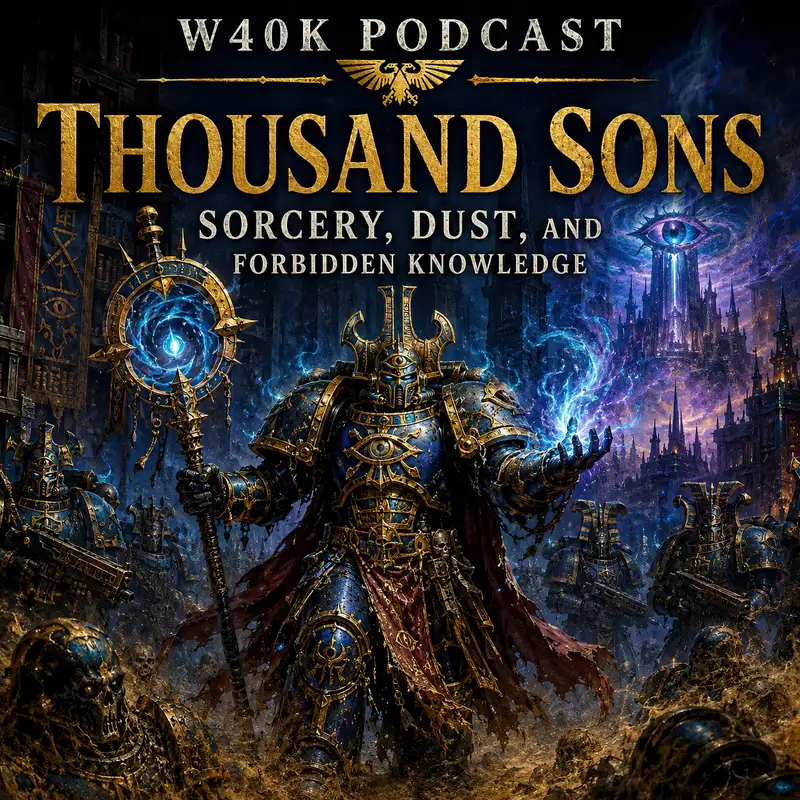
Thousand Sons: Sorcery, Dust, and Forbidden Knowledge
An armoured warrior walks out of a storm of blue fire. His plate is ancient, the colour of midnight glass, edged in gold and marked with the eye of a god that never closes. Bolter shells strike him. One tears through his breastplate. No blood follows. Only a stream of pale dust, glowing for a moment before the rent seals beneath a sorcerer’s gesture. The warrior keeps marching because there is almost nothing left inside him that remembers how to stop.
This is the central horror of the Thousand Sons. They were once among the most learned of the Emperor’s Space Marine Legions, warriors who believed knowledge could rescue humanity from superstition, fear, and ignorance. Ten thousand years later, their surviving sorcerers command the empty armour of their own brothers. How did a Legion devoted to enlightenment become a fraternity of magicians leading the dead? The answer is not simply corruption by magic. It is the belief that every danger can be mastered if only one is clever enough.
The Thousand Sons began as the Fifteenth Legion during the Emperor’s Great Crusade. Even among Space Marines, many displayed extraordinary psychic talent. They could sense thoughts, glimpse possible futures, move matter by will, and burn enemies with power drawn from the warp. In another age, these gifts might have made them revered sages. In the Imperium, where uncontrolled psykers had helped destroy entire worlds during the Age of Strife, they also made excellent reasons for everyone else to stand several steps farther away.
Their greater problem was the Flesh Change. Warriors of the Legion began to mutate without warning. Limbs twisted, bodies flowed into impossible forms, and minds dissolved beneath uncontrolled transformation. Discipline could delay it. Medicine could not cure it. Psychic skill offered no reliable protection. The Legion’s numbers collapsed, and some believed the Fifteenth would disappear before its primarch was ever found.
Then the Emperor discovered Magnus on Prospero.
Magnus the Red was a giant even among primarchs, a scholar, a ruler, and perhaps the most powerful human psyker after the Emperor himself. Prospero had given him a society of philosophers and mystics centred upon Tizca, the City of Light. Its towers, libraries, and temples reflected Magnus’s conviction that the universe was not meant merely to be conquered. It was meant to be understood.
When Magnus was reunited with his Legion, the Flesh Change receded. The precise means remain clouded by secrecy and later accusation. Magnus claimed victory through his own knowledge. Later events suggest that some form of bargain had been made with a power in the warp, whether Magnus understood the full identity of that power or not. His sons were saved, but the debt had not vanished. It had merely become patient.
Under Magnus, the Thousand Sons rebuilt. They became warrior scholars organised into fellowships, orders, and psychic cults. Different schools developed mastery over prophecy, telepathy, telekinesis, and the manipulation of matter. Their commanders could coordinate attacks through thought alone. Their seers could anticipate an enemy’s movement before the enemy had decided to make it. Their battle plans appeared impossibly precise because, on occasion, they had already watched several versions of the battle unfold.
They were still Space Marines. They carried bolters, drove tanks, stormed fortresses, and broke armies in the Emperor’s name. Yet Magnus encouraged them to preserve knowledge as eagerly as other Legions collected trophies. A conquered library might matter more than a captured palace. An alien text might be studied before it was destroyed, which was not always popular with Imperial authorities. The Great Crusade had been designed to reunite humanity. The Thousand Sons quietly hoped it might also educate it.
That ambition contained something admirable. It also concealed a fatal weakness. Magnus and his sons did not merely believe that psychic power could be used safely. They increasingly believed that they were the people qualified to decide what safely meant.
The warp is not simply an ocean of energy. It is shaped by emotion, inhabited by predatory intelligences, and hostile to anyone who mistakes confidence for protection. The Thousand Sons knew more about it than almost any other human force. This did not make them cautious. It persuaded them that caution was a condition suffered by people who knew less.
They formed relationships with strange warp entities they regarded as guides and companions. They explored regions of thought forbidden to ordinary psykers. They used techniques that other Legions considered sorcery, a word Magnus disliked because it suggested superstition rather than disciplined study. The distinction was intellectually elegant and practically less useful when the room filled with daemons.
The wider Imperium was already divided over psychic warfare. Some primarchs saw sanctioned Librarians as necessary weapons. Others regarded them as an invitation to catastrophe. Magnus helped create the Librarius, an organised system through which Space Marine psykers could be trained and controlled. His strongest supporters included Sanguinius and Jaghatai Khan. His fiercest opponents included Mortarion, whose hatred of sorcery had been forged by a lifetime under psychic tyrants.
The dispute came to a head at the Council of Nikaea. Magnus defended the use of psychic powers, but his case was weakened by his own certainty. He spoke as a man explaining fire to people he considered frightened of candles. The Emperor ruled against the Librarius and ordered the Legions to cease such practices. For most Space Marines, this meant closing their libraries. For the Thousand Sons, it meant abandoning the foundation of their identity.
Magnus obeyed in public and continued in private. He believed the judgment was mistaken, temporary, and made without full appreciation of what he knew. This was the pattern that defined him. He could recognise a terrible danger and still assume that rules created to contain it were intended for lesser minds.
When Horus turned against the Emperor, Magnus saw the betrayal through visions and sorcerous investigation. He understood that the Warmaster was falling before the rebellion had openly begun. Conventional warnings would be too slow. Magnus therefore attempted an act of psychic projection on a scale almost beyond imagination, forcing his mind across the galaxy to reach the Emperor on Terra.
He succeeded.
That success was disastrous.
The Emperor was conducting a secret project beneath the Imperial Palace, creating a human route into the ancient Aeldari Webway. If completed, it might have freed humanity from dependence on warp travel and the predators that haunted it. Powerful wards protected the work. Magnus, unable to pass them, accepted aid from an intelligence in the warp and smashed through.
His warning reached the Emperor, but the breach destroyed the protection around the Webway project. Daemons flooded into the tunnels. The Emperor was forced to abandon his larger design and commit immense forces to containing the invasion. Magnus had been correct about Horus and catastrophically wrong about how to deliver the news. It is one of the cruelest moments in the Heresy. The scholar discovered the truth, acted from loyalty, and still caused damage beyond the reach of most traitors.
The Emperor ordered Magnus brought to Terra to answer for what he had done. Leman Russ and the Space Wolves were sent to Prospero, accompanied by Custodians and the Sisters of Silence. Horus, still trusted as Warmaster, manipulated the mission toward destruction. Old hostility did the rest. The Space Wolves saw dangerous sorcerers who had ignored the Emperor’s command. The Thousand Sons saw executioners arriving to punish them for trying to save the Imperium. Neither side understood how completely Horus benefited from their hatred.
Magnus initially refused to prepare Prospero for war. He had seen enough to understand that his warning had ruined the Emperor’s great work, and he appears to have accepted destruction as punishment. He concealed the approaching fleet and prevented an orderly defence. It was an act of guilt masquerading as responsibility. His sons were not asked whether they wished to share the sentence.
The Wolves came anyway.
Prospero’s skies filled with warships. Tizca burned. The Sisters of Silence smothered psychic power around them, turning gifted Thousand Sons into warriors suddenly deprived of the sense upon which they had relied all their lives. Custodians struck with the precision of the Emperor’s own guard. The Space Wolves fought with the fury of a Legion convinced it was carrying out a necessary execution.
The Thousand Sons resisted with everything Magnus had taught them. They bent fire, shattered armour with thought, called upon powers they had once believed obedient, and discovered that some of those powers had never been servants. The Flesh Change returned amid the battle. Warriors transformed as they fought. The distinction between disciplined psychic science and forbidden sorcery collapsed beneath burning towers and screaming flesh.
At last Magnus entered the battle and faced Russ. Their duel became the personal centre of a planetary catastrophe. Magnus was broken, and Prospero was lost. To save what remained of his Legion, he accepted the intervention of the power that had watched him for years. The survivors were torn from their dying world and cast through the warp to Sortiarius, the Planet of the Sorcerers.
The rescuer was Tzeentch, the Chaos God of change, ambition, sorcery, hope, deception, and schemes nested inside other schemes. Tzeentch had not needed Magnus to become a cackling villain. It needed him to remain Magnus. Proud, brilliant, compassionate toward his sons, contemptuous of limits, and certain that one more act of knowledge could repair the consequences of the last.
The Thousand Sons did not enter the Horus Heresy in the same way as the Sons of Horus or the Word Bearers. Their home had been destroyed by Imperial forces before the rebellion was fully revealed. Many fought beside Horus because the Imperium had left them nowhere else to stand. Some still resisted treachery. Others wanted revenge. Magnus himself was divided in body, spirit, and purpose, and his path toward becoming a daemon primarch was neither immediate nor simple.
Yet the destination was the same. By the end of the Heresy, the Thousand Sons had become servants of the power they once believed they could study without submission. Sortiarius offered refuge, but it was refuge inside Tzeentch’s realm. Its landscapes shifted. Its towers defied geometry. Mutation spread through the surviving Legion, and the Flesh Change began consuming them again.
Ahzek Ahriman, once the Legion’s chief librarian, refused to watch his brothers vanish. Ahriman shared Magnus’s greatest virtues and his most destructive flaw. He loved his Legion. He possessed extraordinary discipline. He believed that sufficient knowledge, properly applied, could overcome any curse.
He gathered a cabal of sorcerers and created a ritual intended to stabilise every Thousand Son at once. The Rubric of Ahriman reached across the Legion with immense power. It stopped the Flesh Change. It also transformed nearly every warrior without strong psychic ability into dust, sealing the remains of their souls inside their armour. Those who survived in flesh became more powerful sorcerers. Those who did not became the Rubricae.
The ritual had worked with the sort of precision usually found in nightmares.
A Rubric Marine is not merely a robot wearing Space Marine armour. Something of the warrior remains bound within. In battle, old instincts can stir. The armour advances in disciplined ranks, fires with the skill learned during the Great Crusade, and obeys the sorcerer who directs it. Yet personality, desire, and independent will are buried beneath enchantment. A brother who once debated philosophy in the libraries of Tizca may now stand silent for centuries until commanded to kill.
The elite Scarab Occult Terminators suffered the same fate. Their ornate armour contains dust and a trapped echo, but their martial discipline remains formidable. Led by living sorcerers, they appear from impossible angles, endure wounds that would destroy flesh, and pour enchanted fire into their enemies. They are veterans of a war ten thousand years old who no longer experience time in any human fashion.
Magnus condemned Ahriman for the Rubric and banished him. Ahriman departed with followers who became known as the Prodigal Sons. He has spent millennia seeking a way to reverse what he did. This goal has driven him toward forbidden archives, alien artefacts, captured seers, and knowledge guarded by powers that consider entire star systems acceptable security measures.
Ahriman is therefore both villain and failed saviour. He has sacrificed worlds, betrayed allies, manipulated enemies, and destroyed anyone standing between him and a possible cure. Yet his original purpose was not conquest. It was restoration. He wants his brothers back. The fact that he continues to commit fresh horrors in order to undo an old one is not a contradiction in his character. It is his character.
The modern Thousand Sons are held together by sorcery, memory, and unstable loyalties. Magnus commands from Sortiarius and can unite great hosts when his designs require it, but many sorcerers pursue private ambitions. They form cults, cabals, sects, and warbands, each convinced that its interpretation of fate is superior. Cooperation is possible. Trust is more exotic.
Their armies reflect what the Legion has become. Living sorcerers lead ranks of Rubric Marines and Scarab Occult Terminators. Mortal cultists follow promises of forbidden power, liberation, revenge, or transformation. Tzaangors, beastlike servants shaped by Tzeentch, fight beside daemons and twisted engines. Mutalith Vortex Beasts drag raw change into reality around them. Even the Legion’s tanks and transports may be saturated with warp power, because ordinary maintenance becomes less urgent when the vehicle has developed opinions.
A Thousand Sons attack rarely begins with a simple desire to seize ground. A city may be assaulted because one foundation stone bears a lost inscription. A fleet may be sacrificed so that its destruction forms part of a ritual pattern. A governor may be spared because a descendant not yet born will open the correct vault. Their wars can look irrational until the hidden objective is revealed, at which point they often look worse.
On the battlefield, their sorcerers are the true centre of power. They bend probability, unleash warp fire, cloud minds, alter flesh, and coordinate the hollow warriors around them. Rubric Marines advance with relentless calm, their enchanted weapons burning through armour and bodies. Where another Chaos force may overwhelm through rage or decay, the Thousand Sons seek control. They want the enemy defeated before the enemy understands what battle is being fought.
That control is never complete. Tzeentch is not the god of orderly plans. It is the god of change, and change includes the collapse of plans, the reversal of loyalties, and the discovery that a victory served someone else’s purpose. A Thousand Sons sorcerer may spend centuries arranging a single outcome, only to learn that the failure was the intended result. This does not usually encourage humility. It encourages a more complicated plan.
Their obsession with forbidden knowledge is therefore practical, personal, and religious all at once. Knowledge offers weapons. It offers prophecy. It offers status among rival sorcerers. For Ahriman, it may offer a cure. For Magnus, it may offer vindication or a route toward the future he once imagined. For lesser adepts, it promises escape from mortality, ignorance, or subordination.
The Imperium calls such knowledge forbidden because much of it is genuinely dangerous. A book may contain a thought that allows a daemon to recognise the reader. A formula may open a door that cannot be closed from the same side. A true name may grant power over an entity while also drawing its attention. Imperial censorship is often brutal and self-serving, but in the case of certain arcane texts, burning the library is not entirely unreasonable. The difficulty lies in determining which library, and the Imperium has rarely been accused of excessive patience in that regard.
The Thousand Sons stand on the opposite extreme. They assume that danger is a problem of technique. If a ritual destroyed its previous practitioners, the lesson is not necessarily to abandon it. The lesson may be to obtain better practitioners. If a prophecy causes madness, perhaps the mind must be strengthened. If an artefact consumes souls, perhaps those souls can be supplied more efficiently.
This is why their tragedy cannot be reduced to the claim that knowledge is evil. Ignorance helped condemn them. Fear of psykers made honest debate almost impossible. Horus exploited mistrust that already existed. Russ and Magnus understood one another so poorly that both became instruments in someone else’s design. The Imperium’s refusal to explain the Webway project left Magnus unable to understand what his warning might damage.
Yet knowledge alone did not save the Thousand Sons. They possessed enormous learning and too little wisdom about their own limitations. Magnus knew the warp was dangerous but believed he could negotiate from strength. Ahriman knew the Rubric would reshape his Legion but believed his calculations could contain the result. Their greatest disasters came not from stupidity, but from intelligence refusing to admit uncertainty.
That pattern survives in every Rubric Marine. The spell meant to preserve the Legion preserved it as a procession of tombs. The sorcerers escaped mutation by becoming more deeply bound to the god of mutation. Ahriman searches for freedom using powers granted by the being whose designs made freedom doubtful. Magnus built a civilisation devoted to enlightenment and now rules a kingdom where reality changes according to the will of daemons and magicians.
The Thousand Sons are sorcerers because they reached beyond the limits imposed upon them. They are dust because their greatest act of salvation reduced their brothers to remains. They seek forbidden knowledge because they still believe the next secret can correct all the others.
Perhaps one day Ahriman will find the words that restore the Rubricae. Perhaps Magnus will prove that his ancient dream was not entirely lost. Tzeentch thrives on such hope. Hope keeps the scholar reading, the sorcerer plotting, and the exile walking toward one more sealed door.
Behind them march the silent sons of Prospero, their armour bright, their weapons ready, and their souls buried beneath the dust. They are the proof that knowledge can defeat death, provided one is not too particular about what survives.