The Word Bearers: Missionaries of the Primordial Truth
The first sign of a Word Bearers invasion may not be a bombardment. It may be a voice. It slips through a damaged vox relay, speaks from a shrine that should be empty, or comes from the mouth of a labourer who was considered harmless yesterday. The voice promises that suffering has meaning. It names powers Imperial authorities insist must never be acknowledged. By the time crimson-armoured warriors descend beneath burning icons, the argument has already begun. The Word Bearers do not merely arrive to seize a world. They arrive to explain why the world deserved to be seized.
That is what makes them different from many of the other Traitor Legions. The World Eaters can reduce a city to an abattoir. The Iron Warriors can turn it into a mathematics problem involving walls, artillery, and regrettable life expectancy. The Black Legion may conquer it as part of a wider campaign. The Word Bearers want something more intimate. They want the survivors to kneel for the correct reason. Their wars are sermons delivered with bolters, and every battlefield is an opportunity to prove what they call the Primordial Truth.
The irony begins before Lorgar ever met his Legion. The Seventeenth Legion was originally known as the Imperial Heralds. During the Great Crusade, these warriors accompanied conquest with the destruction of old faiths. Idols were smashed. Temples were burned. Priests were silenced. The Emperor’s secular Imperial Truth was to replace superstition with reason, unity, and loyalty to humanity. The Legion served as militant iconoclasts, purging belief from compliant worlds with the brisk efficiency of men who had not yet realized they were looking for something to worship.
Their primarch, Lorgar Aurelian, had grown upon Colchis, a world shaped by prophecy, religious struggle, sacred texts, and competing interpretations of divine will. Lorgar was not simply a commander who happened to be devout. Faith was the language through which he understood history, authority, and human purpose. When he encountered the Emperor, he did not see merely a ruler or creator. He saw the divine figure for whom his life had prepared him. The Imperial Heralds became the Word Bearers, and the Legion that had once destroyed religions began building one around the Emperor.
Lorgar’s conquests were thorough, but they were slow. A world was not truly compliant merely because its government had surrendered. Its people had to be instructed. Monuments rose. Rituals spread. The Emperor’s image appeared where older gods had stood. To Lorgar, this was the natural completion of conquest. To the Emperor, it was disobedience and delay. The Great Crusade required worlds, armies, resources, and momentum. Lorgar was delivering cathedrals. Magnificent cathedrals, certainly, but military timetables are rarely improved by stained glass.
The rebuke came at Monarchia, the perfect city raised on the world of Khur. At the Emperor’s command, the Ultramarines destroyed it. The Word Bearers were gathered before the ruins and forced into submission while their father was condemned for worshipping the being who stood before him. Accounts and interpretations differ in detail, but the essential wound is clear. Lorgar’s faith was not debated. It was humiliated. The Emperor meant to correct a Legion. Instead, he created a spiritual vacuum inside one of the most religious minds in the Imperium.
Humiliation alone did not make the Word Bearers servants of Chaos. Choices still followed, and responsibility remained with those who made them. Lorgar’s closest advisers, especially Kor Phaeron and Erebus, helped direct his search away from the Emperor and toward older powers. The Legion began a pilgrimage into forbidden regions and into the Warp’s hidden theology. What they found was not a comforting substitute for a rejected father. It was a universe in which emotion had predators, thought could grow claws, and prayer might receive an answer that entered the room through the walls.
The expedition that entered the Eye of Terror returned with proof that no Imperial lecture could dismiss. Some Word Bearers had become hosts for daemonic beings, creating the first Gal Vorbak. They were not merely corrupted warriors in the ordinary sense. They were living demonstrations that a Space Marine and a creature of the Warp could be joined. To Lorgar and his followers, this was revelation. The barrier between the material universe and the Warp was not absolute. Humanity was already connected to the powers beyond it, whether humanity admitted that connection or not.
From this came the Primordial Truth. In the Word Bearers’ understanding, the Chaos Gods are not foreign invaders that can simply be ignored. They are vast powers born from, sustained by, and reflected through the emotions of sentient life. Rage, hope, despair, desire, ambition, fear, and obsession all cast shadows into the Warp. Every civilisation contributes to the realm it dreads. The Word Bearers therefore claim that worship of Chaos is not a preference. It is recognition of reality, and survival requires humanity to accept its place within that reality.
There is a dangerous fragment of truth inside this doctrine. The Warp is real. Daemons are real. The Chaos Gods can answer prayers, grant power, corrupt flesh, alter fate, and tear open the sky. The Imperial Truth denied much of this, and that denial left people unprepared. The Word Bearers seized upon the contradiction. Yet they made a catastrophic leap from existence to worthiness. A predator can be real without deserving devotion. A storm can shape civilisation without becoming moral. The Word Bearers looked into an abyss that could speak, and treated its reply as a commandment.
They did not keep their revelation to themselves. Long before the Horus Heresy became open war, the Word Bearers began the galaxy’s most consequential missionary campaign. Warrior lodges and secret brotherhoods spread through other Legions. Chaplains, officers, and trusted companions carried ideas beneath the surface of military fellowship. Erebus moved among the powerful with the patience of a man planting charges in a cathedral foundation. The corruption of Horus did not arise from a sudden accident. It was prepared by people who understood that belief travels best through relationships already trusted.
This is why the Word Bearers can reasonably be called the first architects of the Heresy, even though Horus became its public leader. They created pathways through which suspicion, grievance, ambition, and forbidden knowledge could move. They offered explanations tailored to the listener. One warrior heard that the Emperor had betrayed his sons. Another heard that power was being withheld. Another was shown a future in which loyalty led to extinction. Missionaries rarely begin by demanding that a convert abandon everything. They begin by finding the wound that already hurts.
When open rebellion came, Word Bearers warfare carried a ritual purpose. At Isstvan, betrayal became public. At Calth, their assault upon the Ultramarines combined military treachery, ancient hatred, and occult design. The violence of Calth and the Shadow Crusade across Ultramar was not only intended to destroy armies and worlds. It fed rituals that helped raise the Ruinstorm, a colossal Warp disturbance that isolated loyalist forces and reshaped the strategic map of the Heresy. For the Word Bearers, massacre was never merely massacre. It was also liturgy with measurable military effects.
That combination survived the failure of Horus. Many Traitor Legions shattered into warbands driven by pride, hunger, rivalry, or simple necessity. The Word Bearers remained comparatively coherent because they still possessed an institution larger than any one commander. They had doctrine. They had scripture. They had ranks that carried religious as well as military authority. They had a story explaining defeat as trial rather than disproof. Faith is useful after a catastrophe because it can make retreat sound like pilgrimage and exile sound like preparation.
In the millennia that followed, the daemon world of Sicarus became the dark spiritual centre of the Legion. Lorgar withdrew from ordinary command for vast stretches of time, while senior apostles and rival figures such as Erebus and Kor Phaeron shaped the Legion’s affairs. The Word Bearers were divided into hosts, each led by a Dark Apostle whose authority combined priest, warlord, judge, and interpreter of divine favour. Their hierarchy could be vicious and political, but it gave their violence a framework. Even treachery required proper ceremony.
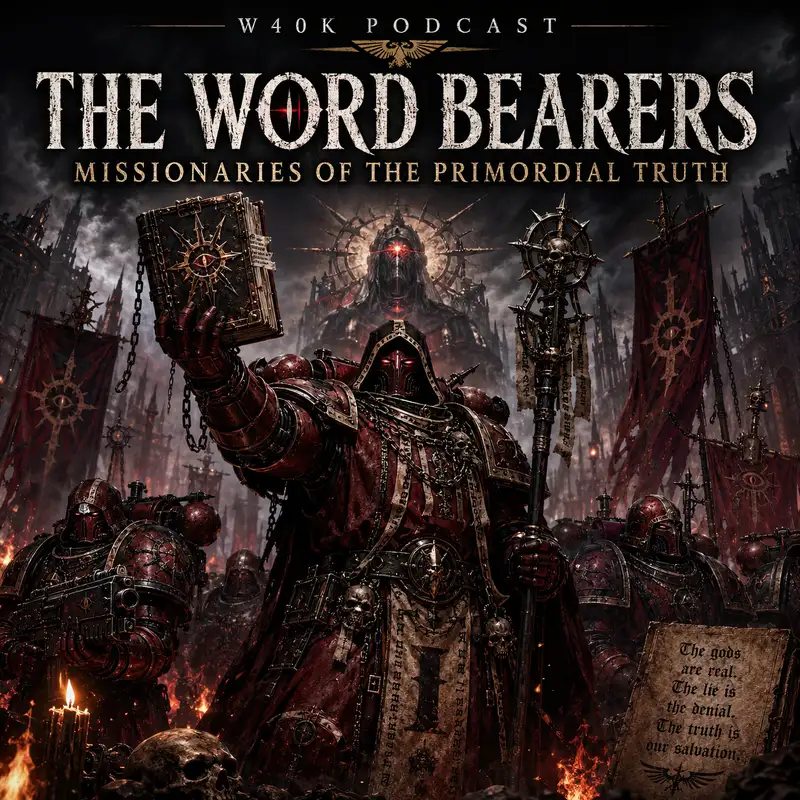
The Legion’s appearance turns doctrine into a weapon before a shot is fired. Crimson armour is scored with Colchisian script, devotional markings, and passages drawn from the teachings attributed to Lorgar. Icons of the burning book proclaim that revelation is something carried into battle. Standards, censers, chained texts, and corrupted crozius weapons make a host resemble an armed procession advancing through smoke. This is not decoration added to warfare. It is part of warfare. The enemy is meant to see a faith that survived ten thousand years of exile and has returned wearing power armour.
A Dark Apostle is not simply a Chaos Space Marine who speaks loudly before battle. He is the keeper of his host’s meaning. He interprets omens, directs sacrifices, disciplines the faithless, and decides how a campaign serves the greater design. Beneath him, other officers may handle the immediate mechanics of war, because even the most sacred invasion still needs ammunition, landing zones, and someone willing to check the fuel manifests. The Apostle’s task is to ensure that logistics and theology arrive at the same destination, preferably over the bodies of the unconvinced.
A Word Bearers campaign often begins before the host reveals itself. Agents move among pilgrims, underhive gangs, penal workers, soldiers, merchants, or disaffected clergy. They do not need to invent misery. The Imperium supplies that in industrial quantities. They explain misery. A starving worker is told that pain is not evidence of abandonment, but proof that the old faith is a lie. A frightened soldier is promised strength. A minor official is offered advancement. A priest is shown a miracle that answers when the Emperor remains silent. Each recruit receives a doorway shaped like a solution.
The first cult cells may know almost nothing about Chaos. They gather around forbidden texts, shared resentment, ecstatic ritual, or the charisma of a local demagogue. Symbols change. Prayers acquire new names. Small acts of disobedience become tests of loyalty. The cult offers fellowship to people whose official society treats them as replaceable parts. By the time its members understand the cost, confession has become conspiracy and conspiracy has become identity. Leaving would mean admitting guilt to the Imperium and betrayal to powers that may already be watching.
When the Word Bearers finally arrive, they enter a conflict whose foundations have been weakened from within. Sabotage disrupts defence grids. Mutinies divide regiments. Shrines become rallying points for insurrection. The Dark Apostle broadcasts sermons across military channels while his host strikes at command centres and sacred sites. This is not random cruelty. It is theatre with strategic purpose. Every toppled statue declares that the old god cannot protect his image. Every captured cathedral becomes evidence. Every public execution asks the crowd which power appears to be listening now.
Ritual then changes the battlefield itself. Sacrifice, mass emotion, daemonic names, and carefully prepared symbols can thin the boundary between reality and the Warp. Possessed warriors surge forward as proof of communion. Daemons manifest where fear and blood have prepared the way. Machines may be bound to hostile spirits. The defenders are forced to fight an argument that has acquired teeth. A conventional commander can destroy a cultist, a tank, or even an Apostle. It is harder to shoot the conviction that the laws of reality have chosen the enemy’s side.
The mortal followers of the Word Bearers are essential to this process, though essential does not mean valued. Cultists provide intelligence, numbers, labour, sacrifice, and the emotional force upon which rituals feed. Some are true believers. Some are terrified. Some hope to rise. Others discover too late that the promised liberation has placed them beneath masters far less merciful than the ones they overthrew. The Word Bearers call them a congregation, but congregations are frequently used as ammunition. Chaos has always been generous with opportunities and remarkably vague about retirement benefits.
Unlike Legions devoted chiefly to one Chaos God, the Word Bearers generally proclaim reverence for the pantheon as a whole. They see the rivalry of the gods as part of the total reality of Chaos, not a reason to choose one and deny the rest. Individual warriors may lean toward particular patrons, and practice is rarely as tidy as doctrine. Still, the Legion’s identity rests upon Chaos Undivided. They are not merely seeking a gift from Khorne, Nurgle, Tzeentch, or Slaanesh. They claim to serve the entire sacred structure behind existence.
This makes their fanaticism disciplined rather than simple. A World Eater lost to rage may be terrifying, but his purpose can be predicted. A Word Bearer may delay violence because conversion will yield more souls, a stronger ritual, or a better example. He can negotiate, deceive, preach, and wait. His faith does not prevent calculation. It gives calculation a destination. This is one reason the Legion remains dangerous across long campaigns. It can plan for generations, cultivate hidden communities, and treat apparent defeat as one movement in a design whose final proof has not yet arrived.
Their devotion also creates a peculiar relationship with truth. The Word Bearers insist that they alone accept the universe as it is. They expose Imperial lies about the Warp, the gods, and the cost of maintaining order. Yet their missionary work depends upon manipulation, selective revelation, staged miracles, and coercion. A recruit is rarely shown the full destination at the beginning. The doctrine may proclaim truth, but the method recognizes that most people would decline if the first sermon included possession, human sacrifice, and eternal servitude in the immaterium.
The greatest irony is that the Imperium eventually embraced a version of the faith for which Lorgar had been condemned. The Emperor became the centre of a galaxy-spanning religion. His divinity was proclaimed by institutions that would execute anyone who spoke Lorgar’s name with anything but hatred. Texts associated with the early worship of the Emperor helped nourish the Imperial Cult, while their author’s Legion became the arch-enemy of that creed. Lorgar lost the argument at Monarchia, betrayed the Imperium, and history then built a cathedral over the position he had once defended.
The Word Bearers therefore serve as a distorted mirror of the Imperium. Both understand that belief can hold together populations spread across impossible distances. Both use ritual, relics, martyrdom, sacred language, and controlled interpretations of history. Both can turn worship into obedience and obedience into military power. The comparison does not make them morally equal, and the Word Bearers’ embrace of daemonic predation is not merely another denomination. It does reveal why they are so effective. They understand the machinery of faith because they helped design part of the machinery used against them.
Their own unity is also less perfect than their sermons suggest. Erebus and Kor Phaeron have long represented rival ambitions within the Legion. Dark Apostles compete for favour, status, relics, and signs of divine approval. Hosts can feud. The Chaos Gods themselves embody conflicting impulses and wage the Great Game without end. The Word Bearers preach a single Primordial Truth, but the powers at its centre reward division as readily as devotion. Their church promises cosmic order while serving gods whose appetites ensure that order can never be complete.
Lorgar remains the sacred father of this enterprise, whether he is issuing commands, absent in meditation, or appearing through prophecy and rumour. His sons do not require his constant presence because he gave them something more durable than a campaign plan. He gave them an explanation of the universe in which every victory confirms their faith and every defeat demands greater faith. That is the mark of a powerful ideology. It does not merely interpret events. It protects itself from events that should disprove it.
The Word Bearers are missionaries because conquest alone cannot satisfy them. A dead world demonstrates strength, but a converted world appears to demonstrate truth. They want the frightened, the resentful, the ambitious, and the broken to participate in their own damnation and call it revelation. Their greatest weapon is not the bolter or the daemon. It is the claim that resistance is ignorance, that corruption is awakening, and that submission is the only honest response to the universe.
That claim contains the final horror of the Primordial Truth. The Word Bearers are not wrong that the Warp touches humanity, or that the gods feed upon mortal emotion, or that the Imperium survives through lies and faith of its own. They are wrong that these facts create an obligation to kneel. So their crusade continues from world to world, announced by hidden voices and completed beneath burning skies. Behind them stand ruined shrines, opened Warp rifts, and congregations that have learned the new prayers. Ahead of them, somewhere in the dark, another listener is already beginning to believe.