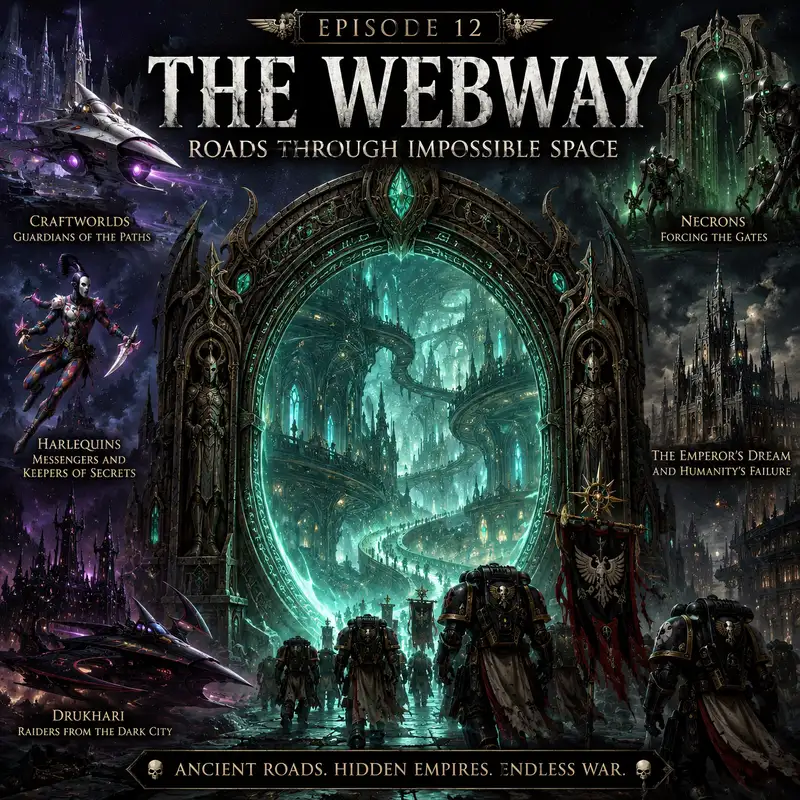
The Webway: Roads Through Impossible Space
A gate opens where no road should exist. One moment there is only a ruined arch standing beneath an alien sky. The next, its empty centre fills with pale light, and beyond it lies neither the landscape behind the arch nor the stars above. There is a corridor without a horizon, curving through distances that refuse to behave like distance. An army can march into that opening and emerge on another world. A raiding fleet can vanish before defenders understand they have been attacked. A traveller can take the wrong turn and discover that the road has been waiting for them longer than their species has existed.
This is the Webway, the nearest thing the galaxy possesses to a road system built through impossible space. It is ancient, damaged, jealously guarded, and only partly understood even by those who use it. It offers passage across immense distances without surrendering a ship to the raw tides of the warp. That alone makes it one of the most valuable creations in the setting. Yet the Webway is more than transportation. It is a buried empire, a battlefield, a fortress, a hunting ground, and the site of one of humanity’s greatest failures. To understand it, the useful question is not simply where the Webway goes. The real question is what control of such roads does to the people who inherit them.
Most interstellar travel in the Imperium depends upon the warp, a realm shaped by thought, emotion, and psychic force. A vessel entering it can cross distances that would be impossible at ordinary speeds, but the bargain is severe. Warp currents shift. Time becomes unreliable. Predatory entities gather beyond the ship’s protective field. Navigators steer by the distant radiance of the Astronomican, and every journey depends upon systems that are dangerous even when they work properly. Imperial civilization survives because it accepts this arrangement. The ship enters hell, the crew secures the hatches, and everyone hopes the mathematics, the wards, and the screaming remain within established limits.
The Webway offers a different bargain. It does not carry travellers through the open warp. Instead, it forms a labyrinthine realm between the material universe and the immaterium, enclosed by structures that resist the pressure outside. Calling those structures tunnels is useful, but incomplete. Some passages resemble vast glowing arteries through which spacecraft can travel. Others narrow into routes suited only for individuals or small war parties. Gates can stand on planets, within ships, aboard craftworlds, or in places that no longer have a clear relationship with ordinary geography. The Webway turns separation into architecture. A world thousands of light-years away may be reached by finding the correct door.
Correct is doing a great deal of work in that sentence. The Webway is not a tidy network of numbered routes and reassuring signs. Its pathways divide, reconnect, collapse, and sometimes seal themselves against intrusion. Directions can depend upon symbols, psychic intuition, inherited maps, and knowledge guarded more fiercely than a planetary arsenal. Time may pass strangely in its deeper reaches. A journey can lead through abandoned cities, broken causeways, silent chambers, or regions where the warp has torn through the walls. The network was never simple, and after millions of years of war and catastrophe, it has acquired the personality of an ancient fortress maintained by ghosts. It still functions. It simply does not feel obligated to explain itself.
The first builders were the Old Ones, a civilization so ancient that almost every surviving account turns history into mythology. During the War in Heaven, they fought the Necrontyr and later the metallic Necrons and their star-god allies. The Old Ones possessed extraordinary mastery of psychic and dimensional technologies. The Webway allowed them to move forces across the galaxy while avoiding the hazards and delays of conventional travel. In strategic terms, they built interior lines on a galactic scale. Armies could appear where they were needed, reinforce distant fronts, and bypass the enemy’s control of normal space. It was logistics elevated to sorcery, which is often how advanced engineering appears after the instruction manual has been lost for sixty million years.
The Necrons eventually found ways to violate that advantage. Through devices known as Dolmen Gates, they could pierce portions of the Webway and force entry into a system that was not made for them. These breaches were unstable, limited, and treated by the network almost like infections. Entire branches could close in response, destroying or trapping those inside. Even so, the Dolmen Gates mattered because the Necrons lacked the psychic relationship with the warp enjoyed by their enemies. Access to the Webway gave them another way to cross the immense distances between tomb worlds and battlefields. The struggle over the network therefore began almost as soon as the network became useful. Roads create commerce and unity. They also create invasion routes.
After the age of the Old Ones, the Aeldari became the Webway’s great inheritors. Their ancestors learned its paths, expanded its use, and bound their civilization together through gates spread across the galaxy. At the height of the Aeldari empire, the Webway was not a mysterious shortcut used by desperate survivors. It was infrastructure. Worlds, vessels, and city-realms were linked through passages that allowed people, armies, and ships to move without crossing the open warp. The network made an empire scattered among the stars feel contiguous. Distance remained real, but it no longer possessed the same political power. A civilization connected by the right gates could behave as though the galaxy were smaller than it appeared.
When the Aeldari Fall came, the birth of Slaanesh tore through both realspace and the warp. The psychic shock destroyed the heart of the old empire and ruptured the Webway in countless places. Some passages collapsed. Others opened into the warp. Cities were isolated, gates became useless, and routes known for generations ended in sealed walls or daemonic infestation. The network survived, but as a wounded version of itself. That distinction is essential. The Webway of the forty-first millennium is not an intact wonder occasionally troubled by intruders. It is a surviving system whose users navigate around ancient amputations. Every journey depends upon knowing which arteries still carry life and which now open into something hungry.
For the craftworld Aeldari, this damaged network remains indispensable. Their enormous world-ships move through realspace, but each craftworld maintains gates that connect to the hidden paths. Through them, warriors can deploy to distant battlefields, seers can travel between scattered communities, and small forces can strike with a speed that appears supernatural to their enemies. Aeldari commanders do not need to fight through every defended system between their starting point and their objective. They need a functioning route and a gate close enough to matter. This is why seemingly minor ruins can become the centre of desperate wars. To an Imperial governor, an ancient arch may be inconvenient archaeology. To an Aeldari seer, it may be the only surviving door to ten thousand years of history.
The Harlequins understand these roads better than almost anyone. Servants of the Laughing God, they move between Aeldari societies that otherwise distrust or despise one another. They carry warnings, perform the tragedies of their people, and emerge from hidden gates with the disconcerting ease of actors arriving exactly on cue. Their knowledge of the Webway is part navigation, part inheritance, and part sacred duty. They also guard the Black Library, a hidden repository of knowledge concerning Chaos. Its location is protected not merely by walls and weapons, but by the labyrinth itself. Finding the correct path is a test few outsiders survive. The library’s first defence is that the road to it refuses to become common knowledge.
The Drukhari built an entirely different civilization inside the same network. Commorragh, the Dark City, is not merely a metropolis placed in one convenient tunnel. It is a vast collection of connected domains, ports, satellite realms, and captured spaces joined through Webway passages. Its scale is deliberately difficult to grasp because normal measures of distance and territory become unreliable there. The city can absorb new districts, sever rebellious regions, and hide power bases behind routes known only to their rulers. Commorragh is protected by secrecy, dimensional depth, and the fact that an invading army cannot easily identify where the city ends. It is less a capital than a malignant civilization spread through the walls of an ancient transport system.
From that refuge, Drukhari raiders launch attacks into realspace. A gate opens near an unprepared world. Fast vessels and assault forces pour through, seize captives, and withdraw before a conventional fleet can respond. Their objective is not territorial conquest. The Drukhari require suffering to replenish what Slaanesh slowly drains from their souls, so the Webway supports an economy of predation. It lets them choose vulnerable targets, avoid defended approaches, and carry prisoners back to a city their enemies cannot reliably reach. The tactical elegance is undeniable. So is the horror. The network that once unified the Aeldari empire now allows one branch of its descendants to turn the rest of the galaxy into a collection of hunting grounds.
Humanity’s greatest attempt to master the Webway came during the Great Crusade. The Emperor understood the strategic weakness at the centre of his expanding Imperium. Human unity depended upon warp travel, astropathic communication, Navigators, and the Astronomican. Every one of those systems tied civilization to the immaterium. Every voyage risked corruption, delay, disappearance, or attack. The Emperor’s secret project beneath the Imperial Palace aimed to create human access to the Webway and eventually replace dependence upon ordinary warp travel. This was not simply a plan for faster ships. It was an attempt to change the relationship between humanity and Chaos by removing the most routine reasons humans had to enter the warp.
The Golden Throne was central to the effort. Deep beneath the Palace, the Emperor opened a portal and directed work into the ancient network. Human-built sections extended toward the existing Webway, supported by Mechanicum specialists and protected by the Emperor’s psychic power. These new passages were not made with the same resilient materials or complete understanding possessed by the original builders. They required active protection. Even so, Imperial forces reached an abandoned Aeldari city within the network and established a foothold. For a brief period, the project was not merely theory. Humanity had placed its hands on the hidden roads of the Old Ones and begun trying to make them its own.
Secrecy protected the project, but secrecy also poisoned the wider strategy. The primarchs were not told why the Emperor withdrew from the Great Crusade. Horus received command without understanding what work had become more important than the conquests they had shared. The Navigator houses had obvious reasons to fear a technology that might make their monopoly unnecessary. Even among the Emperor’s closest servants, knowledge was divided into compartments. There were defensible reasons for caution. Chaos could not be permitted to learn the plan, and political resistance might have destroyed it. Yet the result was a familiar Imperial arrangement in which everyone was expected to obey a purpose they were not allowed to understand.
The catastrophe began with Magnus the Red. Having discovered Horus’s betrayal, Magnus attempted to warn the Emperor by psychic means. He had already been forbidden from using his powers in this manner, but he believed the emergency justified the risk. His message crossed barriers designed to resist precisely such intrusion. The force of his arrival shattered the Emperor’s wards and tore open the vulnerable human sections of the Webway. Magnus intended to save the Imperium. Instead, he created a breach through which daemons could enter the project beneath Terra. It is one of the setting’s defining tragedies because his warning was correct, his method was disastrous, and the difference between those facts arrived too late to matter.
The Emperor was forced onto the Golden Throne to hold the breach in check. Custodians, Sisters of Silence, Mechanicum troops, and other Imperial forces entered the Webway to contain the invasion. They fought through tunnels and ruined domains that had never been designed for human occupation. The Sisters’ psychic null presence weakened daemonic manifestations. The Custodians brought unmatched skill, speed, and discipline. Mechanicum personnel tried to repair and stabilize failing sections while war raged around them. This was not a campaign for territory in the conventional sense. Every defended corridor kept the enemy one step farther from the gate beneath the Imperial Palace. Every lost position moved the warp closer to Terra.
The fighting endured in secrecy while the Horus Heresy consumed the visible Imperium. Within the Webway, Imperial forces established lines around the abandoned city of Calastar, sometimes called the Impossible City. Daemons attacked alongside corrupted warriors and war machines. The defenders launched counterattacks, repaired barriers, and surrendered ground only when holding it became impossible. Attrition favoured the enemy. Daemons destroyed in battle could return through the warp, while every dead Custodian represented a warrior who could not be replaced during the crisis. The Imperium was spending its rarest soldiers to hold a road that most of humanity did not know existed. That was not waste. The alternative was allowing the road to end inside the Palace.
As the war worsened, the Emperor’s project became a trap. His power was required to keep the portal contained, which prevented him from freely directing the wider war. The Custodians and Sisters were bled white in a conflict hidden from the armies defending the Imperium. Calastar fell. The surviving Imperial forces retreated toward Terra, pursued by enemies that could not be permanently exhausted. For a brief time, the Emperor left the Throne and entered the Webway himself, driving into the daemonic host with overwhelming psychic force. The intervention saved the retreat. It did not save the project. Power could clear the road for a moment. It could not rebuild the walls that Magnus had broken.
The portal was sealed, and the dream of an Imperial Webway ended. The Golden Throne became not the control point of humanity’s new road system, but the mechanism that kept a failed road from opening directly into Terra. After the Emperor was mortally wounded during the final confrontation with Horus, he was placed upon the Throne permanently. For ten thousand years, the heart of the Imperium has rested above a locked gate with an army of daemons on the other side. The device that was meant to free humanity from the warp became part of the system that binds its ruler in place. Few Imperial ironies are more complete, and the competition is not gentle.
The failure changed the meaning of the Great Crusade. Without the Webway project, reconquest could unify territory but could not cure the structural weakness of the Imperium. Its worlds remained dependent upon dangerous travel, uncertain communication, hereditary Navigators, and the psychic beacon sustained from Terra. The Emperor’s realm became vast without becoming truly connected. Orders could arrive decades late. Reinforcements could vanish. Entire sectors could be isolated by storms. The Webway might not have solved every problem, and the Emperor’s broader intentions remain debated, but its loss ensured that the Imperium would continue governing a galactic empire through the equivalent of sending official correspondence across a haunted ocean during a hurricane.
The network itself continued without humanity. Craftworld forces still use hidden gates. Harlequins still traverse routes that appear closed to others. Drukhari fleets still emerge from darkness to raid worlds that believed themselves far from danger. Necrons still exploit the surviving Dolmen Gates where they can. Inquisitors, sorcerers, explorers, and conquerors search for entrances because a single reliable passage can overturn an entire campaign. A fortress designed to resist attack from space may be nearly helpless against an enemy arriving from an arch in a sealed chamber. A fleet guarding a major warp route may discover that the opposing army never intended to use it. The Webway turns geography into classified information.
This uncertainty gives the Webway its military power. An ordinary road is valuable because everyone knows where it leads. A Webway route is valuable because almost no one does. It permits concentration without warning, escape without pursuit, and movement beyond the enemy’s map. It also creates dependence on guides, seers, gatekeepers, and inherited secrets. The faction that controls a route can decide who receives rescue, who receives reinforcement, and who is left behind. In a galaxy obsessed with weapons, the Webway demonstrates a quieter truth. The ability to place force at the decisive point can matter more than the size of the force itself.
The Old Ones built the Webway to cross the galaxy and outmaneuver their enemies. The Aeldari turned it into the connective tissue of an empire. The Drukhari made it a fortress for predation. The Harlequins use it as road, stage, sanctuary, and lock. The Necrons force their way into it through wounds. The Emperor tried to make it the path by which humanity escaped its dependence on the warp, and his failure helped create the prison at the centre of the Imperium. Each civilization reveals itself by what it believes a road is for. Trade. Unity. Secrecy. Conquest. Survival. The Webway has served all of them, while belonging completely to none.
That is why the Webway remains one of the most important ruins in the galaxy. It is not merely a faster route between stars. It is proof that distance, isolation, and even the boundary between reality and nightmare can be engineered around, at least for a time. It is also proof that infrastructure outlives intention. Roads built for an ancient war now carry refugees, performers, raiders, armies, and monsters. Behind sealed gates, lost branches still wait in darkness, leading to cities without inhabitants and battlefields without graves. The Webway is the road through impossible space, and every traveller who enters it moves not outside history, but through the wounded body of it.