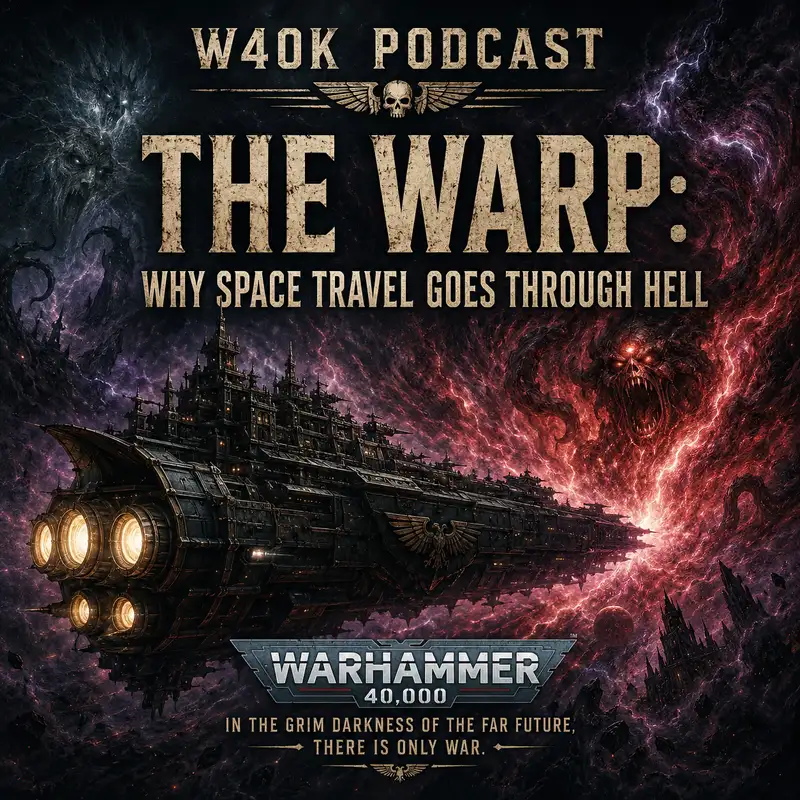
The Warp: Why Space Travel Goes Through Hell
At the edge of a star system, an Imperial warship prepares to do something no sane civilisation would call routine. Blast shutters seal over the viewports. Crew stations are locked down. Priests chant beside machines whose true workings are only partly understood. Deep within the vessel, a Navigator withdraws behind guarded doors, opens an eye that ordinary humans were never meant to possess, and looks toward a place where distance, time, and reason have no dependable meaning. Then the warp engines engage, reality tears open, and the ship leaves the universe.
This is how humanity crosses the galaxy.
The vessel has not entered empty hyperspace, a neat tunnel, or some harmless dimension folded beside the physical world. It has entered the Warp, also called the Immaterium, the Empyrean, and the Sea of Souls. The Warp is a parallel realm of psychic energy shaped by the thoughts, emotions, and souls of living beings. Rage, fear, hope, ambition, despair, and desire leave impressions there. Across ages, the emotions of entire species have gathered into storms, currents, predators, and powers vast enough to answer prayers.
So why does space travel in the Imperium go through hell?
Because the galaxy is too large, humanity has lost most of its better options, and hell is faster.
A ship moving through ordinary space remains bound by ordinary distance. Even a powerful voidship travelling at extraordinary speed would need years, generations, or far longer to cross the distances between many inhabited systems. An interstellar empire cannot survive if every message becomes an heirloom and every reinforcement arrives after the war has entered the history books. The Imperium needs food shipments, armies, pilgrims, colonists, officials, raw materials, and orders to move between hundreds of thousands of worlds. Without faster than light travel, those worlds would not form an empire. They would be lonely islands with similar flags.
The Warp provides the necessary shortcut because space inside it does not correspond cleanly to space in the material universe. A vessel can enter the Immaterium, travel along its currents, and emerge light-years from where it began after far less time has passed for those waiting in realspace. The usual comparison is an ocean. Realspace is the land, the Warp is the sea, and a ship uses currents to move farther and faster than it could by crawling along the shore.
It is a useful comparison, provided one imagines an ocean made from emotion, inhabited by things that can smell fear, and occasionally flowing backward through Tuesday.
The Warp is not simply another name for Chaos, although the two are inseparable in the age of the Imperium. The Immaterium existed as a psychic dimension long before humanity built its first starship. It reflects the minds of living creatures, and in turn it can influence them. The Chaos Gods and their daemonic servants are the greatest powers within that realm, but they are not the whole of it. Warp storms, psychic echoes, the souls of the dead, strange intelligences, and phenomena with no convenient human explanation all move within the same impossible medium.
This distinction matters because an Imperial captain is not deliberately steering into the private residence of a single daemon. The ship is entering a hostile environment whose natural laws allow daemons to exist. That is not much comfort, but the paperwork is probably different.
A daemon is not merely a creature that happens to live in the Warp. It is a portion of that realm given identity and hunger, often bound to one of the great powers of Chaos. This is why guns and bulkheads alone are not sufficient protection. A daemon does not need to approach a ship as a boarding torpedo approaches armour. It can exploit emotion, symbolism, weakness, and invitation. Hatred can become a doorway. Despair can become a voice. Ambition can sound remarkably sensible when it first introduces itself. The danger of the Warp is not only that monsters may enter the ship. It is that the ship already contains minds from which monsters can begin.
Before the jump, the vessel must first travel away from the system’s strongest gravitational fields. Imperial navigators and shipmasters speak of Mandeville points, regions far enough from stars and major planetary bodies for a stable translation into or out of the Warp. Attempting the transition too close to a powerful gravity well can place catastrophic strain on the warp drive. Most ships therefore spend days or weeks crossing a system under conventional power before they can even begin the dangerous part of the voyage.
At the proper point, the warp drive opens a breach between the material universe and the Immaterium. The ship translates across that boundary. This is not merely acceleration. It is a change in the kind of reality surrounding the vessel. A hull designed to endure vacuum, radiation, and enemy fire has entered a realm where physical matter is an unwelcome visitor.
The ship survives because of its Gellar field.
A Gellar field creates a protected envelope of material reality around the vessel. Inside that bubble, walls remain walls, decks retain their shape, and human bodies generally continue obeying the arrangement they had when the voyage began. Outside it, the Warp presses against the ship without respecting matter, causality, or privacy. The field is therefore less like armour and more like the thin boundary that insists the vessel still belongs to the universe it left behind.
Imperial crews treat the Gellar field with the seriousness normally reserved for ammunition magazines and divine judgement. Generators are inspected, blessed, guarded, and surrounded by redundant systems wherever the ship’s builders had the resources and the foresight. The Adeptus Mechanicus understands how to operate and maintain much of this machinery, but complete theoretical knowledge is another matter. The Imperium inherited warp technology from a more capable human past, then preserved it through ten thousand years of war, dogma, loss, and increasingly nervous maintenance rituals.
Those rituals are not necessarily useless. In the Imperium, a prayer may be superstition, a maintenance checklist disguised as religion, a genuine psychic defence, or all three at once. The technician who anoints a control housing with sacred oil may not understand the field equations behind the machine, but the rite may ensure that the correct valve is opened in the correct order. Civilisations have been held together by less.
If the Gellar field fails, even briefly, the ship is exposed. The consequences vary because the Warp does not produce failures with the reassuring consistency of an engine fire. Daemons may breach the hull without crossing any ordinary doorway. Crew members may hear voices that know their names, their regrets, or the one thought they have never confessed. Passages can change. Time can fracture. Flesh can mutate. Machines can become hostile, walls can seem to breathe, and people can turn upon one another before any visible creature appears.
A complete collapse can condemn the vessel almost instantly. A partial fluctuation may be worse in a slower, more intimate way. Something enters. Something remains hidden. The field stabilises, the alarms stop, and the crew congratulates itself on survival. Weeks later, a deck officer begins speaking in a language no one has taught him. The Imperium has learned to treat unexplained good fortune with suspicion.
Even when the field holds, the Warp can affect those inside. Sensitive minds suffer nightmares, visions, nausea, and the sense of being watched from the other side of the hull. Psykers are especially vulnerable because their souls shine more brightly in the Immaterium. Their gifts make them useful to the Imperium, but those same gifts make them visible to the things that hunt there. On many ships, sanctioned psykers are confined, monitored, warded, or surrounded by armed personnel during translation. Trust is valuable. A loaded weapon is easier to audit.
Ordinary crew members may never see the Warp directly. Viewports are covered, access is restricted, and shipboard discipline becomes severe. This is partly practical and partly merciful. Looking into the Immaterium without protection can break the mind, invite possession, or expose the viewer to sights that human perception cannot translate safely. The Warp is not simply ugly. It is incompatible with the assumptions that make human thought possible.
Yet the Gellar field only keeps the environment outside. It does not tell the ship where to go.
That task belongs to the Navigators of the Navis Nobilite. Navigators are a hereditary strain of human mutant bred through ancient noble houses. Their defining feature is a third eye, often concealed when they move among ordinary people. Through it, they can perceive the currents and landmarks of the Warp in a way that normal humans cannot. A trained Navigator does not see a clean chart floating in darkness. The experience is symbolic, psychic, and deeply personal. One may perceive tides, another mountains, another lights, beasts, music, or impossible architecture. What matters is that the Navigator can interpret those impressions well enough to guide a ship.
The great Navigator houses are therefore among the most powerful institutions in the Imperium. They possess wealth, political privileges, arranged bloodlines, private rivalries, and the sort of family histories that require sealed vaults and armed genealogists. The Imperium distrusts mutation as a matter of doctrine, then entrusts its entire interstellar existence to a carefully protected class of mutants. This is not hypocrisy by accident. It is hypocrisy made necessary by logistics.
A warp chart is therefore closer to a collection of remembered passages than a geometric map. It records where currents have tended to flow, where storms have gathered, which signals can be trusted, and which regions have swallowed previous expeditions. Routes acquire reputations. Some are guarded as commercial secrets. Others are avoided because too many vessels have vanished along them. A capable Navigator reads inherited knowledge against present conditions, much as an ancient mariner might compare a trusted chart with a sea that has begun moving in ways no chartmaker anticipated. The difference is that this sea notices the Navigator looking back.
For long voyages, the Navigator seeks the Astronomican, the great psychic beacon projected from Terra. Sustained through immense sacrifice and focused by the Emperor, its light shines through the Warp as a fixed reference point. It is not a lighthouse in the ordinary sense, and it does not mark every destination. The Navigator uses its position, strength, and relationship to other warp phenomena to estimate where the vessel is and how its course is changing.
The Astronomican is also not equally visible everywhere. Its light weakens with distance, can be obscured by storms, and becomes difficult or impossible to perceive in regions cut off by massive disturbances. Skilled Navigators combine the beacon with known routes, local signs, experience, and the records of previous voyages. Some shorter jumps can be attempted without a Navigator, using calculation and brief translations, but such travel is limited. To move fleets across the breadth of the Imperium, the mutant guide and the Emperor’s distant light remain essential.
Even with both, Warp travel is not precise.
Currents shift. Routes that were safe for centuries can become violent. A journey expected to last weeks may consume months. A ship may emerge far from its intended destination, or fail to emerge at all. Time inside the Warp does not remain obedient to time outside it. A crew can experience a short passage and discover that years have passed in realspace. In stranger cases, vessels have arrived before the date on which they departed, leaving Imperial administrators to confront a problem for which no approved form was designed.
This uncertainty is not a colourful inconvenience added to Imperial travel. It determines military campaigns and the survival of worlds. Reinforcements can be delayed until a defence has collapsed. A fleet can arrive scattered because its ships were separated in the Warp. Orders may reach a commander after the situation they describe no longer exists. Supply vessels vanish, forcing armies to fight without fuel or ammunition. A crusade assembled from distant sectors may begin with half its promised strength and no reliable knowledge of whether the other half is late, destroyed, or enjoying an unfortunate century.
The Imperium responds by building enormous margins into everything. Fleets carry vast stores. Worlds maintain garrisons because rescue cannot be guaranteed. Astropathic messages are repeated through relays. Administrators issue duplicate orders along separate routes. Commanders learn that a timetable is a statement of hope written in official ink.
Warp storms make the problem worse. These are regions of extreme turbulence where travel and psychic communication become dangerous or impossible. A storm can isolate a system for decades or centuries. To those trapped inside, the wider Imperium may become a legend. When the routes reopen, Imperial officials may discover that the isolated world has survived, rebelled, evolved into something unrecognisable, or continued filing its taxes with admirable and entirely unnecessary discipline.
The greatest modern example is the Cicatrix Maledictum, the Great Rift. When Cadia fell and the rift tore across the galaxy, reality itself was wounded on an almost unimaginable scale. Warp storms spread, routes collapsed, and the Imperium was divided. On the far side of the rift, in the region called Imperium Nihilus, countless worlds were cut off from the reliable light of the Astronomican. Travel became more dangerous, communication more uncertain, and local commanders were forced to act with little assurance that Terra could hear them, much less help them.
This reveals the deeper truth about the Imperium. It looks like a single empire on a map, but the map lies. The Imperium is a collection of systems connected by dangerous routes through a psychic storm. Its laws, armies, religion, and economy depend upon ships that may arrive late, damaged, corrupted, or not at all. Terra can claim authority over the galaxy because the Warp allows orders and force to travel across it. The Warp also ensures that this authority is always incomplete.
Other civilisations have found different answers, although none offers humanity an easy escape. The Aeldari use the Webway, an ancient network of protected passages that runs through and around the Immaterium. It is faster and generally safer than open Warp travel, but much of it is damaged, hidden, sealed, or controlled by those who have no intention of handing the keys to the Imperium. The Drukhari inhabit sections of that network and regard unexpected visitors less as guests than as inventory.
The Necrons possess technologies built upon principles humanity barely understands, allowing them to cross space without depending upon ordinary Imperial methods. The T’au have developed their own forms of interstellar travel and have repeatedly discovered that the Warp is not a problem solved merely by approaching it with optimism and good engineering. Orks use warp travel with characteristic confidence, relying on crude technology, powerful collective belief, and the reasonable assumption that anything encountered en route can be fought.
Humanity once pursued another path. During the Great Crusade, the Emperor sought access to a human-controlled Webway, a route that could have reduced mankind’s dependence on Navigators and exposed fewer souls to the open Warp. That project ended in catastrophe during the Horus Heresy. The dream of a safer road collapsed, and the Imperium that followed became even more dependent upon the very realm the Emperor had hoped to avoid.
That failure helps explain why Imperial space travel feels so thoroughly gothic. Every voyage combines advanced technology with inherited ritual, aristocratic mutants, sacrificial psychic power, religious terror, and machines no living engineer fully comprehends. A starship is not simply a vehicle. It is a fortified city carrying its own shrines, gun decks, work gangs, prisons, dynasties, and ghosts. When it enters the Warp, every person aboard is protected by a field they cannot see, guided by a mutant they may fear, toward a beacon maintained by suffering on a world they may never visit.
Most voyages still succeed. This is important. If every translation ended in possession or disappearance, the Imperium would have collapsed before anyone finished painting the warning signs. Merchant vessels deliver grain. Navy squadrons reach war zones. Pilgrim ships carry millions to holy worlds. Black Ships complete their terrible circuits. The system functions often enough to preserve civilisation, but fails often enough that every journey carries genuine dread.
The Warp is therefore not a rare supernatural intrusion into an otherwise rational future. It is part of the infrastructure. It carries messages through astropaths, empowers psykers, enables fleets to cross interstellar distances, and allows the enemies of humanity to reach directly into human minds. The same realm that binds the Imperium together gives Chaos a road into it.
That is why space travel goes through hell. Not because the Imperium mistakes danger for courage, and not because its captains enjoy gambling with daemons. It goes through the Warp because ordinary space is too vast, the safer roads are lost or held by others, and the empire cannot survive at the speed of light.
At the system’s edge, another ship closes its shutters. The Navigator opens the third eye. The Gellar field rises around an immense mass of metal and machinery, together with thousands of frightened human lives. Ahead lies a realm built from every fear those lives have ever known. Behind lies a galaxy that cannot be crossed any other way.
The engines engage, reality opens, and humanity takes the only road it has.