The War of the Beast
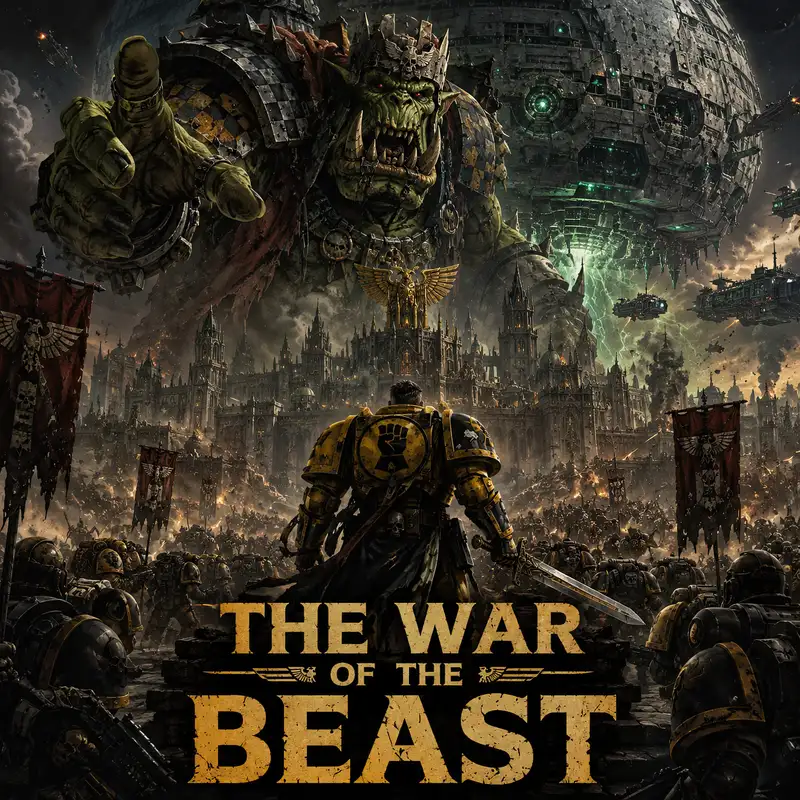
The most frightening Ork to reach Terra during the War of the Beast did not arrive roaring from the ramp of a gunship. It came as an ambassador. It entered the seat of Imperial power under a flag of truce, spoke fluent High Gothic, and demanded the surrender of humanity’s throneworld. The High Lords of Terra, rulers of an empire spread across the stars, could offer no coherent answer. Above them hung an Ork attack moon large enough to distort the planet beneath it. Before them stood proof that the enemy they had dismissed as a collection of violent savages could negotiate, plan, and humiliate them in their own palace. The question was no longer whether Terra could be attacked. It was whether the Imperium still possessed the will and imagination required to save itself.
The War of the Beast erupted in the thirty-second millennium, roughly fifteen hundred years after the Horus Heresy. That distance matters. The traitor primarchs had vanished into legend, the worst wounds of the Heresy had begun to scar over, and the Imperium enjoyed something close to peace. It was not a gentle or enlightened civilisation, but it was more confident, more energetic, and less visibly decayed than the empire of the forty-first millennium. Its leaders believed the great existential wars were behind them. Chaos had been driven back. Alien threats survived mainly along distant frontiers. The Orks, in particular, were treated as a recurring military nuisance rather than a civilisation capable of strategic conquest. Humanity had defeated the greatest Ork empire at Ullanor during the Great Crusade. The matter, as official minds preferred to think of such things, had been settled permanently.
Orks rarely remain settled. Their society expands through conflict, and sustained conflict changes them. As a Waaagh grows, its shared psychic energy strengthens. Individual Orks become larger, their leaders become more formidable, and their culture produces increasingly ambitious weapons, machines, and systems of command. The crude appearance of Ork technology is misleading. A device may look as though it was assembled during an industrial accident, but that does not mean it cannot bend gravity, open portals, or destroy a battleship. Under the Beast, the Orks had not abandoned their love of violence. They had organised it. They developed supply systems, fleets, disciplined armies, specialised castes, and a political hierarchy extending across an empire. The Imperium expected raiders. It encountered a rival power built entirely around war.
The first warning came at Ardamantua. Imperial Fists were fighting an insectoid species known as the Chromes, enemies who appeared less like conquerors than refugees fleeing something worse. Strange gravitational disturbances began tearing at the planet. Then an immense artificial moon phased into existence above it. This was not a hollowed asteroid dragged through space by engines. It was a mobile fortress, equipped with weapons that could manipulate gravity and with portals capable of moving troops and machines through a form of subspace. Reinforcements rushed toward Ardamantua and were destroyed. The Imperial Fists committed almost their entire Chapter and were annihilated with them. Captain Koorland survived, wounded and alone, as the only known living Imperial Fist. A Chapter founded from Rogal Dorn’s own Legion had effectively ceased to exist in a single engagement.
Ardamantua was not an isolated catastrophe. More attack moons appeared across Imperial space. They broke worlds with gravity weapons, disgorged armies through impossible gateways, and moved faster than Imperial commanders believed objects of such size could move. Whole systems disappeared behind the advancing Waaagh. Psychic pressure and gravitational disturbances accompanied the Ork advance, driving populations into panic and madness. Some humans even began worshipping the Beast, apparently reasoning that devotion might prove safer than resistance. It did not. The Orks were not seeking subjects. They were seeking victory, territory, and enemies worth fighting. Billions died while the Imperium struggled even to understand the shape of the invasion.
The Imperial government responded with argument. The High Lords of Terra commanded the Navy, the armies, the priesthood, the bureaucracy, the Mechanicum’s uneasy cooperation, and nearly every other instrument required to fight a galactic war. They also distrusted one another more reliably than they understood the enemy. Fleets had been positioned far from Terra because the heart of the Imperium was considered secure. Powerful officials guarded their own forces, reputations, and political privileges. One naval counterattack at Port Sanctus did destroy an attack moon, but only through a ruinous charge that cost ships by the squadron. Its commander returned to Terra in triumph. The celebration ended when another attack moon materialised directly over the throneworld. Imperial timing has always possessed a certain theatrical cruelty.
Terra descended into riot and religious terror. The moon’s presence disrupted the world below, while the government remained unable to produce a workable plan. One proposal relied upon the Imperium’s most abundant strategic resource: human lives. A Proletarian Crusade gathered billions of ordinary citizens into thousands of vessels and sent them against the Ork moon. Many went willingly, fuelled by faith, fear, and the belief that mass sacrifice could achieve what professional forces had not. The Orks allowed the crusaders to land before closing the trap. The attack ended in slaughter. It was a perfect Imperial operation in one limited sense. Everyone involved demonstrated absolute commitment to a plan that should never have survived its first meeting.
Then came the Ork embassy. The arrival of diplomats revealed the depth of the transformation. These Orks understood Imperial language, ceremonial behaviour, political weakness, and the value of terror delivered without firing a shot. Their demand for surrender was not a joke. The Beast’s empire had reached a level of organisation at which humanity was no longer merely prey. It was an opponent being offered terms. For the High Lords, the humiliation was complete. The Orks had come to Terra not simply to destroy the Imperium, but to make its rulers acknowledge that they had already lost.
Koorland refused that conclusion. As the last Imperial Fist, he possessed a secret order left by Rogal Dorn after the breaking of the Legions. The Last Wall Protocol commanded the successor Chapters of the Imperial Fists to reunite if Terra faced mortal danger. The Black Templars, Crimson Fists, Fists Exemplar, Excoriators, and other sons of Dorn were separate Chapters by law and tradition, but the protocol called them back into something dangerously close to a Legion. That was precisely why it had been hidden. The Imperium’s post-Heresy order rested upon the belief that no single commander should again possess the military power once held by a primarch and his sons. Koorland invoked the protocol because Terra was facing the sort of emergency for which legal caution provides very little ammunition.
The Last Wall reached the Sol System and struck the attack moon. Space Marines and Mechanicum forces landed amid immense Ork defences while Imperial ships endured the moon’s gravity weapons. The assault disabled its portal and ruined much of the structure, although it did not yet eliminate the threat. More important, it demonstrated that the Orks could be hurt when Imperial forces acted together. Koorland’s reward was a reprimand from political leaders offended that he had saved Terra without sufficient authorisation. He tried to remain obedient. He believed that the institutions of the Imperium, however frustrating, existed for a reason. Experience eventually persuaded him that an institution which refuses to perform its purpose becomes a very elaborate obstacle.
With support from figures including Drakan Vangorich, the Grand Master of Assassins, Koorland removed the ineffective Lord Commander and took control of the war effort. He did not become a tyrant in the simple sense. He became an emergency ruler because the established rulers had reduced government to ceremonial paralysis. His objective was to find the centre of the Ork empire and cut out its leadership. The Adeptus Mechanicus eventually identified that centre. It was Ullanor, the world where the Emperor and Horus had once shattered a great Ork empire and celebrated the apparent triumph of the Great Crusade. The Imperium had built a legend upon Ullanor. The Orks had built a capital upon its ruins.
Even Koorland understood that an assault on Ullanor required more than another fleet and another speech. The Imperium needed a figure capable of uniting its forces, frightening its enemies, and silencing the High Lords simply by entering the room. Reports pointed to Caldera, where a gigantic armoured warrior was defending the population against the Orks. The warrior was Vulkan, primarch of the Salamanders, long absent from Imperial history. He had not returned to reclaim authority or receive worship. He had bound himself to Caldera and refused to leave while its people remained threatened. Koorland could not command him. He had to earn his cooperation by helping save the world.
The Orks were stripping Caldera’s mass into orbit to construct another attack moon. Vulkan, Koorland, Space Marines, soldiers, and Mechanicum forces attacked the gravitic machinery while the planet was being dismantled around them. Vulkan endured forces that would have destroyed almost any other being and broke the mechanism driving the process. Caldera survived, and Vulkan agreed to return. On Terra, he condemned the failures of the High Lords but did not remove them. Unity mattered more than punishment while the enemy remained at the gates. It was a disciplined decision, although several people in the chamber probably discovered a renewed interest in competent public service.
The invasion of Ullanor assembled one of the greatest Imperial forces since the Heresy. Space Marine Chapters, Imperial soldiers, Navy warships, Skitarii, battle automata, Knights, and Titans descended upon the Ork capital. Vulkan was the symbol at its head, but Koorland handled much of the command. The Imperials expected the death of the Beast to collapse the Waaagh. The Orks understood that expectation and prepared for it. They drew the invaders into fortified cities and killing grounds, using depth, terrain, portals, and massed counterattacks to bleed them. Ullanor was not a camp surrounding a large Warboss. It was the heart of an industrial war empire.
At Gorkogrod, the capital built over the ground of the ancient Ullanor Triumph, the Beast waited inside a structure that was part palace, part temple, and part colossal war machine. Vulkan confronted him there. The Beast was immense, intelligent, and entirely aware of the symbolic importance of the meeting. He spoke Imperial Gothic and made clear that humanity’s age was ending. Their duel carried them into the machinery channelling the psychic power of the Waaagh. Vulkan used that energy against the Beast and detonated the heart of the structure. The palace was shattered. Vulkan vanished in the destruction, and the Beast appeared to have died with him.
The survivors withdrew believing that the war had turned. Then Imperial communications filled with an Ork chant: “I am Slaughter.” The Beast was alive, or another leader had taken his place, and the attack moon above Terra awakened again. The first Ullanor offensive had consumed armies and a primarch without delivering victory. Koorland finally abandoned the belief that greater mass would solve every problem. The enemy’s hierarchy, portals, psychic network, and industrial systems had to be attacked by small forces able to move quickly and strike precise targets.
From that need came the Deathwatch. Koorland formed mixed kill teams of Space Marines drawn from different Chapters, their armour painted black in mourning for the dead of Ullanor. Combining warriors from separate Chapters challenged custom and provoked political opposition, but the idea worked. The teams struck command nodes, sabotaged strategic systems, and carried Mechanicum devices onto the attack moon above Terra. The attempt to remove the moon through captured Ork technology only partly succeeded. Half vanished. The rest shattered, raining debris across Terra and killing hundreds of millions. The throneworld survived, although survival in the Imperium often arrives with casualty figures that would qualify as extinction elsewhere.
The Deathwatch also helped Koorland recover the Sisters of Silence, remnants of the order of psychic nulls who had once fought beside the Emperor. Their presence suppressed warp-born power, making them a possible weapon against the psychic field binding the Waaagh together. The Imperial plan used a captured Ork psyker and the null aura of the Sisters to send a destructive shock back through that connection. It was dangerous, poorly understood, and dependent upon several groups that Imperial society had neglected, mistrusted, or nearly forgotten. Naturally, it was the most promising plan available.
Koorland led a second assault on Ullanor. The psychic weapon struck, and one enormous Ork leader died. For a moment, victory seemed possible. Then another Beast appeared. The terrible discovery followed: there was not one Beast, but six Prime-Orks, each commanding a major portion of the empire. The Imperium had built its entire strategy around killing a single warlord because that was how it preferred to understand Orks. The enemy had developed redundancy. Koorland, who had survived the extinction of his Chapter and risen to command the Imperium, was crushed by the returning Beast. The last original Imperial Fist was dead, and the second invasion collapsed.
Maximus Thane of the Fists Exemplar inherited the burden. He rebuilt the Imperial Fists by ordering the Chapters of the Last Wall to contribute warriors from their own ranks. A thousand Space Marines put on the yellow armour, and the extinction of the original Chapter was concealed from the wider Imperium. This was partly practical, partly symbolic, and entirely Imperial. Institutions could be reconstructed. Public confidence was more difficult to replace. Thane then gathered the forces for a third attack, working with the Mechanicus, the Sisters of Silence, the Deathwatch, and Vangorich. Unlike Koorland, he had little patience left for normal political consent.
The final invasion used asteroids as weapons and transports, smashing into Ullanor to break its defences and deliver assault forces. Multiple Imperial groups attacked across the world while Thane and the Sisters drove toward the centre of the Ork power structure. The reverse Waaagh effect was attempted again. This time the psychic recoil tore through the network holding the Ork empire together. The greatest of the Prime-Orks died, the remaining Beasts fell with him, and the armies on Ullanor collapsed into death and confusion. Across the wider galaxy, however, Ork forces remained in thousands of systems. The head had been removed, but the body continued fighting for years.
The Imperium declared victory and immediately began improving the story. A smaller Ork corpse was displayed as the Beast, large enough to justify the struggle but not so large that the public might lose confidence. The destruction and re-creation of the Imperial Fists remained secret. The role of improvised alliances, forbidden concentrations of military power, neglected Sisters of Silence, and captured alien technology was softened or hidden. The official version presented an empire tested and triumphant. The surviving evidence suggested something less comfortable: humanity had been saved by repeatedly violating the assumptions under which its government normally operated.
Ullanor carried one final secret. Thane ordered the world destroyed so that it could never again become the centre of an Ork empire. The Fabricator-General instead used reverse-engineered Ork technology to move the planet, preserving its machinery for study. That act helped convince Vangorich that the High Lords would always place private ambition above collective survival. The hidden world was later known as Armageddon, a planet that would draw Ork invasions again and again. The Imperium had tried to erase Ullanor and instead placed it under another name, because the Adeptus Mechanicus considered “destroy the source of the near-apocalypse” an unnecessarily restrictive interpretation of the order.
The political aftermath was nearly as consequential as the war. Thane became Lord Commander and launched a long offensive to clear the remaining Ork empires. He left Vangorich as Lord Protector. Vangorich, disgusted by the High Lords’ conduct and enraged by the deception over Ullanor, carried out the Beheading, murdering almost the entire ruling council in a single coordinated coup. He governed effectively for a time, rebuilt defences, and helped restore Imperial strength. Then effective emergency rule became permanent personal rule, and personal rule decayed into paranoia and bloodshed. A century later, Thane returned to Terra to end the regime he had allowed to begin.
The War of the Beast was therefore not simply the largest Ork invasion since Ullanor. It was the moment when the young Imperium discovered that victory in the Great Crusade had not made history safe. The Orks had learned, grown, and organised while humanity congratulated itself. They nearly won because they combined the primal force of a Waaagh with strategy, technology, diplomacy, and political insight. The Imperium survived only when Koorland, Vulkan, Thane, the Deathwatch, the Sisters of Silence, the Mechanicus, and even the Assassinorum acted outside ordinary boundaries.
That survival came at a cost deeper than ruined fleets and dead worlds. The crisis rewarded secrecy, concentrated authority, political murder, and permanent mobilisation. It produced institutions that would endure, but it also pushed the Imperium closer to the suspicious and brutal civilisation of the forty-first millennium. The Ork ambassador had demanded that Terra admit defeat. The High Lords never did. Instead, they buried inconvenient truths, displayed a more reassuring corpse, renamed the battlefield, and declared the danger finished. The Beast failed to conquer the Throneworld, yet in teaching mankind to survive through secrecy, exceptional rule, and endless war, it left its mark upon Terra all the same.