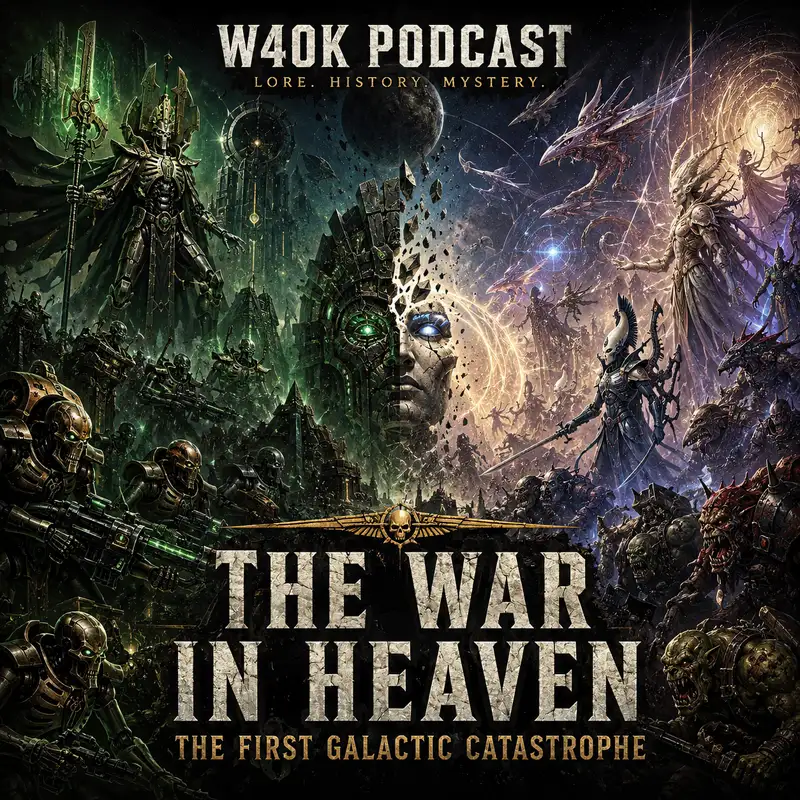
The War in Heaven: The First Galactic Catastrophe
At the moment the Necrons won the War in Heaven, their king ordered them to turn upon their gods.
The Old Ones were broken. Their ancient dominion was collapsing. Whole systems had been stripped of life, the Webway had become a battlefield, and armies created for a single purpose were still multiplying across the stars. The victors should have stood triumphant. Instead, the Silent King looked upon what victory had made of his people and chose one final act of rebellion. The weapons of the Necrons were aimed at the C’tan, the star gods who had promised salvation and delivered an eternity without souls.
That is the first clue to understanding the War in Heaven. It was not merely an ancient war fought on an impressive scale. Warhammer forty thousand has no shortage of those. It was a catastrophe because every solution created a greater danger. A political grievance became a war of species. A war of species became a war of gods. A war of gods spread into the Warp itself. By the time it ended, the galaxy had not returned to peace. It had been redesigned for conflict.
The surviving accounts are not clean. Necron memories have endured for roughly sixty million years, but endurance is not the same as accuracy. Some minds were damaged during biotransference. Others deteriorated in stasis. Aeldari traditions preserve fragments of the conflict as sacred myth, where historical rulers, psychic weapons, and divine beings are not always easy to separate. Even the phrase War in Heaven may cover several connected struggles rather than one continuous campaign with a convenient beginning, middle, and end. No surviving archivist can produce the order of battle. This may be fortunate. The document would require its own moon.
The scale also resists ordinary military language. This was not a front stretching across a continent, or even a campaign moving from one star system to the next. The struggle appears to have unfolded across vast spans of time, with offensives passing into legend before later offensives began. A Webway gate could make a remote world strategically central. A star could be a source of power, a line of communication, or a victim. Entire planets became fortresses, laboratories, tombs, and traps. There was no secure rear area because the enemy might arrive through a hidden dimension, awaken beneath the surface, or alter the conditions that made life possible. The war consumed geography until geography itself became ammunition.
That makes the surviving stories difficult to arrange. Aeldari myth may compress ages into a duel between gods. Necron recollection may preserve a tactical detail while losing the centuries around it. Two accounts that appear contradictory may describe different phases separated by more time than all of human history. The uncertainty is not an invitation to invent a cleaner version. It is evidence of how completely the conflict destroyed the institutions that might have recorded it.
The earliest stage began with the Necrontyr and the Old Ones. The Necrontyr had built a powerful interstellar civilisation despite lives marked by sickness and brevity. They looked upon the Old Ones, who possessed immense knowledge, command of the Webway, and lives that seemed almost without limit. The contrast became intolerable. When the Old Ones would not grant the secret of immortality, resentment hardened into war.
This was not simply envy with battleships attached. The Necrontyr dynasties were divided, and the rule of the Triarch depended upon holding proud, quarrelsome nobles together. An external enemy offered unity. The Old Ones also embodied everything the Necrontyr believed had been denied to them by an indifferent universe. To fight them was politically useful, culturally satisfying, and strategically disastrous. It was, in other words, a policy with broad support.
The Necrontyr could cross the stars and wage war on a vast scale, but the Old Ones controlled the Webway, a hidden network of passages beyond normal space. They could move forces between distant systems without depending upon the slow routes available to their enemies. They also wielded psychic power with a sophistication the Necrontyr could not match. Fleets might arrive to find that the decisive battle had already occurred somewhere else. Strongholds could be reinforced through routes no conventional blockade could close. The Necrontyr fought an enemy that seemed able to choose when distance mattered.
The first war ended in defeat. Necrontyr forces were driven back, and the unity created by the conflict began to fracture. Old dynastic rivalries returned. Secession and civil war threatened the authority of the Silent King. The campaign intended to secure his civilisation had exposed its weakness instead.
Then the Necrontyr found the C’tan.
These beings had once fed upon the energies of stars. Given bodies of living metal, they entered the material world as powers of almost incomprehensible scale. The C’tan offered the Necrontyr what the Old Ones had refused. They promised release from disease, age, and death. The price was biotransference.
The furnaces did remove mortality. They also removed almost everything that had made immortality worth possessing. Necrontyr minds were transferred into bodies of necrodermis, while their souls were consumed by the C’tan. The poorest and most numerous became obedient warriors with little or no individual identity. Nobles and Crypteks retained far more of themselves, although even they remained bound by command protocols and the authority of the Silent King. The Necrontyr emerged as the Necrons: tireless, repairable, and very difficult to persuade that a campaign season was over.
Biotransference was a spiritual betrayal, but it was also a military revolution. The Necrons no longer suffered disease, hunger, exhaustion, or the ordinary limits of flesh. Warriors could march through environments that would kill living troops. Damaged bodies could rebuild themselves or vanish from the battlefield for repair. Their technology could strip matter apart, bend space, imprison energy, and make fortresses into temporary inconveniences. Behind them came the C’tan, beings for whom the laws of nature appeared less like laws and more like suggestions drafted by a junior official.
The second great phase of the war was therefore not a return to the old balance. The Necrons came back transformed, unified, and accompanied by gods who hungered.
The alliance also attacked the Old Ones at the point where their strengths met their vulnerabilities. The C’tan were creatures of material reality, while the Old Ones drew upon the Warp. Psychic force could threaten beings that treated conventional matter with contempt, so the war became a contest between incompatible forms of power. Necron technology sought to control, sever, or bypass the Old Ones’ pathways. The Old Ones answered by bringing still more psychic energy into the struggle. Neither side could simply imitate the other. Each had to build a weapon that changed the terms of battle.
This is one reason the war escalated so rapidly. A lost fleet could be replaced. A lost method of warfare demanded an entirely new species, a new god, or a new law of physics.
The Old Ones still possessed the Webway and immense psychic knowledge, but their enemies could now fight without the weaknesses that had once limited them. Necron legions did not need morale restored after years of attrition. They did not produce a new generation that had to be trained. They did not forget the purpose assigned to them. A destroyed army might return unless its remains were annihilated or its means of recovery severed. The usual arithmetic of war began to fail.
The C’tan made that arithmetic almost meaningless. Their precise powers vary across fragmentary accounts, but the broad picture is consistent. They could reshape matter and energy on a scale beyond ordinary weapons. They consumed life, shattered defences, and turned stars and worlds into instruments of war. The Nightbringer became associated so deeply with death that later species carried echoes of its image in their oldest fears. Whether that influence was literal, psychic, or mythic is uncertain. The result was much the same. Death had acquired a face.
The Old Ones answered in the manner of a civilisation accustomed to shaping life. They cultivated, uplifted, or created new warrior species. The Aeldari became one of their most potent weapons, gifted with powerful psychic ability, speed, and a connection to the Warp that could be directed against enemies rooted in material reality. The Krork were fashioned for a different kind of struggle: physically overwhelming, resilient, aggressive, and able to sustain war under conditions that would destroy more delicate forces. Their distant descendants would become the Orks, though the path from Krork to Ork is obscured by ages of violence and a shortage of historians willing to conduct interviews at close range.
These peoples were not simple equipment taken from an armoury. They possessed minds, cultures, ambitions, and the ability to continue after their makers were gone. That was precisely what made them useful in a war of extinction. A conventional weapon stops when its ammunition is spent. A living weapon can reproduce, adapt, remember, improvise, and develop opinions about who ought to rule the galaxy.
The War in Heaven now expanded beyond armies and territory. It became a contest over the kinds of life that would inhabit the future.
The Aeldari and Krork also represented two very different answers to the same strategic problem. One answer was precision, psychic mastery, and the ability to strike through dimensions the Necrons could not easily dominate. The other was mass, endurance, and a form of war that could continue even after command structures collapsed. If the Aeldari were a blade, the Krork were a spreading fire. The Old Ones were not choosing between elegance and brutality. They were using both.
That decision carried a moral weight the surviving legends rarely pause to examine. The Old Ones were fighting for survival, but they were also shaping entire peoples around military necessity. Those peoples would become more than their intended purpose, yet the purpose remained buried deep within their histories. The first galactic empire to face extinction answered by ensuring that war itself would have descendants.
The Aeldari fought the Necrons with psychic force and weapons whose workings later generations would remember as divine acts. The Krork brought relentless biological warfare against enemies of living metal. Other creations and allied species appear in scattered records, but the details are uncertain. What can be seen is the pattern. Each escalation demanded a countermeasure, and each countermeasure became a permanent inhabitant of the galaxy.
There was another front, less visible and ultimately more dangerous. The Old Ones had long used the Warp, the immaterial realm shaped by thought, emotion, and psychic energy. In an earlier age it appears to have been calmer and more navigable than the nightmare known to humanity. The War in Heaven helped change that.
Countless deaths, terrified populations, psychic battles, and entire species created for war poured violence into the immaterial realm. The Warp did not merely reflect the conflict. It began to answer. Turbulence grew. Predatory entities multiplied or found easier paths into reality. Among the most infamous were the Enslavers, creatures capable of dominating psychic minds and using their victims as gateways for further incursions.
Accounts differ over exactly how decisive the Enslaver plague was. Older traditions present it as a vast disaster that consumed surviving populations and helped finish the Old Ones. Later accounts place greater emphasis upon the Necrons and C’tan. These versions need not be entirely exclusive. A civilisation can be defeated by enemy action, internal exhaustion, and a sudden plague of mind-controlling horrors at the same time. History is often generous in this way.
In practical terms, the Old Ones were now fighting two wars. In material space, Necron legions and C’tan powers dismantled their empire. In the immaterial realm, the emotional and psychic consequences of that resistance created new enemies. A commander might defeat the force before him and still lose the world because a psychic breach had opened behind the lines. Victory on one front fed disaster on the other.
The distinction between military and civilian life also vanished. The C’tan did not require a population to surrender. They required it to exist long enough to be consumed. Enslavers did not recognise non-combatants. Living weapons reproduced beyond the control of any single command. Once survival itself became a resource, every inhabited world was part of the war effort whether its people understood the conflict or not.
The Old Ones had relied upon psychic power to preserve their advantage. Their response to the Necrons intensified that reliance. The result was a strategic trap. The more desperately they fought through the Warp, the more violent the Warp became. The realm that enabled their movement, communication, and weapons grew hostile. The Old Ones were not merely losing systems. The foundation beneath their civilisation was becoming unstable.
There is no reliable account of a final Old One capital falling beneath a single, glorious assault. Their end appears as disappearance, fragmentation, and ruin. Some may have escaped. Some may have died to the Necrons or C’tan. Others may have been consumed amid warp-born disasters. What remained were abandoned works, surviving servant races, broken pathways, and legends powerful enough to be mistaken for religion.
The C’tan, meanwhile, had not become more trustworthy through victory. Their hunger had consumed the souls of the Necrontyr, the lives of enemy worlds, and, according to some traditions, even members of their own kind. The Deceiver encouraged rivalries among the star gods, and the C’tan turned upon one another. A coalition built to destroy the Old Ones was devouring itself before the war had properly ended. This did not make the battlefield safer. It merely meant that the weapons of mass destruction had developed personal disputes.
The Silent King had entered biotransference believing, or perhaps choosing to believe, that it would save his people. He emerged with command over an immortal civilisation that could no longer truly live. The C’tan had taken the souls of the Necrontyr and left behind minds trapped in metal. Even the rulers who retained personality had lost sensation, continuity, and the ordinary certainty of being themselves. For the common warrior, the loss was far greater. Victory over the Old Ones could not restore any of it.
So the Silent King waited.
He allowed the C’tan to spend their strength against the Old Ones and against each other. When the star gods were weakened, the Necrons struck. The weapons used in this rebellion belonged to a level of technology that later ages could scarcely comprehend. The C’tan could not easily be killed without damaging the structure of reality itself. Instead, most were shattered into fragments and imprisoned. Gods became shards, bound within devices and released as weapons by the people they had betrayed.
The act was revenge, liberation, and another dangerous compromise. The Necrons freed themselves from the direct rule of the C’tan, but they did not undo biotransference. They could imprison their former masters, but not reclaim their souls. They could carry fragments of gods into battle, but every such weapon remained a piece of the beings that had deceived them. The victory gave them power without restoration.
Nor were the Necrons in a position to enjoy their triumph. Their armies and dynasties had suffered terribly. The Old Ones were gone, but their warrior races remained. The Aeldari were rising, psychically powerful and increasingly dominant. The Necrons had defeated their makers and broken their gods, yet another prolonged galactic war might destroy what remained of them.
The Silent King chose patience on a scale available only to the deathless. He ordered the Necrons into the Great Sleep. Tomb worlds sealed themselves. Legions entered stasis. Dynasties withdrew beneath dead planets and waited for the Aeldari and other younger races to weaken. The plan was not surrender. It was an ambush measured in geological time.
Before departing into exile, the Silent King broke the command protocols that had bound his people absolutely to his will. The gesture freed the Necron nobility, although freedom came rather late for the countless warriors whose personalities had already been burned away. He then left the galaxy, carrying responsibility for a decision no empire could reverse.
The Aeldari inherited much of what remained. Their civilisation grew into the dominant power of the galaxy, while the Necrons slept and the descendants of the Krork continued their own violent development. The Webway endured, damaged but still immense. C’tan shards remained imprisoned. Ancient machines waited beneath worlds that had not yet acquired names. The Warp had been wounded, and its storms would shape every age that followed.
No faction truly won.
The Old Ones lost their civilisation and perhaps their species. The Necrontyr escaped death by becoming unable to live. The C’tan gained bodies, worshippers, and a feast, then were broken into weapons. The Aeldari survived to inherit the stars, but they also inherited the confidence of a people who had helped defeat gods. The Krork survived in altered form, carrying war within their biology. The Warp became more dangerous because the material galaxy had tried to use it as an unlimited military resource.
That is why the War in Heaven deserves to be called the first galactic catastrophe. It did more than destroy armies or empires. It erased the boundary between soldier and species, between weapon and god, between battlefield and reality. Every major participant tried to solve an immediate threat by creating something that could outlive the war. Almost all of those creations did.
Roughly sixty million years later, the Necrons are waking. The Aeldari still travel the broken roads of the Webway. Orks carry the distant inheritance of the Krork into wars they regard with uncomplicated enthusiasm. C’tan shards burn inside their prisons. The Warp remains full of predators, storms, and hungers fed by mortal minds.
The War in Heaven is ancient enough to be remembered as myth, but it is not over in the way ordinary wars end. Its commanders are gone or mad. Its empires have fallen. Its original causes barely matter. Yet its armies, weapons, roads, and consequences remain active.
The first galactic catastrophe did not leave a peaceful galaxy behind. It left a loaded one.