The War for Vigilus: Gateway Through the Great Rift
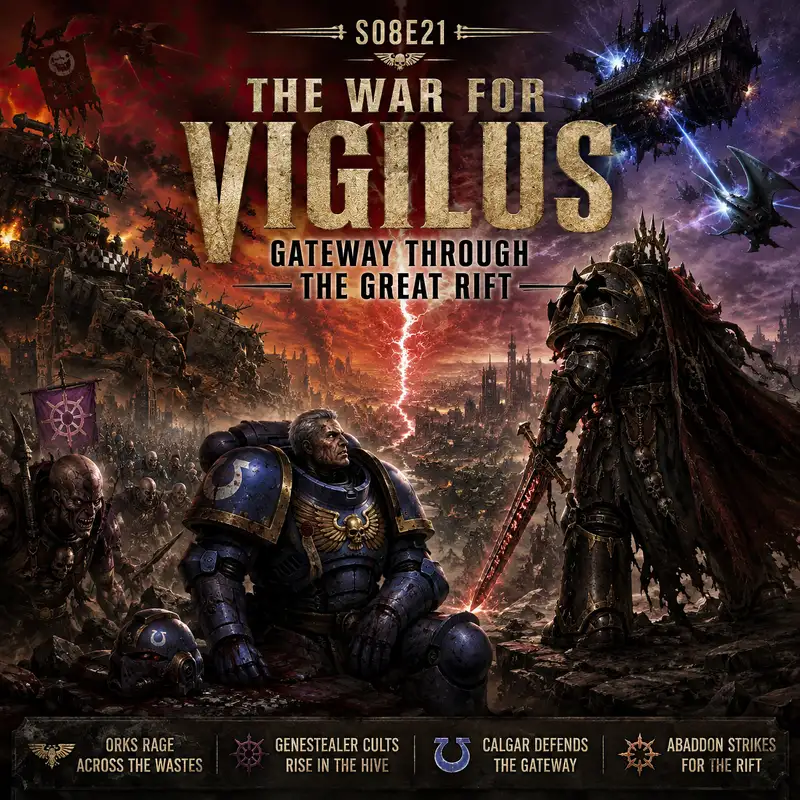
Marneus Calgar lay broken beneath a blood-red sky while Abaddon the Despoiler turned away from him. The Warmaster had not suddenly discovered mercy. Somewhere above Vigilus, alarms were screaming through the decks of the Vengeful Spirit, the ancient flagship of the Black Legion. An Aeldari vessel had reached it and struck hard enough to threaten the ship itself. Calgar had lost the duel, but the duel had never been the whole battle. That moment captures the strange logic of the war for Vigilus. A ruined desert world, already overrun by Orks, infiltrated by Genestealer Cults, and torn apart by rival Imperial authorities, had become important enough for two of the galaxy’s most famous commanders to risk everything. The question is not simply who won. The real question is why this one world mattered so much.
The answer begins with the destruction of Cadia and the birth of the Great Rift. When the Cicatrix Maledictum tore across the galaxy, it divided the Imperium into two unequal and increasingly isolated halves. On the side still connected to Terra, the Astronomican remained a difficult but usable guide. Beyond the Rift lay the Imperium Nihilus, where navigation, communication, and reinforcement became far more dangerous. Entire regions were cut off behind warp storms. Armies could still exist there. Worlds could still resist. What they could not reliably do was remain part of a functioning empire. The Imperium has never been famous for efficient administration, but even it requires ships to arrive occasionally.
There were a few passages through the Great Rift, narrow regions where the storms were less murderous and transit remained possible. The Nachmund Gauntlet was among the most valuable. Vigilus sat at its throat. Control of the planet and its surrounding system meant control of a gateway between the two halves of the Imperium. Through that corridor could pass troops, supplies, astropathic messages, priests, refugees, and the fleets of the Indomitus Crusade. If the passage closed, the Dark Imperium would become still darker. Vigilus was therefore not merely another world to defend. It was a hinge. A hinge is rarely glamorous, but when it breaks, the door becomes someone else’s property.
The planet itself was an unlikely prize. Vigilus was an arid hive world of enormous cities, colossal industrial zones, dust seas, and fortified reservoirs. Water shaped its economy and its class system. The poor drank foul liquid pumped from deep beneath the ground. The wealthy received cleaner water drawn from ice or gathered by orbital machinery. The Adeptus Mechanicus, the Ecclesiarchy, and the planetary ruling dynasty all controlled different pieces of the world’s life-supporting machinery. They cooperated because open civil war would have been inconvenient, although not necessarily because anyone trusted anyone else. Vigilus exported troops, industrial goods, and defensive technology. Its hive-sprawls were protected by formidable force fields. On paper, it looked prepared for siege. On Vigilus, as elsewhere, paper had a limited life expectancy.
The opening of the Great Rift made the world more valuable at exactly the moment it became harder to defend. Refugees crowded into its hives, hoping to cross the Nachmund Gauntlet or escape whatever had followed them from the darkness. Communications failed. Old rivalries sharpened. The planet’s leaders had to decide who controlled the ports, the reservoirs, the fortifications, and the incoming armies. Then, only days after the Rift appeared, an Ork fleet arrived. The greenskins did not approach as cautious students of interstellar strategy. They smashed their ships into the plains and began building a war from the wreckage.
The Ork invasion became a Speedwaaagh, a campaign built around fast vehicles, reckless attacks, and the simple conviction that any road not currently exploding was being underused. Led by the warlord Krooldakka and supported by rival mobs and Mek bosses, the Orks spread across the wastes between the hives. They built scrap cities, racing grounds, workshops, and gun emplacements from the debris of the invasion. Their assaults struck supply routes and defensive lines with tremendous speed. The Orks may not have arrived because Vigilus was the gateway through the Great Rift, but once they were there, their presence threatened that gateway all the same. Strategic consequences do not require strategic intentions.
The defenders soon discovered that the enemy was not only outside the walls. The Pauper Princes, a Genestealer Cult that had infiltrated Vigilus for roughly two centuries, rose in open rebellion. Its members had spread through labour forces, institutions, infrastructure, and even the nobility. Their uprising was not a random riot. It was the activation of a patient hidden network. Cultists sabotaged defences, seized vital facilities, and attacked the systems that moved water and power between the hive-sprawls. The Orks pressed from the wastes while the Pauper Princes struck from below and within. A fortress can be difficult to storm. It is rather less impressive when someone has spent generations copying the keys.
The two invasions fed each other. Every Imperial unit sent against the Orks left some district exposed to the cult. Every cult attack damaged the roads, generators, and reservoirs needed to fight the Orks. Disorder drew further predators. Drukhari raiders appeared to harvest captives from the chaos. Death Guard forces and Gellerpox outbreaks brought disease into already overcrowded districts. Daemonic incursions spread wherever the barrier between realspace and the warp weakened. Aeldari forces entered the theatre for reasons of their own, sometimes attacking the Imperium and sometimes opposing the threats that endangered their wider plans. Vigilus ceased to be a simple siege. It became a stack of wars occupying the same ground.
The Imperial response was powerful, but badly divided. The planetary government wanted to preserve its authority. The Ecclesiarchy wanted sacred districts and faithful populations defended. The Adeptus Mechanicus guarded industrial regions, blackstone deposits, and ancient technology. The Astra Militarum, Adepta Sororitas, planetary troops, Space Marines, Knights, and Titan forces all brought their own command structures and priorities. None of these concerns was entirely irrational. That was part of the problem. Vigilus did not lack defenders. It lacked a single understanding of what could still be saved.
Marneus Calgar arrived with the Ultramarines and assumed command of the wider defence. His importance was not simply that he was a formidable warrior. Vigilus already had formidable warriors in abundance. Calgar brought the ability to turn many separate battles into one campaign. He identified the routes, hives, and resources that had to be held if the planet was to remain useful. He accepted that some positions could not be saved and redirected forces toward those that mattered more. He also exploited the hostility among the attackers, encouraging Orks, cultists, and Chaos forces to collide whenever possible. It was not a clean defence. It was triage conducted with armies.
That distinction mattered because Calgar could not destroy every enemy on Vigilus. The Orks were too deeply established in the wastes. The Pauper Princes had roots beneath cities that had existed long before the current crisis. New hostile fleets could arrive through the same unstable region of space that made Imperial reinforcement so difficult. Calgar’s task was therefore not to restore the old world. The old world was gone. His task was to keep enough of Vigilus functioning that the Nachmund Gauntlet remained open. The Imperium often describes such campaigns as victories. A more honest description would be controlled survival.
The war changed again on Nemendghast, an industrial world on the edge of the Vigilus system. There, Ultramarines encountered Black Legion warriors and daemon engines operating grotesque flesh factories. Their work included the creation of Noctilith Crowns, great ring-like structures made from blackstone. Blackstone can interact with the warp in different ways. Properly configured, it can suppress warp energy. Reversed and corrupted, it can draw that energy closer. The crowns were therefore more than monuments or battlefield fortifications. They were instruments for weakening the boundary of reality and inviting the warp into the war zone.
This discovery revealed the larger hand behind the Chaos assault. Abaddon the Despoiler had not forgotten what the destruction of Cadia had achieved. He understood that the Imperium’s survival depended on routes, beacons, fortresses, and narrow passages. Vigilus was one of those points. If Chaos could corrupt the planet, destroy its blackstone resources, or destabilise the Nachmund Gauntlet, the Imperium Nihilus would become harder to reach and easier to consume piece by piece. The Black Legion did not need to conquer every loyal world. It only needed to make reinforcement impossible. That is the strategic cruelty of a chokepoint. One wound can starve a thousand battlefields.
Abaddon first sent Haarken Worldclaimer, his herald and terror weapon. Haarken proclaimed that Vigilus would fall within eighty days. His Raptors, Warp Talons, and other airborne killers attacked from above, descending on hive towers and command sites rather than grinding through every defensive line below. The method suited him. Haarken’s wars were designed to frighten populations before the main blow arrived. Calgar answered with a denial strategy as ruthless as it was effective. When hive spires could no longer be held, he had them burned or brought down rather than allow Chaos forces to use them. The Worldclaimer could seize the heights, but he often inherited ruins.
Haarken’s deadline passed, yet the failure did not save Vigilus. It announced that the preliminary attack was over. Chaos forces multiplied across the planet. Noctilith Crowns were raised at sites of ritual and strategic importance. Daemons found it easier to manifest. Cult uprisings became harder to separate from deliberate Chaos infiltration. Entire regions were lost or abandoned. Food-producing territory, industrial zones, water systems, and hive districts changed hands. Hyperia, the principal hivesprawl and seat of the planetary government, became the core of the remaining Imperial position. The map of Vigilus did not show a world being defended. It showed a world being reduced.
Then the Vengeful Spirit entered the war. Abaddon’s flagship had survived the Horus Heresy, the long wars within the Eye of Terror, and thirteen Black Crusades. Its arrival brought the authority and violence of the Warmaster himself. Abaddon did not come merely to collect Haarken’s promise. He came because Vigilus offered a chance to deepen the division of the Imperium. The Indomitus Crusade sought to reconnect, reinforce, and stabilise what remained of Imperial space. Abaddon’s campaign sought the opposite. On Vigilus, the two strategies met without their principal architects ever standing in the same room. Roboute Guilliman’s crusade depended on the gateway. Abaddon intended to close it.
The arrival of the Black Legion placed the defenders under pressure in orbit and on the ground. The Vengeful Spirit and its supporting fleet threatened Imperial shipping, while traitor forces attacked the shrinking loyalist strongholds below. Calgar could still win local engagements, but local victories no longer solved the central problem. A regiment might retake a refinery while Chaos gained the orbital approaches. A Space Marine strike force might destroy a crown while three more sites erupted in daemonic activity. The defence was becoming a contest of exhaustion, and Chaos had arrived prepared to make exhaustion permanent.
Calgar’s response required an alliance that Imperial doctrine would normally condemn. He negotiated with Aeldari forces operating around Vigilus. The Aeldari did not become friends of the Imperium, and the Imperium did not become reasonable about xenos. Their interests simply overlapped. Neither side wanted Abaddon to master the gateway. The arrangement was built on necessity, limited trust, and the knowledge that each participant would probably prefer to discuss the matter later with weapons. For the moment, that was enough.
The plan aimed at the Vengeful Spirit. An Aeldari vessel offered the speed, stealth, and psychic capabilities needed to approach the Chaos flagship. Imperial weapons provided the destructive force. Reaching the target would require distraction in orbit, pressure on the ground, and time. Time was the part Calgar could purchase personally. He drew Abaddon into a confrontation at Saint’s Haven, the palace at the heart of Hyperia. The duel that followed has often been remembered as a clash of champions. It was that, but it was also an operational delay measured in blood.
Calgar fought in advanced armour and wielded the Gauntlets of Ultramar, combining heavy fire with the strength of a Chapter Master remade as a Primaris Space Marine. Abaddon carried the Talon of Horus and Drach’nyen, the daemon sword whose name means the End of Empires. Calgar struck hard enough to stagger the Warmaster, but the balance of the fight remained against him. Abaddon broke through his defence and cut him down. There was no hidden triumph in the duel itself. Calgar faced a more dangerous opponent and lost.
The victory Abaddon expected was interrupted by disaster above. The Aeldari attack reached the Vengeful Spirit and crippled it badly enough to demand the Warmaster’s attention. Abaddon withdrew before finishing the destruction of the Imperial command. His flagship escaped, but the immediate Chaos offensive had lost its decisive centre. Calgar’s Victrix Honour Guard recovered their commander. He was grievously wounded, yet alive. The Imperium had preserved the gateway not by defeating Abaddon in single combat, but by forcing him to choose between the planet and the irreplaceable engine of his wider war.
That was the closest the campaign came to a clean ending, and it was not very clean. Vigilus remained in Imperial hands, but much of the planet did not. Ork empires still sprawled across the wastes. The Pauper Princes retained hidden cells and captured territory. Chaos corruption endured. Hive populations survived behind damaged fortifications while supply systems failed around them. The defenders could claim that the world had not fallen. They could not claim that it had been restored. On Vigilus, survival meant keeping the flag above one more functioning command bunker and hoping the water pumps lasted through the night.
Abaddon had also not abandoned the objective. Later fighting spread deeper into the Nachmund Gauntlet as Chaos forces attacked the systems and strongholds that kept the corridor usable. Haarken Worldclaimer returned to the wider campaign. Vigilus remained the most visible symbol of the struggle, but the war had expanded beyond its surface. This was the natural next step. If a fortress cannot be taken quickly, isolate it. If a gateway cannot be smashed from the front, seize the road leading to it. The Warmaster had been forced away from Vigilus, not persuaded that it was unimportant.
The war for Vigilus therefore offers a useful correction to the way wars in the forty-first millennium are often remembered. History prefers champions, banners, and duels because they fit neatly into paintings. The true strategic centre of the campaign was movement. Could ships cross the Great Rift? Could reinforcements reach the Imperium Nihilus? Could water move between reservoirs and hives? Could orders move between commanders before the next communications failure? Calgar and Abaddon mattered because each understood that the campaign was about systems, not simply territory. The duel at Saint’s Haven became famous because two legends fought there. The war was decided, for a time, by what happened above them.
Vigilus also exposes the limits of Imperial strength. The Imperium possesses immense armies, ancient fleets, and worlds crowded with billions of people. Yet all of that power can be made fragile by geography. One narrow corridor through the warp becomes a lifeline. One desert planet becomes the lock on that corridor. One damaged flagship forces a conqueror to retreat. Scale does not eliminate vulnerability. It multiplies the number of things that must keep working.
For the people of Vigilus, none of this strategic importance offered much comfort. Their world became a gateway, and gateways are crossed, fortified, contested, and bombarded. The Imperium defended them because their location mattered. Chaos attacked them for the same reason. Orks fought because the war was excellent. The Pauper Princes rose because generations of infiltration had prepared them for a promised transformation. Each faction saw Vigilus through its own beliefs, but the civilians beneath the hive shields experienced the shared result: rationing, conscription, disease, collapsing districts, and a sky filled with other people’s destinies.
So who won the war for Vigilus? The Imperium prevented the immediate closure of the Nachmund Gauntlet. Abaddon failed to take the world and withdrew when the Vengeful Spirit was crippled. That is a real success. It is not a final victory. Chaos remained active, the xenos threats survived, and the gateway stayed under siege. Vigilus was held in the way a soldier holds a door against an enemy on the other side: with both hands, failing strength, and no illusion that the pressure has ended.
The world mattered because it connected a broken empire to the half it could barely see. It survived because Calgar understood that defending a gateway sometimes means sacrificing the city around it, cooperating with an enemy, and losing the battle everyone will remember. Above Vigilus, ships still attempt the passage through the Great Rift. Below them, the wastes burn, the cults wait, and the fortress guns continue their watch. The gateway remains open, and every vessel that crosses it sails over a world still paying the price.