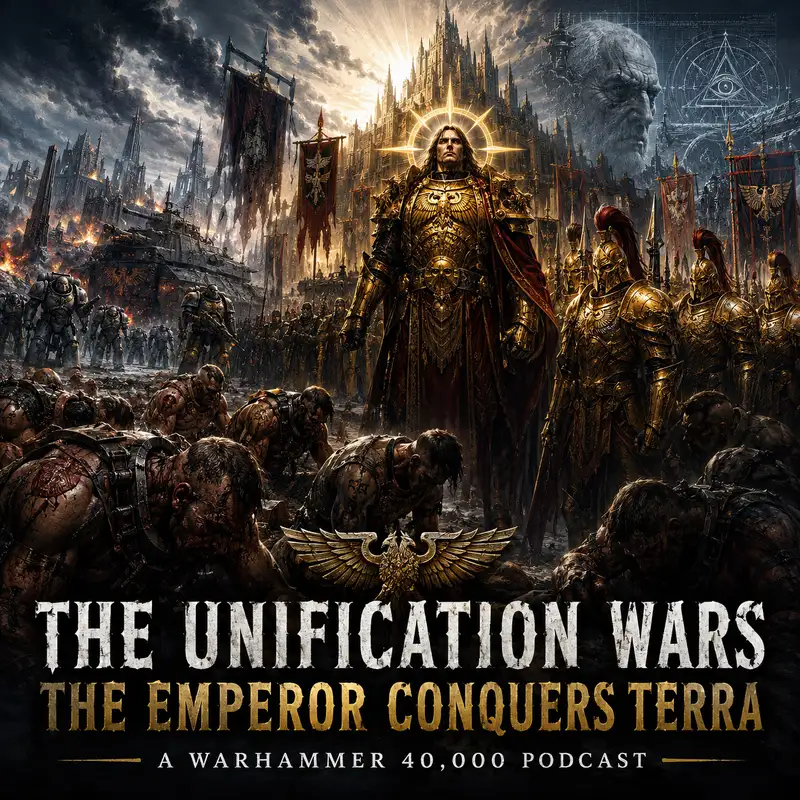
The Unification Wars: The Emperor Conquers Terra
At Mount Ararat, the soldiers who had carried the Emperor to victory discovered that victory did not include them. Imperial histories would remember the Thunder Warriors as heroes who died defeating the last great enemies of Unity. Other accounts preserve a colder version. In those, the surviving warriors returned from battle exhausted, only to find grey-armoured troops waiting for them beneath a storm-dark sky. The newcomers did not salute. They opened fire. Whether the executioners were Custodians, the first Space Marines, or some combination of forces remains uncertain. The purpose is clearer. The army built to conquer Terra had reached the end of its usefulness, and the ruler who had created it was already preparing for a larger war.
That is the contradiction at the heart of the Unification Wars. The Emperor did save humanity’s home world from an age of predatory warlords, uncontrolled sorcery, genetic monstrosities, and failing technology. He also built a regime in which survival depended upon obedience, history could be rewritten by decree, and even the most loyal servant might be discarded when the plan moved beyond him. Terra was unified, but it was not reconciled. It was conquered, reorganised, and aimed at the stars.
By the closing centuries of the Age of Strife, Terra was not merely ruined. Ruins can be quiet. Terra was crowded, armed, poisoned, and divided among powers that had learned to survive without trusting anyone beyond the range of their own guns. Ancient seas had receded or vanished. Irradiated wastelands separated fortress cities. Human populations endured in hives, enclaves, nomadic machine caravans, subterranean complexes, and territories whose names preserved only distorted echoes of older nations. The planet remained full of technology, but much of it survived as relic, ritual, monopoly, or threat.
That is why the phrase techno-barbarian matters. The warlords of Old Earth were not barbarians because they lacked advanced weapons. Many possessed gene-forges, armoured war machines, psychic cadres, buried arsenals, and devices inherited from humanity’s lost golden age. They were barbarian powers because those wonders served narrow dynasties, death cults, slave systems, and personal empires. A ruler might command weapons capable of emptying a city while lacking the knowledge to repair the machine that purified his own people’s water. Terra had retained the tools of civilisation after losing the civilisation that had made them. Some states possessed weapons that had outlived the languages in which their manuals were written. Others bred soldiers for wars no living commander could explain. The Emperor was not introducing violence to Terra. He was centralising it. This was inconvenient in the way that a loaded gun in a burning house is inconvenient.
Into that world came the figure who would become the Emperor of Mankind. He did not appear as the elected leader of a planetary coalition. He emerged as another warlord, though one with a reach, patience, and vision unlike any rival. His declared purpose was not to win one kingdom or secure one continent. He intended to abolish the political order of Old Night and place all humanity beneath a single authority. He offered an Imperial Truth founded upon reason, human unity, and the rejection of gods. To people who had watched witch-kings and cult rulers feed entire populations into their private nightmares, that promise could sound like liberation. The condition attached to it was simple. The Emperor alone would decide what reason, unity, and humanity required.
He began with more than personal power. Around him formed the earliest institutions of the future Imperium. Constantin Valdor commanded the Custodians, individually crafted warriors who served as the Emperor’s companions, agents, and executioners. Malcador the Sigillite became counsellor, administrator, and keeper of the machinery of rule. Scientists, soldiers, logisticians, and defeated specialists were drawn into the new regime. The Emperor’s laboratories produced weapons that were not tanks or aircraft, but altered human beings. His armies grew from loyal territories, conquered populations, mercenary formations, and troops whose former masters had either submitted or stopped needing them.
The most famous of those creations were the Thunder Warriors. They were not early Space Marines in different armour. They were a separate answer to a specific problem. Terra’s battlefields demanded soldiers who could survive radiation, chemical attack, psychic horror, and close combat with gene-bred monsters. The Thunder Warriors were immense, fast, brutally strong, and capable of smashing armies that would have destroyed ordinary troops. They were also unstable. Their bodies deteriorated. Their tempers could become uncontrollable. Some died suddenly. Others descended into violence or madness. They were magnificent siege engines made from flesh, and siege engines are rarely invited to help govern the city afterward.
One of the first great tests came at Maulland Sen in the frozen north. The Confederacy there was ruled by a Priest-King whose forces included altered warriors, witches, and zealots. The Emperor attacked not merely because Maulland Sen was powerful, but because it represented the kind of order he meant to erase. He led Custodians, Imperial regiments, and an entire formation of Thunder Warriors into a battle remembered as the Red Frost. The enemy greatly outnumbered the attackers. The Emperor’s forces won, but the cost was savage. Thousands of Thunder Warriors fell. Those who survived were driven into a frenzy so extreme that Valdor reportedly began to question what place such warriors could have in the future.
Maulland Sen revealed the pattern of the war. The Emperor’s forces could defeat horrors that had endured for centuries, but every victory created a new requirement. Territory had to be held. Populations had to be fed, screened, registered, and recruited. Weapons had to be recovered before local commanders decided they had always belonged to them. Cults had to be broken. Roads and supply systems had to be secured. A conquered state could not simply be left behind while the army marched onward, because on Terra the distance between a pacified province and a fresh rebellion was often one ambitious cousin with access to an atomic device.
The Emperor therefore used more than annihilation. Some powers gave allegiance early and escaped the worst destruction. The Achaemenid domains and other comparatively stable territories supplied soldiers and recruits to the growing Imperial cause. Albia resisted fiercely, using its own armoured warriors and ancient engines to halt repeated assaults. Rather than spend both sides into extinction, the Emperor eventually negotiated. The Albian lords accepted a place in the new order and later supplied some of the finest recruits for the first Space Marine Legions. This was not mercy detached from strategy. It was conquest by incorporation. A defeated enemy who could be trusted was more useful than a smoking crater, and considerably easier to tax.
Other settlements were harsher. The Xeric tribes of the Asiatic dust fields were brought to heel by the Emperor and the Thunder Warriors. Their sons were taken into the gene-forges and raised as early Legionaries. Those new warriors were then used to enforce obedience among the people from whom they had come. Noble houses in Europa offered youths as tribute after defeat. Some did so resentfully, treating the levy as hostage-taking. Others became sincere supporters of the Emperor’s project. The new Imperium consumed opposition and converted it into manpower. Every conquest enlarged the army that would conduct the next conquest.
The kingdom of Ursh showed why ordinary politics could not settle every conflict. Under the tyrant Kalagann, Ursh had expanded across the central Asiatic regions and employed powerful psykers in war. Later Imperial readers dismissed parts of its chronicles as superstition and exaggeration, even when those accounts described daemons, mutation, and things moving through the dark. The scepticism is understandable. It is also awkward, because the setting repeatedly demonstrates that the impossible was often standing just beyond the artillery range. When the Emperor’s forces moved against Ursh, they faced not only fortifications and armies, but weapons shaped through the Warp. Kalagann was defeated and killed, and his realm was broken.
The conquest of Ursh also demonstrated the changing character of the Emperor’s military. Early formations of the Nineteenth Legion, the warriors who would one day become the Raven Guard, infiltrated the region, identified weak points, eliminated leaders, and herded defeated armies into containment. Other early Legions ranged ahead of the main host, probing strongholds and attacking exposed targets. The Emperor was no longer relying solely upon the Thunder Warriors to break whatever stood in front of them. He was building a collection of specialised forces able to scout, decapitate, occupy, terrorise, and destroy according to a larger design.
The decisive difference was discipline. The Thunder Warriors could be individually stronger than the Space Marines who replaced them, but the new Legiones Astartes were engineered for unity, endurance, and expansion. They could operate as true armies. They could be trained in common doctrine, organised in great numbers, and sent far beyond Terra. At Samerkend, the First Legion deployed in mass against the gene-forged Udug Hul of Akkad. The enemy was monstrous, numerous, and strong enough to have checked earlier Imperial advances. The Legion broke it. The lesson was not that the Emperor had created a better duellist. He had created a military system.
As the later Unification Wars continued, that system became increasingly sophisticated. One Legion moved ahead through wastelands that would kill ordinary scouts. Another struck command structures from concealment. Another carried the Imperial ultimatum into temples and fortress enclaves, demanding surrender before the main assault. When resistance was rooted in religion, the early Imperial Heralds did not stop after taking the walls. They destroyed shrines, burned forbidden texts, and forced survivors to accept the Imperial Truth. The war was being fought over memory and belief as deliberately as it was fought over ground.
This ideological campaign is essential to understanding the Emperor’s victory. He did not want a loose alliance of Terran states that agreed to stop shooting for a few years. He wanted one political identity. Independent kings, priesthoods, and ancestral loyalties could survive only when they were made subordinate to the Imperium. The Emperor’s rejection of religion was partly a defence against the predations of the Warp, though most of his subjects were not told the full danger. It was also a means of denying rival authorities any sacred claim. There would be no god above the state, no priest beyond its judgement, and eventually no state beyond the Emperor.
Malcador’s work made that ambition practical. Armies can seize capitals, but clerks make capitals remain seized. The nascent Imperium needed courts, archives, supply offices, intelligence networks, labour systems, and rules for deciding which conquered ruler would be pardoned and which would be introduced to Valdor. Malcador became the master of those daily burdens. His influence is less visually dramatic than a charge by Thunder Warriors, but without administration the Emperor would have conquered Terra several times and still not owned it. Bureaucracy was the quieter super-weapon of Unity, and unlike the Thunder Warriors, it proved distressingly long-lived.
Even before every rival had been eliminated, work began on the Imperial Palace high in the Himalazian mountains. Its location linked the Emperor’s new capital to ancient strongholds and hidden laboratories. Its scale announced that his reign was not temporary. The complex was fortress, government centre, residence, arsenal, laboratory, and symbol. Beneath it, the Legiones Astartes were developed. Above it, walls and towers rose vast enough to shelter armies. The Palace did not merely sit at the centre of the new Imperium. It demonstrated the Emperor’s habit of constructing the next age before the current war was finished.
That habit mattered because some enemies could not be beaten by the methods that had worked before. The Ethnarchy possessed gene-modified troops, relic weapons, enslaved psykers, and fortress systems protected by immense power fields. An early Imperial attack cost appalling numbers of Thunder Warriors and ordinary soldiers. When the Emperor returned to the problem, he used the emerging Space Marine Legions differently. Warriors of the Eighteenth Legion penetrated the underground Tempest Galleries and destroyed the generators that sustained the defences. Once the shield failed, the Ethnarchy fell. The victory was still bloody. It was simply bloody with a plan.
Across Terra, rulers met different fates. Kalagann of Ursh was killed. Narthan Dume of the Panpacific Empire was executed. Some defeated sovereigns were imprisoned in the deep fortress of Khangba Marwu. Others retained limited authority beneath Imperial oversight, their titles surviving after their independence did not. The Emperor could be patient when patience served him and absolute when it did not. His policy was consistent at only one level. No rival centre of power would be allowed to threaten the unity he intended to carry into the galaxy.
By the time the major campaigns reached their climax, the Thunder Warriors had become a problem the Emperor had anticipated from their creation. Their bodies were failing, their numbers were no longer being replaced, and their style of war belonged to Terra’s brutal opening struggle. They had names, loyalties, memories, and commanders of their own. They also knew what the Emperor had done to win. Sending such an army into the Great Crusade would have risked instability. Releasing it would have created thousands of superhuman warlords on a newly conquered world. Telling them politely that their contracts had ended was unlikely to produce a calm exchange of ceremonial gifts.
The official story made Mount Ararat their noble ending. The darker record suggests a cull. Accounts differ over precisely who carried it out, and some Thunder Warriors certainly escaped, but the transition was deliberate. The Emperor replaced a short-lived weapon of conquest with the scalable Legiones Astartes. It was strategically rational. It was also betrayal. Both statements can be true, and the Imperium would spend the next ten thousand years insisting that necessity made the second statement irrelevant.
The dead did not remain entirely silent. Surviving Thunder Warriors under their commander Ushotan later joined a revolt within the still-unfinished Imperial Palace. The movement also involved Grand Provost Marshal Uwoma Kandawire, who believed that even the Emperor’s servants should answer to law, and Amar Astarte, one of the chief architects of the Space Marine project, who had lost faith in its future. Their motives were not identical. Kandawire sought judgement. Astarte sought destruction of the project she had helped create. Ushotan wanted revenge and, perhaps, a death worthy of the life he had been given.
The revolt ended when the First Legion was unleashed in mass. The new Space Marines did what they had been made to do. They fought together, maintained formation, and overwhelmed warriors who could still kill them individually. Valdor slew Ushotan. The coup failed. The laboratories survived through safeguards the Emperor had prepared, and the Space Marine project continued. The scene was the Unification Wars reduced to a single chamber. Old servants, new soldiers, law, revenge, secrecy, and absolute authority collided beneath a Palace still under construction. The future won.
Terra’s conquest was therefore not one long battlefield advance by an invincible golden ruler. It was a campaign of adaptation. The Emperor allied with useful powers, destroyed irreconcilable ones, absorbed their soldiers, seized their knowledge, replaced unstable forces, suppressed competing beliefs, and built institutions capable of holding what his armies took. He offered an end to Old Night, and many people had good reason to accept. The alternatives included tyrants who used enslaved psykers, human sacrifice, genetic slavery, and relic weapons they barely understood. The Emperor was not conquering a peaceful world that had simply declined to join his club.
Yet the methods of Unity also established the moral machinery of the Imperium. Human survival became the justification for unlimited command. Compliance became the measure of peace. Knowledge was preserved when useful and destroyed when dangerous to the plan. Law existed, but the sovereign could stand beyond it. Loyalty was honoured until strategy required something else. The Emperor defeated the techno-barbarian warlords partly because he could build a state larger and more disciplined than theirs. He also inherited their central assumption, that the future belonged to whoever possessed the power to impose it.
When the Unification Wars finally ended, Terra had one master, one expanding bureaucracy, one official truth, and armies designed to take that arrangement across the stars. The home world was no longer a battlefield divided among a hundred tyrants. It had become the headquarters of a single civilisation preparing to reclaim humanity’s lost worlds. That was a real achievement, purchased from a nightmare age at a cost no gentler power may have been able to pay.
The final proof of the Emperor’s conquest was not the fall of a fortress or the execution of a rival king. It was the silence after Mount Ararat, when the warriors who had made Unity possible disappeared from the story and a new army marched past them toward the sky. Terra had been saved from endless war by a ruler who turned war into the foundation of everything that followed.