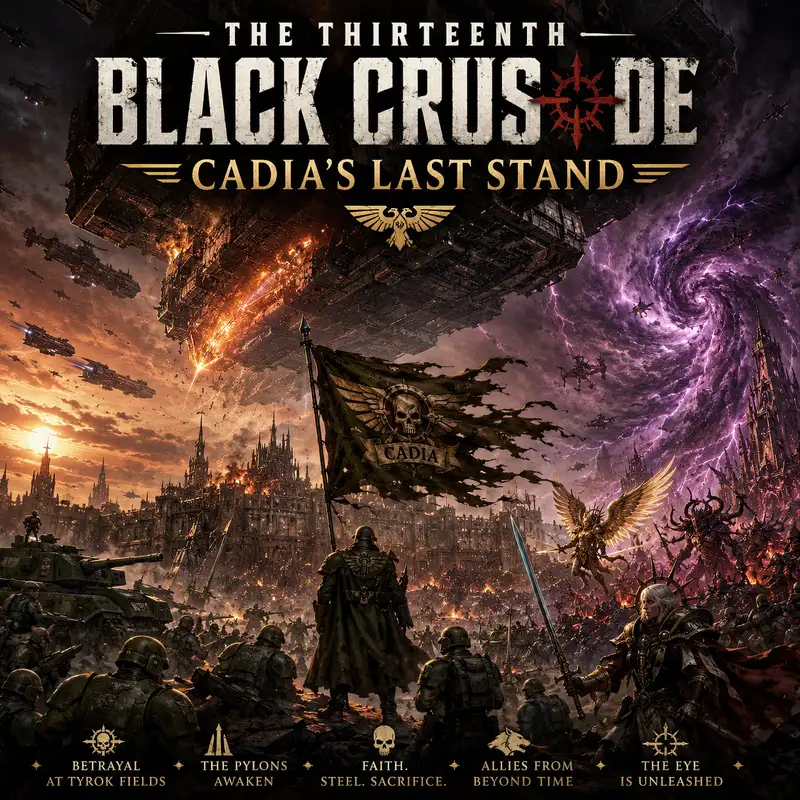
The Thirteenth Black Crusade: Cadia’s Last Stand
Cadia was still fighting when the sky began to fall. Guns fired from shattered walls, tanks crawled through streets buried in ash, and infantry held positions whose maps no longer matched the ground. Above them, a crippled Blackstone Fortress slipped toward the planet, not as a warship but as a weapon large enough to turn geography into shrapnel. The defenders had not surrendered, and their lines still existed. Abaddon the Despoiler solved that problem by changing what victory meant. If Cadia could not be conquered, Cadia could be destroyed. That is the central truth of the thirteenth Black Crusade. It was not simply an army overwhelmed by a larger army. It was the moment when one side discovered that the fortress itself mattered more than the people defending it, and the other proved that a world can die without admitting defeat.
Cadia stood near the Eye of Terror, the immense wound in reality where the warp pressed against the material galaxy. The Traitor Legions had retreated there after the Horus Heresy, using its madness as both sanctuary and prison. Great fleets could emerge from the Eye, but reliable routes were limited. One of the most important passed through the Cadian Gate, a corridor of comparatively stable space watched by Cadia. The Imperium therefore did what it usually does when confronted by a strategic problem. It added walls, guns, armies, shrines, paperwork, more guns, and several additional walls in case the first walls developed doctrinal doubts. Cadia became a planet organized for war. Its cities were fortress settlements known as kasrs. Its children learned weapons drill early. Its regiments fought across the Imperium while Cadia watched for the next invasion.
The planet’s importance was greater than its position on a star chart. Across Cadia stood ancient black pylons, structures built by the Necrons long before humanity understood that the galaxy had already suffered several endings. Their purpose was not fully understood by the Imperium, but their effect was clear. They suppressed the warp. Around Cadia, the tides of unreality were held back enough to create the Gate. The Imperium treated the pylons as useful mysteries, meaning no one understood them and everyone feared switching them off. Abaddon understood enough. Cadia was not merely a fortress blocking the road from the Eye of Terror. It was part of the lock on the prison door. To open the way toward Terra, he needed the pylons broken, the Gate torn open, and the Eye allowed to spread.
Abaddon had launched twelve Black Crusades before this one, and Imperial histories often presented them as repeated failures. That interpretation was comforting, and comfort is always suspicious in Imperial history. The earlier crusades had gathered weapons, tested routes, shattered defenses, and weakened the systems surrounding the Eye. They were not neat rehearsals, and accounts differ on how much Abaddon intended from the beginning. Even so, the pattern is clear. By the end of the forty-first millennium, he possessed the Black Legion, the authority to command or bargain with rival warbands, and the patience to use hatred as logistics. His followers did not become cooperative. Chaos offers no such service. He held them together with promises of plunder, vengeance, divine favor, and the chance to burn the Imperium that had outlived their rebellion by ten thousand years.
The attack began before the main fleet appeared. Plague spread through surrounding systems. Cults rose. Raiders struck naval stations and supply routes. Space hulks emerged where they could cause the most confusion. On Cadia itself, the blow fell at Tyrok Fields. The Volscani Cataphracts, celebrated as hardened Imperial troops, arrived as reinforcements and were welcomed by the assembled Cadian high command. Then they revealed their allegiance to Chaos and opened fire. In minutes, much of Cadia’s senior leadership was dead. The betrayal should have paralyzed the planet. Instead, Ursarkar Creed took control of the survivors, crushed the traitors, and became Lord Castellan. Creed was not a demigod, saint, or immortal machine. He was a soldier with an excellent grasp of terrain, timing, deception, and the useful habit of continuing to think while everyone else was shouting. Cadia would need all of those qualities.
Creed inherited a world under attack and a coalition that was never truly one army. Cadian regiments answered to Cadian command. Space Marines followed their Chapter masters. The Adepta Sororitas served faith and order. The Mechanicus guarded knowledge it did not care to explain. The Inquisition possessed authority so broad that agreement could become treason between one meeting and the next. Knights, naval officers, commissars, and priests arrived with their own commands. Creed had to turn these separate powers toward the same enemy without pretending they had become friends. His genius was not that he could produce soldiers from behind convenient rocks. It was that he understood an Imperial army is often a political negotiation with artillery. He kept the defense moving while rival institutions argued over who was entitled to save it.
For a time, the defense seemed to work. The first waves were checked. Kasrs were retaken. Chaos fleets were scattered or driven back. Reinforcements reached the Cadian Gate, and some Imperial commanders began discussing victory. Creed remained uneasy. The enemy had spent lives and ships on a scale that seemed wasteful even for Chaos, yet Abaddon had not committed his full strength. The destruction around Cadia looked less like a failed invasion than preparation. When the next fleet emerged, its size confirmed Creed’s fear. Warships, transports, traitor vessels, and Dark Mechanicum engines advanced beneath the Black Legion. At their center came the Will of Eternity, an ancient Blackstone Fortress vast enough to dominate the orbital battle. The preliminary war had exhausted the defenders and persuaded the Imperium that the worst might be over. Abaddon had allowed hope to become another vulnerability.
Imperial pickets were destroyed, orbital positions were overwhelmed, and the Will of Eternity moved above Cadia with weapons capable of erasing fortress cities. Abaddon’s challenge was not merely to defeat the defenders. He also had to manage his own alliance. The champions of the Chaos Gods wanted slaughter, glory, relics, revenge, and opportunities to betray one another with professional dignity. Abaddon needed them focused on the pylons and the defenses around Kasr Kraf. This separated a raid from a campaign. He could not simply unleash madness and hope it wandered in the correct direction. He had to give every faction enough of what it desired while preserving the objective that mattered. Cadia had to cease functioning as a barrier. Everything else, including the survival of his followers, was negotiable.
The surface war became a contest between disciplined resistance and supernatural escalation. Traitor Guard, cultists, Chaos Space Marines, daemon engines, and creatures from the warp pushed toward the fortress zones. The Cadians fought from trenches, gun lines, bunkers, and ruins they had known since childhood. Near the pylon fields, the null effect weakened daemonic manifestations and made the battlefield less hospitable to the warp. That did not make it safe. It merely forced Chaos to kill people in more conventional ways, a restriction the Black Legion accepted with reasonable flexibility. Kasrkin and ordinary Guardsmen poured fire into enemies who had fought since the Heresy. Space Marines counterattacked wherever mortal lines bent. The cost was appalling, but each hour bought time for fleets to gather, machines to be repaired, and plans to become slightly less impossible.
Then Saint Celestine came to Cadia with warriors of the Order of Our Martyred Lady. Her arrival meant more than additional troops. Celestine was a living expression of Imperial faith, a figure who had returned from death and appeared where the need was greatest. To exhausted defenders, she was proof that Cadia had not been abandoned. To the forces of Chaos, she was both target and insult. She led counterattacks into the worst fighting and confronted the champions driving toward the null arrays. Her presence also exposed one of the battle’s deepest contradictions. The pylons that suppressed daemons could weaken Celestine, because her miracles were also bound to the warp. The defenders needed both faith and machinery that denied the realm from which faith drew power. On Cadia, theology became a problem of battlefield engineering.
Belisarius Cawl arrived carrying another part of the answer. The ancient archmagos believed the pylon network might be reawakened. He was joined, improbably, by Trazyn the Infinite. Trazyn was a Necron overlord, collector, thief, historian, and the sort of ally who might save your civilization because its destruction would damage his exhibits. He had no love for the Imperium. He did have a practical objection to the galaxy being consumed by the warp. They represented civilizations built on older knowledge, one investigating and the other remembering more than it cared to share. Their cooperation was not trust. It was recognition that reality itself had become the common defensive position. The Imperium accepted the arrangement because events had reached the rare level of disaster at which using xenos technology seemed less dangerous than not using it.
In orbit, the defenders gained one last reprieve. Space Wolves had boarded the Will of Eternity, fighting through its impossible interior and drawing Abaddon’s attention. Then the Phalanx, the vast fortress ship of the Imperial Fists, arrived and struck the Blackstone Fortress with punishing fire. The Will of Eternity was crippled. For a moment, Cadia appeared to have survived its intended killer. That moment matters because it shows how close the defense came to succeeding. Imperial forces had endured betrayal, invasion, daemonic assault, and orbital bombardment. They had damaged Abaddon’s greatest engine and still held the pylon fields. This was not a ceremonial last stand performed after hope was gone. Hope remained. It was battered, unreasonable, and surrounded by burning tanks, but in the Imperium that still qualifies as operational readiness.
Cawl proposed using the pylons not only to shield Cadia, but to push back the Eye of Terror itself. The plan demanded time and cooperation from people who regarded cooperation as an emergency measure. Abaddon understood the danger and attacked the Imperial command. During the escape, Creed’s standard bearer, Jarran Kell, stayed behind to delay the Despoiler. Kell had carried the colors through years of war, and his death was not a grand strategic maneuver. It was one soldier buying seconds for another. Abaddon killed him and continued toward the pylon fields. Creed escaped, gathered what forces remained, and returned to the fight. He knew the defense was narrowing toward a single point. If the pylons activated, Abaddon’s daemons could be banished and his access to the warp threatened. Cadia still had one move left.
At the pylon fields, the war became a collision of incompatible ages. Cawl worked with mechanisms older than the Imperium. Trazyn opened dimensional vaults and released warriors collected from other centuries, including Imperial soldiers taken from forgotten wars. Kasrkin, Space Wolves, Black Templars, Sisters of Battle, Custodes, Mechanicus troops, and Guardsmen fought beside forces that should never have shared a battlefield. Inquisitor Katarinya Greyfax emerged from Trazyn’s collection into a future she did not recognize. Celestine descended upon Abaddon. Creed brought reinforcements into a battle crowded with miracles, relics, and practical ammunition shortages. The coalition was absurd, unstable, and effective. For several moments, even Abaddon was driven back. Cadia’s last defense was not pure Imperial unity. It was a desperate convergence of people who disagreed about almost everything except the immediate value of continued existence.
The pylons activated. Across the sky, the pressure of the Eye of Terror receded. Warp storms halted. Daemons vanished as the null field denied them substance. Cadia was forcing the Eye itself backward. Yet the effect was impartial. Celestine weakened as the same field that banished daemons cut her from the power sustaining her. Abaddon struck her down and turned on Creed. The Warmaster of Chaos had survived the Great Crusade, the Horus Heresy, and ten thousand years of conflict. Creed was a mortal commander carrying the weight of a dying world. Their clash was never equal. Before Abaddon could finish the matter, the wounded Celestine attacked again, forcing him to withdraw before the growing null field trapped him on Cadia. The defenders had held the ground. The pylons were working. By the ordinary standards of battle, Abaddon had failed.
Abaddon did not accept the ordinary standards of battle. From the Vengeful Spirit, he looked upon the crippled Will of Eternity and gave it one final purpose. The fortress had failed as a gun platform, but its immense mass still hung above the planet. Abaddon sent it down. The fortress entered Cadia’s gravity well and struck the world with force beyond any artillery barrage. Continents split. The crust ruptured. The pylon network failed as the planet broke around it. This was not the angry gesture of a commander who had forgotten his objective. It was the ruthless completion of that objective by another method. The defenders had won the fight for the pylons, so Abaddon destroyed the ground beneath them. He sacrificed a priceless fortress, abandoned vast numbers of his troops, and traded possession of Cadia for the certainty that Cadia would never block him again.
The evacuation began amid collapsing cities, spreading warp storms, and orders written for disasters no one had expected to survive. Some plans dated back thousands of years. Others were obstructed by fears that survivors might carry corruption elsewhere. Creed had quietly prepared better routes and triggered them when the fortress fell. Even then, ships could not reach everyone. Units fought through ruined kasrs toward extraction zones while the sky filled with debris and daemons returned as the pylons died. Imperial vessels took on survivors while under attack. Many Chaos commanders simply abandoned their mortal followers, demonstrating the warm fellowship for which the Dark Gods are rarely praised. Celestine led withdrawals. The Phalanx covered the escaping fleet. Aeldari forces later guided some survivors through the Webway, another alliance that necessity made merely uncomfortable.
Creed remained behind with soldiers of the Cadian Eighth, holding back the enemy while others escaped. His precise fate vanished into the collapse. Imperial records treated him as missing, while later hints pointed toward Trazyn and the habits of a collector who dislikes losing historically significant objects. What matters is that Creed did not leave as Cadia died. He continued commanding a battle that could no longer save the planet but could still save people. Around him, the symbols of Cadian identity became ruins. Kasrs cracked apart. Regimental shrines vanished beneath fire. The fields where generations had trained were swallowed by the warp. Cadia’s soldiers had spent their lives preparing to keep the enemy from taking their world. In the end, the enemy destroyed the world and still failed to make its defenders behave as though they had been conquered.
With the pylons gone, the consequences spread far beyond the Cadian system. The Eye of Terror expanded as warp rifts tore across the galaxy and joined into the Cicatrix Maledictum, the Great Rift. The Imperium was divided. Worlds on the far side were cut off from the Astronomican or could perceive it only weakly. Travel and communication became even more dangerous. Daemonic invasions erupted, supply routes collapsed, and entire regions entered the darkness later called Imperium Nihilus. Cadia had been a lock, and its destruction helped tear open the door. Abaddon had not reached Terra in one triumphant advance, but he had transformed the strategic map of the galaxy. His crusade ended an age. The surviving Imperium was wounded, divided, and driven into the Era Indomitus.
This was Abaddon’s greatest victory, but it was not a simple one. He destroyed the fortress world, opened the path from the Eye, and inflicted a wound the Imperium could not fully close. He also paid with ships, warbands, allies, and the Will of Eternity. The defenders disrupted his plans and nearly used the pylons to turn the Eye back upon itself. His success came from recognizing that strategic purpose mattered more than possession, prestige, or the survival of his forces. Creed’s success came from the opposite direction. He could not preserve the planet, but he preserved the defense long enough for survivors, traditions, and regiments to escape. One commander won by being willing to destroy the prize. The other denied him the satisfaction of destroying what the prize meant.
Cadia’s survivors carried their identity into exile. Cadian regiments continued to fight across the Imperium, joined by descendants who had never seen the violet skies of the lost world. The name stopped referring only to a place. It became a military culture, a claim of continuity, and sometimes a refusal to admit that logistics had already delivered an unfavorable opinion. The phrase Cadia stands did not mean the planet remained intact. Everyone could see the debris. It meant Cadian soldiers still formed ranks, followed orders, and treated the destruction of their home as a reason to continue rather than permission to stop. That is propaganda, certainly. It is also true in the way strong military myths become true, by giving survivors a shape for grief.
Cadia’s last stand ended in both defeat and defiance. Abaddon won the strategic objective because he understood that the pylons, not the fortresses, were the real center of gravity. Creed and the defenders won no comparable prize. They could not save their world, close the Eye, or prevent the Great Rift. They made the victory costly, incomplete, and morally revealing. Chaos abandoned its followers and broke a planet to escape a battle it might not win. The Cadians kept fighting after the purpose of holding ground had vanished, because each additional minute opened another path for someone else to live. Cadia fell. The Gate failed. The galaxy split. Yet the final image is not of soldiers running beneath a falling sky. It is of soldiers turning back toward the enemy while the evacuation continued behind them, holding a line on a world that no longer had time to exist.