The Third War for Armageddon: A World That Would Not Fall
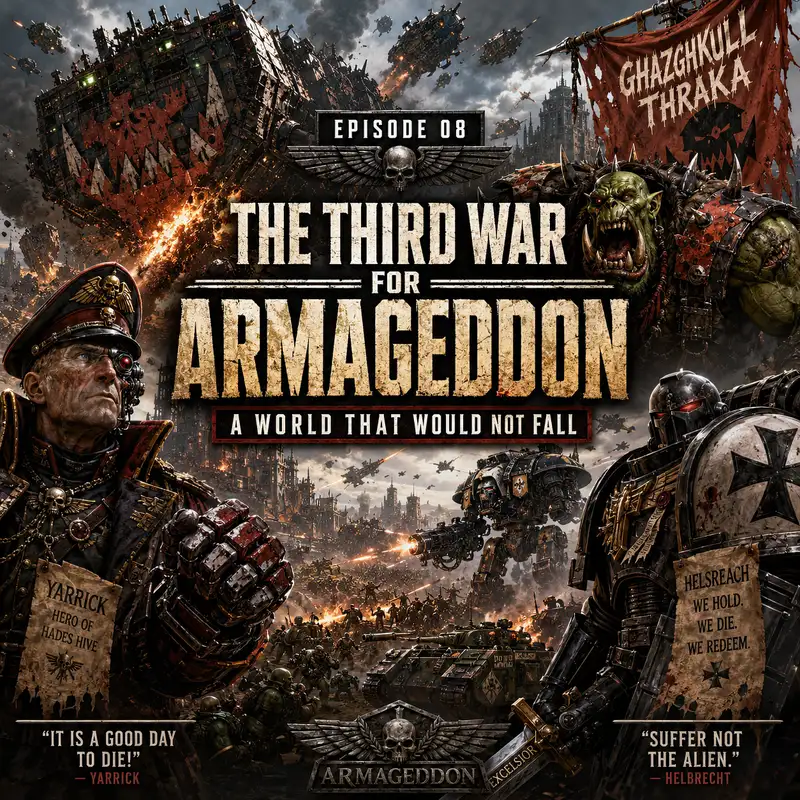
Hades Hive did not fall in the opening hours of the Third War for Armageddon. It vanished. An Ork asteroid struck from orbit and erased the city where Ghazghkull Thraka had once been defeated, burying fortifications, factories, soldiers, and memory beneath a continent of fire and dust. The message was brutally clear. Ghazghkull had not returned to repeat his previous invasion. He had returned after studying it. The old battlefield would offer no heroic second stand, because he had removed the battlefield itself.
That destruction frames the central question of the war. Armageddon faced an enemy larger, better organised, and more inventive than the one it had survived before. Its orbital warning stations were destroyed. Its fleet was outnumbered. Ork fortresses dropped from the heavens, while armies appeared from the sea, the jungle, and machinery that treated distance as an inconvenience. Entire hive cities were lost. Yet the planet did not fall. The reason was not one champion, one miracle, or one decisive battle. Armageddon endured because it had become a system built to survive catastrophe.
Armageddon was valuable long before it became famous. It was an industrial hive world whose refineries, manufactorums, transport networks, and immense populations supplied weapons and armoured vehicles far beyond its own system. Armageddon Secundus held the densest industrial regions. Armageddon Prime contained fortified hives separated by ash wastes and mountain barriers. Between them lay the equatorial jungle, a green belt capable of hiding armies beneath its canopy. Beyond the main continent were burning seas, volcanic wastes, polar water sources, and enough toxic air to make a sealed troop carrier less a luxury than a basic expression of optimism.
This geography made Armageddon difficult to conquer in a single stroke. The planet was not one capital surrounded by obedient territory. It was a chain of immense hive cities, ports, fuel complexes, roads, rail lines, water stations, and fortified passes. Each could function as a battlefield and, for a time, as a world of its own. An invader might destroy a hive without controlling the highways beyond it. He might seize a port while another port continued unloading tanks. Armageddon could lose organs and remain alive, although the patient was rarely consulted about the arrangement.
Ghazghkull understood this better than most Imperial officials would have liked to admit. During the Second War for Armageddon, he had learned how the Imperium reacted to invasion, how long reinforcements required, which hives mattered, and which human leaders could turn panic into resistance. He had also found the opponent who gave the war meaning. Commissar Sebastian Yarrick had become the Hero of Hades Hive, the human commander Orks feared and respected in equal measure. Their rivalry was personal, but it was also useful. Each transformed the other into a symbol larger than any ordinary commander.
After Armageddon, Yarrick pursued Ghazghkull across the stars. At Golgotha, the pursuit ended in disaster. Yarrick was captured, yet Ghazghkull released him. The Ork wanted his enemy alive, and the available accounts suggest he wanted Armageddon warned. That decision appears irrational only if victory is measured by territory. Ghazghkull wanted a greater war, one capable of drawing more Orks to him and proving his claim to be the prophet of Gork and Mork. A terrified, unprepared world could be conquered. A prepared world might become a legend.
Preparation did not mean safety. The Imperium expanded naval facilities in the system and constructed great monitoring stations to provide early warning. Yarrick helped shape the planetary defence forces and Armageddon regiments into a disciplined machine. Reinforcements gathered from the Imperial Guard, the Titan Legions, the Adepta Sororitas, and more than twenty Space Marine Chapters. The defenders knew Ghazghkull would return. They simply could not know whether enough guns, ships, and bodies could be assembled before the green tide reached them.
Ghazghkull also prepared. He allied with the Bad Moons warlord Nazdreg and obtained access to advanced Ork teleportation technology. His Mekboy Orkimedes developed weapons and transport systems that gave the invasion an operational reach the Imperium had not expected. Giant Roks carried warriors, guns, workshops, and force fields. Submersibles crossed hostile seas beneath Imperial observation. Teleporters shifted heavy equipment from orbit to the surface. None of this made the Orks orderly in the Imperial sense. It made their disorder arrive exactly where it was most damaging.
When the armada entered the system, its scale overwhelmed the warning network. The monitoring stations named for Mannheim, Dante, and Yarrick were destroyed in the opening advance. Imperial accounts describe Battlefleet Armageddon as outnumbered by roughly six to one, with additional Ork formations still approaching. Imperial ships fought with discipline, but discipline does not make empty space where six enemy vessels are currently trying to ram one cruiser. The fleet could inflict losses and delay the invasion. It could not seal the planet.
Six weeks after the Orks entered the system, the Roks began to descend. Some were broken apart by defence lasers and attack craft. Others survived behind force fields, slowed their fall, and struck the surface as ready-made fortresses. Their impact killed defenders before the doors opened. Then the doors opened. Orks poured into the wastes, followed by vehicles, artillery, Gargants, and the machinery needed to keep a Waaagh moving. Hades Hive was annihilated, not assaulted, because Ghazghkull had learned that symbols could be killed more efficiently from orbit.
The assault did not remain concentrated around one landing zone. Ork forces struck across Armageddon Prime and Armageddon Secundus. Feral Orks, descended from spores left after earlier wars, emerged from the equatorial jungle and attacked from territory the Imperium had never fully cleansed. Coastal defences faced submersible landings. Armoured columns raced through the ash wastes. Every successful Ork landing created another workshop, another fuel dump, and another gathering point for greenskins drawn toward the promise of battle. The invasion fed upon its own noise.
Ghazghkull's host was enormous, but it was not a centralised army in the Imperial sense. It was a coalition of clans, warbands, Meks, and ambitious bosses held together by his authority and the shared momentum of the Waaagh. That made it hard to destroy with one decapitation strike. It also made sustained control difficult. A boss who broke through might pursue a better fight, argue over plunder, or build his own fortress instead of supporting a distant offensive. Ghazghkull could direct the flood. He could not supervise every current.
Armageddon's first great advantage was that its defenders understood the terrain in practical terms. The Steel Legion fought from sealed Chimeras because the ash wastes poisoned exposed troops. Its officers knew which roads could support super-heavy armour, which passes channelled an advance, and which supply lines mattered more than a ruined district. Local regiments were not glamorous reinforcements arriving at the final hour. They were the permanent structure of resistance. They could lose a company, reroute around a crater, and continue fighting because the planet's war machine had been designed around movement under lethal conditions.
Its second advantage was command continuity. Yarrick was not simply a commissar threatening frightened soldiers from behind the line. By the Third War, he possessed decades of experience against Ghazghkull and an authority recognised by Guardsmen, planetary commanders, and Space Marines who were not accustomed to taking instruction from ordinary humans. His legend mattered because Armageddon had already seen what happened when leadership collapsed. Yarrick could make disconnected formations believe they were participating in one defence, even when they fought hundreds of miles apart and received orders through smoke, static, and failing relays.
The legend worked on the Orks as well. Yarrick's iron will, bionic eye, and captured power claw had become part of greenskin folklore. Orks called him Old Bale Eye and treated his presence as proof that a proper fight had begun. That respect did not make them merciful. It made them eager. Ghazghkull's obsession drew pressure toward Yarrick, but it also made the commissar a fixed point around which Imperial morale could form. The two commanders were enemies, yet each helped create the other's army by giving it a story worth joining.
The Space Marines brought immense power, but they did not arrive as a single harmonious legion. More than twenty Chapters contributed forces with different traditions, command styles, and ideas about honour. High Marshal Helbrecht of the Black Templars took a leading role in the naval war alongside Admiral Parol. On the surface, Black Templars, Salamanders, Blood Angels, White Scars, Space Wolves, and many others fought according to their own doctrines. Coordinating them was less like moving pieces on a board and more like persuading several armed religions to face roughly the same direction.
That diversity became useful because Armageddon did not present one kind of battle. Fast formations hunted Ork raiders across open ground. Fleet commanders boarded hulks and attacked transports. Titan Legions fought Gargants in engagements that shook the wastes. The Salamanders became known for defending human populations with unusual determination. The Blood Angels paid in noble blood, including Captain Tycho, who met his end amid the fighting at Tempestora. Each force could answer a different crisis. No single Chapter saved Armageddon, and that is precisely why the defence remained possible after local disasters.
The Siege of Helsreach became the war's clearest image because it compressed the entire struggle into one city. Helsreach was a coastal hive and a critical industrial centre, crowded with workers, militia, soldiers, machines, shrines, and the exhausted remnants of earlier lives. Reclusiarch Grimaldus led a force of one hundred Black Templars assigned to its defence. He understood that the city might not be held. His task was not to promise survival. It was to make the Orks pay so heavily that the rest of Armageddon gained time.
The defenders of Helsreach were far more numerous than the Black Templars, and far more fragile. Steel Legion units, hive militia, dockworkers, engine crews, Titan personnel, and civilians kept the city functioning while bombardment stripped away its towers. Their contribution matters because Space Marines could win impossible fights at individual gates, but they could not load every shell, repair every conduit, carry every wounded soldier, or hold every kilometre of wall. Helsreach endured through layers of people whose names did not survive the archive.
Orkimedes attacked the city with the kind of solution only an Ork genius would consider reasonable. Vast submersibles crossed the Boiling Sea and delivered armies where Imperial planners had expected the water to provide protection. The docks became killing grounds. Orks forced their way deeper into the hive while surface columns pressed from elsewhere. Helsreach was not surrounded by a neat siege line. It was penetrated, flooded with attackers, and divided into shrinking islands of resistance. Every street gained a front, then lost it, then gained it again under different ownership.
Grimaldus entered the battle as a warrior prepared to die with his brothers. The surviving accounts of Helsreach show him becoming something more difficult: a commander responsible for people who could not share his armour, training, or certainty. He learned the names and value of human defenders, not because the Black Templars became gentle, but because the city revealed what their vows were meant to protect. The distinction is important. Heroism on Armageddon was not the ability to remain pure above the disaster. It was the willingness to become answerable to those trapped inside it.
The final defence gathered at the Temple of the Emperor Ascendant. Orks broke into the sanctuary, and the fighting continued until the structure collapsed around attackers and defenders alike. Most of the Black Templars who had come to Helsreach were dead. Grimaldus emerged from the ruins carrying sacred relics recovered from the fallen temple, an image that turned him into the Hero of Helsreach. Yet the city had not been cleanly saved. It had been gutted, depopulated, and scarred. Survival meant that something remained under Imperial control after the smoke cleared.
Elsewhere, the Imperium suffered defeats that no amount of ceremony could disguise. Hive Tempestora fell after the Orks used massed submersible assaults, and the Order of Our Martyred Lady fought a devastating rearguard action before being overwhelmed at the Sanctorum of Saint Katherine. Hive Acheron was lost through treachery when the disgraced former ruler Herman von Strab returned in alliance with the invaders. The Third War was not a chain of Imperial last stands ending in victory. It was a map covered with positions that changed hands, disappeared, or continued fighting after headquarters had marked them lost.
Von Strab's betrayal exposed another reason Armageddon survived. The Imperium could absorb even political treason without the entire defence collapsing, because authority no longer rested in one planetary governor. Yarrick, Guard commanders, naval officers, Space Marine leaders, the Mechanicus, and the Ecclesiarchy maintained overlapping structures of power. This was inefficient, contentious, and often murderous. It was also resilient. Removing one commander did not remove the war. The Imperium had accidentally created redundancy, which is what bureaucracy calls wisdom after the original plan has caught fire.
In orbit, Helbrecht and Admiral Parol fought to keep the invasion from becoming completely one-sided. Space Marine vessels and Imperial Navy warships attacked Ork hulks, escorted reinforcements, and launched boarding actions at ranges where a single mistake could turn a cruiser into debris. They did not restore peaceful control of the system. They preserved access. That difference kept Armageddon alive. As long as troops, ammunition, fuel, and replacement machines could still reach the planet, every hive the Orks failed to take remained a fortress connected to the wider Imperium.
Then Armageddon itself intervened. The Season of Fire drove surface temperatures to murderous extremes and transformed open terrain into a furnace. Operations slowed as even Orks sought shelter and exposed machinery failed. The pause did not end the war, but it denied Ghazghkull the uninterrupted momentum on which a Waaagh depends. The Imperium used fortified hives, sealed vehicles, and established logistics to endure conditions that punished armies moving through the wastes. The planet was not loyal. It was merely hostile to everyone, which on Armageddon counted as useful support.
By this stage, the campaign had become a war of attrition. The Orks held major territories and continued to receive fighters drawn by Ghazghkull's fame. The Imperium held critical hives, supply routes, docks, and industrial zones. Counterattacks recovered ground, then stalled. Ork offensives broke through, then lost cohesion. Titans and Gargants destroyed one another while infantry fought over ruins neither side could fully exploit. There was no single front to collapse and no enemy capital whose capture would end resistance. The war had become too large for a decisive ending.
Ghazghkull eventually left Armageddon. Imperial retellings sometimes present this as the invader losing interest in a stalemate, which is true but incomplete. For Ghazghkull, war was not merely a means to possess a planet. It was the force through which Orks gathered, grew, and answered the will of their gods. Armageddon had served its purpose. It had attracted warriors, tested weapons, magnified his legend, and shown that his Waaagh could challenge the strongest defence the Imperium could assemble. Remaining to administer conquered factories would have been a strangely human conclusion.
He departed to pursue a greater war, leaving Ork commanders and armies behind. Yarrick joined Helbrecht's Black Templars in the hunt for him, because neither rivalry nor oath had been settled. Armageddon remained divided and burning. The major invasion had been contained, but the fighting did not stop. Orks still occupied territory. Imperial forces still launched offensives. Spores guaranteed that even cleared ground could become dangerous again. The Third War therefore ended in the manner most appropriate to Armageddon: it did not end so much as become the planet's normal condition.
Why, then, would Armageddon not fall? Preparation mattered. Yarrick's leadership mattered. The Steel Legion's mobility, the Navy's stubborn access, the Titan Legions' firepower, the Sororitas' sacrifice, and the Space Marines' specialised violence all mattered. So did geography, industrial depth, redundant command, and the fact that Ghazghkull sought a transcendent Waaagh rather than the patient occupation of a conquered world. The defence succeeded because no single defeat could finish it, while the invasion failed to turn many victories into one final decision.
Calling that survival should not be mistaken for calling it salvation. Hades was gone. Helsreach stood as a wounded shell. Tempestora and other regions were lost, retaken, or condemned to endless siege. Generations lived beneath poisoned skies while factories continued producing the weapons needed to defend the factories. The Imperium preserved Armageddon because it was too valuable to abandon, and Armageddon preserved the Imperium by consuming lives on an industrial scale. Both statements are true, which is usually where the darkness enters.
The enduring image is not Yarrick raising a banner over a silent field, because there was no silent field. It is a convoy of sealed Steel Legion vehicles moving through ash beneath burning clouds, carrying fresh troops past the ruins of those who held the road before them. Behind the convoy, hive furnaces continue to glow. Ahead, Ork guns begin firing again. Armageddon did not endure by remaining whole. It endured by turning every wound into another defensive line, until falling and fighting had become the same act.