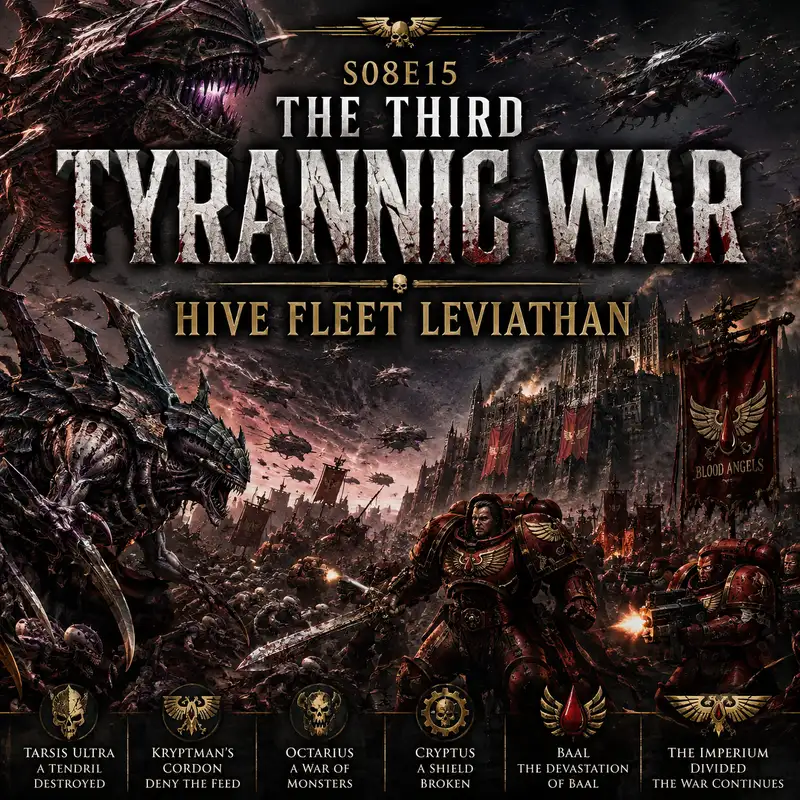
The Third Tyrannic War: Hive Fleet Leviathan
The stars above Baal did not vanish all at once. They disappeared by degrees, smothered behind living ships so numerous that the night itself seemed to grow a shell. Beneath that darkened sky stood the Blood Angels and the scattered descendants of Sanguinius, warriors drawn from across the Imperium to defend the world from which their bloodline had begun. They had artillery, fortress walls, ancient weapons, and nearly thirty thousand Space Marines. Hive Fleet Leviathan had hunger. By the time the battle began, it was no longer clear which side possessed the greater advantage. The Third Tyrannic War is often remembered through this final siege, but Baal was not the beginning of the disaster. It was the moment the Imperium finally understood what kind of enemy had entered the galaxy.
The first two Tyrannic Wars had encouraged a dangerous belief. Hive Fleet Behemoth had been shattered at Macragge, though the Ultramarines paid for that victory with the destruction of their First Company and wounds that lasted for generations. Hive Fleet Kraken had spread more widely, devastating worlds and nearly turning the craftworld Iyanden into a tomb, yet its major tendrils were also broken. The Imperium therefore possessed examples of survival, and Imperial institutions are very good at turning survival into doctrine. A hive fleet appeared. Defenders identified its course. A great battle was fought. Enough ships and organisms were destroyed, and the invasion ended. The cost might be obscene, but obscenity is not considered a disqualifying feature in Imperial planning.
Leviathan did not follow that pattern. In the closing years of the forty-first millennium, Inquisitor Fidus Kryptman began an enormous astropathic survey of the Imperium's southern reaches. Worlds were contacted one after another. Some answered. Others had fallen silent. When those silences were placed on a map, they formed a shape. Something vast was rising into the galaxy from beneath the galactic plane, bypassing the eastern approaches from which earlier hive fleets had come. Its principal masses advanced like two widely separated jaws, while the psychic pressure known as the Shadow in the Warp spread between them. Astropathic messages failed. Navigators struggled to guide reinforcement fleets. Systems disappeared not only from military control, but from conversation. Before Leviathan consumed worlds, it isolated them.
Calling Leviathan a fleet is useful, but misleading. An Imperial fleet is a collection of ships with crews, fuel, ammunition, repair yards, and commanders. Leviathan was an ecosystem moving through space. Its vessels were organisms. Its weapons were organisms. Its ammunition lived long enough to bite, burrow, poison, or reproduce. When a world fell, digestion pools reduced its life, water, atmosphere, and useful minerals into raw material. That material returned to the hive ships and emerged later as new warriors, new vessels, and new answers to whatever resistance had been encountered. A conventional army becomes weaker as it advances beyond its supply lines. A Tyranid force can become stronger with every populated world it takes. This makes defending badly almost worse than not defending at all.
The Hive Mind bound these organisms together through synapse creatures and psychic control, but Leviathan was not a single column following one road. It divided into tendrils, splinter fleets, vanguard swarms, and feeding fronts. Some moved toward vital systems. Others consumed whatever lay near them. Genestealer cults and infiltrating organisms prepared worlds from within, while the Shadow in the Warp concealed the approach from without. A tendril could be destroyed without killing the greater fleet. A planet could be saved while three neighboring systems were stripped bare. The Third Tyrannic War therefore lacked the clean geography Imperial commanders preferred. There was no one front, no single capital to capture, and no enemy government that could be persuaded to recognize a defeat.
One of Leviathan's major tendrils drove toward Tarsis Ultra, an agri world protected by an ancient oath of the Ultramarines. Captain Uriel Ventris led the Fourth Company to its defense, joined by the Mortifactors, Imperial Guard regiments, planetary troops, naval forces, the Deathwatch, and Kryptman himself. The defenders fought in orbit and on the ground, buying time at terrible cost. Early successes taught the Tyranids as much as they encouraged the Imperium. A method used once against a hive ship became less effective when attempted again. Every clever trap entered the Hive Mind's memory. Leviathan did not need officers gathered around a table to revise its doctrine. The bodies that survived were the revised doctrine.
Tarsis Ultra was saved through an attack aimed at the biological command structure of the invading tendril. Using material derived from a captured Tyranid organism, Kryptman and his allies developed a gene poison. Ventris joined a desperate mission into the last great hive ship and delivered the weapon against its Norn Queen. When the controlling organism died, the remaining swarm lost cohesion. Tyranids turned upon one another or perished in the freezing aftermath, and the tendril was destroyed. It was a genuine victory, earned through courage, sacrifice, and a willingness to abandon safe doctrine. It was also strategically tiny. Leviathan continued moving across the galaxy almost without noticing that one of its claws had been cut away.
Kryptman understood the implication more clearly than most. If every consumed world fed the next attack, then the Imperium had to deny Leviathan food. He established a cordon across the hive fleet's path and ordered worlds evacuated, burned, or subjected to Exterminatus. Some planets were destroyed as the Tyranids descended, forcing the swarm to spend biomass taking ground that would yield nothing in return. Billions of Imperial citizens died. Many had no opportunity to escape. In military terms, the cordon slowed Leviathan and bought time for larger forces to assemble. In human terms, Kryptman committed destruction on a scale so severe that even the Inquisition found it excessive, which is rather like being criticized for noise by an artillery regiment.
The judgment against Kryptman was not merely sentimental. His strategy exposed a central contradiction in Imperial rule. The Imperium claimed every human world as sacred territory held in trust for the Emperor, yet Kryptman's defense of that realm required him to erase large portions of it. He treated populations as denied resources and planets as fuel dumps to be demolished before capture. There was ruthless logic in the decision, but logic did not make it sustainable. An empire cannot preserve itself indefinitely by destroying what it means to preserve. Kryptman was stripped of authority and cast out, though the Tyranids remained inconveniently unaffected by the paperwork.
His next plan was more imaginative and, in the long term, possibly worse. Kryptman observed that Tyranids and Orks could become locked in wars of mutual destruction. He arranged for captured Genestealers to be carried aboard a space hulk toward the Ork empire of Octarius. Their psychic presence drew Leviathan into the sector. The theory was brutally elegant. Let two enemies consume one another while the Imperium fortified the surrounding regions. The plan had the advantage of requiring no agreement from either participant. Orks needed no encouragement to fight, and Tyranids required no persuasion to eat them.
Octarius became a furnace. Orks thrive through conflict, gathering into larger wars under stronger leaders. Tyranids adapt through conflict, converting the lessons and biomass of each battle into new forms. Instead of two fixed armies wearing each other down, Kryptman had brought together two systems that improved under pressure. The war delayed Leviathan and gave the Imperium breathing room, but it also produced more dangerous survivors. Eventually the Tyranids gained the upper hand across much of the sector, while Ork forces spread outward and the violence threatened everything nearby. Kryptman had solved an immediate problem by moving it into a larger container. The container then caught fire.
Elsewhere, Leviathan demonstrated that famous defenses and industrial importance offered no immunity. Gryphonne Four was one of the greatest forge worlds of the Adeptus Mechanicus, armed with immense manufactories, Titan forces, and the accumulated confidence of an institution that considered machinery a form of revealed truth. Leviathan consumed it. The world was reduced to a lifeless husk, and only a small number of its Magi survived. There was no single heroic duel that explained the loss. The forge world simply met a force able to absorb punishment, alter its methods, and replace destroyed organisms from the substance of conquered planets. Gryphonne Four mattered because it showed that Leviathan was not merely killing soldiers. It was eating the Imperium's ability to make future soldiers.
The most famous tendril of the Third Tyrannic War eventually moved through the Red Scar toward Baal, home world of the Blood Angels. Between the swarm and Baal lay the Cryptus System, a chain of harsh inhabited worlds regarded as a strategic shield. Commander Dante knew that if Leviathan consumed those populations, the added biomass would strengthen the assault on his Chapter's home. He led Blood Angels, Flesh Tearers, Imperial Guard, Sisters of Battle, naval forces, and other defenders into the Cryptus Campaign. The alliance was already strained by incompatible doctrines and old suspicions. Then Necron forces awakened within the system, because the forty-first millennium rarely allows a crisis to remain properly organized.
The defense of Cryptus revealed Leviathan's adaptability at every level. Bio-ships protected themselves against the system's deadly conditions. Swarms divided toward multiple worlds. Defenders were forced to choose which populations could be reached and which positions could only delay the inevitable. Dante and his allies fought beside Necrons under Anrakyr the Traveller when temporary cooperation served both sides. Ancient Necron machinery was used in a final act of destruction that devastated the system and denied much of it to the Tyranids. The result was called a victory because Leviathan suffered enormous losses. It was called pyrrhic because the shield worlds were ruined and the survivors still had to retreat toward Baal. Imperial terminology can be flexible when the alternative is admitting that the enemy remains hungry.
Dante sent a call to the Successor Chapters descended from Sanguinius. Twenty-six full Chapters answered in some strength, along with other scattered forces, creating the greatest gathering of the Blood Angels' lineage since the days of the old Legion. This was not a simple family reunion. The descendants of Sanguinius carried different traditions, reputations, and methods of controlling the Red Thirst and Black Rage. Some were noble exemplars. Some were barely tolerated. The Knights of Blood had been condemned and excommunicated, yet they came because Baal was the origin of their bloodline and because extinction has a way of simplifying protocol. Dante accepted them all. Leviathan was not interested in their internal distinctions.
The defenders transformed Baal and its moons into a fortress system. Fleets conducted strikes against approaching splinters. Guns were emplaced. Old defenses were restored. Mortal inhabitants and aspirants were drawn into the preparations. Yet the approaching mass remained so great that its bioships obscured the heavens. The Space Marine fleet inflicted extraordinary destruction in the opening battle, but numbers that would have ended another invasion became losses Leviathan could absorb. Bio-ships isolated Imperial vessels, swarmed them, and forced the surviving fleet aside. The Angels Excelsis were destroyed in the void fighting. More Tyranid vessels emerged behind the first wave. The defenders had not found the edge of the swarm. They had found its outer skin.
On the surface, the sons of Sanguinius held layered defensive lines around the Arx Angelicum, the fortress monastery of the Blood Angels. Moats, artillery, armored positions, void shields, mortal troops, and Space Marines broke repeated assaults. Leviathan answered with expenditure. Smaller organisms packed the defensive trenches with their own bodies until larger beasts could cross over them. It was a grotesque form of combat engineering, performed without hesitation because the Hive Mind did not distinguish between soldier, bridge, and ammunition. Every corpse remained useful. The defenders killed uncounted creatures and watched the dead become terrain for the next wave.
The Hive Mind also searched for the structure beneath the spectacle. A Lictor infiltrated the defenses and discovered forgotten tunnels below the fortress. Trygons opened a path through the ground. Genestealers surged into the complex and threatened the chambers where new Blood Angels were being created. The attack drew defenders inward, exactly as the Hive Mind intended. While the sons of Sanguinius fought to save their future brethren, the Lictor disabled the void shield system. The fortress was exposed. This was the intelligence behind Leviathan's hunger. It could drown walls in bodies, but it could also identify what its enemy loved, strike there, and use the response as a weapon.
Chapters died in the defense. Five Chapter Masters were killed, and entire brotherhoods were erased or reduced to fragments. The Black Rage claimed warriors who believed themselves to be Sanguinius fighting his final battle against Horus, while the actual enemy poured over the walls in chitinous waves. Dante eventually faced the Swarmlord, the Hive Mind's ancient commander organism, and killed it at the cost of terrible wounds. Even that achievement did not end the assault. A Swarmlord is not a monarch whose death forces surrender. It is a weapon and a memory that the Hive Mind can create again. Dante had slain the enemy leader and remained surrounded by the enemy.
Then the galaxy broke. The Great Rift opened, splitting the Imperium and flooding the Baal System with warp disturbance. The psychic catastrophe disrupted the Tyranid assault and prevented more of Leviathan from reaching the battlefield, but it did not bring merciful rescue. Daemons entered the war. Ka'Bandha, the ancient enemy of Sanguinius and his sons, manifested amid the devastation with hosts of Khorne. The daemon sought the Blood Angels' destruction for itself and slaughtered Tyranids on an appalling scale. On Baal Prime, the Knights of Blood made their last stand against the daemonic tide, surrendering fully to the Black Rage as they bought time for others to escape. Baal was saved in part because two nightmares disputed ownership of its corpse.
Roboute Guilliman and the Indomitus Crusade arrived after the worst of the battle, though the temporal violence around the Great Rift made any simple account of timing unreliable. The crusade cleared surviving Tyranid forces and brought Primaris reinforcements with which the shattered Chapters could rebuild. Guilliman found Dante grievously wounded, his world ruined, and his bloodline reduced by losses unmatched in millennia. He did not treat Baal as a triumphant fortress that had defeated an invasion. He treated it as the command post of a new, darker realm. Dante was appointed Regent of Imperium Nihilus, responsible for the half of the Imperium cut off beyond the Great Rift.
The Devastation of Baal was a victory only in the narrowest necessary sense. The Blood Angels survived. Their home world did not become a feeding ground. A vast concentration of Leviathan was destroyed by the defenders, the opening of the Great Rift, daemonic violence, and the arrival of the Indomitus Crusade. No single one of those forces could claim the result alone. Remove any one of them, and Baal probably falls. The cost was the destruction of Chapters, the ruin of worlds, and the transformation of Dante's command from defense of a home system into stewardship of an isolated empire. Survival had promoted him.
For a time, Imperial leaders could look at Baal and believe Leviathan had been broken. That conclusion repeated the error made after Behemoth and Kraken. The mass attacking Baal was enormous, but it was still a portion of something distributed across the galaxy. Tendrils remained active. Splinter fleets continued feeding. The Hive Mind did not recognize Baal as the signing place of a peace treaty. In the forty-second millennium, still greater portions of Leviathan emerged from the galactic west, opening what the Imperium called the Fourth Tyrannic War. The new assault did not replace the meaning of the Third. It confirmed it.
The Third Tyrannic War was the conflict in which the Imperium learned that a hive fleet could not be understood as a single invading army. Tarsis Ultra proved a tendril could be killed. Kryptman's cordon proved the swarm could be slowed by denying it biomass. Octarius proved it could be diverted. Cryptus proved it could be wounded through alliances and planetary destruction. Baal proved that even its greatest concentration could be shattered under extraordinary circumstances. None of those victories destroyed Leviathan. Each removed a limb, closed a mouth, or delayed a feeding cycle. The organism remained larger than the map on which Imperial commanders tried to contain it.
That is what made Leviathan different. Its greatest weapon was not a particular monster, toxin, or strategy. It was scale joined to adaptation. The Imperium could win battles against it, but every victory encouraged the comforting belief that the battle had represented the whole war. Above Baal, the stars eventually returned. The sons of Sanguinius rebuilt beneath their light, counted their dead, and prepared to defend a divided Imperium. Far below the galactic plane, beyond the routes marked by human charts, other living shapes continued to rise. Baal had survived the closing of one jaw. It had not seen the size of the creature.