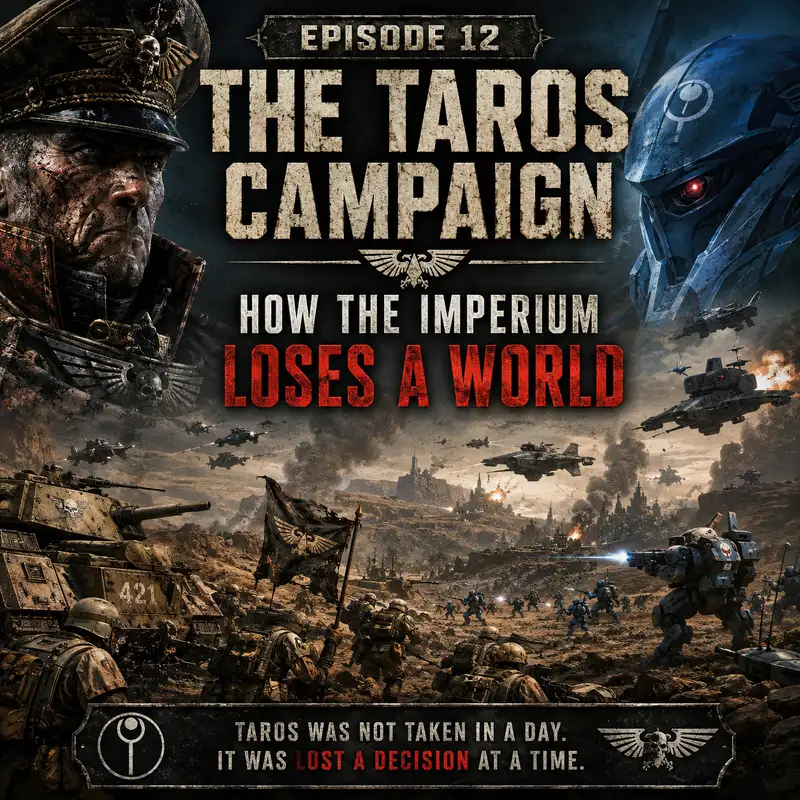
The Taros Campaign: How the Imperium Loses a World
The Imperium did not lose Taros when the last transports clawed their way into the sky. By then, the defeat had already been measured in empty water tanks, burning supply vehicles, abandoned landing strips, and orders that arrived after the enemy had moved on. The final evacuation was only the moment when the paperwork caught up with reality. Taros was a mining world, a dry and seemingly minor possession on the edge of the Damocles Gulf, yet its loss exposed a truth the Imperium prefers not to examine. A force can possess heavier armour, more artillery, Space Marines, Titans, and warships, and still be defeated by an enemy that understands the campaign better.
Taros was not beautiful, prosperous, or easy to defend. It was a furnace of rock and dust, dependent on vast hydro-processing facilities for the water that kept its settlements alive. Its real value lay beneath the ground. The planet supplied rare mineral resources needed by the forge world of Stygies Eight, whose factories were contributing to the wider Imperial war effort as Abaddon's thirteenth Black Crusade approached. That made Taros more than a remote colony. It was one small gear inside an enormous military machine, and the machine had noticed that the gear was no longer turning at the expected speed.
The first warning came through an Imperial Navy patrol in the Denab system. After a clash with T'au vessels and a waystation, Imperial officers discovered evidence that merchant ships had recently called at Taros. Auditor Prime Nymus Dree had already suspected that the world's mineral accounts did not balance. The missing ore had not vanished into the desert. It was being traded to the T'au. In an empire where an accounting discrepancy can lead to an invasion fleet, this was not merely smuggling. It was treason, economic theft, alien contamination, and an administrative embarrassment of the highest order.
Planetary Governor Uphir Aulis had allowed the relationship to develop in secret. T'au Water Caste merchants offered goods and opportunities that the distant Imperium either could not or would not provide. In return, Taros supplied minerals. The arrangement appears to have gained support among much of the population, which is not difficult to understand. The Imperium demanded its tithe and offered duty. The T'au arrived with trade, negotiation, and a very clear long-term interest in ownership. Their methods were gentler at the beginning, but they were not disinterested. Taros was being drawn into the T'au Empire one contract, one shipment, and one political concession at a time.
The Imperium first attempted a surgical solution. The Avenging Sons Space Marines were sent to remove Aulis and restore control. It was meant to be swift, exemplary, and terrifying. Instead, the Marines discovered that T'au forces were already present in strength around the governor's palace and the capital of Tarokeen. The fighting cost the Avenging Sons heavily, including more than half of their Terminator force and the Dreadnought Caim. They withdrew without killing the governor. A mission designed to prove that Imperial authority was absolute instead proved that the T'au had prepared for the moment when persuasion would need armour.
The aftermath revealed the limits of Aulis's partnership. Commander R'myr, the T'au officer directing the defence, secured the planet, removed Aulis from power, disarmed the planetary defence forces, and destroyed the local Adeptus Arbites presence. Some human troops later served alongside the T'au as auxiliaries, but Taros was no longer simply a human world choosing a different trading partner. It had passed under T'au martial control. The governor had escaped Imperial execution only to discover that a useful client is not the same thing as an equal. The Greater Good could be accommodating, but it still expected everyone to stand in the assigned place.
The Imperium answered with a full counter-invasion. Lord High Commander Otto Ivan Gustavus received overall command, while Lord Marshal De Stael directed the ground war. The main force became the four thousand six hundred and twenty-first Imperial Army, built around Tallarn desert regiments, Cadian infantry, Elysian Drop Troops, armoured units from Krieg and Tallarn, storm troopers, engineers, and extensive support elements. Two companies of Raptors Space Marines joined the expedition. Four Warhound Titans of Legio Ignatum added the sort of reassurance that comes from bringing buildings that can walk and carry guns.
This was not a collection of fools. The Tallarn were experienced desert fighters. The Raptors were patient, disciplined, and unusually practical by Space Marine standards. The Elysians specialised in airborne operations. The Imperial Navy brought fighters, bombers, troop carriers, cruisers, escorts, and transports. The campaign also included Mechanicus teams, labour corps, hospitals, logisticians, archivists, statisticians, and mortuary units. The Imperium had planned for victory, maintenance, record keeping, and burial. What it had not planned for was an enemy determined to deny it the kind of war that made those preparations useful.
The invasion took nearly a year to organise, delayed by bureaucracy, competing authorities, and the difficulty of assembling forces from across Imperial space. That delay mattered. It gave the T'au time to study the terrain, prepare hidden positions, organise human collaborators, and decide where not to fight. It also revealed a deeper weakness. The Imperial expedition was powerful, but it was assembled for a limited punitive campaign while greater threats demanded men and ships elsewhere. Taros had to be retaken, yet it could not be allowed to consume the resources reserved for the coming Black Crusade. The campaign began under pressure to succeed cheaply.
Commander R'myr understood that he did not need to defeat the Imperial fleet in open battle or hold every kilometre of desert. He needed to destroy the invasion after it landed. T'au naval forces withdrew rather than contest the initial approach directly. On the surface, defenders avoided presenting a single decisive target. They would trade space, preserve their strength, and attack the systems that allowed the Imperial army to move. The plan was not glamorous. It was also exactly suited to a world where distance and water were more dangerous than fortifications.
The first Imperial operations seemed to confirm that the enemy was weak. Raptors struck the planet's missile silos, destroying key installations with minimal losses. The main landings followed against little resistance. Human defenders fled or surrendered, and the expedition spent days building its beachhead without serious interference. To an Imperial staff, this looked like the beginning of control. To R'myr, it was the beginning of commitment. Every regiment that landed brought vehicles, ammunition, food, fuel, spare parts, and a daily requirement for water. The T'au were not failing to stop the invasion. They were allowing it to become heavy.
After two weeks, the Imperial advance toward Tarokeen and the primary starport began. Tallarn columns moved across the desert under artillery and air cover. The obvious expectation was that the T'au would eventually defend the routes, settlements, and terrain that appeared important on Imperial maps. Instead, Pathfinders, Stealth teams, and mobile cadres watched from concealment. They marked vehicles for seeker missiles, called in aircraft, struck exposed units, and withdrew before Imperial firepower could concentrate. The invaders kept gaining ground, but each gain stretched the line connecting the front to the landing zones.
At Tungusta Station, T'au Pathfinders damaged and destroyed Imperial armour before Barracuda aircraft arrived to strengthen the attack. When the Imperials returned under darkness with Basilisk artillery support, the T'au were gone. That pattern repeated across the campaign. The T'au did not remain in place to be crushed by heavier guns. They attacked when the local balance favoured them, then vanished into the operational depth of the desert. The Imperium could win possession of empty ground. It could not force the enemy to stay on it.
The fighting at the Phyrra Heights and Gladamak showed both sides of the problem. Kroot forces helped stall repeated Imperial assaults at the heights, forcing De Stael to redirect effort. At Gladamak, the Imperials achieved a genuine battlefield victory and compelled a T'au withdrawal. Yet the campaign did not turn. The T'au could afford to yield a position if doing so preserved their cadres and consumed Imperial supplies. The Imperium treated terrain as progress. R'myr treated time, distance, and fuel as weapons. One side counted captured ground. The other counted how far the next water convoy had to travel.
Soon the rear areas were no safer than the front. Orca transports inserted Pathfinders and Stealth teams behind Imperial lines. Supply dumps burned in the night. Airstrips were raided. Convoys required escorts, escorts required fuel, and every diversion weakened the main advance. The Imperial army had brought seventy-eight major air assets, but those aircraft had to protect transports, support ground forces, defend bases, and contest a T'au air arm built for rapid concentration. The T'au could choose where to mass Barracudas and Tiger Sharks. The Imperials had to be ready everywhere, which is another way of saying they were strong nowhere for very long.
The naval war followed the same logic. T'au ships attacked convoys, damaged transports, and drew Imperial warships away in pursuit. The Imperial Navy eventually destroyed the T'au battleship A'Rho, an important and costly success. Yet winning that duel did not secure the supply system. The fleet still had to protect a stream of vulnerable ships crossing the system and feeding an army on the surface. A capital ship could be hunted and killed. A campaign built from scattered raids, false movements, and selective attacks was harder to bring within gun range.
By the forty-second day, the Tarokeen offensive had stalled. Water shortages, mechanical wear, air attacks, and constant skirmishing had done what a fortified line might not have achieved. Imperial units remained dangerous, but their offensive rhythm had broken. They could still destroy anything they caught. They simply caught less and less. The problem was no longer how to reach the capital. It was how to keep the army alive while reaching it. This was the point at which the geography of Taros ceased to be a setting and became the principal T'au weapon.
Operation Comet was designed to break that deadlock. The plan called for the Elysian Twenty-third Drop Troops and storm troopers to seize a major hydro-processing facility deep behind T'au lines. Control of the plant could relieve Imperial water shortages, threaten the defenders' own supply, and create a position around which the campaign might regain momentum. It was bold, logical, and dependent on rapid reinforcement. In other words, it relied on the Imperial army doing quickly what the T'au had spent weeks making slow.
The airborne assault succeeded. Elysians descended from Valkyries, stormed the facility, and captured it after hard fighting. For a brief moment, the Imperium held the most important resource on the battlefield. Yet the seizure created an isolated pocket far from the main force. The T'au reacted with speed. Barracudas attacked Imperial aircraft. Tiger Sharks bombarded the position. Mantas delivered heavy support, while Hammerheads, Devilfish, Fire Warriors, and other elements tightened the ring. The Elysians had won the plant. Now they had to survive long enough for that victory to matter.
A relief force pushed forward with Raptors and Warhound Titans at its head. The sight of Titans advancing across the desert should have represented the restoration of Imperial certainty. One of them, Advensis Primaris, was destroyed by concentrated T'au fire from a Tiger Shark, its protection overwhelmed by missiles and rail weapons. The remaining Imperial column continued, but ambushes slowed the Guard behind the Space Marines. Fast scout vehicles attempted a desperate breakthrough and failed. The relief force could smash through individual positions, yet it could not defeat the distance, delay, and repeated disruption between those positions.
At the hydro-processing plant, Colonel Balach refused a demand to surrender. On the third day, with Imperial air support tied down and relief still distant, the T'au closed in. The Elysian defenders were overwhelmed. General Scykava was captured, becoming the highest-ranking Imperial prisoner of the war. Operation Comet had begun as an attempt to seize the campaign's centre of gravity. It ended by demonstrating that the T'au could isolate, surround, and destroy an elite Imperial force before a powerful relief column could cross its own operational space.
The failure shattered confidence in the high command. Gustavus and De Stael were removed, and Commissar-General Mordred Van Horcic took control after arresting much of the command staff. He shortened the front and tried to reduce the burden on the supply lines. This was militarily sensible, though it arrived after the offensive had already been broken. The Imperial command system had spent weeks debating, coordinating, and reallocating while R'myr's cadres moved according to a coherent plan. Taros was not lost because Imperial officers never recognised the logistical crisis. It was lost because recognition and effective response were separated by too much time.
Scykava, held in a T'au prisoner camp, refused an offer from the Ethereal Aun'Vre to serve the Empire as a leader of human auxiliaries. He later helped organise an escape and crossed the desert toward Imperial lines. Near death from thirst, he was found by an Imperial patrol. His account revealed the location of the T'au command headquarters and the presence of Aun'Vre. That intelligence produced Operation Deathblow, a final attempt to change the war not by repairing the Imperial position, but by cutting the head from the enemy command.
Storm troopers attacked the headquarters while an Eversor assassin drove into the bunker complex. The assassin detonated within the position and killed Aun'Vre. It was a brutal tactical success, exactly the kind of blow Imperial institutions were designed to deliver. R'myr, however, was outside the bunker directing the defence and survived. The death of the Ethereal did not collapse T'au resistance. It enraged the Fire Caste commander who had already shaped the campaign. The Imperium had killed the spiritual leader and missed the operational one.
R'myr gathered his forces for the final offensive. T'au attacks struck the retreating Imperial regiments as the shortened line gave way. The withdrawal of several Tallarn formations became a rout, while aircraft and mobile patrols harried units trying to reach the landing zones. Evacuation was authorised as order dissolved around the transports. Soldiers fought for space. Commissars and storm troopers tried to control the embarkation. The Raptors arrived to defend the shrinking perimeter and held long enough for surviving Imperial forces to escape. They could not save the world, but they prevented defeat from becoming annihilation.
The cost was severe. Five Imperial regiments were effectively destroyed, while others lost most of their vehicles and equipment. Thousands were killed, many more were wounded, and almost twenty thousand became prisoners. Hundreds of tanks and armoured carriers were lost, along with aircraft and naval vessels. The T'au had also suffered heavily, including the loss of their battleship and many warriors, but their army remained in possession of the objective. Taros was renamed T'ros, its mineral wealth redirected into the T'au Empire, and new colonists followed the soldiers.
The simplest explanation is that the Imperium lost because it underestimated the T'au. That is true, but incomplete. The expedition knew the T'au possessed advanced weapons, mobile armour, and capable aircraft. What it failed to understand was how those elements would work together across an entire campaign. Imperial planners treated T'au mobility as a battlefield characteristic. R'myr used it as an operational system. His forces decided when to fight, where to concentrate, when to withdraw, and which part of the Imperial machine to cut next.
The Imperium also misunderstood what it meant to control Taros. It could land troops, destroy silos, occupy stations, and win tank battles without controlling the planet's human networks, water infrastructure, airspace, or distances. The T'au had spent years building influence before the first shot was fired. Local collaboration gave them knowledge, manpower, and political depth. Their annexation was not benevolent, but it was prepared. The Imperial return arrived as an external army demanding that a population resume obedience after many had already chosen, accepted, or been compelled into another order.
None of this makes the T'au invincible or the Imperium merely stupid. Imperial forces repeatedly fought with skill and courage. Their commanders faced genuine strategic limits, uncertain intelligence, competing authorities, and a galaxy-wide emergency that restricted reinforcement. The T'au took losses, abandoned positions, and nearly lost senior leadership. Their victory depended on Taros being the right battlefield for their methods and on the Imperium continuing to advance after the original plan had become untenable. A different world, a larger Imperial commitment, or a commander willing to pause earlier might have produced another result.
Taros was lost because the Imperium brought overwhelming pieces without creating an overwhelming whole. Its regiments, Titans, aircraft, fleet, and Space Marines remained formidable, but each depended on a supply structure stretched across a hostile desert and attacked faster than it could adapt. The T'au did not defeat every Imperial strength. They made those strengths arrive late, fight in isolation, or guard something else. When the last transports rose through the dust, the Imperium still possessed weapons capable of destroying cities. It had simply run out of the water, time, and freedom of movement required to reach one.