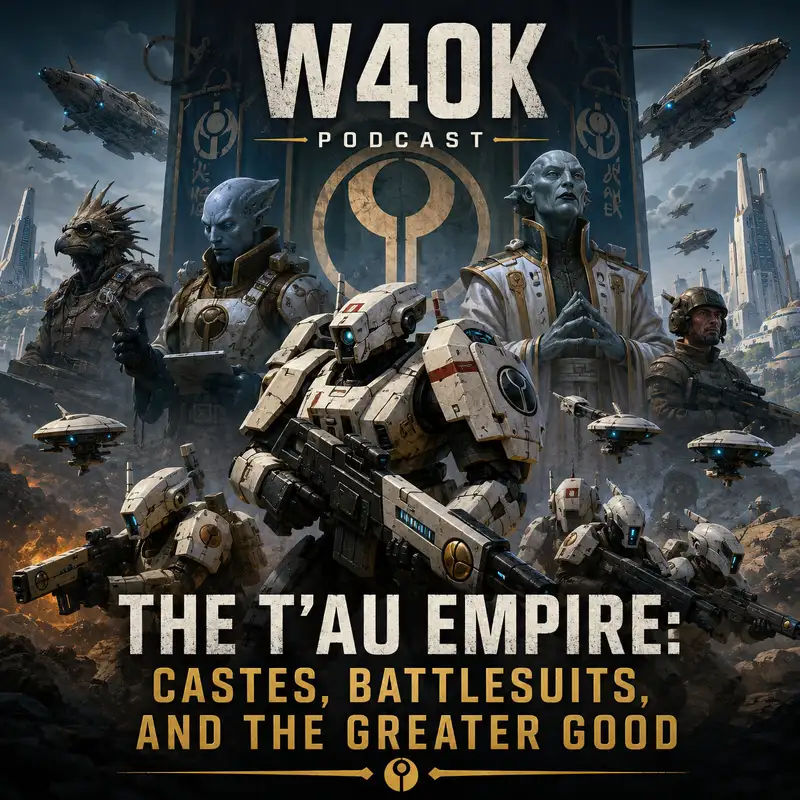
The T’au Empire: Castes, Battlesuits, and the Greater Good
The first offer is usually polite.
A Water Caste envoy arrives beneath a banner of peace. The delegation brings food, medicine, engineering support, trade agreements, and a patient explanation of the Greater Good. Behind the diplomats wait Fire Warriors, grav-tanks, drones, and battlesuits hidden beyond the horizon. The choice is presented calmly. Join a growing commonwealth in which every people contributes to a shared future, or refuse and discover how accurately a rail rifle can define the limits of political independence.
That contradiction is the heart of the T’au Empire. It is young, energetic, technologically daring, and convinced that history has a direction. It speaks of cooperation in a galaxy built on conquest. It welcomes alien auxiliaries when most powers answer difference with extermination. Its cities can be clean, its machines efficient, and its rulers capable of planning beyond the next religious purge. Yet its society is rigidly divided by birth, its truth is managed by a ruling caste, and its diplomacy becomes remarkably less flexible once a world has been identified as useful.
The question is not whether the T’au are secretly as cruel as everyone else. They are not merely the Imperium with smoother armour and better lighting. The more interesting question is how a civilisation built around collective purpose turns that purpose into empire, and why the battlesuit is the perfect symbol of everything admirable and dangerous about it.
The T’au were not born into galactic power. When Imperial explorers first encountered their ancestors, they found a comparatively primitive species living on a world of plains, mountains, and scattered tribal territories. The Imperium marked the planet for the sort of attention it commonly gives vulnerable alien life, which is to say destruction followed by paperwork. Warp storms intervened, isolating the region. By the time outsiders returned, the tribes had become an interstellar civilisation.
T’au accounts describe an age before unity called the Mont’au, a period of terror and civil war. Different peoples competed for land, resources, and survival. Those who would become the Fire Caste fought. The ancestors of the Earth Caste built fortifications and weapons. Air-dwelling tribes carried messages and crossed distances others could not. Traders and negotiators struggled to maintain contact between communities that increasingly preferred siegecraft to conversation.
Then the Ethereals appeared.
The oldest stories place them at the gates of a city threatened by war. They persuaded enemies to speak, then convinced them that every tribe possessed qualities needed by all the others. Whether the meeting occurred exactly as later tradition claims is uncertain. Founding stories have a habit of becoming tidier as governments become older. What matters is the result. The wars ended. The tribes were reorganised into a system of castes, and the T’au accepted the T’au’va, the Greater Good, as the principle that would govern their civilisation.
The four main castes were associated with the elements. Earth would build. Fire would defend and conquer. Air would travel the skies and void. Water would negotiate, administer, and connect. Above them stood the Ethereals, linked to no ordinary element and entrusted with guiding the whole.
This was not simply a division of labour. The castes became hereditary populations with distinct traditions, physical tendencies, educational systems, and social expectations. An Earth Caste child does not review a list of professions and decide that diplomacy looks pleasant. A Fire Caste warrior does not retire from military service and open a modest shipping company because the hours are better. Each life begins inside a defined purpose.
To the T’au, this is not automatically experienced as oppression. Purpose is one of the great promises of their society. Every citizen is taught that their work matters because it supports something larger than personal ambition. The system coordinates millions of lives with extraordinary efficiency. It also makes dissent difficult to express, because rejecting one’s assigned role is not merely a career decision. It appears as a refusal to contribute to everyone else’s survival.
The Earth Caste gives physical form to that promise. Its engineers, scientists, labourers, and technicians produce the infrastructure of expansion. They build cities, weapons, drones, starships, artificial intelligences, medical systems, and the battlesuits for which the empire is famous. Their technology is not treated as a sacred inheritance that must be preserved without comprehension. It is tested, modified, and replaced.
That difference from the Adeptus Mechanicus is profound. An Imperial machine may be ancient, powerful, and maintained through rituals whose practical origins have been buried beneath millennia of fear. A T’au device is expected to improve. If it fails, the Earth Caste studies the failure. If the enemy adapts, the design changes. The machine is a tool rather than a relic. This occasionally leads the T’au to assume that every problem can be solved by sufficient analysis. The galaxy has spent ten thousand years developing counterarguments, many of them daemonic.
The Air Caste carries the empire between worlds. Its members pilot atmospheric craft, command voidships, manage orbital traffic, and maintain the routes that turn distant colonies into a political system. Their long association with flight and low-gravity environments has shaped their bodies as well as their culture. They are not simply drivers assigned to the military. They are the connective tissue of an empire whose ambitions extend far beyond its original stars.
The Water Caste performs a different kind of navigation. Its diplomats, merchants, interpreters, administrators, and propagandists move between cultures. They learn what another people needs, what it fears, which leaders can be persuaded, and which divisions can be widened. A Water Caste negotiation may begin with genuine mutual benefit. Trade improves. Food shortages ease. Local rulers receive technology and protection. T’au advisors become indispensable. Eventually, the question is no longer whether the world will join the empire, but how painful the final transition needs to be.
The Fire Caste stands behind that process. Its warriors are professionals rather than mass conscripts. Their population is too limited and their empire too widely spread to indulge in endless wars of attrition. They prefer mobility, concentration of force, coordinated fire, and withdrawal from positions that no longer serve a purpose. A heroic last stand may inspire an Imperial regiment. A T’au commander is more likely to ask why the position was allowed to become isolated in the first place.
Fire Warriors fight as parts of a network. Pathfinders identify targets. Markerlights and sensor data improve accuracy. Drones scout, protect, relay information, and add firepower. Devilfish transports move infantry rapidly. Hammerhead gunships engage armour. Aircraft and orbital assets extend the battlefield upward. Battlesuits strike where the line is weakest or where the enemy command believes itself secure.
This approach is sometimes mistaken for cowardice because the T’au prefer shooting an opponent from a distance rather than meeting it with a ceremonial sword. From the Fire Caste perspective, allowing an Ork, a Space Marine, or a Tyranid warrior to reach arm’s length is not proof of courage. It is evidence that several earlier decisions have become regrettable.
Their two best-known martial philosophies express different methods of controlling battle. Mont’ka, the Killing Blow, seeks the decisive point. The commander identifies the enemy’s centre of strength or critical weakness, strikes with speed, and ends the engagement before the opponent can recover. Kauyon, the Patient Hunter, uses deception, bait, delay, and positioning. The enemy is encouraged to move where the T’au want it, often while believing it has discovered an opportunity.
Neither philosophy is simply aggressive or defensive. Both depend on information and timing. Mont’ka without discipline becomes a reckless charge. Kauyon without nerve becomes endless retreat. The ideal commander understands the conditions, chooses the method, and coordinates every element toward the same result.
That last phrase matters. Every element toward the same result. T’au warfare mirrors T’au society. No unit is supposed to exist for its own glory. A Pathfinder team may expose itself so a gunship can destroy the target. Fire Warriors may withdraw to draw the enemy into a prepared engagement zone. Drones may be sacrificed without hesitation. Victory belongs to the cadre, the sept, and the Greater Good, not to the individual who happened to fire the final shot.
The battlesuit is the purest expression of this system.
A T’au battlesuit is not a walking tomb containing a warrior too damaged to live outside it. Its pilot is a veteran Fire Caste soldier who has survived training, combat, and a Trial by Fire. The machine magnifies the pilot’s mobility, protection, awareness, and weaponry. It can leap over terrain, descend from aircraft, exchange targeting data with drones, and carry weapons selected for a particular mission.
The iconic Crisis battlesuit is less a single weapon than a platform. Its systems can be configured to burn through armour, scatter infantry, destroy heavy targets, or sustain mobile fire. Stealth suits infiltrate and mark vulnerable positions. Ghostkeels combine concealment with heavier striking power. Broadsides provide punishing long-range support. Riptides take the principle to an intimidating scale, carrying enough energy and armament to challenge threats that would otherwise require tanks or fortifications.
The important feature is not size. It is adaptability. The Earth Caste builds a system that the Fire Caste can configure around the mission. Air Caste transports deliver it. Drones extend its senses. Water Caste intelligence may identify the political or logistical target. Ethereal strategy determines why the battle is being fought. The pilot appears alone inside the armour, but the entire civilisation stands inside the machine with them.
This is why battlesuits should not be understood as the T’au equivalent of Imperial knights seeking personal honour. The pilot may earn distinction, rank, and a heroic reputation, but the suit remains part of a coordinated structure. Even commanders who become famous are expected to represent the Greater Good rather than themselves.
The empire learned the value and limits of this doctrine during its clashes with the Imperium. When Imperial forces crossed the Damocles Gulf, the T’au confronted a civilisation far older and more violent than anything they had fully understood. Space Marines, Imperial Guard regiments, warships, and armoured formations pressed into T’au territory. The fighting around Dal’yth revealed strengths and weaknesses on both sides.
The T’au discovered that Imperial technology could be crude in appearance yet devastating in effect. They learned that the Imperium could absorb losses on a scale their own population could not sustain. They also learned that Imperial forces were divided by doctrine, status, communication, and competing chains of command. The crusade eventually withdrew while facing a wider Tyranid threat and a grinding stalemate. The T’au had survived, but survival was not the same as proving their system invincible.
They adapted. They studied captured equipment, revised doctrine, expanded defences, and continued outward. This is one of their greatest strengths. The T’au can be shocked without becoming paralysed by the discovery that the universe does not match their textbooks.
They also misunderstand what they encounter. Their rational culture has limited experience with the Warp, Chaos, and the power of belief. The Imperium’s superstition often appears absurd to them, and much of it is absurd. Unfortunately, some doors really are haunted. Some symbols really do attract attention. Some diseases can hate you personally. A civilisation trained to dismiss religious explanations may take too long to recognise a daemon because the preliminary report describes it as an aggressive, unidentified energy-based life form.
No figure exposes the tensions within the empire more clearly than Commander Farsight.
Farsight was a gifted Fire Caste warrior, a student of the legendary Commander Puretide, and a master of Mont’ka. He became one of the empire’s greatest heroes. During campaigns beyond established T’au space, his forces encountered horrors for which their education had not prepared them. On Arthas Moloch, the Ethereals accompanying his expedition were killed, and Farsight faced beings that the wider empire did not adequately understand.
Without Ethereal supervision, his campaign did not collapse. His warriors remained organised. The colonies endured. Farsight came to believe that the Ethereals were not merely wise coordinators but controllers who concealed essential truths. He broke from their authority and established the Farsight Enclaves.
The Enclaves are dangerous to the official story because they did not reject every principle of the Greater Good. They preserved cooperation, military discipline, and communal purpose while refusing Ethereal rule. That does not prove every accusation against the Ethereals, but it demonstrates that T’au unity can survive without them. A government built on the claim that its guidance is indispensable rarely considers such an experiment reassuring.
The Ethereals remain one of the empire’s deepest uncertainties. Their arrival ended the Mont’au. Their presence can inspire extraordinary obedience and calm. T’au society treats their judgment with reverence. Imperial observers have proposed psychic, biological, pheromonal, and technological explanations for their influence, but none settles the matter completely. Some accounts present them as sincere leaders carrying an immense civilisational burden. Others reveal manipulation, censorship, and ruthless control.
The secrecy surrounding the death of Aun’Va, the supreme Ethereal, gives weight to the darker interpretation. After he was killed, the leadership concealed his death and continued to present an artificial likeness to the empire. The stated purpose was stability. The practical effect was a government using advanced technology to preserve the image of an infallible leader who was no longer alive. Even the Imperium might consider that a little theatrical, though hardly unfamiliar.
The Greater Good also extends beyond the T’au species, and this is where the empire looks most distinct from its rivals. Kroot serve as scouts, hunters, mercenaries, and close-combat specialists. Vespid provide fast-moving assault troops. Human communities incorporated into the empire become Gue’vesa, human helpers or auxiliaries. Other species contribute navigation, trade, diplomacy, labour, and military capability.
This cooperation can be genuine. A human worker under T’au rule may receive food, medical care, and security unavailable beneath a corrupt Imperial governor. A species threatened with extinction may find survival through alliance. The empire recognises that different peoples possess different strengths. In a setting where the common diplomatic opening is orbital bombardment, being asked to sign a treaty is meaningful progress.
It is still an empire.
The T’au define the shared future, establish the hierarchy, and decide which forms of difference are useful. Alien cultures may be respected, adjusted, supervised, or suppressed according to their compatibility with the Greater Good. Worlds that decline peaceful integration can face blockade, subversion, regime change, and military conquest. The open hand and the armed battlesuit belong to the same policy.
The Fourth Sphere Expansion revealed how fragile the inclusive promise could become. Experimental drives carried a great fleet into disaster. The survivors endured the Warp, a realm their rational worldview had barely prepared them to comprehend. Accounts suggest they were saved by an immense presence associated with the Greater Good, perhaps shaped not by the faint psychic presence of the T’au themselves, but by the beliefs of the empire’s more psychically active subject peoples.
For many survivors, the experience did not create gratitude. It created horror. Some turned violently against alien auxiliaries, blaming them for the thing encountered in the Warp. Forces that had departed to spread a multi-species philosophy returned suspicious of the species that helped give that philosophy psychic form. The Greater Good had become something they could no longer control, and they responded with atrocity.
The Fifth Sphere Expansion under Commander Shadowsun pushed through the Startide Nexus and resumed the advance. Shadowsun represents Kauyon at its most refined: patient, disciplined, and capable of seeing a battlefield as a web of relationships rather than a contest of individual champions. She also carries the burden of commanding an empire whose frontier is colliding with Chaos, Imperial faith, internal division, and the unintended spiritual consequences of its own success.
That frontier is where the T’au story becomes most compelling. They are a young power entering a galaxy full of ancient crimes. They believe ignorance can be corrected, systems improved, and enemies understood. Often, they are right. Their weapons become better. Their alliances expand. Their commanders learn. Their citizens can build functioning societies amid ruins produced by older empires.
Yet progress does not answer every moral question. Efficiency can distribute medicine, or make occupation easier. Unity can prevent civil war, or silence disagreement. A caste can give purpose, or deny choice. Diplomacy can save a world, or prepare it for annexation. The Greater Good can be a sincere commitment to mutual survival and a language through which power excuses itself.
The battlesuit holds all of these meanings at once. It is a triumph of science over inherited limitation. It allows a living pilot to meet monsters built by ten thousand years of war. It succeeds because engineers, pilots, soldiers, diplomats, artificial minds, and commanders contribute to one design. It is cooperation made metal.
It is also a sealed system. The pilot sees the battlefield through information selected by sensors, doctrine, and command. The mission has already been defined. The enemy has already been classified. The purpose of the weapon has already been justified by the Greater Good.
That is the T’au Empire’s promise and its danger. It offers a future in a galaxy that has largely forgotten how to imagine one. It asks every person and every people to take a place within that future. The place may be useful, prosperous, and protected. It is not necessarily chosen.
When the Water Caste extends an open hand and a battlesuit waits beyond the horizon, neither gesture is false. The T’au believe in cooperation. They believe in progress. They believe the galaxy can be made better.
They also believe they are the ones who must decide what better means.