The T’au Castes and the Making of a Citizen
A T’au child is born into a future that has already been narrowed to a single path. Long before that child earns a name of honour, boards a starship, carries a pulse rifle, or speaks before an alien court, one fact has been settled beyond appeal. The child belongs to a caste. That caste will shape the body, the education, the friendships, the duties, and the range of ambitions that society considers healthy. The T’au do not usually experience this as a sentence. They experience it as belonging. That is the central achievement of their civilisation, and also its most unsettling feature. The T’au Empire does not merely assign work to its people. It teaches them that a life becomes meaningful only when it fits the place prepared for it.
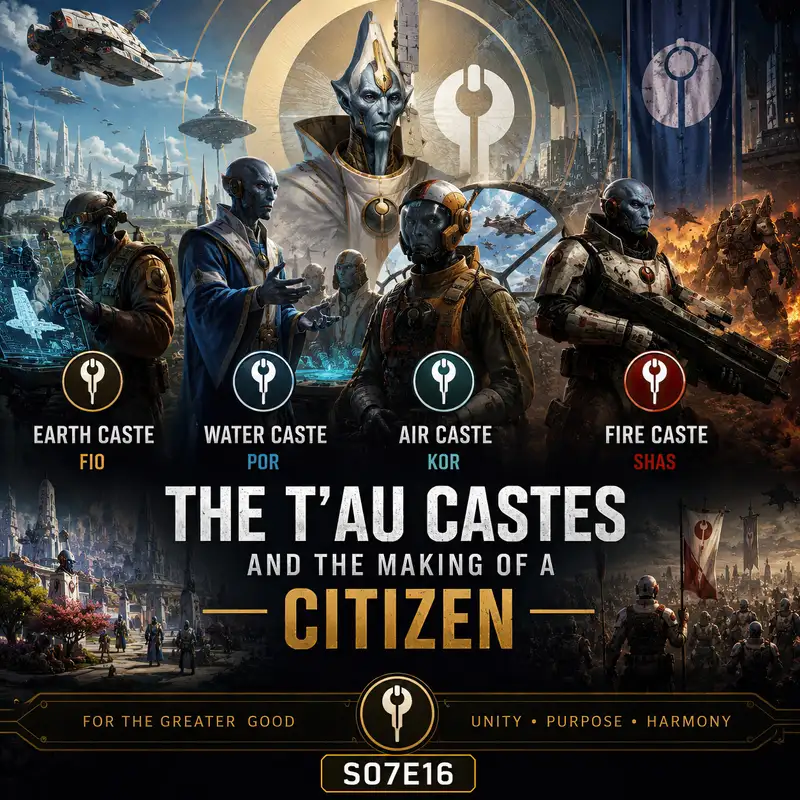
For an Imperial citizen, identity may begin with a hive, a regiment, a forge, a shrine, or an inherited debt to institutions too old to remember why they exist. For a T’au, identity begins with function. The Earth caste provides. The Water caste connects and persuades. The Air caste carries the Empire between worlds. The Fire caste protects and conquers. Above them stand the Ethereals, who define what all that labour is for. This arrangement is often described as simple, almost elegant. It is not simple at all. Each caste is a culture, a profession, a biological lineage, and a political boundary. To understand how the T’au make citizens, we have to look beyond the familiar diagrams of five neat symbols. We have to ask how an entire people learned to treat limitation as harmony.
The answer begins during the Mont’au, the age of terror remembered as the T’au species’ great warning against division. On their home world, different populations had developed separate ways of life and increasingly distinct physical traits. The plains produced hunters and warriors. Settled communities built cities, cultivated land, and defended fortified places. Other groups travelled, traded, carried messages, or moved through the high places and open air. These differences did not create cooperation. They created rivals. T’au memory presents the period as a descent toward mutual destruction, a time when every strength became a weapon aimed at another branch of the same species. It is the nightmare behind their politics. When a T’au leader warns against selfishness, the shadow in the room is not merely disorder. It is a return to the Mont’au.
The decisive moment came at the fortified city of Fio’taun. Warriors from the plains and their allies had placed the city under siege. The defenders held behind their walls, and neither side possessed a convincing path to peace. Then figures calling themselves Ethereals appeared. The surviving tradition describes them entering both camps, speaking with the opposing leaders, and achieving in a single night what prolonged war had failed to produce. The gates opened. Negotiation replaced assault. The Ethereals taught that the different peoples were not condemned to destroy one another because of their differences. Those differences could be arranged, disciplined, and directed toward the T’au’va, the Greater Good. It was a brilliant political solution. It also ensured that the new society would never again permit difference to exist without an assigned purpose.
Caste is inherited. A T’au does not select it after schooling, and changing caste is not treated as an ordinary career choice. Interbreeding between castes is forbidden, preserving the physical distinctions that had already emerged and reinforcing them across generations. The result is more than a class system. A labourer cannot study hard and become a Water caste diplomat. A gifted speaker born to the Fire caste does not simply transfer to an embassy. A technically minded Air caste pilot is not free to join an Earth caste laboratory. Ability may alter status within a caste, but it does not erase the caste itself. T’au society offers advancement along a path. It does not usually offer the right to choose another path.
This is where the making of a citizen truly begins. The T’au child is not taught to discover an unrestricted self and then decide what to contribute. The child is taught to understand the self through contribution. Education develops the aptitudes that the caste already values. Ceremony links duty to history. Rank provides an approved form of ambition. Public stories celebrate individuals whose excellence advances the whole, while selfish achievement is treated as a failure of character. The message is repeated in architecture, language, military doctrine, art, administration, and ritual. You have a place. Your place matters. Others depend on you. The society has no shortage of reassurance. It has rather less patience for the question of whether the place was chosen.
The Earth caste, known as the Fio, makes the material world of the Empire. It is the largest caste and the one most responsible for the difference between a T’au sept and an Imperial ruin with a tax office. Earth caste workers cultivate food, construct dwellings, operate industry, design machines, maintain infrastructure, and turn scientific knowledge into practical systems. Their labour produces drones, habitats, weapons, vehicles, orbital installations, and the countless quiet mechanisms that keep a young interstellar state alive. They are often portrayed as practical, stoic, and unadorned. That description can sound dismissive until one remembers that nearly every visible T’au achievement began as an Earth caste problem.
An Earth caste citizen is therefore made through mastery of useful creation. The ideal is not the solitary genius demanding that society recognise a private vision. Innovation is praised when it solves a shared need. T’au technology advances because experimentation is not automatically treated as sacrilege, which already gives the Earth caste a considerable advantage over large sections of the Adeptus Mechanicus. Yet freedom in method should not be confused with freedom in purpose. The engineer may devise a better reactor, a more capable drone, or a cleaner habitation system, but the Ethereals and the councils of the Empire determine where that invention serves. The Earth caste is encouraged to ask how. The larger question of why is generally considered to have been answered.
The Water caste, known as the Por, governs communication, administration, and persuasion. Its citizens are diplomats, merchants, negotiators, interpreters, historians, artists, legal specialists, propagandists, and, when necessary, investigators and spies. They are trained to understand movement between people rather than movement between stars. A Water caste envoy studies language, custom, desire, fear, and the small gestures that reveal where an argument may bend. When the T’au encounter another species, it is often the Water caste that first presents the open hand of the Greater Good. They explain that cooperation is rational, prosperity is possible, and resistance is unnecessary. If the explanation fails, the Fire caste may continue the discussion with less delicate equipment.
The Water caste does more than communicate policy. It helps create the reality in which policy appears natural. Its artists preserve the images society admires. Its historians arrange the past into lessons. Its administrators make the castes function together. Its diplomats interpret outsiders to the Empire and the Empire to outsiders. Its propagandists celebrate victories and convert sacrifice into meaning. This need not mean that every Water caste speaker is consciously lying. The most effective advocate is often the one who genuinely believes the story being told. A citizen formed inside the T’au system may see persuasion not as manipulation but as rescue. Those outside the Greater Good are not merely enemies. They are people who have not yet understood what is best for them.
The darker edge appears when persuasion turns inward. Water caste institutions also monitor information, investigate crime, and help manage dissent. Accounts of re-education facilities make clear that disagreement with the caste system is not treated as one political position among several. It may be diagnosed as confusion, selfishness, or a failure to understand the Greater Good. That language matters. A tyrant who calls a dissenter evil still admits that the dissenter has made a choice. A system that calls dissent illness can claim that coercion is care. The T’au state prefers correction to public spectacle, which is certainly tidier than an Imperial execution ground. The person being corrected may find the distinction less comforting.
The Air caste, the Kor, lives with a different horizon. Its distant ancestors carried messages and moved through the high regions of the T’au home world. In the Empire, the Air caste pilots atmospheric craft, commands merchant vessels and warships, operates orbital cities, and maintains the routes that bind separated septs into one political body. Generations in low gravity have left Air caste T’au tall, slender, and lightly built, with bodies adapted to a life many of them spend almost entirely away from planetary surfaces. They are sometimes called the invisible caste because most inhabitants of conquered worlds see their ships far more often than they see the people inside them.
The Fire caste, the Shas, is the face most enemies know. Its members descend from the hunters and warriors of the plains and have been shaped across generations for strength, aggression, and endurance. They are not a temporary army drawn from civilian life. They are a permanent warrior culture. Fire caste children train toward military service because military service is not one possible profession. It is the central meaning of their caste. The Code of Fire teaches loyalty, martial discipline, ruthless action, and the wisdom to control violence rather than worship it. This distinction is important. The T’au do not want warriors who fight merely because fighting is glorious. They want warriors who apply force precisely when the larger design requires it.
Fire caste training turns that principle into habit. Units learn to move, observe, mark targets, support one another, and concentrate overwhelming fire where it will decide the engagement. Their doctrine prefers mobility and coordinated shooting to wasteful attrition. This is partly technological confidence and partly necessity. The T’au Empire is small compared with the ancient powers surrounding it. It cannot feed every problem into a trench until the trench stops objecting. Fire warriors are therefore taught that survival, withdrawal, deception, and patience can be honourable when they preserve strength for the decisive moment. Courage is not measured solely by proximity to an enemy’s teeth, a standard that several other galactic cultures have adopted with predictably dental results.
Advancement gives the Fire caste an approved arena for personal ambition. A warrior who survives service faces Trials by Fire at intervals, earning higher rank through proven performance. Veterans may become team leaders. The most capable may be selected to pilot battlesuits, wearing machines built by the Earth caste and delivered by the Air caste to execute plans supported by Water caste intelligence. Even the celebrated hero is therefore presented as a point where the castes meet, not as a self-made conqueror. Rank matters. Honour matters. Skill matters. Yet each is legitimate because it returns value to the collective. The warrior may become famous, but fame is supposed to illuminate the Greater Good rather than the warrior alone.
The ritual of the Ta’lissera makes this ideal intimate. Most closely associated with Fire caste teams, though not limited to them, the bonding ritual joins participants into a group whose identity is meant to outweigh the separate individual. Blood is shed, vows are made, and the bonded promise to stand together even at the cost of life. The ritual is not marriage in the human sense, though Imperial observers have sometimes translated it that way. It is a deliberate miniature of T’au society. The group becomes the moral unit. Loyalty is no longer an abstract duty to billions of unseen citizens. It has faces, voices, shared danger, and remembered sacrifice. The Greater Good succeeds because it can turn a political doctrine into affection.
Even a T’au name reveals how citizenship is constructed. Formal names can identify caste and rank, the sept from which a person comes, and honours or personal names earned through achievement. Status is not merely attached to the individual. It becomes part of how the individual is spoken. Promotion changes address. Accomplishment adds meaning. A famous commander such as Farsight carries a name that tells a social story before it tells a private one. The system does not erase personality. T’au heroes possess distinct temperaments, rivalries, loyalties, and ambitions. What it does is place those qualities inside a public grammar. The individual is understandable because society can say where that individual belongs.
Sept identity adds another layer. The Empire is unified, but it is not culturally flat. Different sept worlds develop reputations, traditions, and preferred ways of solving problems. Vior’la is renowned for martial intensity. Bork’an is associated with learning and technical achievement. Dal’yth is shaped by commerce and contact with alien peoples. Two members of the same caste may therefore share a basic function while carrying different local assumptions about how that function should be performed. This variation is useful. The Greater Good can tolerate difference when difference becomes specialisation. It is much less comfortable when difference becomes an independent claim to authority.
At the centre stand the Ethereals, the Aun. They are described as guides, philosophers, political leaders, and living representatives of unity. They arbitrate among the castes, direct expansion, define acceptable interpretations of the Greater Good, and occupy the highest place in councils that present themselves as cooperation among elements. Their authority is extraordinary. T’au near an Ethereal often display profound devotion, and the death of one can shatter discipline or provoke furious retaliation. Imperial investigators have proposed psychic influence, pheromonal control, hypnosis, and other mechanisms. None has been established beyond dispute. The uncertainty is part of the point. The Ethereals rule through a mixture of reverence, institutions, culture, and perhaps something more.
Calling the T’au simply brainwashed avoids the harder question. The Greater Good offers benefits that many citizens can see. The castes do cooperate. Their technology improves lives as well as weapons. Their cities are generally cleaner and more functional than Imperial equivalents. Competence is rewarded. Every caste is told that it is necessary, and the claim is largely true. A Fire warrior genuinely needs Earth caste armour, Air caste transport, Water caste coordination, and strategic direction. The system works because dependence is real. Indoctrination is most powerful when it explains facts that people experience every day. The T’au citizen looks around, sees the machinery functioning, and concludes that harmony has been proven.
The cost lies in the questions the system prevents from becoming normal. What if a citizen’s talent does not match inherited caste? What if service to the whole is defined badly? What if an Ethereal is mistaken, dishonest, or dead? What if a conquered people values something that cannot be translated into usefulness? The official answer is usually that proper understanding will restore alignment. The Farsight Enclaves complicate that confidence. They rejected Ethereal rule yet retained much of the caste structure, military culture, and cooperative practice of the wider T’au. Their existence suggests that the castes are more than a spell cast by the Aun. It also proves that obedience is not as inevitable as the Empire prefers to believe.
Alien members of the Empire reveal another boundary. Kroot, Vespid, humans known as Gue’vesa, and other peoples may serve the Greater Good without becoming one of the biological T’au castes. They can fight, trade, settle, advise, and contribute according to arrangements that vary from alliance to annexation. The T’au often permit local customs and beliefs to continue so long as they do not obstruct the larger project. This can be a genuine improvement over Imperial rule, especially for humans whose previous government offered hunger, conscription, and an inspiring choice of approved last words. Yet tolerance remains conditional. The Empire welcomes difference, then asks that difference point in the same direction.
This is why the phrase making a citizen matters. The T’au are not born as empty pieces waiting for an Ethereal to issue a job card. Biology gives them tendencies. Families, instructors, teams, ceremonies, ranks, names, sept traditions, public art, and shared danger turn those tendencies into identity. By adulthood, duty can feel as personal as memory. A Water caste diplomat may hunger to achieve a brilliant peace. An Earth caste engineer may take pride in a machine that saves a colony. A Fire warrior may love a bonded team more than life. These feelings are real. The system does not need to manufacture false emotion. It needs to ensure that authentic emotion reinforces the approved structure.
A T’au citizen therefore possesses individuality, but usually within walls that were built before birth. There is room to rise, excel, earn honour, form deep bonds, and leave a name remembered across the Empire. There is little room to decide that the inherited category itself was wrong. Freedom is vertical. One may climb within the caste, perhaps to extraordinary heights. Freedom is not commonly lateral. The door into another caste is not a door. It is a painted section of wall, and society has thoughtfully explained why attempting to walk through it would endanger everyone.
So the making of a T’au citizen is not completed by birth, schooling, military graduation, or a first oath. It is completed when the individual can no longer imagine identity apart from contribution to the whole. Earth gives the Empire substance. Air gives it reach. Water gives it voice. Fire gives it force. The Ethereals give those elements a single direction. Across bright sept cities and silent orbital stations, the result can look hopeful, efficient, even humane beside the nightmares surrounding it. That is precisely why it deserves careful attention. The T’au offer belonging without equality of choice, purpose without freedom of direction, and dignity within a place that cannot be refused. In their Empire, a citizen is not asked what life should become. A citizen is taught why the answer was decided long ago.