The T’au and the Leagues of Votann: Greater Good and Ancient Kin
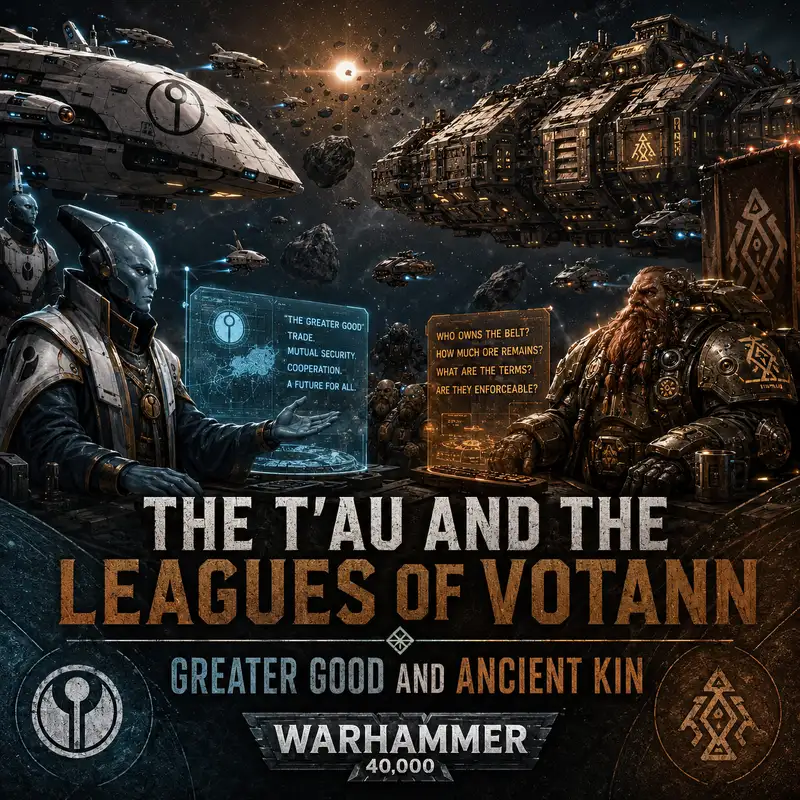
Picture two ships meeting at the edge of a mined star system. One is clean-lined and purposeful, its hull marked by the symbols of the T’au Empire. A Water caste envoy transmits an offer of trade, mutual security, and eventual cooperation beneath the philosophy of the Greater Good. The other vessel is broader, older, and built like an industrial fortress that has learned to travel. Its Kin captain wants to know who owns the asteroid belt, how much ore remains, and whether the terms are enforceable. Both sides speak the language of reason. Both value technology, planning, and collective effort. Both can negotiate before opening fire, which already makes them unusual by galactic standards. Yet they are not natural reflections of one another.
The T’au look toward a future they intend to build. The Leagues of Votann carry a past so heavy that it is beginning to crush the minds preserving it That contrast is why these civilizations belong together. Each can appear almost sensible beside the Imperium’s cathedral warships, the Orks’ cheerful devastation, or the hungering fleets of the Tyranids. The T’au offer unity and progress. The Kin offer competence, loyalty, and practical survival. Neither sacrifices technology upon the altar of ignorance. Look closer, however, and their virtues reveal sharp edges. The Greater Good can become obedience without consent. Kin solidarity can become ruthless indifference toward anyone outside the kindred. They are alternatives to the Imperium, but they are not escapes from the darkness of the setting.
The T’au are among the youngest powers to matter on the galactic stage. When Imperial explorers first encountered their home world, the species appeared primitive and divided. Human authorities marked the planet for colonisation, then lost access when violent warp storms swallowed the region. By the time outsiders returned, the T’au had advanced at extraordinary speed. They had cities, starships, sophisticated weapons, and an expanding interstellar state. The Imperium had mislaid a minor colonisation project and rediscovered a rival. This is not especially unusual for the Imperium, but the speed of T’au development was remarkable.
Their own history begins with division. Early T’au tribes competed across their home world until conflict threatened to consume them. Then came the Ethereals. Their arrival is surrounded by legend, uncertainty, and carefully maintained reverence. They persuaded, compelled, or somehow inspired the warring peoples to accept a common order. The old struggle, known as the Mont’au, gave way to the T’au’va, the Greater Good. From that point, every person and every caste would contribute to the prosperity of the whole.
The resulting society is organised into five castes. The Earth caste builds, farms, researches, and manufactures. The Air caste pilots spacecraft. The Water caste serves as diplomat, administrator, and merchant. The Fire caste fights. Above and between them stand the Ethereals, who provide direction and claim to embody the needs of all. Caste identity shapes occupation, education, marriage, and social purpose. A T’au is not encouraged to discover an entirely personal path. The path has already been assigned for the benefit of society.
This order is not merely a cynical disguise. Many T’au sincerely believe in it. Their cities function. Their technology improves. Their armies try to avoid wasteful slaughter when manoeuvre and firepower will achieve the same result. Citizens are taught that individual sacrifice has meaning because it serves a larger future. Compared with an Imperial worker born into toxic darkness, labouring until death beneath machinery no one understands, life in a prosperous T’au sept can look almost merciful.
Mercy, however, is not the same as freedom. The Ethereals possess immense authority, and the source of their influence remains deliberately uncertain. Some accounts suggest social conditioning and cultural reverence. Others imply a more direct form of control. Their society may be held together by genuine conviction, subtle coercion, or both. In practice, open rejection of Ethereal rule is treated not as reasonable political disagreement, but as a dangerous failure to understand one’s proper place.
The Greater Good reaches beyond the T’au species. Their Empire absorbs alien peoples through diplomacy, economic dependence, military alliance, pressure, and conquest. The Kroot serve as scouts, hunters, and close-combat auxiliaries. The insectile Vespid bring abilities the T’au cannot easily reproduce. Human populations that accept T’au rule become Gue’vesa and may fight against the Imperium that once claimed them. This willingness to integrate other species is one of the Empire’s greatest strengths. It is also one of its most effective forms of expansion.
A Water caste diplomat may arrive with medicine, infrastructure, and promises of representation. Those promises can be real. So can the warships waiting beyond the moon. Worlds that join peacefully are praised for recognising the future. Worlds that refuse may discover that the Fire caste has prepared a second presentation, delivered at railgun velocity. The T’au do not usually seek destruction for its own sake. They seek compliance with a destiny they consider rational.
Their military reflects the same philosophy. T’au commanders prefer coordinated movement, careful target selection, and overwhelming ranged fire. Infantry teams guide one another’s attacks. Drones scout, shield, and support. Grav vehicles reposition troops before an enemy can trap them. Battlesuits allow skilled warriors to carry the firepower of armoured vehicles while retaining speed and flexibility. Rail weapons can punch through targets that appear far too large to fear the relatively small blue soldier standing on the horizon.
Two strategic ideas are closely associated with T’au warfare. Mont’ka, the Killing Blow, seeks the decisive moment when concentrated force can destroy the enemy’s critical strength. Kauyon, the Patient Hunter, draws an opponent into a prepared position and closes the trap. Together they express a culture that wants war to be controlled and efficient. The difficulty is that the galaxy contains enemies who do not cooperate with efficiency. Orks may enjoy the trap. Tyranids may absorb losses that would bankrupt a sane commander. Chaos may ignore the laws of reality.
The T’au learned the scale of that problem during their clashes with the Imperium. Early victories encouraged the belief that human forces were another obstacle to be measured and overcome. Then the Damocles Crusade crossed into their territory. The T’au discovered that the Imperium was not a single nearby state but a vast, ancient power capable of committing armies and fleets on a scale their young Empire had barely imagined. The Imperial force discovered that the supposedly minor aliens possessed disciplined troops, advanced weapons, and no intention of disappearing politely.
The crusade produced no simple verdict. Imperial pressure drove deep and inflicted terrible damage, but wider crises forced the attackers to withdraw before the T’au Empire could be destroyed. Both sides took comfort from the outcome. The Imperium could claim that greater force would have finished the task. The T’au could claim that they had survived humanity’s assault and would adapt. Both conclusions were probably correct, which is rarely reassuring.
Commander Farsight embodies the danger within that adaptation. He was one of the Fire caste’s greatest commanders, a master of aggressive Mont’ka warfare and a hero of the Empire. His campaigns carried him beyond the comfortable explanations provided by the Ethereals. On the world of Arthas Moloch, his forces encountered daemonic enemies the T’au scarcely understood. The Ethereals accompanying the expedition died. Farsight survived, gained a strange ancient blade, and came to distrust the authority that had shaped his life.
He eventually established the Farsight Enclaves, a breakaway realm beyond direct Ethereal rule. To the central Empire, he is a warning about pride and disobedience. To his supporters, he is evidence that the Greater Good can survive without the Ethereals who claim to define it. Neither interpretation makes him a simple liberator. The Enclaves remain militarised, embattled, and dependent upon Farsight’s leadership. Escaping one hierarchy does not automatically produce a peaceful republic. The galaxy is unhelpful in that way.
The warp presents an even deeper challenge. The T’au have a relatively faint presence within it and little natural understanding of its predators. Their human and alien subjects are not so fortunate. As expansion fleets pushed through dangerous routes, some T’au encountered phenomena apparently connected to the growing psychic belief in the Greater Good itself. Some saw protection. Others blamed the Empire’s more psychically active auxiliaries for horrors they could not explain. A creed designed to unite species began producing fear between them.
This is the central tension of the T’au. They are hopeful by the standards of Warhammer forty thousand, but their hope is imperial. They genuinely build as well as conquer. They can improve the lives of people the Imperium has abandoned. They can also erase cultures, manipulate populations, and demand loyalty to a system whose ruling caste is beyond meaningful challenge. The Greater Good asks everyone to contribute. It is less comfortable discussing who gets to define what good means.
The Leagues of Votann approach the galaxy from the opposite direction. They are not a young people racing into history. They appear to descend from an ancient human offshoot that entered the galactic core during humanity’s forgotten age of expansion. There, among crushing gravity, violent stellar phenomena, and mineral wealth beyond ordinary measure, they adapted. Over immense spans of time, they became the Kin: shorter, denser, resilient, and culturally distinct from the humanity beyond the core.
The Imperium often calls such populations abhumans, a category that can mean accepted cousin, useful labour force, tolerated irregularity, or future target, depending upon the official involved. The Kin do not define themselves by Imperial approval. They know their civilisation is ancient, their technology is often better maintained, and their ancestors crossed deadly space while much of modern humanity’s knowledge was still collapsing into myth.
At the centre of Kin civilisation stand the Votann themselves. These Ancestor Cores are immense machine intelligences that preserve knowledge, guide kindreds, and contain technological systems inherited from humanity’s lost golden age. To the Kin, they are counsellors, archives, creators, and the accumulated presence of generations. The wisest Kin approach them through interfaces called Fanes, asking questions whose answers may shape the fate of entire Leagues.
The word ancestor is literal as well as ceremonial. The experiences of the dead can be returned to the Votann, adding memory and identity to an already colossal store of information. Across millennia, this reverence has created a problem. The Ancestor Cores were never meant to process an eternity of accumulated lives. They have slowed. Some take decades or longer to answer. Each has developed peculiarities and faults that the Kin are reluctant to acknowledge. Their gods are not dying in flame. They are becoming old, overloaded, and uncertain.
That slow failure reaches into the creation of new Kin. Most are produced through stable genetic templates known as cloneskeins. They are not identical copies. The templates provide adaptations suited to difficult environments, specialised labour, heightened senses, physical endurance, or limited psychic ability. Kin society was built to manufacture people prepared for the work ahead. It is an efficient answer to survival in the galactic core, and an unsettling reminder that individual life can be planned as carefully as an excavation.
Alongside flesh-and-blood Kin live the Ironkin, self-aware artificial beings housed in mechanical bodies. They work, fight, and participate in society as equals. The Kin do not treat them as tools pretending to be people. To the Adeptus Mechanicus, which regards independent machine intelligence as a forbidden horror, this would be intolerable. The Kin solve that diplomatic difficulty by not explaining everything. It is an effective policy when dealing with organisations that regard questions as a prelude to confiscation.
Kin society is organised through Holds, kindreds, and Leagues. A kindred is a community bound by shared origin, obligation, and access to an Ancestor Core. Leagues unite many kindreds through trade, mutual defence, sworn oaths, and practical interest. They are part nation, part commercial federation, and part extended family enterprise. Authority matters, but so do contracts. Promises are remembered. Debts are recorded. Insults do not vanish merely because several centuries have passed.
This is the origin of the Kin reputation for grudges. A grudge is not simply bad temper preserved for dramatic effect. It is a judgement that harm has been done to the community and remains unsettled. The offender may owe payment, restitution, service, or blood. Abandoning such a debt would betray both the living and the ancestors who endured it. From everyone else’s perspective, discovering that a mining dispute has become hereditary can be inconvenient.
Resources shape nearly every League decision. The Kin are explorers, miners, salvagers, merchants, and industrialists. They survey systems with extraordinary thoroughness, measuring value against the cost of extraction. They can bargain fairly and maintain agreements with impressive reliability. They can also decide that a planet’s population is an obstacle between the League and necessary material. The Kin do not destroy worlds because destruction is entertaining. They do it because the numbers have been checked.
That practicality shapes their wars. Kin commanders form oathbands for defined purposes. Hearthkyn warriors are trained citizens rather than a separate caste bred only for battle. Armoured Hearthguard protect leaders and break hard targets. Hernkyn range ahead as prospectors and scouts. Engineers keep weapons and vehicles operating to standards that would make an Imperial tech-priest either weep with joy or begin an immediate purge.
Kin weapons resemble some human designs because both descend from ancient technological traditions, but League versions are often refined and reliable. Their vehicles are built for hostile terrain, resource work, and combat because the Kin see little reason to maintain three machines when one excellent machine can perform all three tasks. When fighting becomes necessary, industrial tools become weapons with very little philosophical adjustment.
They are not reckless with Kin lives. A battle that cannot justify its cost may be abandoned. The wounded are recovered, whether flesh or iron. Within the kindred, this can be genuinely humane. The boundary of that concern is important. Outsiders may be trading partners, honoured allies, useful clients, competitors, claim thieves, or expendable impediments. The distance between those categories can be measured in contracts and artillery range.
This brings the Leagues back to the T’au. Some Kin prospecting groups have been known to outsiders as Demiurg. Demiurg brotherhoods have traded with the T’au and aligned their powerful vessels with Air caste fleets. Such cooperation makes sense. The T’au respect useful technology and negotiate with aliens. The Kin value profitable agreements and do not object to letting an enthusiastic young empire fight shared enemies. Each side can see the other as unusually reasonable.
The misunderstanding begins beneath that surface. The T’au assume cooperation can become integration, and that integration should eventually serve the Greater Good. The Kin may accept alliance, exchange, or mutual defence while having no interest in becoming part of someone else’s destiny. Their loyalty already belongs to kindred, League, and Ancestor Core. A Water caste envoy sees a relationship progressing. A Kin negotiator sees a contract being performed exactly as written.
Their technologies reveal opposing attitudes toward the future. The T’au innovate rapidly because progress is a cultural duty. The Kin inherit devices rooted in ancient human knowledge, then maintain and refine them with patience. The T’au believe tomorrow can be designed. The Kin believe survival depends upon preserving what yesterday entrusted to them. One civilisation risks moving too quickly to understand the forces it encounters. The other risks being trapped beneath everything it refuses to forget.
Both are communal, but community means something different. T’au society asks the individual to serve an abstract good that claims to include all willing peoples. Kin society asks the individual to serve a specific network of ancestors, relatives, obligations, and sworn partners. The Greater Good is universal in ambition. Kin loyalty is particular and fiercely bounded. The T’au can welcome strangers, then reshape them. The Kin can respect strangers, then leave them outside the shelter when the calculation turns grim.
Neither faction is simply heroic. The T’au show that empire can advance through development and persuasion as well as terror. That does not make it harmless. The Leagues show that a society can honour artificial life, preserve technology, and protect its own people without becoming generous to everyone else. Competence is not morality. Solidarity is not compassion when its circle has been drawn too tightly.
Their existence exposes failures Imperial propaganda would rather conceal. The T’au prove that technology can improve instead of decline. The Kin prove that ancient human knowledge can be used without wrapping every maintenance procedure in incense and mortal fear. Both show that cooperation across species is possible. The Imperium responds mainly by reaching for larger weapons, which is consistent, if not intellectually adventurous.
Yet both carry approaching disasters. The T’au Empire is expanding into a galaxy whose spiritual dangers its founders never understood, while contradictions grow between Ethereal authority, alien auxiliaries, and commanders willing to think beyond doctrine. The Leagues depend upon Ancestor Cores that are slowing under the burden of memory, even as war around the core threatens Holds, trade routes, and the resources required for survival. Their strengths have become the mechanisms of their crises.
The Greater Good and the ancient Kin offer two answers to the same question: how can a civilisation survive without becoming the Imperium? The T’au answer with unity, adaptation, and a promised future, then risk turning that promise into compulsory obedience. The Leagues answer with memory, workmanship, and loyalty, then risk valuing ancestral obligation above every life beyond their own circle. Both answers are more humane in some ways and merciless in others.
At the edge of that mined star system, the two ships may trade, cooperate, and depart without firing a shot. In Warhammer forty thousand, that alone counts as a minor triumph of civilisation. The T’au vessel leaves believing another people has taken a step toward the future. The Kin vessel leaves with a profitable agreement, a revised survey, and no intention of being absorbed by anyone. Between them lies the difference between a cause that claims everyone and a family that remembers everything.