The Swarmlord: The Face of the Hive Mind
Cold Steel Ridge did not fail because the Ultramarines lacked courage. It failed because the enemy changed its mind. One moment, Hive Fleet Behemoth was a pressure wave of claws, wings, and living artillery. The next, the swarm began making choices. Tunnelling beasts struck one flank, not to break it, but to pull defenders away. Flying organisms hunted officers. Artillery forced infantry to spread out, leaving gaps for creatures waiting beneath the ice. A Baneblade that had anchored the line was isolated and torn apart. The Tyranids had stopped behaving like a storm. They had begun behaving like an army.
Marneus Calgar saw the change as it happened. He was one of the finest commanders in the Imperium, defending the home world of the Ultramarines with troops trained to turn doctrine into instinct. Yet every response opened another weakness. Reinforce the flank, and the centre thinned. Disperse against bombardment, and burrowing organisms erupted among the separated units. Protect the senior officers, and lesser formations lost direction. The enemy was not merely adapting its bodies. It was reading the battle.
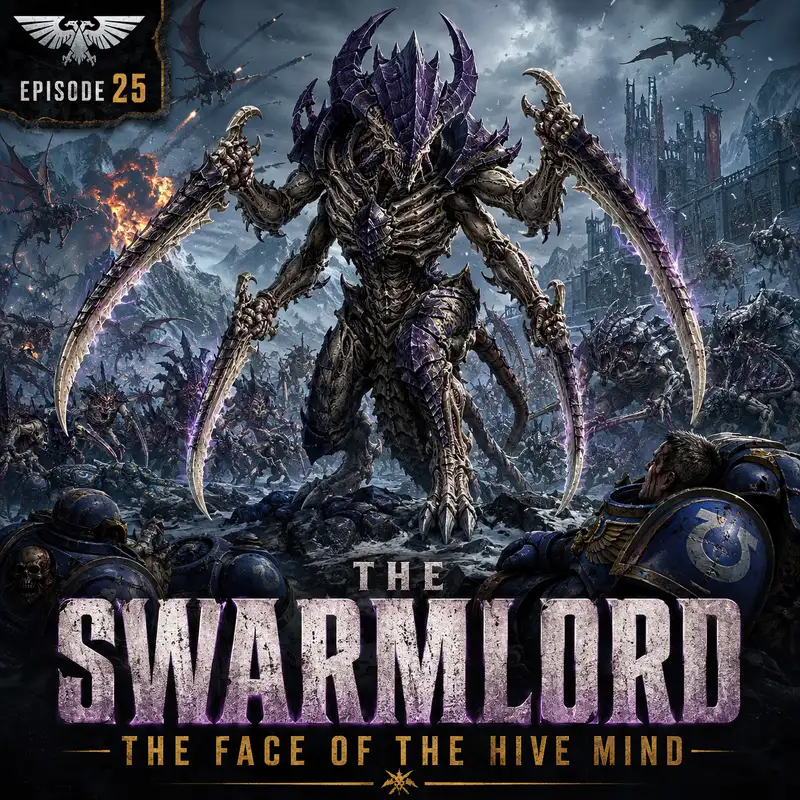
Then the creature responsible came into view. Taller and heavier than a common Hive Tyrant, surrounded by Tyrant Guard and armed with four living blades, it advanced toward Calgar as though the entire campaign had narrowed to a single target. The Imperium would call it the Swarmlord. The name suggests a king among monsters. That is close enough for a battlefield report, and dangerously misleading everywhere else.
The Swarmlord is not a monarch. It has no throne, no dynasty, and no subjects in any human sense. It does not issue speeches, claim territory, or seek glory. It is something stranger. It is a recurring thought given flesh, a commander grown when the Hive Mind encounters a problem that appetite and adaptation alone have not solved. That makes it the nearest thing the Tyranids possess to a legendary hero, except that heroism, fame, and even individual survival are concepts the Tyranids have little use for.
To understand why it matters, the Hive Mind has to be understood as more than a signal passed between alien animals. Tyranid organisms are linked through a vast psychic network. Lesser creatures can revert to instinct when that network is disrupted, while synapse organisms impose unity and purpose upon them. Across a battlefield, a Hive Tyrant is not simply an officer shouting orders. It is a living command node through which the greater intelligence of the swarm becomes immediate.
The Hive Mind itself is difficult to describe without borrowing inadequate human language. It appears singular, yet it is expressed through uncounted organisms. It can act with calculation, memory, and focused intent, but it is not merely one enormous brain hidden aboard a ship. It is the intelligence of the Tyranid species operating across fleets and worlds, an awareness so distributed that destroying one body usually removes little more than a finger from the hand.
The Swarmlord is the exception that reveals how sophisticated that system can become. When conventional methods fail, the Hive Mind can recreate this particular bioform with its accumulated experience intact. The body can be killed. The pattern returns. Its memories, strategic knowledge, and learned responses are preserved within the greater Tyranid consciousness and expressed again when needed. The Swarmlord that falls on one world is not replaced by a novice wearing the same armour. It comes back knowing why the last body died.
That is why calling it immortal is both accurate and incomplete. The Swarmlord does not survive death by protecting a soul in the way an Aeldari might, nor by returning from the Warp like a daemon. It is rebuilt because the Hive Mind remembers it. The distinction offers little comfort to anyone facing it. A slain enemy normally becomes less experienced. The Swarmlord treats death as an unusually violent after-action review.
Its body reflects its purpose. The creature is the apex of the Hive Tyrant strain, immensely strong, psychically potent, and protected by heavy living armour. Four bone sabres move with a speed that seems impossible for something so large. Their alien cores generate disruptive energies capable of biting through advanced armour and defensive fields. Yet the blades are almost a distraction. The Swarmlord's true weapon is the ability to make thousands of separate organisms behave as parts of one deliberate plan.
The sabres are living weapons rather than manufactured tools. They are extensions of the same biological system that carries them, grown for one purpose and discarded with the body when that purpose ends. In combat, the Swarmlord can use them with the precision of an ancient duellist while projecting psychic force and maintaining command of the swarm around it. Most generals become less effective once the fighting reaches their position. The Swarmlord becomes more dangerous, because command and personal violence were designed into the same organism.
Hive Fleet Behemoth brought that plan to Macragge during the First Tyrannic War. Humanity had only recently learned that the Tyranids existed. The planet Tyran had vanished beneath their assault, Imperial worlds had been consumed, and Inquisitor Kryptman's warnings reached the Ultramarines with barely enough time to prepare. Macragge was not an ordinary target. It was the centre of Ultramar, a fortified world defended by one of the Imperium's most disciplined Space Marine Chapters and a fleet prepared to fight for annihilation rather than withdrawal.
Calgar organised the defence in depth. Orbital forces would contest the hive ships. Ground formations would delay the invaders and fall back toward the polar fortresses if necessary. The plan was rational, layered, and built around the Ultramarines' greatest advantages: discipline, communication, and commanders who could react faster than an ordinary enemy. Against a mindless horde, it might have been enough. The difficulty was that the horde had a mind, and it identified Calgar as the centre of Imperial resistance.
At Cold Steel Ridge, the Swarmlord did not simply throw larger creatures into the strongest guns. It dismantled the logic of the defence. Raveners struck as a diversion. Gargoyles and other winged predators targeted leaders. Biovore bombardment shaped the defenders' movement. Subterranean organisms exploited the resulting gaps. Carnifexes destroyed the Pride of Hera, the Baneblade supporting the line. Each attack created the conditions for the next, and each Imperial correction arrived one step too late.
The final move was personal only in appearance. The Swarmlord advanced on Calgar because removing him would damage the entire defence. Hormagaunts that had seemed dead rose among the Ultramarines trying to reach their Chapter Master. The Honour Guard fought to hold the monster back. Calgar was gravely wounded, and his warriors paid for the seconds needed to evacuate him. Aloysius, commander of the Honour Guard, died beneath the Swarmlord's blades as Thunderhawks carried the survivors away.
The road to Macragge's northern polar fortress lay open. There, the Ultramarines First Company made its last stand. The veterans fought in the ice-bound chambers until the company was destroyed. The fortress held long enough for the wider battle to turn, but victory came in the particular Imperial fashion that leaves survivors arguing over whether the word still applies. Hive Fleet Behemoth was broken, yet the First Company had been erased and Macragge carried wounds that would take generations to close.
Imperial records listed the Swarmlord among the dead. Physically, that was probably true. Strategically, it missed the point. The creature had already demonstrated that the Tyranids could recognise leadership, construct deceptions, coordinate specialised organisms, and attack an enemy's decision-making system. Even in defeat, the Hive Mind had gained information. Macragge had taught it what an Ultramarine defence looked like under maximum pressure.
The Imperium learned as well. Veterans of the war developed specialised methods for fighting Tyranids. Chaplain Cassius helped form warriors whose entire purpose was to understand the Great Devourer rather than dismiss it as animal savagery. Calgar recovered. Years later, on Ichar Four, he faced the Swarmlord again and killed it. The rematch matters because it prevents the story from becoming a simple claim that the Swarmlord cannot be beaten. It can. So can every body the Hive Mind sends to war.
Calgar's victory also exposes the real contest. He remembered Cold Steel Ridge, altered his approach, and entered the second confrontation as a commander shaped by defeat. The Swarmlord arrived with its own accumulated experience. Two veterans met, each carrying lessons purchased by earlier bloodshed. One was a man whose survival had required sacrifice from his companions. The other was a biological pattern that regarded its former corpse as useful data.
The cycle appeared elsewhere. On Kolovan, Chaplain Cassius and a small force of Ultramarines managed to kill a manifestation of the Swarmlord after a savage engagement. Later, aboard a Tyranid vessel, the creature was grown again. The important detail is not whether each death involved a flawless plan or an unlikely opening. It is that the Hive Mind can risk its greatest commander in ways a human civilisation cannot risk its irreplaceable leaders. Failure costs biomass. Success may cost a world.
This is the quality that separates the Swarmlord from a merely powerful monster. A Carnifex can break a gate. A Trygon can place an assault where no surface approach exists. A Lictor can remove a commander before the main invasion begins. The Swarmlord can decide how those capabilities fit together. It chooses the sequence, pressure, and target. It turns adaptation into strategy.
Reports place manifestations of the Swarmlord in wars fought by different hive fleets and against radically different enemies. It has directed assaults against the Imperium, the T'au, Orks, and other civilisations remembered only because something survived long enough to record their destruction. Its appearance across separate fleets suggests that the Hive Mind does not treat it as property of Behemoth, Kraken, or Leviathan. The body belongs wherever the problem exists.
That freedom has sometimes been described as autonomy. The word should be handled carefully. The Swarmlord appears able to exercise more independent judgement than other Tyranid organisms, because a commander that must wait for detailed instruction would be a rather expensive ornament. Yet independence does not make it a rebel, a citizen, or a personality secretly yearning to escape. Its initiative is part of its function. The Hive Mind gives it room to think because those thoughts remain the Hive Mind's thoughts.
The best human comparison may be a field marshal who is also a sensory organ. Through the Swarmlord, the swarm perceives resistance in tactical terms. It notices which formation is holding, which commander is improvising, which weapon is changing the battle, and which sacrifice is buying time. It does not need officers to translate those observations into orders. The command passes through the synaptic network and becomes movement, aggression, restraint, or sudden stillness across the horde.
That last possibility is important. Tyranid intelligence is often hidden by the scale of Tyranid violence. When millions of organisms are available, a direct assault may be perfectly rational. The swarm does not have to preserve soldiers for retirement, explain losses to grieving families, or defend a procurement request before a committee. This can make its strategy look crude. The Swarmlord demonstrates that expenditure is not the same as stupidity. A wave of gaunts may be ammunition, reconnaissance, bait, and a bridge made from bodies at the same time.
Its campaigns also reveal how alien Tyranid objectives truly are. Human commanders seize ground to gain political leverage or protect populations. The Swarmlord fights to collapse resistance so that the consumption of a world can proceed. Cities, fortresses, and sacred sites matter only because defenders gather around them or biomass lies within them. There is no negotiation waiting behind victory. The military campaign is one phase of digestion.
Whether the Swarmlord possesses emotions is harder to settle. Tyranid accounts do not explain themselves, and human witnesses tend to interpret focused aggression as hatred. Some records, especially those surrounding Baal, suggest the Hive Mind can direct something resembling malice toward enemies that have frustrated it. Even then, the emotion may not be human. A predator can fix upon prey without resenting it, and an immune system can attack an infection without anger. The Swarmlord is where that alien intent becomes easiest to mistake for personality.
The Devastation of Baal gave the Swarmlord another enemy whose identity had become inseparable from his people. Commander Dante had led the Blood Angels for more than a thousand years. He was ancient even by Space Marine standards, burdened by duty and by the hereditary curses of Sanguinius's sons. When Hive Fleet Leviathan closed on Baal, Dante gathered the Blood Angels and many of their successor Chapters for a defence that both sides understood in absolute terms.
The Tyranid assault was not a blind rush against monastery walls. Infiltration organisms found hidden approaches. Burrowing beasts opened routes beneath the fortress. Gaunts filled defensive trenches with their own bodies so larger creatures could cross. Synapse organisms kept the pressure coherent while specialised bioforms attacked shields, leadership, and reserves. Nearly thirty thousand Space Marines had assembled in the Baal system, and the swarm reduced that extraordinary concentration of power toward collapse.
At the centre of the attack stood the Swarmlord, directing Leviathan's organisms and pressing toward the remaining defenders. Its presence did not mean the Hive Mind had become dependent on one creature. It meant the resistance had become difficult enough to justify bringing its most experienced battlefield mind into physical range. Once again, the face appeared where the prey had refused to die on schedule.
Dante met it after a battle that had already stripped away much of his strength. The duel was not a clean contest held apart from the war. It was the collision of two exhausted systems. Dante carried centuries of personal experience, the burden of command, and weapons made sacred by the history of his Chapter. The Swarmlord carried memories reaching far beyond one lifetime, psychic force, and four blades grown for killing things exactly like him.
The Swarmlord shattered Dante's defences and drove a broken bone blade through his body. Dante, mortally wounded and with his armour failing, found the opening he needed. He destroyed the creature at point-blank range, then collapsed so badly injured that death seemed certain. The Blood Angels remember the act as one of their commander's greatest victories. The Hive Mind could record it as a technical note concerning the danger of wounded golden targets.
Baal did not survive because one champion won one duel. The opening of the Great Rift disrupted the war, daemonic forces struck the Tyranids, and Roboute Guilliman's Indomitus Crusade arrived amid the catastrophe. The defenders endured through a convergence of courage, sacrifice, and events no military planner could responsibly place on a timetable. The Swarmlord died, but Hive Fleet Leviathan was not erased from the galaxy. Neither was the intelligence that had grown it.
Repeated death has sometimes made the Swarmlord seem less threatening than characters protected by a single continuous life. That is the wrong measure. A recurring enemy can lose because its return is part of the horror. The Swarmlord is allowed to die in ways Abaddon, Guilliman, or Dante cannot, precisely because the destruction of its body does not close its story. Each victory over it solves the immediate problem and confirms the larger one.
Nor should every enormous Hive Tyrant be casually identified as the Swarmlord. Imperial accounts are incomplete, battlefield witnesses are unreliable, and the Tyranids produce variations faster than human scholars produce confident labels. Some chronicles use titles loosely. The safest distinction is functional. The Swarmlord is not simply the largest leader-beast present. It is the recurring, remembered commander deployed when the Hive Mind requires exceptional tactical judgement.
That makes the creature a kind of message. Its appearance tells the enemy that ordinary consumption has encountered meaningful resistance. The Hive Mind has noticed. It has reached into its accumulated memory, selected a commander older than human empires, and built that commander a new body. There is a grim compliment in this. The defenders have performed well enough to receive personal attention from something that barely recognises persons.
The face of the Hive Mind is therefore not a face in the human sense. It offers no expression that can be trusted, no eyes behind which a negotiable motive waits. It is a surface through which a distributed intelligence looks back at the battlefield. The four swords, the psychic pressure, and the towering body make that attention visible for a few terrible hours.
When the Swarmlord falls, the face is broken. The Hive Mind does not appear to mourn it. Somewhere within the synaptic immensity, the defeat becomes memory, and memory becomes design. On another world, beneath another sky, the digestion of a civilisation may hesitate. The swarm will search its ancient experience for an answer. Then a Norn Queen will begin to grow four swords.