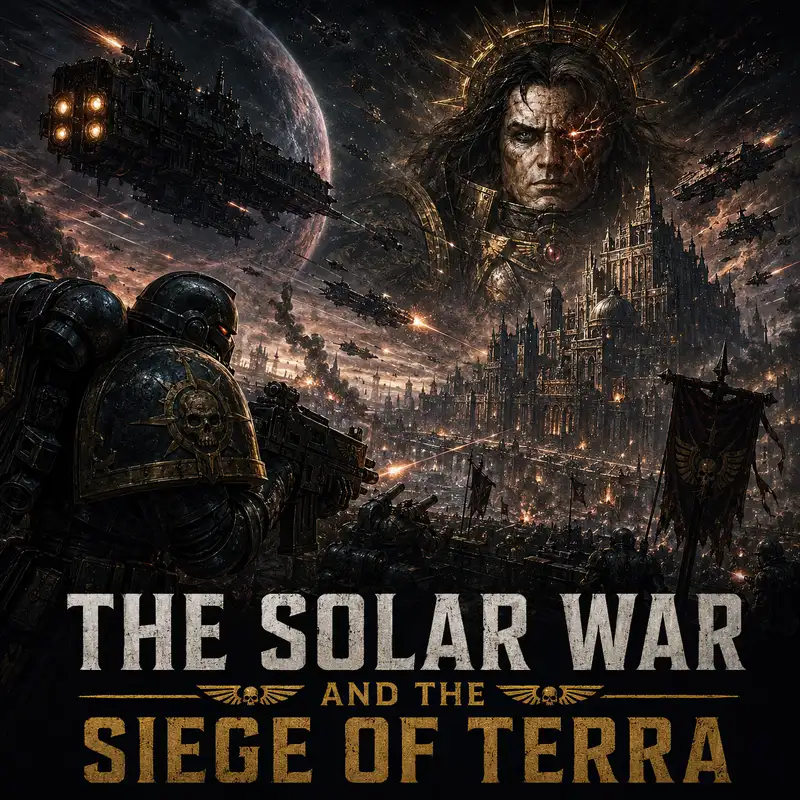
The Solar War and the Siege of Terra
The first warning was not a flash upon a distant sensor. It was the disappearance of the stars. One by one, the outer stations of the Sol System fell silent, and behind that silence came engine light, weapon fire, and the impossible pressure of the warp. After seven years of civil war, Horus Lupercal had reached the birthplace of humanity. The rebellion that had consumed a galaxy was narrowing toward one planet, one palace, and one final question. Could the Emperor’s defenders hold long enough for Horus’s alliance to collapse, or would the Warmaster reach his father before help arrived?
Terra was not undefended. Rogal Dorn had spent years turning the Sol System into a fortress measured in billions of kilometres. The Solar War was therefore not simply a battle near the Sun. It was a campaign fought across planets, moons, stations, minefields, fleet anchorages, and carefully prepared killing zones. Pluto guarded the outer approaches. The giant planets and their moons formed further layers. Luna protected Terra’s immediate orbit. The Imperial Palace had become less a residence than a continent-sized citadel. Dorn did not merely build walls. He built depth.
That distinction mattered because Dorn understood the strategic truth better than almost anyone. He did not need to destroy Horus’s entire host. He needed to delay it. Roboute Guilliman was forcing his way toward Terra with the Ultramarines, and other loyalist forces were still fighting across the galaxy. Every day bought by a minefield, a fortress moon, or a doomed fleet was another day in which the Warmaster’s coalition could fracture. Dorn’s defence was a clock built from armour plate. Horus’s task was to smash it before time ran out.
The loyalists waiting at Terra were formidable, but incomplete. The Imperial Fists formed the defence’s spine. Sanguinius and the Blood Angels had reached the Throneworld, while Jaghatai Khan and the White Scars brought speed to a plan dominated by fortification. Custodians, Sisters of Silence, Solar Auxilia, Titans, Mechanicum forces, and uncounted Imperial soldiers stood with them. Yet several loyal Legions remained far away, and Mars had already been torn apart by civil war. The heart of the Imperium was fortified, but infected.
Horus arrived with the opposite problem. His strength was enormous, but less coherent by the day. The Sons of Horus and Iron Warriors still possessed discipline. Around them gathered the Death Guard, World Eaters, Emperor’s Children, Thousand Sons, traitor Mechanicum, renegade Titans, corrupted armies, cultists, and things that had never been human. It was enough force to conquer a star system, and enough rivalry, divine compulsion, and old resentment to make commanding it unpleasant.
For the Solar War, Horus relied heavily on Perturabo. The primarch of the Iron Warriors understood fortifications as systems rather than monuments. He looked for overlapping fields of fire, reserve routes, supply lines, sensor coverage, and the point where one defensive layer depended upon another. Dorn had designed the greatest fortress in human history. Perturabo intended to demonstrate that every fortress was also a machine, and every machine could be broken if one applied sufficient force in the correct place.
The opening battles vindicated Dorn’s preparations. Traitor formations met hidden batteries, coordinated fleet attacks, and defenders who knew withdrawal was part of the plan. Sigismund, Fafnir Rann, and White Scars under Jubal Khan fought among the forward defences. They could not stop the invasion, but they could make every advance expensive, then fall back toward the next sphere before destruction became pointless.
Perturabo accepted the cost. He secured the outer worlds and pressed inward with the patience that had defined the Iron Warriors. Ships died in numbers that would have ended lesser wars. The loyalists were fighting according to Dorn’s design, but that was also its weakness. A defence built from predictable layers gives the enemy a sequence to study. Perturabo studied it very well.
Conventional strategy was only half of Horus’s answer. The traitors combined intelligence gathered through years of infiltration with rituals that treated distance as an inconvenience. Abaddon led a crucial assault toward the inner system while sorcerers and agents prepared a wound in reality between Luna and Mars. Horus would not fight through every remaining defensive sphere in proper order. Proper order had become one of the loyalists’ more charming disadvantages.
The human cost was embodied by Mersadie Oliton, a remembrancer who had known Horus before the rebellion. Manipulated into carrying a daemonic presence toward the Phalanx, she became an unwitting weapon against Dorn’s greatest warship. When Samus manifested, Mersadie understood what had been made of her and chose death rather than allow the possession to continue. Her sacrifice helped save the Phalanx. It could not save the Solar System.
The ritual near Luna and Mars tore open the path Horus required. The main traitor armada emerged inside defences intended to stop it much farther out. Warships that should have spent weeks forcing their way through Dorn’s remaining barriers appeared near Terra’s doorstep. The logic of the fortress had not been disproved. It had been bypassed. This is the central truth of the Solar War. Dorn’s system failed not because it was foolish, but because Horus brought a weapon that attacked causality, loyalty, and reality alongside armour and guns.
The loyalist fleet fought on, but the strategic contest in space was decided. The Phalanx survived and withdrew to continue the war from the system’s edges. Other ships scattered, hid, or died. Luna was overcome, and the Warmaster’s guns turned toward the Throneworld. The Solar War had wounded Horus’s forces without preventing the siege. Dorn had lost the outer fortress. He still possessed the walls that mattered most.
The bombardment of Terra began with a scale that made ordinary artillery language feel inadequate. Orbital fire struck shielded bastions, defensive lines, cities, and wastelands already crowded with soldiers and refugees. The Palace’s Aegis shield protected the central fortifications, but a shield is not an answer. It is a reservoir. Every impact consumes power. Every generator damaged elsewhere places greater strain on what remains. Horus did not need to break the Aegis with one magnificent shot. He could exhaust it.
The first ground assaults were therefore built around attrition. Vast numbers of traitor soldiers, cultists, mutants, and conscripts were sent against the outer lines. Many were poorly equipped. Some were barely controlled. Their purpose was not elegant victory. They forced the loyalists to fire weapons, expose positions, spend ammunition, lose sleep, and reveal where reserves were moving. Behind them came Space Marines, armour, plague weapons, daemonic rites, and the disciplined machinery of Perturabo’s siege. Human lives became a method of measuring Imperial gun barrels.
The defence rested upon three loyal primarchs with very different instincts. Dorn controlled the whole and accepted losses with a severity demanded by the arithmetic. Sanguinius moved among failing lines as both commander and symbol, burdened by visions of his own death. Jaghatai Khan challenged Dorn’s preference for conservation, arguing that a defender who never counterattacks eventually becomes a prisoner waiting for the door to fail.
The Emperor was present, but not in the way his armies needed. Bound to the Golden Throne, he held shut the catastrophe beneath the Palace created by the broken Imperial Webway project while opposing Horus in a psychic struggle. Malcador coordinated what remained of the Imperium’s machinery. To the soldiers outside, however, the Emperor was unseen. The Imperial Truth had promised a rational future led by a living ruler. Terra now survived beneath a silent throne while frightened people began calling that ruler a god.
As the outer redoubts fell, Mortarion’s Death Guard turned air and soil into weapons. Angron’s World Eaters attacked with fury that made sustained command nearly impossible but local resistance extremely brief. The Emperor’s Children pursued appetite as often as objectives, while the Thousand Sons worked to weaken the barrier against the warp. Perturabo was attempting to conduct a siege while several brothers became natural disasters with opinions.
The struggle for the Lion’s Gate spaceport showed why the siege could not be reduced to walls. Horus needed routes to land troops, armour, ammunition, and Titans in overwhelming quantities. The Iron Warriors ground toward the port through Imperial Fists who understood what its loss meant. When it fell, the traitors gained more than prestige. They gained logistics. Even in a war involving daemons and demigods, someone still had to deliver the shells.
Dorn answered with deception at Saturnine. A weakness in the Palace appeared to offer Perturabo a route beneath the walls. The traitors committed elite forces, including Sons of Horus led by Abaddon, into subterranean assault tunnels. Dorn had recognised the same weakness and prepared a trap. Loyalist kill teams struck where retreat and reinforcement were almost impossible. The Sons of Horus suffered devastating losses, and Abaddon survived only after being dragged from the battle.
Above ground, Fulgrim and the Emperor’s Children attacked in support of the Saturnine gambit. Dorn confronted his brother and drove him from the field, exposing the difference between the two primarchs. Dorn treated the battle as duty stripped of vanity. Fulgrim treated it as sensation, performance, and wounded pride. For a brief moment, the loyalists achieved something more valuable than survival. They demonstrated that the traitor host could still be deceived, divided, and bloodied.
Saturnine was a genuine victory, but it did not reverse the siege. Dorn had destroyed an assault force. Horus still possessed armies beyond counting. The Palace had fewer walls than before, fewer defenders, and less room in which to trade ground for time. This is one of the cruellest features of defensive warfare. A brilliant success may save a position without improving the larger situation. The official report can be entirely accurate and still sound suspiciously like an obituary.
The next great pressure came with the Titan assault remembered through Mortis. Traitor god-engines advanced while Titans of Legio Ignatum fought among ruins that shook under every step. The corrupted Imperator Dies Irae helped drive the breach. At the same time, the warp spread across Terra. Distances became uncertain and nightmares walked. The siege no longer took place entirely in physical space, which was unfortunate because most fortifications are designed with physical space in mind.
Perturabo eventually abandoned the siege. Horus had used him to reduce the defences, but the Warmaster increasingly favoured the logic of Chaos over the logic of engineering. For Perturabo, who had endured years of resentment and had expected this campaign to prove his superiority over Dorn, the insult was intolerable. His departure removed the traitors’ most disciplined siege commander at the moment they were closest to victory. Horus had gained the power of the gods, but that power was consuming the coalition he needed to use it.
Jaghatai Khan then launched the counterstroke Dorn had resisted. The White Scars rode for the Lion’s Gate spaceport, seeking to retake the landing field and disrupt the flow of traitor reinforcements. It was an operation shaped by the Khan’s character. Fast, dangerous, and strategically sensible only if one accepted that remaining behind the walls was also fatal. The White Scars broke into the port and fought the Death Guard at close quarters while Jaghatai faced Mortarion.
Mortarion had become a creature of supernatural endurance, sustained by Nurgle. Jaghatai won by understanding his brother’s pride and accepting injuries that should have killed him. Mortarion was banished and the loyalists reclaimed the port, but the Khan was carried away near death. The victory disrupted traitor supplies and bought time. It did not reopen the road out of Terra.
The final retreat toward the inner Palace placed an impossible burden upon Sanguinius and the Blood Angels. At the Eternity Gate, Sanguinius faced enemies drawn from both his past and his future. He defeated the greater daemon Ka’Bandha and then fought Angron, now transformed into a daemon primarch of Khorne. Sanguinius banished him and held the gate long enough for the surviving defenders to withdraw. Then the gate closed, leaving countless soldiers outside. A fortress survives by deciding which people are still inside its definition of survival.
Terra had ceased to resemble a world being defended and had become a world sacrificed in layers. Millions of individual acts vanished inside casualty figures too large to comprehend. Soldiers held stairwells, gun pits, hospitals, tunnels, and nameless breaches. Some fought for the Emperor, some for the person beside them, and some because nowhere remained to run. Primarchs shaped the campaign, but ordinary people kept it alive after reason stopped offering a reward.
As the inner defences failed, Horus drew Terra deeper into the warp. Time fractured. Locations bled into one another. The Vengeful Spirit became more than a flagship, while the Imperial Palace became more than a fortress. Both were stages in a psychic confrontation that Horus had been preparing since his arrival. The Warmaster did not simply want to kill the Emperor. He wanted his father to witness the destruction of his dream and acknowledge the son who had destroyed it.
Loyalist relief forces were approaching. Horus could not allow the siege to become an endless contest of attrition, especially after Perturabo’s departure and the growing disorder among the traitor Legions. He lowered the shields of the Vengeful Spirit. It was an invitation, a challenge, and a trap. The Emperor accepted because the alternative was the final collapse of the Palace. Malcador took his place upon the Golden Throne, knowing that the burden would consume him.
The Emperor teleported to the Vengeful Spirit with Sanguinius, Dorn, Constantin Valdor, Custodians, and selected warriors. The warp scattered them through a vessel that no longer obeyed ordinary dimensions. Corridors led into memory and nightmare. The assault meant to strike as one became isolated fragments. Horus had made his flagship a battlefield where organisation dissolved and personal destiny took command.
Sanguinius reached Horus first. He had long foreseen that confrontation and understood that he was unlikely to survive it. He fought anyway, not because he believed fate had become kind, but because every wound, every delay, and every moment of resistance might matter. Horus killed him. The death of Sanguinius was not simply the loss of a primarch. It became a psychic trauma carried by his sons across ten thousand years, returning in the Black Rage as memory transformed into inherited madness.
To face the Warmaster’s power, the Emperor drew so deeply upon the warp that he risked becoming a new god of ruin, associated with the name of the Dark King. Such a transformation might have crushed Horus, but it would also have damned humanity. The Emperor relinquished that power. He entered the final confrontation wounded, limited, and still recognisably himself, perhaps the last victory available before the battle began.
The duel between Emperor and Warmaster was fought with weapons, psychic force, memory, temptation, and the remnants of their bond. Horus was empowered by the four Chaos Gods and, for much of the struggle, he was stronger. The Emperor could not defeat that power by meeting it directly. He endured, deceived, and exploited the part of Horus that still needed to prove the victory belonged to him rather than to the gods using him. When Horus no longer held the full protection of that borrowed divinity, the Emperor struck and destroyed him.
Horus’s death broke the traitor cause at its centre. His followers remained dangerous, but no longer possessed a single will or reason to stay while Guilliman closed upon the system. The retreat began. Dorn found the Emperor mortally wounded and carried him back to Terra. Malcador had been consumed by the Golden Throne, and the Emperor was placed upon it to preserve the last thread of his life and maintain the barriers protecting humanity.
The loyalists had held Terra, but almost nothing they had intended to preserve survived unchanged. Sanguinius was dead. Malcador was dead. The Emperor could no longer rule as he had. The Palace was a ruin, the Legions were shattered, and the rational Imperial project had burned away beneath visions, miracles, and sacrifice. The people who survived did not see a distant architect recovering from injury. They saw a martyr upon a golden throne. The religion the Emperor had rejected now possessed the perfect image around which to grow.
Dorn’s defences failed in every conventional sense. The enemy crossed the system, took the ports, broke the walls, and reached the inner Palace. Yet the defence achieved its real purpose. It consumed Horus’s time, ships, soldiers, commanders, and unity. The Warmaster won the Solar War and nearly every stage of the siege, but reached the final moment with his coalition disintegrating and relief forces approaching. He had to gamble everything upon a personal confrontation.
The fortress did not hold. It collapsed piece by piece. Terra survived because each piece took time to destroy, because loyalists kept fighting after victory became impossible, and because Horus could conquer a system more easily than master his need to face the Emperor. Dorn built a defence to delay a military enemy. That delay exposed the weakness inside a would-be god.
The guns fell silent over a Throneworld that could scarcely recognise itself. Horus was dead, the Emperor endured, and the Imperium proclaimed victory. Yet the future born there was the Imperium of the forty-first millennium: wounded, fearful, devout, and permanently at war. The Siege of Terra saved humanity’s empire by destroying the dream that had once made it worth saving. Its final monument was not an unbroken wall, but a dying father sealed upon a throne while the age of reason became an age of faith.