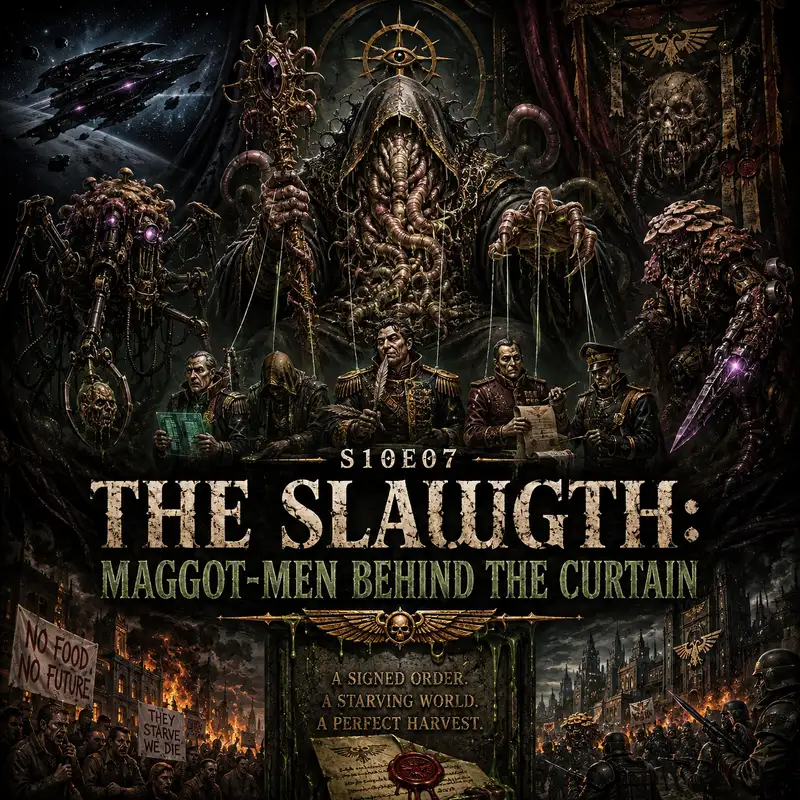
The Slaugth: Maggot-Men Behind the Curtain
A world does not always fall when the first shot is fired. Sometimes it falls when a relief shipment is delayed, when a governor accepts an unusually generous loan, or when a minor official moves one name from one ledger to another. Months later, food riots become rebellion. Rebellion becomes civil war. Ships arrive only after the cities have begun to burn. By then, the creatures waiting beyond the curtain have already won. They did not conquer the world. They persuaded its people to prepare the table.
The Slaugth are among the most disturbing xenos in the Imperium’s scattered records, not because they command famous armies or rule a clearly marked empire, but because they prefer to remain almost entirely invisible. Frontier tales call them maggot men, dream eaters, carrion lords, and worms that walk. Most Imperial citizens will never hear those names. Many senior officials would dismiss them as voidborn superstition. The Inquisition knows better, although even its sealed archives do not provide a complete answer to the simplest question. What do the Slaugth actually want?
Much of their known activity clusters around the Hazeroth Abyss, a region of cursed space and dead stars near the edge of the Calixis Sector. Whether their true home lies there is unknown. Some xeno-savants place a wider Slaugth domain beyond the Trailing Halo Stars, while uncertain accounts suggest encounters with humanity as far back as the Age of Strife. The geography remains vague because the Slaugth do not leave helpful border markers. Their territory is best recognised by absences: silent stations, missing crews, and records that end halfway through a sentence.
Their appearance offers one answer, but only the most immediate one. A Slaugth stands roughly three metres tall and holds a vaguely humanoid outline. That outline is not a body in the familiar sense. It is a congregation of writhing, maggot-like organisms, half-melded together beneath a coat of viscous necrotic slime. The mass can stretch, compress, and reform with boneless ease. Wounds close with startling speed. Age, disease, and poison appear to mean little to them. Killing one requires the sort of violence the Imperium normally reserves for buildings.
The revulsion is understandable. It is also misleading. The Slaugth are not dangerous merely because they are difficult to kill or unpleasant to look at. The Imperium contains no shortage of creatures that meet both qualifications. Their true weapon is the intelligence directing the worms. Slaugth minds are described as cold, patient, and profoundly alien. Imperial accounts portray them as psychic voids, presences that do not fit comfortably within humanity’s normal understanding of thought or soul. They are not ravening beasts wearing a shape. They are calculating predators whose shape happens to be a ravening colony.
When concealment is necessary, the Slaugth use layered shrouds that absorb and refract light, hiding the movement beneath. At a distance, the result may pass for a tall, misshapen human wrapped in heavy robes. More sophisticated armour can cloud perception and make the wearer difficult to notice at all. This is not a perfect theatrical disguise. It does not need to be. A Slaugth rarely walks through a crowded market shaking hands. It waits in the private chamber to which only the most compromised servant is admitted.
Their hunger gives that intelligence a purpose. Slaugth consume the dead flesh of sentient beings, especially cranial matter. Rotting brain tissue provides a narcotic pleasure, but fresher material offers something more useful. By feeding on a victim’s brain, a Slaugth can absorb memories and knowledge. Those stolen impressions eventually fade unless reinforced, used, or recorded, yet even temporary access can be devastating. A murdered navigator becomes a route through guarded space. A dead clerk becomes a map of bureaucratic weakness. A noble’s private secretary becomes the key to an entire household.
This transforms feeding into espionage. Human intelligence services interrogate prisoners, steal documents, monitor communications, and cultivate informants. The Slaugth can do all of those things through agents, then consume the agent, the target, or both. Every corpse may become a report. Every massacre may become an archive. Their appetite and their strategy are not separate features. The hunger that makes them monstrous also makes them informed.
Even their bodies produce weapons. Slaugth tissues exude necrotic fluids containing corrosive compounds and flesh-eating organisms. These secretions can destroy living tissue and damage metal. Their technology follows the same refusal to separate biology from machinery. Slaugth devices are often grown rather than assembled, combining flesh, metal, crystal, and unfamiliar physical principles into functional organisms. To an Imperial observer, the result may look like sorcery. That conclusion is convenient, understandable, and frequently wrong.
The Slaugth possess weapons capable of reducing living targets to ruin with necrotic energy. They employ sceptres and lances that function as both symbols of rank and instruments of destruction. Their ships are black, powerful, and able to cross interstellar distances without relying upon the Warp in the familiar Imperial manner. That alone makes them strategically difficult to predict. Imperial defence is built around known routes, astropathic warning, and the dangers of translation through the Immaterium. An enemy that follows different roads can arrive where the map says no road exists.
When those vessels strike directly, they favour isolated outposts and vulnerable shipping. Some victims are found mutilated. Others disappear. Renegade humans have received Slaugth technology in exchange for slaves, turning forbidden trade into another form of predation. The artefact is never merely an artefact. It is leverage, bait, and often evidence that someone has already agreed to terms they do not understand.
Their servants are no less unnatural. Slaugth vassal constructs are pseudo-living machines shaped for labour, surveillance, security, and war. Many appear as asymmetrical masses of fungal flesh threaded with veins, metal filaments, and crystalline growths. Warrior constructs move on skeletal limbs and carry weapons that can disintegrate a human target in moments. Harvest constructs have a more specialised purpose. They seek sentient prey, seize it with mechanical tendrils, and preserve the cranial matter for their masters. The battlefield is not merely cleared. It is processed.
This ability to grow servants helps explain why the Slaugth can act across great distances without exposing large numbers of their own kind. A Slaugth does not need to recruit a loyal army in the human sense. It can cultivate one. Constructs do not need ideology, wages, or promises of land after victory. They require direction and maintenance. This is efficient, if one is willing to overlook the wet noises.
Yet the Slaugth do not rely on constructs alone. Their greatest creations may be human organisations. They understand that a machine grown from flesh can guard a chamber, but a merchant house can move cargo across a sector. A warrior construct can kill a regiment, but an official seal can redirect that regiment before the battle begins. The Slaugth therefore use human greed, fear, ambition, and desperation as components in a much larger device.
The clearest example is the Amaranthine Syndicate in the Calixis Sector. To most who encounter it, the Syndicate appears to be a powerful and secretive trade cartel with connections to smugglers, nobles, criminals, and the Cold Trade in forbidden xenos artefacts. It offers assistance to people in difficulty. A failing merchant receives credit. A threatened aristocrat gains protection. A rival disappears. The bargain seems generous because the true price has not yet been presented.
Dependency follows. Other sources of help become unavailable. Enemies become more aggressive. Misfortunes accumulate with suspicious discipline. The beneficiary returns to the Syndicate because the Syndicate is now the only organisation capable of solving the problems that the Syndicate has quietly encouraged. Requests begin small. A shipment changes destination. A record is altered. A particular official is promoted. None of these acts appears sufficient to condemn a world.
The requests escalate. Medicine may be diverted from a district already near revolt. Food prices may be manipulated. Security forces may be reassigned at the precise moment a riot begins. A colonist transport may be exposed to raiders. By the time the human servant understands the pattern, guilt and dependence have closed every exit. The Syndicate does not need every participant to worship the Slaugth, know the Slaugth exist, or even believe in aliens. It needs them to obey.
At the highest level stand the figures called the Principals. Their true nature is hidden from most of the Syndicate’s human membership. The Principals are Slaugth, or at least a Slaugth leadership group whose exact place within the species remains uncertain. Orders descend through layers of intermediaries, deniable agents, commercial partners, and frightened clients. The creature behind the curtain may never enter the governor’s palace. It does not need to. Its signature is already on the supply contract.
This method answers part of the central question. The Slaugth want food, knowledge, influence, and conditions in which all three can be gathered safely. Open conquest would unite their prey against them. Manipulation divides the prey before the predator arrives. Humanity vastly outnumbers the Slaugth. A single Slaugth may be more than a match for ordinary humans, but even an ancient and resilient species can understand arithmetic. The Imperium’s most dependable military resource is quantity, usually delivered with paperwork.
So the Slaugth avoid a war they may not be able to sustain. Instead, they encourage human societies to consume themselves. Sealed Inquisitorial reports describe frontier worlds deliberately pushed toward civil conflict before Slaugth incursions. When institutions collapse and bodies fill the streets, black vessels can enter a system without facing a coherent defence. The Slaugth harvest the dead, the dying, and the information locked inside them. A civil war is therefore not collateral damage. It is cultivation.
Their long-term design in the Calixis Sector appears to extend beyond isolated raids. The available accounts suggest an effort to infiltrate criminal, economic, political, and religious structures on a much wider scale. The Adeptus Administratum and the Ecclesiarchy are especially attractive targets because both reach into nearly every Imperial life. Corrupt a pirate and one ship changes course. Corrupt a bureaucracy and a hundred worlds may receive the wrong orders with every seal properly applied.
That does not mean the Slaugth control the Imperium from a single hidden chamber. The surviving lore does not support such a grand claim. Their plans remain regional, fragmented, and only partly understood. It does mean their preferred battlefield is institutional. They look for the places where authority is trusted, where suffering can be explained as routine failure, and where no one compares the ledgers from one world with the corpses on another.
Imperial secrecy makes the problem worse. The Inquisition suppresses knowledge of the Slaugth to prevent panic, heresy, and uncontrolled fascination with xenos power. Such suppression is entirely consistent with Imperial practice. It is also useful to an enemy that depends on disbelief. Local investigators cannot connect incidents to a threat they have been ordered not to know. Survivors sound insane. Officials classify evidence. A myth dismissed by one department becomes a massacre investigated by another, and the two files never meet.
The Slaugth are not incapable of direct violence. The Cleansing of Vigil proved that. Beneath the surface of the dead world of Vigil, the Storm Wardens Chapter fought Slaugth and their warrior constructs through narrow, lightless tunnels. The confined terrain prevented the Space Marines from using heavy armour and forced the battle into brutal close quarters. The Storm Wardens advanced cautiously and methodically, which was sensible. The Slaugth then worked to provoke them into abandoning that discipline, which was also sensible, though considerably less helpful.
The fighting cost the Chapter dearly. The Storm Wardens eventually destroyed the Slaugth presence on Vigil, but the victory came through endurance, tactical correction, and heavy loss. Veterans emerged with a renewed respect for method and restraint. The encounter demonstrates both sides of the Slaugth problem. They can be defeated by organised military force. They are also skilled at shaping the fight so that organised military force stops behaving in an organised manner.
Vigil helps explain why the Slaugth prefer the curtain. Once identified and trapped, they can be burned out. Space Marines, Inquisitorial kill teams, and sufficiently determined Imperial commanders can destroy their constructs and inflict catastrophic damage on their operations. The Slaugth’s advantage lies in preventing that clean confrontation. Their ideal campaign ends before the Imperium realises there has been a campaign.
There are hints that their history with humanity reaches back far beyond the Calixis Sector’s present intrigues. Accounts from the Great Crusade connect the Slaugth to the Rangdan Xenocides, among the most destructive wars fought by the early Imperium. The Rangdan were enemies of terrible military power, and the records surrounding them are deliberately incomplete. Some texts use the phrase Slaugth murder-minds. Others describe Slaugth following in the wake of Rangdan forces, harvesting the dead and the surviving.
The relationship remains uncertain. The Slaugth may have been allies, masters, parasites, scavengers, or something for which Imperial categories are inadequate. The records do not settle the matter. What they do establish is presence. The maggot men were not a late discovery made by a declining Imperium. They were active during an age when the Emperor’s armies crossed the galaxy in strength, and they survived wars that erased entire civilisations from the map.
One disputed account reaches even closer to the central myths of the Imperium. A version of Alpharius’s story claims that Omegon, his twin, was found at the edge of known space after enslavement and torment by the Slaugth. This account comes from a narrative built around deception, and other versions of the primarch’s discovery directly contradict it. It should not be treated as settled history. Even so, the possibility is revealing. The Slaugth are associated not merely with missing colonists and corrupt merchants, but with the hidden wounds of the Great Crusade itself.
Their patience is not perfect. The figure known as Intendant Recusant shows that Slaugth hunger can fracture Slaugth discipline. Recusant once directed portions of the Amaranthine Syndicate, then became consumed by an obsession with necrotic cranial matter. He broke from his masters, taking infiltrators, warrior constructs, and human followers with him. Those humans apparently remained loyal without understanding that they now served a renegade faction inside an organisation they barely understood in the first place.
Recusant matters because he prevents the Slaugth from becoming too simple. They are not a single flawless intelligence executing one eternal plan. They possess ranks, factions, appetites, and failures. Their cold intellect can be compromised by the very hunger that drives their species. A Slaugth may spend decades arranging the collapse of a world, then endanger the design because appetite becomes obsession. Immortality does not cure addiction. It merely gives it time to become administrative policy.
This internal weakness does not make them less frightening. It makes them recognisable in the worst possible way. The Slaugth manipulate human beings by exploiting desires that overwhelm judgement, yet they are not free of such desires themselves. Their superiority is real in some fields, especially endurance, biological science, and covert preparation. Their self-mastery is not. Behind the impossible body and the alien technology remains a predator capable of mistaking hunger for strategy.
So what do the Slaugth want? The surviving evidence points to more than simple feeding. They seek a dependable ecology of death, secrecy, and control. They want access to minds as well as bodies. They want human institutions weak enough to manipulate but functional enough to move goods, issue orders, conceal crimes, and deliver victims. They do not merely hunt within civilisation. They cultivate civilisation into a hunting apparatus.
That is why the Amaranthine Syndicate is more important than any necrotic lance. A weapon destroys what stands before it. A compromised institution destroys people who never see the attacker. It produces famine without invasion, rebellion without declaration, and obedience without open occupation. The Slaugth’s most effective servants may die believing they worked for a merchant consortium, a noble patron, or the security of their own world.
The horror behind the curtain is therefore not simply that a tall shape made of worms is waiting there. It is that the curtain has been paid for, transported, installed, inspected, and approved by human hands. The Slaugth survive because they understand the Imperium’s weaknesses without needing to invent new ones. Greed opens the first door. Secrecy locks it behind the victim. Bureaucracy ensures that the screams are filed correctly.
Somewhere near the Hazeroth Abyss, a black vessel may be moving between dead stars without touching the Warp. Somewhere in the Calixis Sector, an official may be signing an order that looks routine. A shipment will be delayed. A district will go hungry. A small war will begin for reasons no participant fully understands. Long before the maggot men step into the light, the feast will already be waiting.