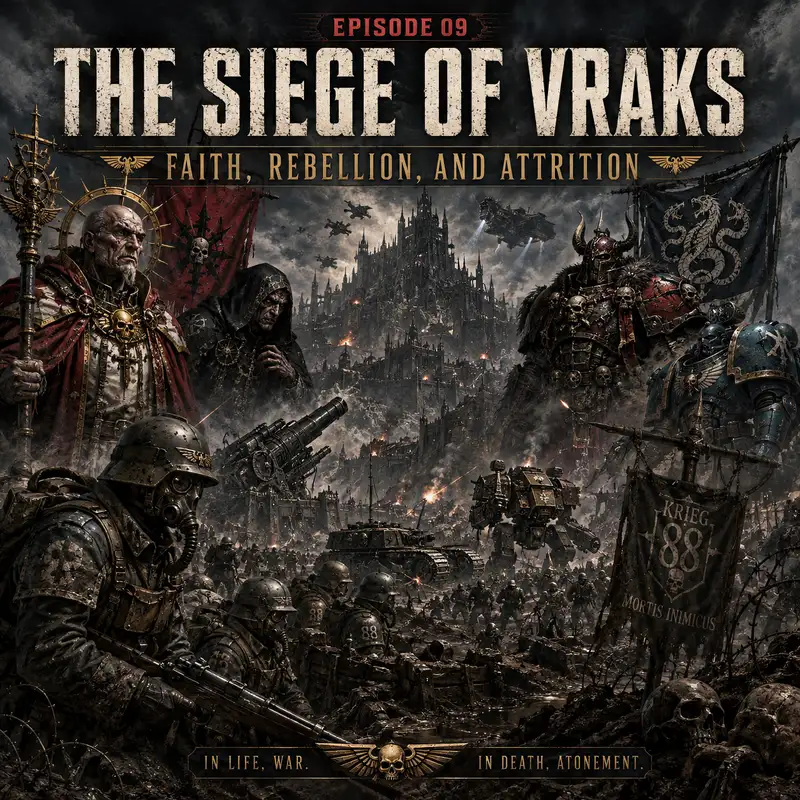
The Siege of Vraks: Faith, Rebellion, and Attrition
The Siege of Vraks began with a bullet that failed. A Vindicare assassin had waited for days in the tower of a basilica, watching for Cardinal Xaphan to appear. When the moment came, the shot struck true, but the energy field of the Cardinal’s rosarius turned it aside. His guards closed around him. His preachers moved faster than any investigation could. Before the smoke had cleared, the attempted killing was being proclaimed as proof that Xaphan’s enemies were enemies of the Emperor. One missed assassination did not merely save a life. It gave a rebellion its founding miracle.
Vraks was an unlikely place for a miracle, or for much of anything else. It was a cold armoury world near the Eye of Terror, built around stockpiles rather than cities, culture, or comfort. Its central fortress stood within the caldera of an extinct volcano, protected by layered defence lines, artillery positions, minefields, void shields, and a starport designed to keep the Imperium’s weapons moving toward other wars. The labouring population existed to maintain that machinery. Vraks was less a society than a warehouse with weather, and the weather was mostly sulphurous mud.
The value of Vraks created the trap. The Imperium could not simply erase the fortress from orbit without destroying the munitions, vehicles, fuel, and equipment it intended to recover. Nor could it bypass the planet while those stores remained in rebel hands near one of the galaxy’s most dangerous regions. The world had to be taken, not merely punished. That requirement handed the defenders the strongest possible advantage: the attacker was obliged to approach the target carefully, while the defender was free to spend the target in order to survive.
Cardinal Xaphan arrived as a celebrated preacher of the Imperial Creed. He was charismatic, ambitious, and unusually attentive to the workers who lived beneath the Administratum’s notice. He told them that their labour mattered, that they were the true warriors of the Emperor, and that a great War of Faith was approaching. This was not, at first, an open rejection of the Imperium. It was an argument about who truly represented it. Xaphan offered dignity to people treated as replaceable parts, then tied that dignity to loyalty to himself. In a system built on obedience, the distinction was dangerously easy to blur.
Beside him stood Deacon Mamon. The available accounts present Mamon not as a sudden convert, but as the patient corrupter who understood how to turn Imperial devotion against Imperial authority. He shaped Xaphan’s public appearances, cultivated rumours of hidden enemies, organised the most zealous followers into the Disciples of Xaphan, and removed voices that might have challenged the Cardinal. The process was gradual. Doubt became disloyalty. Disloyalty became heresy. Heresy became whatever Mamon needed it to mean before lunch.
The local Sisters of Battle and the Adeptus Arbites did not accept Xaphan’s growing power. Suspicion reached the Ordo Hereticus, and the Inquisition chose the clean solution: one assassin, one shot, one dead cardinal. It was efficient, discreet, and catastrophically mistimed. When the shot failed, Xaphan’s followers attacked the institutions that had opposed him. Administratum officials were murdered. Arbites compounds were overrun. The small force of Sisters from the Argent Shroud was crushed, with only a handful surviving as prisoners. Vraks did not suddenly stop believing in the Emperor. Its people were told that rebellion was the purest form of loyalty.
That is the first key to the siege. Faith on Vraks did not vanish and leave an empty space for Chaos. Faith was redirected. Xaphan’s followers had already accepted that the official Imperium could betray the Emperor, that violence against Imperial servants could therefore be sacred, and that obedience to one inspired leader mattered more than law. Chaos did not need to persuade them to abandon every belief at once. It only needed to keep changing the names attached to virtue and treason. By the time daemons appeared, the moral ground had been excavated for years.
A garbled warning escaped the planet before the astropaths were killed. The message moved through the great organs of Imperial administration, each level adding delay, review, and paperwork while Vraks armed itself from its own stores. Eventually the Departmento Munitorum approved a reconquest. The planners estimated that the fortress could be taken in twelve years by accepting casualties at a rate the Imperium considered sustainable. The problem had been reduced to arithmetic, which was reassuring so long as one was not included in the arithmetic.
The force selected was the Eighty-eighth Siege Army, composed of thirty-one regiments from the Death Korps of Krieg. The choice was logical. Krieg specialised in trench warfare, heavy artillery, engineering, and the steady reduction of fortified positions. Its soldiers were raised within a culture of inherited guilt and redemption through service. They did not seek death for its own sake, despite the reputation. They accepted that their lives were expendable if expenditure advanced the mission. Vraks would test the difference between courage, conditioning, and institutional permission to waste human beings.
Krieg doctrine suited that task because siege warfare is not one heroic charge repeated until the wall becomes embarrassed and falls over. It is surveying, counter-battery fire, drainage, roads, ammunition columns, casualty stations, replacement drafts, and engineers digging toward men who are digging toward them. The infantry assault is only the visible edge of a vast machine. On Vraks, that machine would function with terrible competence. It would also reveal the danger of a military culture that could endure almost any loss without forcing its masters to reconsider the plan.
The opening campaign followed the textbook. Transports landed beyond the fortress guns. Engineers raised supply depots and gun lines. Artillery hammered the outer defences across the Van Meersland Wastes. Then massed infantry advanced through mud, mines, wire, shell holes, and interlocking fire. Hundreds of thousands were committed to the first great attacks. Entire platoons disappeared from the order of battle in hours. Trenches were captured, lost, and captured again. The maps changed by distances that could be crossed on foot, provided the walker had not been assigned to the first wave.
The defenders were not merely fanatics with stolen rifles. Vraks had been built to supply wars, and its garrison now possessed the weapons intended for loyal armies elsewhere. Forts protected one another. Reserve lines waited behind forward trenches. Armoured columns could counterattack any breach. The fortress complex had depth, and depth is what turns an assault into a siege. The Death Korps might seize a position at terrible cost, only to discover another prepared position behind it and enemy armour moving against an exhausted flank.
Fort A Four-Five-Three became the first great proof that the system could work. After prolonged bombardment, Krieg grenadiers, tanks, and super-heavy armour broke into the position. Death Riders pursued withdrawing rebels, and the outer line finally cracked. It was a victory, but not a release. The rebels soon launched a major counteroffensive in the north, recovering ground and forcing the Imperials to cancel planned attacks. From then on, Vraks settled into its natural rhythm: offensive, counteroffensive, burial detail, revised timetable.
For roughly seven years, the lines moved without producing decision. Artillery consumed ammunition from the armouries both sides claimed to be fighting over. Infantry consumed food, replacements, and time. Commanders measured success through captured trench coordinates because the fortress itself remained remote. This is how attrition changes a war. The original objective stays in the orders, but daily survival creates smaller objectives that feel urgent enough to replace it. A ridge, a bunker, a sap, or a ruined pumping station becomes the centre of the universe until the next map is issued.
The Imperial calculation had assumed that losses would eventually exhaust a fixed defender. It did not account for the way a prolonged war creates new resources for itself. The rebels learned, hardened, and reorganised. Propaganda turned every bombardment into evidence of persecution. The dead became martyrs. Captured weapons replaced destroyed ones. Outside powers noticed the opportunity. Attrition was supposed to simplify the campaign by removing variables. Instead, time invited more variables to Vraks, most of them wearing power armour and none inclined toward moderation.
Then reports reached Lord Commander Zuehlke that warriors of the Alpha Legion were fighting beside the rebels. The rebellion had always been more compromised than its followers understood. Mamon had summoned Arkos the Faithless and his warband, and the Alpha Legion had allowed the siege to ripen before revealing itself. Arkos offered Xaphan what the Cardinal could no longer provide: experienced command, transhuman raiders, and access to allies beyond the world. Xaphan remained the sacred face of resistance while other men increasingly controlled the war behind it.
The presence of the Alpha Legion drew the Dark Angels to Vraks in extraordinary strength. Led by Azrael, they struck the starport with orbital fire, aircraft, armour, and infantry, achieving in minutes what ordinary troops might have required months to prepare. Yet the Alpha Legion had prepared an ambush inside the urban fighting. Arkos met Azrael in personal combat before the Deathwing intervened and forced the traitor to withdraw. The starport fell, but the Dark Angels lost heavily. Their private purpose on Vraks remained unclear, because secrecy is the one supply the sons of Caliban never seem to exhaust.
After nine years, the Death Korps finally shattered the second defensive line. The renegades were exhausted. Their reserves were thinning. For a brief moment, it appeared that the original plan had merely been delayed rather than disproved. Arkos answered by calling into the warp. A Chaos fleet arrived, drove off the Imperial naval force, and gained control of the space above Vraks. World Eaters descended behind the Krieg lines while orbital bombardment struck formations already committed around the fortress. The attackers became the surrounded, and an army trained never to retreat discovered that retreat can still be imposed by physics.
The war now escaped the boundaries of a conventional siege. Khornate warbands attacked for slaughter and prestige. Followers of Nurgle raided chemical stores and released weapons capable of defeating even Krieg protective equipment. Traitor aircraft contested the skies. Titans walked across landscapes already too damaged for ordinary scale to matter. Xaphan’s rebellion had become a marketplace of Chaos, with each warlord pursuing a different purpose while using the same battlefield. The Cardinal himself appeared less often, but his name remained useful, so the war continued to be fought beneath it.
Mamon’s path shows how completely the rebellion had been consumed. He had helped create the crisis, armed its most fanatical servants, and brought the Alpha Legion into the fortress. When Zhufor’s rise made him vulnerable, Mamon sought protection among the followers of Nurgle. The plague god rewarded the architect of so much disease and death by transforming him into a daemon prince. Xaphan had wanted to lead a holy war. Mamon had wanted to use one. In the end, both men were devoured by the powers they believed they could direct.
Zuehlke was removed and Marshal Amim Kargori took command. Fresh Krieg regiments and Titans of the Legio Astorum restored the Imperial position through firepower and further attrition. Engineers began tunnelling beneath enemy lines, creating a second war in darkness where listening posts, mines, and sudden underground assaults replaced the open killing fields. Above them, Imperial and traitor aircraft fought for local control. On the surface, Titans duelled among trench systems designed for men. Vraks had acquired every layer of modern war except a sensible reason to continue it.
Kargori forced new breaches, but the cost remained grotesque. One thrust gained local ground at the price of roughly a million soldiers, and even that did not settle the campaign. The Administratum began withdrawing regiments for other wars because Vraks had failed to produce a timely return on its investment. This created a familiar Imperial correction: reduce the resources available to a delayed operation, then express concern that it remains delayed. Kargori turned to the Red Scorpions, whose Space Marines seized a critical breach and opened the way toward the central citadel.
By then the signs of daemonic activity could no longer be treated as an unpleasant variation of heresy. The Ordo Malleus claimed jurisdiction, and Lord Inquisitor Hector Rex assumed supreme command. Grey Knights and other Space Marines joined the final operations. The change in command revealed how far the war had travelled. What began as the suppression of an apostate preacher had become a campaign against warp rifts, daemon engines, plague warriors, and rituals of mass sacrifice. The paperwork had finally caught up with reality, only several million deaths behind.
Each change of command was rational within its own narrow frame. The Munitorum understood fortifications, the Space Marines understood decisive assault, and the Ordo Malleus understood daemons. Yet no authority ever possessed the whole war for long enough to ask whether its original strategic value still justified its expanding cost. Vraks became a succession of emergencies, and each emergency demanded escalation. The campaign survived by becoming too dangerous to abandon, which is one of the oldest ways for a failed plan to acquire immortality.
Inside the rebel hierarchy, faith had completed its transformation into theatre. Zhufor, a champion of Khorne, seized control through violence and agreement with Arkos. Xaphan’s remaining followers were massacred, and the Cardinal was imprisoned in his own fortress. The renegade soldiers were not told. They continued to fight in Xaphan’s name while Xaphan himself had no command, no congregation, and scarcely any remaining identity. A rebellion built around personal revelation had become so impersonal that the prophet was no longer required.
The final drive against the citadel crossed defence lines known with grim accuracy as the Murder Slopes. Gorgon transports delivered Krieg infantry under artillery, tank, and air support. Void shields failed beneath sustained bombardment, but prepared fire from the fortress walls slaughtered attackers at close range. A Red Hunters strike force descended into a trap and was annihilated. Two Krieg regiments were then spent in further attacks before the ravine was finally taken with bombers, Titans, and yet more infantry. The plan had one reliable component: somewhere, there were always more casualties available.
At the gates, the siege ceased to resemble any war the Departmento Munitorum had planned. Daemons poured from a warp rift opened within the citadel. Red Scorpions held one approach while Grey Knights and Hector Rex fought at another. The Bloodthirster An’ggrath entered the battle and was banished by Rex after a brutal duel. Elsewhere, the Angels of Absolution struck Alpha Legion positions, captured Arkos, and removed him for reasons they did not explain. Even at the end, several wars were being fought on the same ground for different truths.
Imperial forces broke into the citadel and found the remains of the rebellion. The surviving Sisters of Battle had endured years in captivity. Xaphan was discovered not as a triumphant dark prophet, but as a ruined Chaos Spawn, his promised greatness reduced to mutation without meaning. Zhufor and other traitor leaders escaped through the warp, leaving lesser followers and daemons to die in their place. Grey Knights sealed the rift. The guns quieted. After nearly two decades, Vraks belonged to the Imperium again.
More than fourteen million Krieg Guardsmen had died, along with uncounted rebels, Space Marines, Titan crews, Inquisitorial servants, and civilians absorbed into the war. The armouries were emptied or destroyed. The fortress was contaminated. The world was quarantined and rendered useless for the purpose that had made its recovery essential. Imperial records could still call this victory, because the enemy no longer held Vraks. The qualification was merely that there was almost nothing left to hold.
Faith caused the rebellion because it had been separated from truth and attached to obedience. Chaos succeeded because it did not invent that weakness. It cultivated it. Attrition prolonged the war because both sides possessed institutions capable of spending lives long after the original purpose had begun to disappear. The Imperium finally won through endurance, discipline, and overwhelming sacrifice, but those same virtues also allowed the catastrophe to continue. Vraks did not fall because its people stopped believing. It fell because belief became a weapon, and every power that reached the planet found a way to fire it.
The last image of Vraks is not a banner rising over an intact citadel. It is an empty armoury beneath a poisoned sky, surrounded by trench lines filled with the dead of competing certainties. The Cardinal who promised holy war became a nameless creature in a dungeon. The soldiers sent to reclaim the world reclaimed ruins. The siege ended where it began, with the Imperium declaring that its authority had been restored. This time, no one remained to argue.