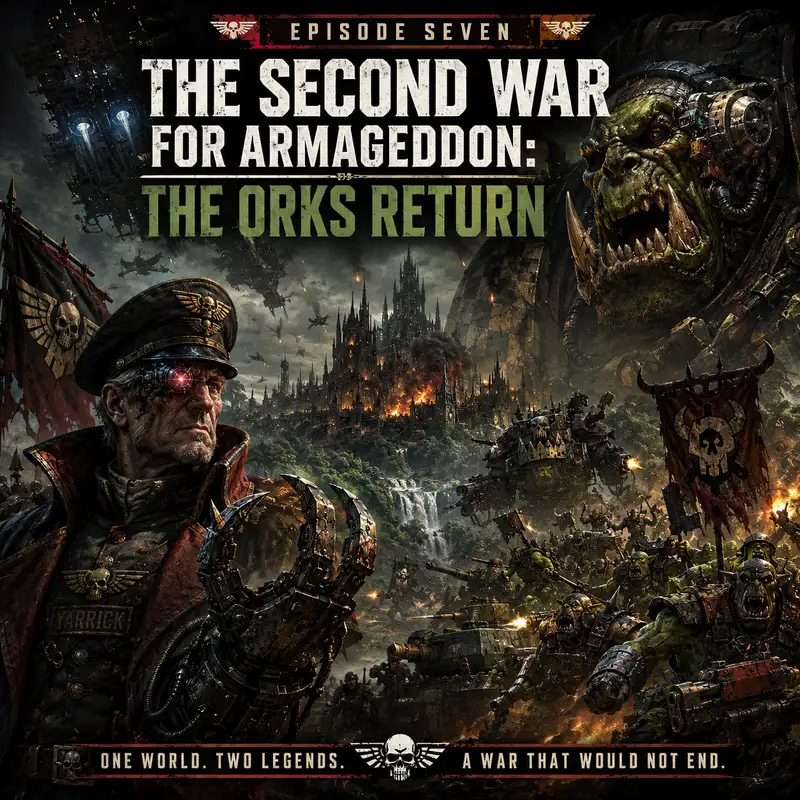
The Second War for Armageddon: The Orks Return
The first warning was not a siren. It was a shadow broad enough to cover cities. Above Armageddon, fused wreckage and stolen engines drifted out of the void like a dead world. The planetary ruler called it salvage. The men watching the tracking screens called it impossible. Then its guns opened fire, the orbital defences vanished, and pieces of the sky fell toward the northern continent. Armageddon had survived invasion before, although almost nobody living there had been permitted to remember it. This time, the enemy wore green.
The Orks arrived on the Feast of the Emperor's Ascension in the year nine hundred and forty-one of the forty-first millennium. Their landing craft were crude ships, hollowed asteroids, and portions of a space hulk aimed at the ground with great confidence and limited concern for braking. One impact destroyed Hive Uffern outright. Across Armageddon Prime, wreckage became fortresses, landing zones became camps, and camps became an invading civilization. The Orks had not come to raid. They had come to stay, multiply, build, and fight until the planet belonged to them.
The central question of the Second War for Armageddon is not how the Orks reached the planet. Orks have crossed the galaxy in machines that would make an Imperial safety inspector resign, assuming such a person existed. The question is why Armageddon nearly fell so quickly, and why it did not fall completely. The answer lies in three men. One was an Ork prophet who understood war. One was an Imperial governor who understood almost nothing and commanded everything. The last was an old commissar who knew that fear could become a weapon.
Armageddon was worth conquering. It was a hive world and an industrial engine, its cities rising above ash wastes poisoned by centuries of production. Its factories armed armies far beyond the system. The main landmass was divided into Armageddon Prime in the north and the more industrialized Armageddon Secundus in the south, with an immense equatorial jungle between them. Violent seasons, volcanic activity, and toxic air made ordinary life difficult. The Imperium responded by adding foundries, labour quotas, and more people.
Beneath that industry lay a history almost entirely concealed. Centuries earlier, daemons and the forces of the traitor primarch Angron had invaded Armageddon. The Imperium survived that first war, then erased knowledge of it through sterilization, forced labour, execution, and the destruction of witnesses. To most citizens, the Ork invasion would be remembered as the first war for their world. Armageddon entered its second great war with its population denied the lessons of the first.
The new invader had also been remade by violence. Ghazghkull Mag Uruk Thraka began as one Ork among many on the world of Urk. A bolter shell tore away part of his skull. Mad Dok Grotsnik replaced what was missing with metal, wires, and whatever else seemed suitable at the time. Ghazghkull awoke claiming that Gork and Mork had shown him a vision. Orks were not meant to waste themselves in small feuds. They were meant to unite, conquer, and fill the galaxy with a war worthy of their nature.
It is easy to laugh at an Ork prophet created by battlefield brain surgery. It is less amusing when the prophet unites a planet. Ghazghkull defeated, persuaded, or intimidated rival warlords and gathered the major clans beneath him. He did not remove the qualities that made Orks Orks. He directed them. Speed Freeks still wanted to race. Goffs wanted the hardest fighting. Meks built weapons according to principles that offended engineering and probability. Ghazghkull gave them a larger purpose and made competing appetites serve one campaign.
Urk's star was dying. Solar flares scorched the system, and even Orks understood that remaining was becoming impractical. Ghazghkull promised deliverance. A vast space hulk appeared, a drifting continent assembled from countless wrecks. The Orks seized it, named it Wurld Killa, and escaped before their home system was destroyed. Whether this was divine intervention, psychic foresight, or astonishing luck remains uncertain. For Ghazghkull's followers, the distinction did not matter. Their prophet promised a road to war, and the road arrived.
Armageddon appeared in Ghazghkull's visions as a holy place. The accounts do not explain exactly what he understood. Later revelations identify Armageddon as the displaced world of Ullanor, ancient centre of Ork power, moved across the stars by the Mechanicum after the War of the Beast. Ghazghkull was being drawn toward a battlefield buried beneath another name. Whether he consciously knew this is doubtful. Ork memory does not always behave like an archive. Sometimes it behaves like instinct.
When Wurld Killa entered the Armageddon system, Overlord Herman von Strab had time and warnings. Tracking stations detected the hulk. Navigators and freighter captains reported disturbances. Divinations pointed toward danger. Von Strab declared the object uninhabited and considered its salvage value. When evidence of Orks became undeniable, he still refused to request proper assistance. Armageddon was his world, its armies were his armies, and any victory must be his. Reality was expected to cooperate.
Commissar Sebastian Yarrick disagreed. He was old, experienced, and approaching retirement. He had studied the Ork language and, more importantly, the Ork mind. He recognized that the enemy was not a loose gathering of raiders. Ghazghkull was imposing strategy upon a species whose wars often fractured when rival bosses lost interest or attacked each other. Yarrick ordered Armageddon's astropaths to call for aid. Von Strab treated military necessity as insubordination and banished him to Hades Hive. It was an unusually productive punishment.
The Orks struck Armageddon Prime with overwhelming force. Von Strab ordered piecemeal attacks, feeding formations into battle before they could concentrate. Hive militias fought from prepared positions, but one city after another was isolated and overrun. Yarrick arranged dangerous shuttle runs to carry weapons and supplies north, with pilots climbing beyond the atmosphere before diving toward threatened positions. Many were shot down. Within roughly a week, most organized resistance on Armageddon Prime had collapsed, and refugees were moving toward the equatorial jungle.
Ghazghkull did not merely push south along the obvious roads. He waited for the Season of Shadows, when volcanic clouds darkened the sky, then sent forces through terrain Imperial commanders considered impassable. Snakebite Orks carved a route through the jungle's lethal wildlife. Armoured columns followed. Three major Ork groupings emerged where von Strab had not prepared to meet them, and the defensive line of Armageddon Secundus began to break. The governor had assumed the jungle was a wall. Ghazghkull treated it as concealment.
At the Mannheim Gap, Princeps Kurtiz Mannheim and the Titans of Legio Metalica met the advancing Gargants. Towering engines exchanged fire through smoke and ash while infantry vanished beneath their feet. Mannheim's own engine was crippled. Rather than allow it to be taken or leave the advance intact, he drove the fight to its conclusion and destroyed his Titan amid the Ork machines. The sacrifice blunted one thrust, but it could not repair a planetary strategy that had already failed.
The Orks crossed rivers, took Hive Infernus, and drove refugees across poisoned deserts. Von Strab announced that offensives had been halted at positions the enemy had already passed, then spent lives trying to make his declarations true. His family possessed ancient virus weapons held since Armageddon's settlement. Many missiles failed to launch. Others failed to arm. Those that worked killed Orks, but not enough. The governor had finally produced a decisive answer. Time had corroded it in storage.
Hades Hive became the place where the invasion stopped behaving like a clean advance. Yarrick welded blast doors shut, organized soldiers and workers, and negotiated with hive gangs that normally treated Imperial authority as a distant inconvenience. He turned maintenance crews into tunnel fighters and civilians into fire teams. The defenders lived under bombardment, reduced power, and shrinking food stocks. Accounts speak of rats and insects becoming part of the ration system. Hades did not become strong. It became too stubborn to die on schedule.
Yarrick's authority rested on more than a commissar's bolt pistol. At Hades, the usual machinery of discipline was almost beside the point. Later traditions insist that he did not execute a single soldier for cowardice. The defenders saw him along the lines, inspecting barricades, hearing reports, and appearing where pressure was greatest. He understood that courage is not the absence of fear. It is the belief that fear is shared, sacrifice has purpose, and the person giving the order accepts the same danger.
Ghazghkull recognized Hades as a challenge. That recognition saved Armageddon and doomed thousands inside the hive. More Orks were drawn into the siege. Gargants pounded the walls. Kommandos attempted to enter through upper structures and ventilation systems. Siege machines tore at the approaches. Yarrick answered with ambushes in service tunnels, rapid movement through the hive's internal transport network, and raiding parties sent out to destroy weapons before they could be brought to bear. Each failed attack increased the importance of the next. Hades was becoming personal.
This is where Ork psychology mattered. A warlord gains authority by winning and being seen to win. A fortress that refuses to fall is not merely an obstacle. It is a public insult. Ghazghkull could have contained Hades and driven deeper into Secundus, but the hive offered resistance his culture demanded he crush. Yarrick understood this. He could not defeat the invasion from behind those walls, but he could make one position so offensive to Ork pride that the enemy would spend armies proving it was not afraid.
Ghazghkull sent the Snakebite warboss Ugulhard to break the defenders. During the fighting, Ugulhard severed Yarrick's right arm with a power klaw. Yarrick survived the wound, killed the warboss, and raised the captured klaw where both sides could see it. The effect was immediate. Human defenders saw proof that the Orks could bleed and die. The Orks saw an old human who had taken the strength of one of their bosses. Later, Yarrick would have the klaw fitted as his own bionic weapon. Legend had begun converting injury into authority.
The famous bionic eye followed, although accounts differ over exactly when and how Yarrick lost the natural one. To the Orks, its red beam became proof that Old Bale Eye could kill with a glance. Yarrick encouraged the fear. He knew Orks were superstitious, and that collective belief shaped their behaviour. The Imperium often creates heroes by removing the human being beneath ceremonial titles. Yarrick created himself by understanding the enemy's imagination.
Hades also changed Ghazghkull. He had expected the campaign to prove his divine purpose. Instead, one battered commissar kept answering his plans. Ghazghkull tried infiltration, bombardment, siege engineering, and direct assault. Yarrick countered enough of them to create doubt. That did not make Ghazghkull foolish or weak. It made him dangerous in a different way. He was learning that the Imperium could produce enemies worthy of him, and that victory might require more than mass. Armageddon was becoming an education.
Elsewhere, the situation remained desperate. Port Helsreach resisted with gangs, improvised weapons, heavy machinery, and evacuation ships that could not carry everyone. Hive Acheron prepared for attack with little meaningful support from von Strab, who offered encouragement and a token detachment of guards. Ork columns closed around the hive. Then the sky changed again. This time the descending ships belonged to the Imperium. Orbital fire tore into the attackers, Thunderhawks entered the atmosphere, and Space Marines landed in the path of the advance.
The relief force included the Blood Angels, Ultramarines, and Salamanders. Their arrival could not restore dead hives or replace shattered armies. Space Marines are devastating shock troops, not a substitute population. They provided concentrated force, secure command, and the ability to strike exposed Ork formations. At Acheron, the invaders suffered one of their first clear reverses. Until then, the Orks had advanced through every failure of Imperial planning. Now something had hit back hard enough to make them stop.
Commander Dante of the Blood Angels assumed overall command. Ancient even by the standards of the Adeptus Astartes, he had no interest in preserving von Strab's dignity. The governor protested that the war remained under control. Dante placed him under arrest for the ruin he had helped create. Von Strab escaped, leaving a wrecked vehicle and no body. He had spent the war converting responsibility into orders for other people, and abandoned command when command finally acquired consequences.
Dante reorganized the defence and struck the Ork spearheads. A daring assault targeted Ghazghkull's headquarters, although the warlord was away at the front. The raid failed to capture him, but damaged the offensive. Imperial forces fought to retake Hive Tartarus, where narrow approaches and brutal close combat denied the Orks open manoeuvre. Space Marine strike forces cut into positions while surviving Guard formations held ground and rebuilt lines. For the first time, Ghazghkull had to answer an enemy plan rather than exploit the absence of one.
Hades still paid the price. Food failed. Ammunition dwindled. The walls and lower levels became a geography of rubble, smoke, and bodies. Accounts of the hive's final hours do not agree in every detail. Some describe an evacuation under attack. Others remember the position being overrun just before relief arrived, with only scattered survivors recovered. What remains consistent is that Yarrick was found alive, barely, amid the ruin. Hades had fallen as a place, but succeeded as a military act. It had consumed the one resource Ghazghkull could not manufacture on demand. Time.
The relief of Tartarus and the counterattacks in Secundus broke the momentum of the invasion. Ork forces were pushed back toward the jungle and Armageddon Prime. Ghazghkull survived reports of his death and attempted another offensive, but the strategic moment had passed. Reinforcements could now reach the Imperium. The Orks were increasingly divided, undersupplied, and forced to fight over ground they had once crossed at speed. What had begun as planetary conquest became a long retreat interrupted by savage local battles.
The main war lasted roughly two years. Fighting continued far longer as Imperial forces cleared strongholds, hunted raiders, and tried to restore authority across a devastated world. Feral Ork populations remained in the equatorial jungle and in ruined regions, because removing Orks from a planet is less like defeating an army and more like trying to persuade a fungus that the campaign is over. Armageddon was rebuilt, fortified, and surrounded with stronger monitoring stations. The Imperium had learned the value of early warning immediately after ignoring every early warning it received.
Victory did not mean that the system had returned to safety. Ghazghkull escaped. Some Imperial accounts treated the invasion as his destruction, because official certainty is often most energetic when evidence is absent. In reality, he withdrew with his authority damaged but intact. He had lost Armageddon, yet he had found the kind of war his visions promised and the enemy against whom he could define himself. Yarrick also refused retirement. Each man left the conflict convinced that the other remained unfinished business.
Their rivalry was not friendship, despite the strange respect that later grew around it. Ghazghkull valued Yarrick because the commissar made war meaningful. Yarrick pursued Ghazghkull because every world spared the Ork's attention would owe its survival to someone stopping him. The distinction matters. One sought the perfect enemy. The other understood that being chosen as that enemy was a sentence imposed on millions. Their connection was built from recognition, but it was paid for by people whose names never entered either legend.
The Second War also reveals why Orks are more dangerous than their reputation suggests. Their machines are crude, but crude does not mean ineffective. Their command is violent, but violence can still produce hierarchy. Their culture rewards personal combat, yet a sufficiently powerful warlord can direct that hunger across continents. Ghazghkull crossed terrain the Imperium dismissed, coordinated separate tribal forces, exploited weather and timing, and adjusted when resistance stiffened. The Orks nearly won because they behaved exactly like Orks under a leader capable of turning instinct into strategy.
The Imperium survived for the opposite reason. Its formal ruler failed, its communications were delayed, and its armies were squandered. Survival came from disobedience, local initiative, sacrifice, and the arrival of commanders willing to replace prestige with necessity. Yarrick sent the call for help he had been forbidden to send. Mannheim spent his life to halt an advance that should have been anticipated. Hive populations fought without waiting for perfect orders. Dante removed the man whose authority had become a weapon in the enemy's hands.
Why, then, did the Orks return to Armageddon? Ghazghkull believed the world was holy, and the buried identity of Ullanor suggests that belief may have reached deeper than conscious knowledge. Yet the Second War gave Armageddon a second kind of sanctity. It became the place where the greatest Ork prophet met the one human he could not dismiss. It offered defeat without humiliation, resistance without an end, and the promise that another invasion might produce an even greater war. For an Ork, that is not a warning. It is an invitation.
Armageddon remained Imperial, but the victory contained its own future disaster. Hades Hive became a symbol. Yarrick became Old Bale Eye. Ghazghkull became more patient, more ambitious, and more determined to return with a force large enough to finish what he had begun. When he came back decades later, he did not waste time trying to conquer Hades again. He destroyed it from orbit. The lesson of the Second War was therefore written in the method of the third. Armageddon had survived by teaching its enemy how dangerous one stubborn fortress could be.