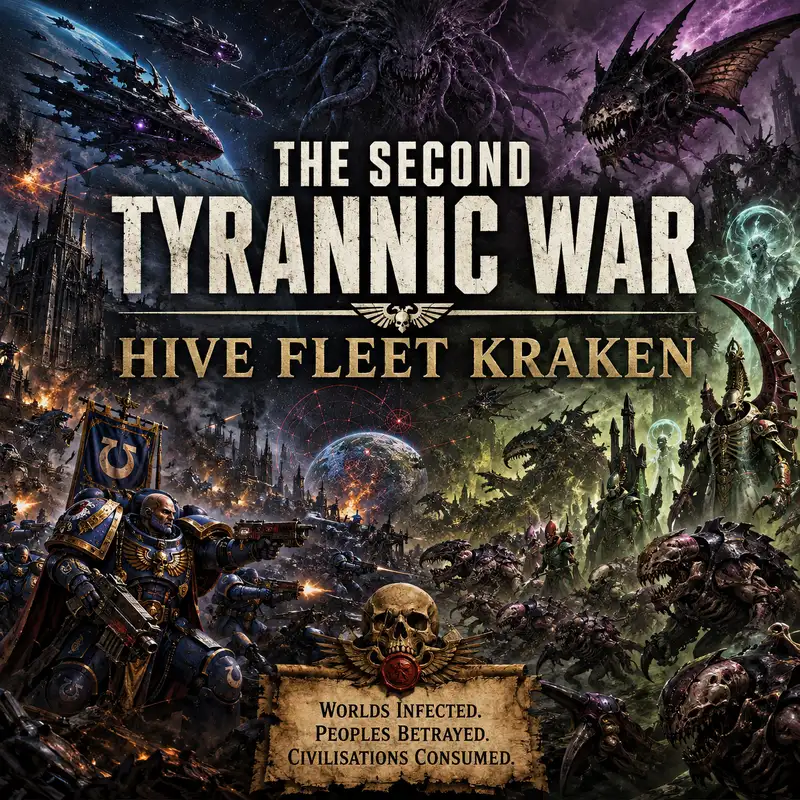
The Second Tyrannic War: Hive Fleet Kraken
By the time Prince Yriel saw Iyanden again, the craftworld was already dying. Its fleet had been torn apart. Tyranid organisms moved through halls that had carried Aeldari life for thousands of years. Shrines burned, living gardens became killing grounds, and the dead had been called from the Infinity Circuit to defend the living. Yriel had left Iyanden in anger and sworn never to return. Now he came back at the head of a corsair armada, not to reclaim an office or settle an old dispute, but to save whatever remained of his people before Hive Fleet Kraken turned their last refuge into another silent shell.
That scene captures the central contradiction of the Second Tyrannic War. Kraken was stopped at its greatest battles, yet its arrival made the galaxy more frightened than before. Hive Fleet Behemoth had struck like a spear, driving toward Ultramar until it was broken at Macragge. Kraken came as spreading claws. Its tendrils attacked across enormous distances, while Genestealer cults weakened worlds before the first bio-ship appeared. Victories against it were real, but they were local. Every commander could win the battle in front of him and still discover that another part of the war had already moved beyond reach.
More than two centuries had passed since Behemoth’s destruction. The Imperium maintained forces along the Eastern Fringe, but vigilance has a natural enemy in the Administratum: the budget review. Officials questioned why ships and regiments remained tied to a threat that had not returned. Some argued that Behemoth had been the Tyranid race entire, a single migration destroyed at terrible cost. It was a comforting theory, especially when accepting the alternative required more ships, more soldiers, and several uncomfortable memoranda to Terra.
The first signs of Kraken did not resemble an alien invasion. Worlds erupted in riots, sabotage, religious unrest, and political violence. Officials blamed hardship and resentment of Imperial rule. That was not absurd. Life on many Imperial worlds provides ample reason for rebellion without help from beyond the galaxy. The pattern was the warning. Investigators found links among figures who had travelled through the same regions, even when they had never knowingly met. Something had spread through populations and families long before the fleet arrived.
That something was the Genestealer curse. A Genestealer can implant a biological and psychic infection that passes through generations. The resulting cult grows inside society, binding families to a hidden Patriarch and teaching them that obedience is liberation. To outsiders, it may look like a labour movement, a faith, or a local resistance. To its members, the approaching hive fleet feels like deliverance. They do not understand that the gods answering their prayers intend to consume them with everyone else. Tyranid strategy has a certain economy. Even its worshippers are recyclable.
On Ichar Four, the infection wore the face of a religious movement called the Brotherhood. Its preachers promised the return of the Emperor and a better life for workers ground down by factory labour. It gathered followers and built a great cathedral in Lomas. Imperial authorities watched for obvious heresy and found none. The Brotherhood used familiar language and familiar misery. Only when it rejected tithes, resisted conscription, and armed its followers did the situation become open revolt. By then, much of the planetary defence force had joined it.
Inquisitor Agmar arrived to find a rebellion that was too coordinated to be spontaneous. He called for the Ultramarines, and their assault eventually carried them beneath the Brotherhood’s cathedral. There, in crypts below the public face of the movement, they found Genestealers and the swollen Patriarch at the centre of the psychic brood. The Patriarch was killed, the uprising lost cohesion, and Imperial forces purged the survivors with their customary distinction between thoroughness and mercy. Ichar Four returned to Imperial control. On paper, the operation was complete. On Ichar Four, paper had once again achieved a victory that reality had declined to recognise.
The surviving records describe an astropath sensing something vast turn its attention toward the planet. The cult had not merely prepared Ichar Four for conquest. Its psychic presence had acted as a beacon. Far beyond the system, the Hive Mind was approaching. When Kraken finally appeared, Genestealers emerged again from places the purge had supposedly cleansed. The lesson was brutal and practical. Killing the visible leadership of a cult does not guarantee that every brood, infection, hidden chamber, or compromised official has been found. The first battle for Ichar Four had been a warning. The second would be an invasion.
Kraken did not repeat Behemoth’s concentrated advance. It divided into many tendrils and struck along a broad front. That made its total strength difficult to judge and its direction almost impossible to predict. A defender could not assume that the largest detected swarm was the main body, because the idea of a single main body no longer applied in any useful way. Each tendril carried organisms capable of scouting, infiltrating, adapting, and harvesting. Some attacked major worlds. Others passed through lesser systems, leaving silence behind them. The name Kraken suggested one monster. The reality was closer to a nest of feeding mouths sharing one appetite.
The home world of the Scythes of the Emperor showed what that meant. Sotha was defended by Space Marines, but Kraken arrived with Genestealer cults already undermining the world from within. The Chapter was also spread across regional operations. Sotha fell, its population was consumed, and the Scythes became scattered survivors carrying what gene-seed and relics they could save. Power armour still matters when the sky is full of monsters. It matters less when the enemy has prepared the battlefield inside your own household.
The survivors withdrew to Miral, where a great rock formation called the Giant’s Coffin offered a natural fortress. The name lacked optimism, but possessed admirable honesty. The Scythes fortified the heights for a final stand. Kraken followed. Their Chapter Master died, the defences were overwhelmed, and only a fraction escaped. The Scythes survived as an institution, but survival became their objective rather than a consequence of victory. For them, the war was the repeated discovery that every refuge had already become part of the feeding ground.
At Ichar Four, the main Tyranid assault descended upon a world scarred by the cult uprising. Gaunts flooded defensive lines. Warrior organisms directed lesser beasts. Carnifexes broke fortifications, while larger creatures brought living artillery against the defenders. The war was fought in factories, hive streets, and orbital approaches. The Shadow in the Warp smothered psychic communication and filled vulnerable minds with dread. It was the sensation of an intelligence too large to address and too alien to negotiate with pressing against the edges of thought.
Marneus Calgar led the Ultramarines and allied forces. He had survived the First Tyrannic War and understood that the swarm had to be treated as a coordinated military system, not an unusually aggressive collection of animals. Synapse creatures directed the attack. Break those links, isolate the broods, and the defenders could regain freedom of action. The Swarmlord was present as the Hive Mind’s supreme battlefield instrument, carrying experience shaped across earlier wars. Calgar eventually overcame it, reversing the humiliation he had suffered during the fighting for Ultramar. With Tyranid coordination disrupted, Imperial forces drove the surviving organisms from Ichar Four.
It was a victory, and it cost almost everything without changing its official classification. Ichar Four was devastated. Allied Space Marines suffered appalling losses, while regions of the Eastern Fringe were already dead or fighting. The Imperium could point to a slain commander organism and a world retained. Kraken could lose that tendril and continue elsewhere. Imperial command thought in territories and campaigns. The Hive Mind could spend a fleet as a human commander spends ammunition, provided the expenditure improved the larger harvest.
While Ichar Four fought beneath Imperial banners, another mass of Kraken moved toward Iyanden. Craftworlds are not merely ships. They are wandering nations built from the remnants of the Aeldari civilisation that survived the Fall. Iyanden had once been among the largest and most populous. Its halls contained living communities, temples, forests, military docks, and the Infinity Circuit that preserved the souls of its dead. To lose Iyanden would not mean the destruction of a vessel alone. It would erase a people, their ancestors, and a portion of Aeldari memory that could never be reconstructed.
Rangers brought the first direct reports of the swarm. Farseer Kelmon gathered Iyanden’s people to decide how they would meet it. Some argued for trusting the craftworld’s shields. Others favoured a forward strike. The available accounts describe a warning from those who had actually witnessed Kraken: the approaching mass was too great for a raid and too persistent to evade. Iyanden would have to become a fortress, and every part of its society would have to fight. Guardians were raised from citizen paths. Aspect Warriors prepared their shrines. Seers armed for battle. The Avatar of Khaine was awakened.
Then Kelmon ordered the dead to rise. Aeldari spirit stones preserve souls from Slaanesh, and within a craftworld those souls can join the Infinity Circuit. In desperate war, some are placed within Wraithguard and Wraithlords, constructs that let the dead fight again. Awakening them risks the souls and asks ancestors to leave the circuit for battle. Iyanden accepted that cost because the alternative was extinction. Before Kraken reached the hull, the craftworld had crossed a line it would never completely uncross.
The first Tyranid waves met Iyanden’s fleet in the void. Aeldari ships cut apart bio-vessels with speed and precision, but each attack was followed by another. The defenders were not being tested by a conventional admiral seeking the right manoeuvre. They were being measured by an intelligence willing to sacrifice living ships until it found the pressure needed to break through. Eventually, the surviving Aeldari vessels were swept aside. Mycetic spores struck the craftworld. They opened like wounds, releasing organisms into skies, gardens, fortresses, and corridors never designed to become trenches.
Battle spread through Iyanden as if the craftworld had developed a fever. Aspect Warriors fought specialised Tyranid organisms in engagements too violent for ordinary soldiers. Wraith constructs met Carnifexes with the strength of the honoured dead. Phantom Titans duelled bio-titans amid ancient structures. Warlocks fought through the psychic weight of the Hive Mind. At the Fields of Sanctuary, the Phoenix Lord Maugan Ra and his Dark Reapers held against wave after wave. Heroism was everywhere. So were the bodies.
Kraken’s advantage was attrition. Every Aeldari death removed a person from a dwindling species. Every destroyed spirit stone risked a soul beyond recovery. A Tyranid organism was grown for a task and expended without regret. Its death mattered only if the biomass could not be reclaimed or the loss disrupted the attack. Iyanden could destroy vast numbers and still move closer to defeat with every exchange. The Tyranids did not need to outfight the Aeldari warrior for warrior. They needed only to make them keep paying.
Prince Yriel had once been Iyanden’s High Admiral. Decades earlier, he had led the fleet away in a pre-emptive campaign against a Chaos threat. His offensive succeeded on its own terms, but Iyanden was left exposed to a damaging attack. The craftworld’s leaders stripped him of rank. Yriel answered judgment with exile, gathered corsairs around him, and became the master of the Eldritch Raiders. Pride shaped the break, but so did genuine disagreement over command. Yriel believed decisive action had saved Iyanden from something worse. Iyanden believed an admiral who abandoned his station had gambled with everyone else’s lives.
News of Kraken forced that old argument into a harsher frame. Yriel could preserve his oath never to return, or he could preserve the people who had condemned him. He chose Iyanden. The Eldritch Raiders drove into the Tyranid fleet when the craftworld’s remaining defences were close to collapse. Yriel’s skill as an admiral mattered because he did not merely add more guns. He imposed direction on a broken battle. His ships struck the bio-fleet’s vulnerable structure, coordinated with Iyanden’s survivors, and prevented more Tyranid organisms from reaching the craftworld. In the void, Kraken’s grip began to loosen.
The war inside Iyanden was not yet won. A monstrous Hive Tyrant led the final assault against the remaining defenders. The Avatar of Khaine moved to confront it, an embodiment of the Aeldari war god seeking a decisive duel. The Tyranids had no interest in the symbolism. Carnifexes overwhelmed the Avatar by mass and violence, which was tactically sensible and spiritually devastating. Yriel reached the ground carrying the Spear of Twilight, a weapon of immense power that consumed the life of its bearer. He drove it through the Hive Tyrant and broke the local synaptic command holding the assault together.
The remaining Tyranids were isolated and destroyed, but Iyanden’s survival barely resembled triumph. Accounts differ on the proportion of the dead, yet agree that most of the population was gone. Farseer Kelmon was among them. The fleet was shattered, sacred places ruined, and spirit stones destroyed beyond recovery. Iyanden would endure increasingly through Wraithguard, Wraithlords, and souls whose descendants were too few to replace them. The dead had saved the living and became a permanent part of how the living would wage war.
The battles of Ichar Four and Iyanden are described as Kraken’s defeat. That is true because its largest thrusts were broken and its advance lost coherence. It is misleading if it suggests a clean destruction. Kraken fragmented. Splinter fleets continued toward other systems with the same capacity to infiltrate, consume, and grow. Some were hunted down. Others remained active for years. A hive fleet’s collapse could create dozens of smaller wars, each beginning with authorities who hoped the danger belonged elsewhere.
Kraken changed the meaning of a Tyrannic War. Behemoth had shown that Tyranids could devour worlds and threaten Ultramar. Kraken showed that invasion did not need a single front. The enemy could prepare revolutions, divide across sectors, absorb defeats, and continue through surviving tendrils. There might be no capital to capture, no government to decapitate, and no peace delegation after the last battle. The Hive Mind’s strategy was not conquest in the Imperial sense. It was the creation of feeding opportunities until resistance ceased to produce enough delay.
The war exposed institutions that required certainty before acting. The Administratum wanted proof that Tyranids remained a strategic threat. Planetary authorities wanted proof that unrest was alien. Commanders wanted proof that a detected swarm was the main attack. By the time each standard was satisfied, Kraken had gained time or biomass. Not every rebellion was a cult, and panic was not wisdom. The Imperium’s answer to uncertainty was often a purge, which is efficient mainly at producing more enemies. Kraken turned slow judgment into part of its invasion plan.
For the Aeldari, the lesson was intimate. Foresight could reveal danger, but not guarantee escape from every path. Their skill could destroy enemies by the thousands, but not make those exchanges affordable. Iyanden survived because it used everything it had tried to preserve: its dead, its exiles, its cursed weapons, and allies from beyond the craftworld. Yriel’s return did not erase his earlier choices or prove his critics fools. It showed that loyalty can survive condemnation, and that broken relationships may still contain obligations stronger than pride.
The Tyranids are difficult to describe because familiar moral language slips away from them. Kraken did not hate Iyanden, resent Calgar, or deceive its cults from personal malice. The Hive Mind used biological tools according to function. That absence of hatred does not make it innocent. It makes negotiation meaningless. A Tyranid fleet is an ecosystem organised for war, with intelligence expressed through adaptation, coordination, and consumption. Calling it mindless underestimates it. Calling it evil may feel accurate to its victims, but does not explain what it will do next.
The Second Tyrannic War ended without a treaty, surrender, or final battlefield. Ichar Four remained in Imperial hands. Iyanden remained alive. The Scythes of the Emperor remained a Chapter, though only barely. Those survivals mattered, but none restored what Kraken had consumed. The war’s true result was a new understanding of the enemy. A hive fleet could be defeated and still persist. A world could be liberated after the invasion had already achieved its purpose elsewhere. A people could survive by giving their future over to their dead.
That is why the most revealing image of Kraken is not a slain Hive Tyrant or a burning bio-ship. It is Iyanden after the guns fall silent, its vast halls guarded by Wraith constructs carrying the souls of those who once walked them. Beyond the craftworld, fragments of the defeated fleet drift toward new stars. Both sides continue through what remains of their dead. Iyanden remembers. Kraken recycles. The defenders won their battles, but the hunger survived them.