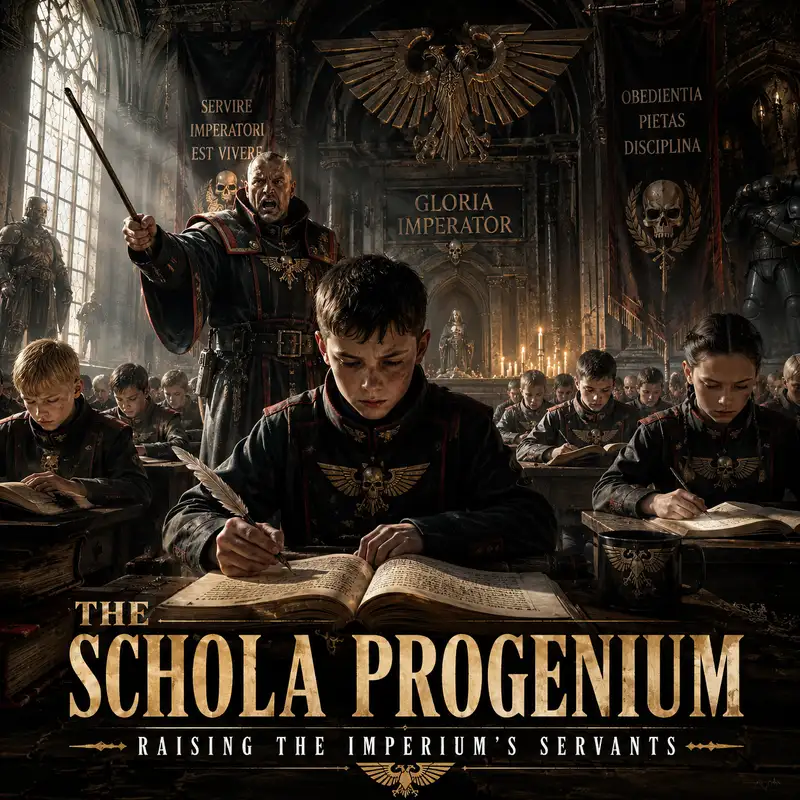
The Schola Progenium: Raising the Imperium’s Servants
The Imperium often begins a servant’s education with a funeral. An officer dies on a distant front. An administrator disappears aboard a ship that never reaches port. A judge is murdered, a missionary is martyred, or a naval commander is lost with an entire squadron. Their child survives. In another society, that child might be returned to relatives, raised by a community, or allowed to preserve some small piece of the life that has just been destroyed. The Imperium offers a different form of mercy. It takes the child, places them beneath the double-headed eagle, and explains that they have not been abandoned. They now belong to something greater. The dead parent served the Emperor. The orphan will do the same.
That is the central purpose of the Schola Progenium. It is not one school, and it is not merely an orphanage. It is a vast network of academies spread across the Imperium, operated through the machinery of the Ecclesiarchy and connected to the wider needs of Imperial government and war. Its pupils are commonly the sons and daughters of Imperial servants who died in service, especially officers, officials, clergy, nobles, and members of institutions important enough for their dependants to be noticed. The children are known as progena. By Imperial standards, they receive an extraordinary opportunity. They are fed, housed, educated, trained, and considered for some of the most prestigious careers available to an unmodified human being. The price is that the Schola does not simply prepare them for adulthood. It claims the right to decide what adulthood will mean.
The first lesson is belonging. A progena may retain a name, a face, and perhaps a few memories, but the institution steadily weakens every loyalty that might compete with the Imperium. Home world, family custom, inherited privilege, regional identity, and private grief are all subordinated to a larger story. The Emperor becomes the child’s spiritual father. The fallen parents become martyrs whose service must be continued rather than mourned in an ordinary way. Records of ancestry may exist, but curiosity about them is often discouraged. The message is simple and repeated until it becomes instinct. Whatever family gave birth to the child, the Imperium gave that life purpose.
This explains why the Schola is more important than its grim classrooms and famous graduates suggest. The Imperium is a state spread across a million worlds, divided by distance, language, custom, class, religion, and long periods of isolation. Most human beings are loyal first to the place they know. A soldier may fight for a regiment because that regiment is drawn from the same cities, clans, or hive levels. A noble may govern in the interests of a dynasty. A priest may carry local traditions that barely resemble those of the next sector. The central authorities on Terra cannot remove those differences, and often do not try. What they can do is create a small class of people trained to place Imperial identity above local identity. The Schola produces that class.
The academies themselves vary enormously. There is no single building plan or universal daily schedule that reaches every world without alteration. Some scholae occupy fortress monasteries, shrine complexes, or isolated compounds far from ordinary settlements. Others are buried inside hive cities or attached to major centres of Imperial administration. Their methods reflect local resources and the temperament of those in command. One establishment may be severe but orderly. Another may be negligent, corrupt, or openly sadistic. Imperial institutions are remarkably consistent in their demands and remarkably inconsistent in how they meet them. The desired result, however, is familiar everywhere: disciplined servants who can endure hardship, obey authority, and act without being paralysed by doubt.
A young progena’s education combines religion, academics, physical conditioning, and constant assessment. Reading and writing matter because officials, officers, and clergy must understand orders, reports, doctrine, and scripture. Arithmetic matters because ammunition, rations, payrolls, troop strengths, and tithes have an unfortunate habit of requiring numbers. Imperial history is taught as moral instruction as much as chronology. Saints demonstrate obedience. Traitors demonstrate the cost of disobedience. Victories prove the value of faith. Defeats usually prove that someone did not possess enough of it. Rhetoric, memory drills, recitation, and formal prayer train the mind to reproduce approved ideas quickly and confidently.
Physical training begins early. So does deprivation. Progena may face exhaustion, hunger, cold, pain, collective punishment, and tests designed to expose hesitation or disloyalty. Some accounts describe brutal competition among pupils, encouraged by instructors who believe mercy produces weakness. The point is not simply to make children suffer, although the distinction may be difficult to observe from inside the punishment chamber. The official logic is that future servants will face battlefields, interrogations, riots, heresy, political pressure, and the possibility of death. Better to discover weakness in the Schola than during a planetary rebellion. The less official reality is that institutions built around obedience often begin to treat cruelty as proof of seriousness.
The most feared instructors are the drill abbots, often veterans who have exchanged one form of Imperial service for another. They bring military experience into an environment already saturated with religious authority. To a drill abbot, posture can be a moral issue, hesitation a spiritual failure, and a missed shot evidence of insufficient devotion. Their task is to convert doctrine into habit. A lesson repeated in a chapel must still function when alarms are sounding, comrades are dying, and the person giving the order appears to have lost all contact with reason. This is not education in the modern sense of encouraging a student to discover an independent voice. The Imperium already has more than enough independent voices. Several are being questioned by the Inquisition.
Yet the Schola cannot rely on obedience alone. Its graduates must often make decisions far from direct supervision. A commissar may have to judge whether an officer is frightened, incompetent, corrupted, or merely correct about an impossible situation. A Tempestus Scion may be cut off from command during a covert strike. A Sister Hospitaller may have to choose which wounded soldiers can still be saved. An Arbitrator may confront a governor whose legal authority is genuine but whose conduct threatens Imperial order. The Schola therefore teaches initiative within boundaries. A pupil is expected to think, but to think from approved assumptions. Creativity is valuable when it helps fulfil the mission. Creativity concerning the legitimacy of the mission is less warmly received.
As the children grow, instructors watch for aptitude. Intelligence, physical ability, aggression, memory, piety, leadership, emotional control, and even useful forms of suspicion can determine a future path. The process is not gentle career counselling. A progena may be transferred with little explanation, separated from familiar classmates, and placed into increasingly specialised training. Those without exceptional promise may still become guards, clerks, menials, or lower-ranking servants. Those who fail more seriously may disappear into punishment, disgrace, or death. Potential psykers face a different fate altogether, because psychic talent places them under the shadow of the Black Ships rather than the ordinary career tracks of the Schola.
The most recognisable graduates are commissars. This is not an accident. The Officio Prefectus needs people who can enter an Astra Militarum regiment as outsiders and still claim authority over its officers and soldiers. A commissar must not be tied too closely to the regiment’s home world, aristocracy, rivalries, or customs. The black coat represents more than discipline. It represents the presence of the wider Imperium inside a military force that might otherwise think of itself as Cadian, Valhallan, Mordian, Tallarn, or something even more local. The Schola gives the future commissar a loyalty that is deliberately portable.
Commissar training includes tactics, history, weapons, languages, observation, leadership, and the management of fear. The popular image is the officer who shoots the first soldier to retreat. That happens, and the threat is part of the role, but a commissar who relies only on executions is usually a poor commissar and may soon discover that an entire regiment can become surprisingly inaccurate when firing near his back. Effective commissars inspire, negotiate, advise, shame, deceive, and lead by example. They must understand when discipline will restore a unit and when punishment will destroy it. After academy training, cadet commissars serve in the field under experienced mentors. The final examination is therefore conducted with live ammunition and very limited opportunities for revision.
Other progena with exceptional combat ability may enter the Militarum Tempestus and become Tempestus Scions. These are elite human soldiers trained for dangerous missions that ordinary regiments are not equipped to perform. They strike command posts, seize vital installations, conduct airborne assaults, recover sensitive targets, and fight in conditions where precision matters as much as courage. Their training develops marksmanship, small-unit tactics, physical endurance, and the ability to follow complex orders under extreme pressure. Their equipment is better than that issued to most Imperial soldiers, but the real weapon is reliability. A Scion unit is expected to arrive, understand the task, and continue operating after the plan has encountered the enemy.
The Schola background matters here because Scions are often used where secrecy, political trust, or independence from local command is essential. A planetary governor may possess loyal troops, but those troops are loyal to the governor. A regiment may be brave, but unfamiliar with the mission or entangled in local rivalries. Scions belong to a central military structure and have been conditioned to obey its authority. They are not fearless machines. They are human beings trained so thoroughly that fear is placed beneath procedure. The Imperium does not eliminate human weakness. It builds routines strong enough to function while weakness is screaming.
Many female progena are selected for service in the Adepta Sororitas. The most famous become Sisters of Battle, but the Sisterhood is broader than its armoured warriors. Its Orders Militant fight the enemies of the faith. Its Hospitallers heal bodies. Its Dialogi preserve, translate, and interpret knowledge. Its Famulous advise noble houses and shape dynastic politics. Across these roles, the Schola provides a foundation of literacy, discipline, ritual, and devotion. A novitiate does not enter the Sisterhood as a blank slate, but as someone already taught that service to the Emperor is both identity and obligation.
This connection reveals something important about the Schola. It does not simply produce soldiers. It produces people who can carry Imperial authority into different kinds of spaces. A commissar brings it into the regiment. A Battle Sister brings it into the war of faith. A Hospitaller brings it into the field hospital. A Dialogus brings it into archives and negotiations. An Arbitrator brings it into the courtroom and the riot line. A priest brings it into the pulpit. An administrator brings it into the office where a missing seal can condemn a world to wait another century for supplies. The weapons change. The underlying function does not.
Graduates may also become officers in the Astra Militarum or Imperial Navy, officials of the Administratum, servants of the Ecclesiarchy, members of the Adeptus Arbites, medical personnel, or recruits noticed by more secretive Imperial organisations. The Inquisition can select promising individuals, especially those with unusual intelligence, determination, or an ability to ask dangerous questions without asking the wrong dangerous questions. Some pupils may vanish into institutions that do not explain their requirements. The Schola’s alumni therefore appear throughout the Imperium, often in positions where loyalty, education, and freedom from local attachments are especially valuable.
Why use orphans for this work? The obvious answer is that they need care, and the Imperium can present the Schola as repayment for their parents’ sacrifice. That promise has practical value. An officer ordered into a hopeless battle may take some comfort in believing that surviving children will not be abandoned. An administrator sent to a lethal frontier may believe that service can secure a future for the family. The Schola turns that promise into a system of recruitment. It rewards Imperial service, preserves useful bloodlines and social connections, and gathers talented children into institutions where their loyalties can be shaped.
The darker answer is that an orphan is easier to detach. Family is a competing source of authority. It teaches private memory, local obligation, affection without permission, and loyalty that cannot always be redirected by decree. The Schola does not need to erase every emotion, but it teaches the child where emotion must point. Grief becomes reverence. Loneliness becomes fellowship in service. Anger becomes hatred of the Emperor’s enemies. Ambition becomes a desire to prove worthy of the dead. Even love is reorganised around the Imperium. This can produce genuine courage and self-sacrifice. It can also produce adults who have never learned to separate duty from abuse.
There is a class dimension as well. The Schola is often described as a path for the orphans of those already serving the Imperial state, many of them drawn from military, administrative, clerical, or noble backgrounds. It therefore renews the Imperium’s elite while claiming to judge pupils by aptitude. Both things can be true. Within the academy, a child may rise because of talent, endurance, or faith. Outside it, countless equally talented children will never be considered because their parents died in a manufactorum accident rather than beneath an official banner. The Imperium calls this merit. The paperwork is impeccable.
None of this means that every progena becomes identical. The Schola can standardise doctrine, punish dissent, and shape behaviour, but it cannot completely erase personality. Its graduates include severe true believers, practical professionals, ambitious officials, compassionate healers, brilliant commanders, frightened survivors, and people who learn to perform certainty while privately living with doubt. Commissars such as Ibram Gaunt and Ciaphas Cain are useful contrasts. Both emerged from the same broad institutional tradition, yet one is remembered for austere duty and command, while the other’s own accounts reveal a far more anxious and self-protective personality beneath the heroic reputation. The Schola creates a framework. Human beings continue to occupy it.
That distinction matters because loyalty produced by the Schola is not necessarily false. A person can be indoctrinated and still believe sincerely. A Sister of Battle may possess genuine compassion. A commissar may die protecting soldiers who once feared him. A Scion may sacrifice himself for a squadmate rather than for an abstract command. The institution attempts to direct every virtue toward Imperial survival, but virtues do not remain perfectly contained. Courage can become defiance. Duty can become moral judgment. Faith can inspire mercy as easily as punishment, although the latter tends to generate more official documentation.
The reverse is also true. Education, discipline, and sacrifice do not guarantee wisdom. A graduate may become a fanatic whose certainty kills thousands. A commander may apply a lesson correctly to the wrong war. An Arbitrator may preserve the letter of Imperial law while destroying the people it supposedly protects. A priest may mistake suffering for holiness because suffering was the language of childhood. The Schola’s great strength is that it produces servants who can continue functioning under pressure. Its great danger is that it may also produce servants who continue functioning long after a sane person would stop and question the order.
Across the long history of the Imperium, individual scholae have also been vulnerable to corruption, neglect, political interference, and the ambitions of those who control them. That should not be surprising. The children are valuable, the institutions possess prestige, and the graduates feed powerful organisations. Any system that claims absolute authority over isolated pupils creates opportunities for abuse. Imperial oversight tends to be severe when scandal threatens loyalty and remarkably patient when cruelty merely improves graduation statistics. The Schola can be a disciplined academy, a brutal orphanage, a religious institution, a military preparatory school, and a mechanism of social control at the same time.
From the perspective of Imperial survival, the system works. The Imperium cannot govern its worlds through direct supervision. Messages may take months, years, or never arrive. Reinforcements may emerge from the warp after the war is over. Local rulers possess enormous power. Under those conditions, the state depends on people who carry its assumptions inside themselves. A schola-trained servant does not need Terra to explain every decision. The central authority has already been internalised as doctrine, ritual, shame, ambition, and faith. The graduate becomes a small, mobile piece of the Imperium’s governing machinery.
This is why the Schola Progenium is one of the quiet foundations of Imperial power. Space Marines win impossible battles, fleets cross the void, and titans shake cities apart, but empires survive through cadres. Someone must enforce discipline, interpret law, maintain records, train soldiers, advise rulers, preserve doctrine, and decide which order still applies when every superior officer is dead. The Schola prepares people for those moments. It gives them a shared education and a common understanding of whom they serve. In a civilisation defined by fragmentation, that common understanding is a strategic resource.
It is also a deeply Imperial solution. The state encounters bereaved children and sees both a responsibility and an opportunity. It protects them by taking possession of them. It educates them by narrowing the range of acceptable thought. It honours their parents by replacing them. It offers status, purpose, comradeship, and the possibility of remarkable achievement, then binds every gift to a debt that can never be repaid. The result is neither simple rescue nor simple exploitation. It is a bargain made with people too young to refuse, and many of them will spend the rest of their lives believing the bargain saved them.
Somewhere beneath artificial light, a child recites the names of saints, learns to strip a weapon, memorises the proper forms of address, and is told that pain is temporary while duty is eternal. Years later, that child may stand on a command deck, in a burning chapel, beside a hospital cot, before a firing squad, or at the sealed door of a governor’s palace. The uniform will reveal which path the instructors chose. The posture, the certainty, and the instinct to place service before self will reveal where the journey began. The Schola Progenium does not merely raise the Imperium’s servants. It teaches its orphans that service is the only family they have left.