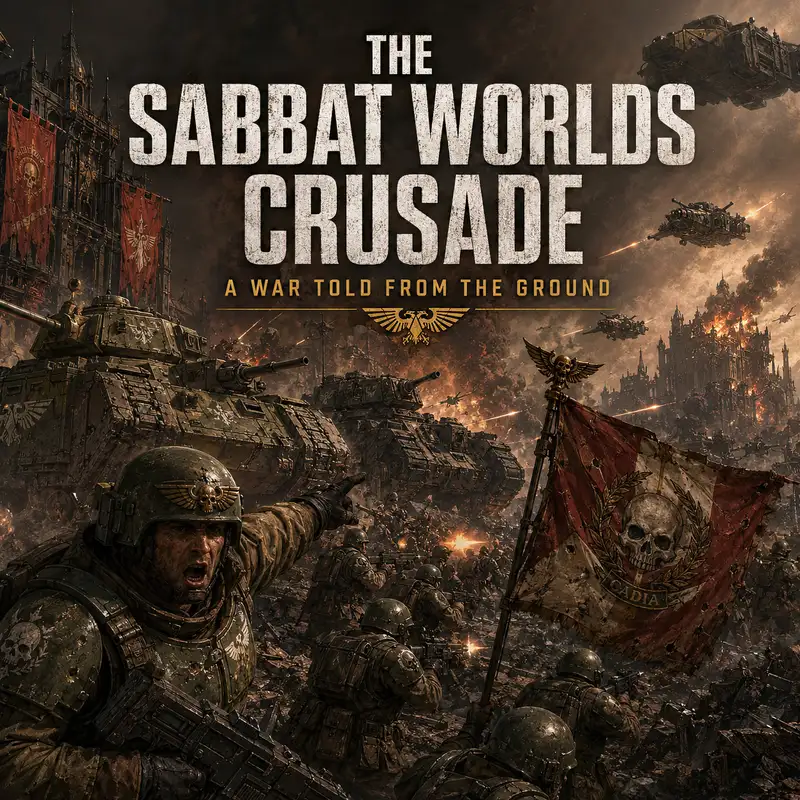
The Sabbat Worlds Crusade: A War Told From the Ground
A crusade can be drawn as a line across a star chart. The line advances from one world to the next, neat and confident, while clerks change coloured markers and generals speak of momentum. On the ground, the same advance is measured differently. A soldier counts the rounds left in a power pack. A medic counts stretchers. A refugee counts the names of relatives who did not reach the evacuation point. Somewhere above them, the campaign has a grand title and a sacred purpose. Down in the mud, it has rain, smoke, bad orders, and the man beside you trying not to bleed out. That difference is the key to the Sabbat Worlds Crusade. It is one of the Imperium’s great wars, but its most enduring story is not told from the throne of a Warmaster. It is told from the firing step.
The Sabbat Worlds are a broad region of inhabited systems in the Segmentum Pacificus, once bound together by the victories and faith of Saint Sabbat. Long before the forty-first millennium, the saint led a war of liberation that brought the region into the Imperium. Her memory became part religion, part history, and part political claim. When the worlds later fell under Chaos rule, the loss was more than strategic. To the Imperium, it was a desecration of sacred ground and an admission that an earlier triumph had been allowed to rot. By the time a reconquest was approved, the region had been outside Imperial control for roughly a thousand years. Whole generations had known no other order. Liberation therefore meant invasion.
The crusade began in the year seven hundred and fifty-five of the forty-first millennium under Warmaster Slaydo. He was not chosen merely because he could gather armies. He had studied the Sabbat Worlds for years, believed deeply in Saint Sabbat’s cause, and understood that the war required a moral centre as well as a strategic plan. His early offensives recovered several objectives quickly, but the road toward Balhaut, the enemy’s principal seat of power, became a grinding struggle. Campaign schedules slipped. Enemy counterattacks tore across the Imperial line. Slaydo repeatedly revised the date by which Balhaut would fall, an experience familiar to commanders in every age and usually less amusing to the troops expected to make the revised date possible.
Balhaut became the axis of the war because it mattered in several ways at once. It controlled important routes, carried enormous symbolic weight, and offered the chance to break the authority of Archon Nadzybar, the dominant Chaos warlord of the region. In the year seven hundred and sixty-five, Slaydo committed the crusade to the assault. Imperial Guard regiments, naval forces, Titans, and Space Marines were thrown into a battle that consumed cities, plains, islands, and fortified palaces. Slaydo reached the enemy’s high command and killed Nadzybar, but he was mortally wounded. The crusade won the world and lost the man who had given the war its shape. A strategic map would mark Balhaut as a decisive Imperial victory. A field hospital would have used other language.
Before he died, Slaydo named the comparatively young Marshal Macaroth as his successor. Senior officers who expected the honour were not delighted, which is the traditional military response when destiny selects someone else. Macaroth survived the political struggle and continued the advance with a reputation for bold, sometimes alarming gambles. From high command, the crusade became a contest of fronts, supply corridors, feints, and competing enemy warlords. From below, the change in Warmaster was often little more than a new portrait, a new name in orders, and the same demand to take the next ridge. The gap between those views is not a flaw in the story. It is the point.
The best-known ground-level witnesses are the Tanith First and Only, the regiment called Gaunt’s Ghosts. Their existence begins with a decision that never stops haunting them. Colonel-Commissar Ibram Gaunt arrived on Tanith to take command of newly raised regiments just as the world came under attack. He could keep the transports on the ground and spend the regiment in a doomed defence, or launch with whoever could be saved. Gaunt chose evacuation. Tanith died behind them. The survivors became the first regiment of their world and the only regiment it would ever produce. Every victory afterward carried the same uncomfortable question. Had Gaunt preserved Tanith’s last soldiers, or abandoned Tanith when it needed them most?
That question gives the Ghosts an identity stronger than any uniform. They are light infantry, scouts, marksmen, infiltrators, and woodsmen shaped by a vanished forest world. They carry straight silver blades and memories of nalwood groves that most of their later comrades will never see. They are also refugees in military service. They cannot go home after the campaign because home is ash. Their nickname sounds romantic from a distance, but it is painfully literal. They are ghosts because their world is dead, because they move unseen, and because the Imperium is very good at spending people whose past has already been erased.
Gaunt himself embodies the contradictions of the Imperial Guard. As a commissar, he is responsible for discipline, loyalty, and the political reliability of the troops. As a colonel, he must also command them, understand them, and accept responsibility for their survival. Those roles do not always sit comfortably together. A commissar can enforce obedience with a bolt pistol. A commander has to earn trust after the shot echoes. Gaunt’s authority therefore rests less on terror than on the belief that he will share danger, challenge wasteful orders when he can, and still demand terrible things when he must. He is not free from the Imperium’s brutality. He is compelling because he tries to exercise judgment inside a system designed to make judgment unnecessary.
The early campaigns show how little the common soldier understands of the war’s true shape. On Fortis Binary, the Ghosts fight through industrial trenches while rival Imperial commanders pursue private ambitions and regiments compete for honour. A conspiracy aimed at Warmaster Macaroth reaches down into units whose soldiers barely know why their deployments have changed. The enemy is dangerous, but so are jealousy, patronage, forged orders, and officers who regard casualties as a useful way to improve their own position. The Imperium can field armies across the stars. It remains vulnerable to the ancient weapon known as a superior with a grievance.
This is where the crusade’s ground-level perspective earns its power. Strategy is never absent, but it arrives as consequence. A supply line cut somewhere beyond the horizon means half rations. A naval defeat means no ammunition convoy. A political dispute means a regiment is sent into an attack without support. The soldier rarely sees the full chain of cause and effect. Neither does the listener, at least not at first. We learn the war as the troops do, through rumours, briefings, overheard arguments, and the sudden discovery that yesterday’s ally has different orders today. The uncertainty makes the campaign feel larger, because its edges remain beyond the characters’ reach.
The individual Ghosts matter for the same reason. They are not merely a mass labelled Tanith First. They have rivalries, talents, fears, habits, and loyalties that change under pressure. Some become leaders because rank has been blown away above them. Some fail at the moment when courage is expected. Others perform acts of skill or sacrifice that no official history will preserve. The Imperium celebrates saints, Warmasters, and victories with monuments tall enough to block the sun. It has less space for the trooper who held a doorway for thirty seconds. The Gaunt’s Ghosts stories insist that those thirty seconds may be the most truthful part of the war.
The siege of Vervunhive on Verghast makes that argument on the scale of a city. The Ghosts arrive to help defend a vast hive under assault from the forces of Heritor Asphodel. The battle is fought through walls, hab blocks, industrial zones, transit routes, and shattered districts inhabited by people who cannot simply be moved off the board. Civilians become labourers, refugees, irregular fighters, and casualties. Local leaders argue over status while the city burns around them. The defenders are not protecting an abstract resource marker. They are protecting homes, families, water systems, and the remaining routes by which a population might escape annihilation.
Vervunhive also changes the Tanith. Survivors from Verghast join the regiment, including people whose culture, accents, and experiences differ sharply from those of the original Ghosts. The regiment that defined itself as the last fragment of one dead world must decide whether it can become something larger. That is not a simple administrative merger. It is an argument about grief. Some Tanith fear that accepting outsiders will dilute the memory of home. The Verghastites have lost homes of their own and have little patience for being treated as replacements. Over time, shared danger creates a new identity, but it never erases the old ones. The regiment survives by changing, which is often the only form of survival the Imperium permits.
On Aexe Cardinal, the crusade encounters a different kind of prison. Local forces have fought a trench war for generations, with doctrine, pride, and political arrangements hardened around stalemate. The Ghosts bring methods suited to movement and infiltration, but military institutions do not enjoy being informed that centuries of sacrifice may have been tactically unhelpful. The front is mud, wire, artillery, raids, and positions whose names matter desperately to the men dying in them and hardly at all to the wider crusade. Here the ground-level view exposes the inertia hidden inside Imperial strength. An army may possess starships and laser weapons while still repeating an attack because the paperwork already describes it as necessary.
Phantine presents the opposite problem. Its inhabited cities rise above toxic cloud and industrial pollution, so the battlefield is vertical. To seize valuable facilities, the Tanith must adapt to aerial assault, unfamiliar equipment, and a world where falling can kill as efficiently as enemy fire. The wider campaign sees fuel production and momentum. The troops see open air beneath their boots, unreliable harnesses, and a landing zone that is not nearly as empty as promised. Every planet changes the terms. There is no standard battlefield, only soldiers repeatedly told that their previous experience has prepared them for something it plainly has not.
Faith moves through the crusade in the same practical way. Saint Sabbat is not only an image on a banner. Her shrines shape objectives, her relics influence orders, and belief affects whether soldiers hold or break. On Hagia, the saint’s homeworld, Gaunt is ordered to remove sacred remains from a threatened shrinehold. He instead chooses to defend it, a decision tied to his loyalty to Slaydo and the blood oath sworn by officers who promised to continue the liberation. From a logistical perspective, dying for a shrine may look irrational. In an Imperial army, however, morale, legitimacy, and faith are military resources. The problem is that resources do not usually ask whether they deserve to be believed.
The later appearance of a living Saint Sabbat makes that tension sharper. The crusade gains a figure who may unite armies and restore purpose at a moment of danger, but the soldiers assigned to protect her cannot treat the matter as a clean theological certainty. They face assassins, treachery, enemy attacks, and doubts about what they are witnessing. For ordinary troops, a miracle does not remove the need to check fields of fire. The saint may carry the hope of worlds, but someone still has to guard the door. This mixture of the sacred and the procedural is deeply Imperial. Revelation arrives surrounded by staff work.
The enemy also becomes more frightening when seen close enough to have doctrine. Early Imperial propaganda can describe Chaos forces as a single mass of cultists and monsters. The Blood Pact proves otherwise. These are disciplined, organised soldiers associated with Archon Urlock Gaur, capable of planning, reconnaissance, combined operations, and patience. The Sons of Sek provide another organised power under Anarch Sek. Rivalries among Chaos leaders matter, but they do not make the enemy harmless. They make the war political on both sides. A Guardsman facing a well-concealed Blood Pact position is not comforted by the knowledge that the enemy high command has internal disagreements.
Gereon strips away even the comfort of a front line. Gaunt and a small team infiltrate a world under Chaos occupation to stop a captured Imperial general from surrendering vital knowledge. There are no massed Imperial formations nearby and no clear border between battlefield and civilian life. The population lives under surveillance, exploitation, fear, and spiritual contamination. Resistance fighters must decide whom to trust and what survival has already cost them. The Ghosts confront Chaos not as a charging horde but as a system that has settled into roads, farms, homes, and habits. Occupation becomes a slow weapon. It changes what people eat, what they say, what they hide, and what they are willing to become.
Returning from such a mission does not restore innocence. The Imperium fears contamination almost as much as it fears defeat, sometimes with reason and often without mercy. Veterans who have endured enemy territory may be treated as possible carriers of corruption. Their knowledge is valuable, their loyalty is suspect, and their trauma is administratively inconvenient. The ground-level story therefore continues after extraction. Soldiers bring the battlefield back with them in memory, altered relationships, and the inability to explain what happened to people who were not there. The crusade can recover a world while permanently losing parts of those who recovered it.
Other stories of the Sabbat Worlds widen the same perspective. Pilots fight campaigns in which minutes of air combat decide whether armies below receive support. Titan crews experience war through cathedral-sized machines whose steps can flatten the land they defend. Regiments such as the Volpone Bluebloods reveal different cultures of class, honour, and command. Space Marines appear, but they do not replace the human scale. Their rarity makes ordinary Guardsmen seem more exposed. The setting contains demigods, living saints, and engines tall as fortresses, yet the war still depends on people who can be frightened, exhausted, jealous, loyal, and brave.
Macaroth’s crusade continues through vast manoeuvres, costly advances, covert missions, and struggles against Gaur, Sek, and their subordinates. Worlds such as Urdesh become decisive because industry, routes, leadership, and symbolism converge there. A raid by a small force can shape an offensive involving millions. A message carried out of enemy territory can matter more than a captured district. A regiment holding a breach can preserve a plan devised by officers it will never meet. The ground-level view does not deny grand strategy. It shows what grand strategy is made from. Every arrow on Macaroth’s chart is assembled from thousands of local decisions, many taken by people who do not know the arrow exists.
That perspective also makes the crusade morally complicated. The Imperial forces fight Chaos regimes capable of atrocity, enslavement, corruption, and deliberate cruelty. Their cause is not meaningless. Yet reconquest does not make the Imperium gentle. Liberation may bring conscription, purges, religious scrutiny, political replacement, and institutions that regard individual life as expendable. The people of a recovered world may welcome the Aquila and still discover that Imperial salvation has forms to complete. The crusade can be necessary and brutal at the same time. The stories become stronger when neither truth erases the other.
The Tanith First and Only give that contradiction a human face. They fight for an Imperium that failed to save their world. They honour a commander whose first great act was to leave part of their population behind. They build a new home inside a regiment devoted to recovering worlds for other people. They are praised for adaptability by commanders who repeatedly spend them on missions because adaptability makes a useful substitute for adequate support. Their loyalty is real, but it is not simple. It is loyalty to comrades, memory, promises, and the possibility that saving one place may give meaning to the loss of another.
This is why the crusade feels different from a catalogue of Imperial victories. We know the texture of its wars. We know that uniforms wear out, that replacement troops alter old friendships, that officers can be courageous and vain in the same hour, and that a victory parade may pass men who are still trying to remember the names of the dead. We see jokes used as armour, discipline used as care, and ritual used to hold fear at a manageable distance. The scale remains enormous, but scale no longer means abstraction. A million casualties are still a statistic. One empty place beside a cooking fire is an absence.
The surviving accounts do not provide a perfectly objective view. Much of the best-known narrative follows Gaunt and the Ghosts, and their understanding is limited by secrecy, distance, propaganda, and the confusion of battle. Imperial records glorify some actions and bury others. Enemy motives are often reconstructed from fragments. Saints, visions, and miracles are filtered through belief as well as evidence. That uncertainty is appropriate. Real soldiers rarely possess the historian’s finished map. They act with incomplete information, then discover that later histories have made their choices look obvious. The crusade is remembered from the ground because the ground is where certainty breaks first.
A war told from headquarters is a contest of intentions. A war told from the ground is a contest of endurance. The Sabbat Worlds Crusade matters not because it makes the Imperium noble, nor because every Guardsman becomes a hero, but because it shows how enormous causes are carried by limited human beings. Slaydo can name the destination. Macaroth can move the fronts. Saint Sabbat can give the struggle meaning. None of them can take the next trench without the frightened soldier who rises when the order comes. On the star chart, the crusade is a line returning lost worlds to Imperial rule. At eye level, it is people carrying one another through the smoke, and that is where the war becomes real.